Best Human Services Degree Programs in Colorado
Compare 5 accredited Human Services programs in Colorado, with net price after aid, graduation rates, earnings and debt from IPEDS and the U.S. College Scorecard.

The salary spread for human services graduates in Colorado is wide enough to make program choice a financial decision. MSU Denver reports recent graduates of its human services major earning $31,810 to $56,310 a year, a range shaped less by coursework than by supervised fieldwork and the credential taken afterward. The bachelor's degree in human services is the standard entry point, awarded as a Bachelor of Science at some schools and a Bachelor of Arts at others.
The ranked schools run from on-campus programs in Greeley, Colorado Springs, Denver and Grand Junction to a fully online, asynchronous option at Colorado State University Global.
Supervised field placement separates these programs more than curriculum does.
Key Points
- CSU Global offers its B.S. in Human Services fully online.
- MSU Denver graduates earn $49,323 five years out, topping CSU Global.
- Colorado's addiction counselor credential, issued by DORA, has three levels.
Best Bachelor's Degree in Human Services Programs in Colorado, Ranked
What separates the top of this list from the rest is supervised field experience. The strongest programs place students in real agencies for hundreds of hours before graduation and build coursework around addiction, trauma, and case management rather than general social science. Cost and completion rates swing widely across the five programs below, so the right pick depends on whether you need a fast, flexible finish or a deep local placement network.
Colorado State University Global
#1Denver, CO · ~$17,000/yr (est.)
Best for: Working adults seeking asynchronous online study
Colorado State University Global is a Denver-based public institution built around working adults, and its human services degree is designed to be finished without pausing a job. Coursework covers case management, crisis intervention, legal and ethical issues, and human services administration, capped by a required capstone. Admission is unusually experience-friendly: applicants generally need about two years of work, internship, or volunteer experience rather than a traditional freshman profile.
- $375 per credit, locked rate, no fees, same for in-state and out-of-state students
- 120 credit hours; up to 90 transfer credits accepted
- 100% online, asynchronous 8-week courses with 12 start dates per year
- Capstone required before graduation
- Median earnings one year after completion: $43,336
- Median earnings four years after completion: $52,742
- Coursework spans case management, crisis intervention, and administration
- Military benefits accepted; application fee waived for servicemembers and dependents
University of Northern Colorado
#2Greeley, CO · $18,000/yr (est. net price)
Best for: Future case managers wanting a senior internship
The University of Northern Colorado in Greeley runs one of the state's broader human services programs, with four concentrations and a 450-hour senior internship that places students in agencies such as United Way and the Weld County Area Agency on Aging. Coursework blends helping skills, substance use treatment, ethics, and program planning instead of a single disciplinary lens. It suits students who want a wide base before choosing between case management, advocacy, and program coordination.
- Four concentrations: aging, health promotion, family services, psychiatric rehabilitation
- 450-hour senior internship with community agencies
- 120 credit hours; combines psychology, social work, and advocacy
- Prepares students for case manager, program coordinator, and victim advocate roles
- Flexible minor option pairs with the major
- Offered in person and online
University of Colorado Colorado Springs
#3Colorado Springs, CO · $10,000 – $24,000/yr (est.)
Best for: Students wanting a generalist human services option
The University of Colorado Colorado Springs offers a Bachelor of Arts in Human Services with a generalist option that lets students sample substance use recovery, military support, or student affairs before committing to a specialty. The curriculum is built around culturally informed practice, ethics, case management, and communication, with fieldwork woven through the degree. The campus setting suits students who want classroom instruction plus local agency placements in the Pikes Peak region.
- Generalist option plus multiple concentration choices
- Coursework covers culturally informed treatment, ethics, and case management
- High-quality fieldwork placement built into the course of study
- Emphasizes evidence-based service delivery with diverse populations
- Prepares for social services, nonprofit, and community outreach roles
Metropolitan State University of Denver
#4Denver, CO · $15,000/yr (est. net price)
Metropolitan State University of Denver sits in the middle of the city's health and human services corridor, and its human services major is one of the most explicitly practitioner-focused on this list. Students choose among addiction studies, mental health counseling, trauma studies, or high risk youth studies, and the program prepares them for the Certified Addictions Technician credential alongside the degree. Intensive field placements, a capstone, an honor society, and a student human services organization give graduates supervised experience and professional contacts before they apply.
- Four concentrations: addiction studies, mental health counseling, trauma studies, high risk youth studies
- 120 credit hours with intensive field placement experience
- Prepares students for the Certified Addictions Technician credential
- Capstone required; scholarships and financial aid available
- Tau Upsilon Alpha honor society and a student human services organization
- Median earnings one year after completion: $41,938
- Median earnings four years after completion: $54,896
- Curriculum includes trauma-informed care and ethical decision-making
Colorado Mesa University
#5Grand Junction, CO · ~$15,000/yr (est.)
Colorado Mesa University in Grand Junction houses human services as a concentration inside the sociology major, which suits students who want an applied social science degree rather than a counseling-track program. Coursework draws on psychology and counseling psychology, and an internship connects students with nonprofits and criminal justice agencies on the Western Slope. It is a sensible fit for students aiming at a master's in social work or a direct step into community services.
- Human services concentration inside the sociology major
- Applied sociology perspective with courses in psychology and counseling psychology
- Internship builds job skills and agency connections
- Prepares for social services and criminal justice roles or social work graduate study
- Social Work Club assists local charities and teens in need
Cost & outcomes by school
Federal data for the highest-earning Human Services programs, independent of the ranking above. Earnings are this field's bachelor's graduates four years after completing where the Scorecard reports them, else the school's undergraduate median.
| School | Net price / yr | Grad rate | Earnings | Debt | Grads/yr | Format |
|---|---|---|---|---|---|---|
| Metropolitan State University of Denver CO | $15,327 | 32% | $54,896 | $21,084 | 39 | Campus |
| University of Colorado Colorado Springs CO | $15,788 | 47% | $54,659 | $20,000 | 35 | Campus |
| Colorado State University Global CO | $16,510 | — | $52,742 | $29,051 | 57 | Online |
| University of Northern Colorado CO | $17,760 | 51% | $52,231 | $20,470 | 37 | Campus |
| Colorado Mesa University CO | $15,103 | 41% | $45,823 | $22,000 | — | Campus |
Sources: U.S. Department of Education. Net price, graduation rate, earnings and debt: College Scorecard (earnings and debt for this field's bachelor's graduates where reported, else school-wide); graduates: IPEDS. A dash means no figure is reported.
Cost, debt & payoff
Median earnings of this field's bachelor's graduates (4 yrs after completing, else the school's undergraduate median) vs. their median federal loan debt · U.S. College Scorecard
Across these programs the median graduate earns about $52,742 and finishes with roughly $21,084 in debt — a ratio that clears a common rule of thumb (keep debt below first-year salary). Net price and debt vary widely school to school, so check the per-school figures in the table above before you shortlist.
How We Ranked Colorado Human Services Programs
Colorado bachelor's programs in human services are compared here on federal College Scorecard data rather than on what schools say about themselves. The comparison rests on five measures a student pays for or walks away with:
- Net price: the average yearly cost after grants and scholarships are subtracted.
- Program earnings: what graduates of the human services program typically earn after finishing.
- Debt: typical federal loan balances for graduates of the program.
- Completions: how many students finish the bachelor's program each year, a rough sign of program size and stability.
- Graduation rate: the share of students who complete a degree at the school.
Read two numbers with care
Graduation rate and net price are reported for the whole institution, not for human services students alone. Treat them as approximate. Your actual cost will depend on residency, financial aid and how much transfer credit you bring, and a school's overall graduation rate may not match outcomes in its human services department.
Bachelor's programs only, ranked independently
Only bachelor's programs are included, from Metropolitan State University of Denver's Human Services B.S. to Colorado Mesa University's sociology degree with a human services concentration. Graduate programs are not part of this ranking. The order reflects federal data, not school advertising or marketing claims.
Is a human services degree accredited in Colorado?
Accreditation works on two levels. Institutional (regional) accreditation applies to the school as a whole, affecting credit transfer and federal aid eligibility. Programmatic accreditation, granted to human services programs by the Council for Standards in Human Service Education, is a separate and optional layer. Many solid programs operate without it, so check each school's human services page to confirm both types of accreditation and their current status before you apply.
What Colorado Human Services Graduates Earn and Borrow
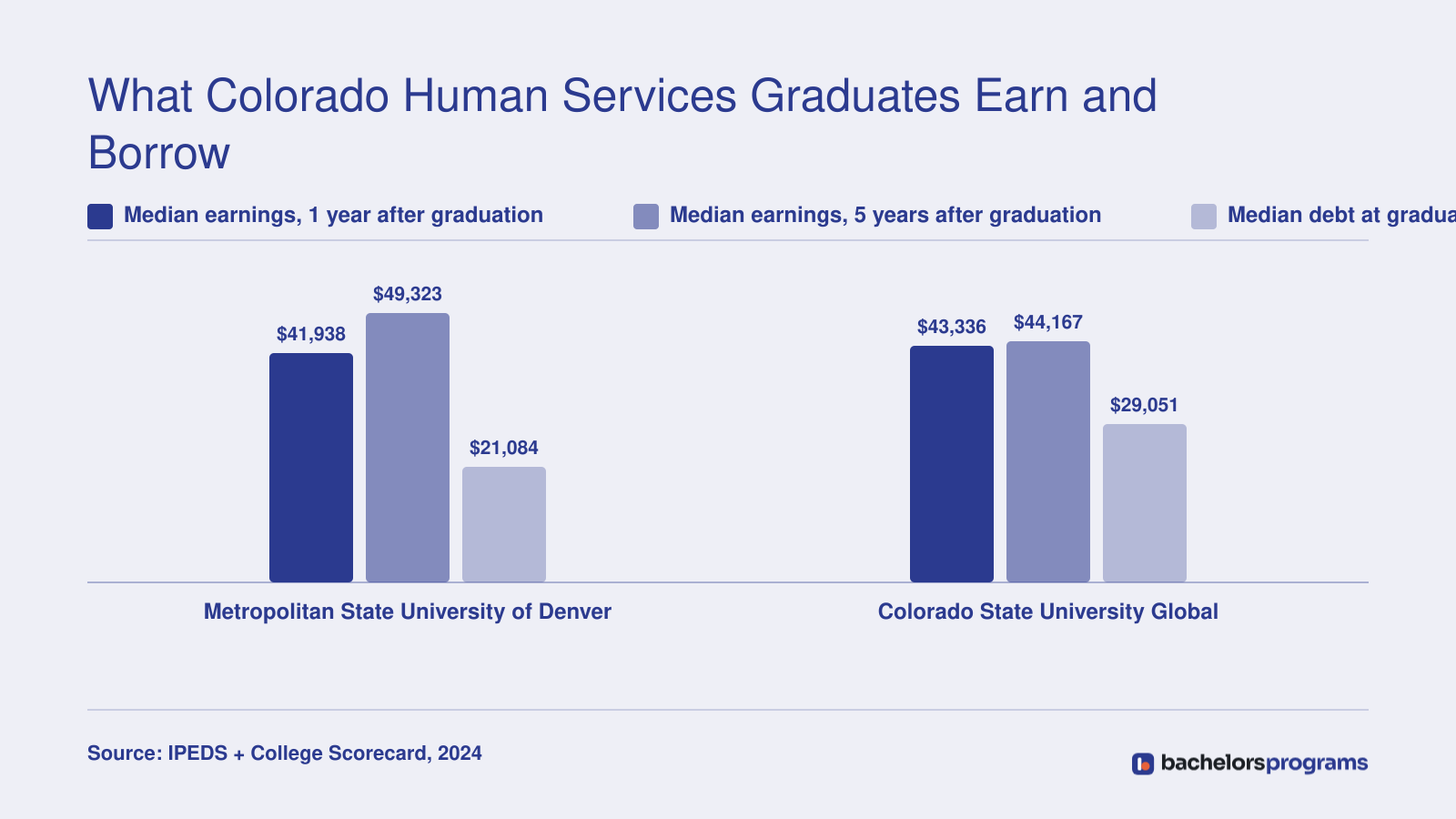
MSU Denver and Colorado State University Global report program-level outcomes for their human services bachelor's graduates. CSU Global graduates start slightly higher ($43,336 vs. $41,938 one year out), but MSU Denver pulls ahead by year five ($49,323 vs. $44,167) with lower median debt ($21,084 vs. $29,051). For the University of Northern Colorado, UCCS and Colorado Mesa University, only institution-wide median debt is reported ($20,000-$22,000), so those schools are kept off the chart rather than mixed in with program figures.
Online and Hybrid Bachelor's in Human Services Options at Colorado Schools
A student can earn a bachelor's degree in human services entirely online from a school based in Colorado. Colorado State University Global offers its Bachelor of Science in Human Services fully online. University of Northern Colorado (UNC), University of Colorado Colorado Springs (UCCS), Metropolitan State University of Denver (MSU Denver) and Colorado Mesa University list their programs as campus-based, so plan to attend in person at those schools.
How CSU Global's Format Works for Working Adults
CSU Global's courses are asynchronous, so there are no set login times. You complete coursework around a job or family schedule. Classes run in 8-week terms, and the school offers 12 start dates per year, so you don't have to wait for a fall semester to begin. Other details that matter to adults returning to school:
- Transfer credit: Up to 90 credits may transfer toward the 120-credit degree.
- Pricing: Tuition is $375 per credit, with a locked rate and no out-of-state surcharge.
- Final project: A capstone is required.
The campus programs follow a traditional semester calendar with scheduled class meetings. That structure suits students who want face-to-face instruction and regular contact with faculty and local agencies.
Field Placement and Practicum
Hands-on hours are where formats differ most. At MSU Denver, majors complete at least 12 internship credits. They can take two 6-credit semesters at 200 hours each or one 12-credit semester at 400 hours. Before registering, students meet with the Internship Coordinator to discuss a possible site, advising and a graduation plan. Placements are at approved agencies, and students can't intern at an agency where they were a client within the previous five years. UNC builds a 450-hour internship into the senior year. UCCS and Colorado Mesa also include fieldwork or internships.
Ask a CSU Global advisor whether the capstone includes a field component. If it does, find out whether you secure your own site near home or the school helps arrange one. Online students in rural parts of Colorado should raise this question before enrolling.
Which Format Fits You
Choose CSU Global if you need flexible, year-round online study. Choose a campus program if you want structured semesters and coordinator-guided local placements.
Admission Requirements for Colorado Bachelor's Programs in Human Services
Metropolitan State University of Denver and the University of Northern Colorado both publish community college routes into the bachelor's degree in human services. MSU Denver says an associate degree aimed specifically at human services is unnecessary, because Colorado community college courses already apply to its B.S., while UNC's transfer guide maps 60 community college credits to 60 UNC credits for its Human Services B.S. Under Colorado transfer guides, courses generally must be completed with a C- or higher, and earning more than 60 college-level credits before transferring can cost you credit, so match your community college plan to the receiving school's guide early. For Colorado State University Global, the University of Colorado Colorado Springs and Colorado Mesa University, confirm GPA, test and transfer rules directly on each school's admissions page. Treat any admission rate or selectivity figure as context for your planning, not as a guarantee of acceptance.
| School | GPA Requirement | Test Policy | Transfer Credit Policy |
|---|---|---|---|
| University of Northern Colorado (Human Services B.S.) | 2.00 cumulative GPA required for graduation; the transfer guide reviewed lists no separate admission minimum | Not stated in the transfer guide reviewed | Colorado community college transfer guide maps 60 community college credits to 60 UNC credits for the Human Services B.S.; some degrees are covered by statewide transfer articulation agreements |
| Metropolitan State University of Denver (Human Services Major, B.S.) | Not stated in the program materials reviewed | Not stated in the program materials reviewed | Does not recommend an associate degree specifically in human services, since Colorado community college courses apply to the B.S.; Colorado AA/AS transfer guide requires grades of C- or higher, credits may apply to major, elective or other requirements, and exceeding 60 college-level credits or earning below C- may result in lost transfer credit |
Related Articles
Colorado Median Wage for Human Service Assistants
Use this national figure as a starting benchmark, then check the newest Colorado numbers before you weigh a job offer or a program's cost.
Colorado Certified Addiction Counselor (CAC) Pathway
Colorado's addiction counselor credential has three levels, and each one adds education, training, supervised work and testing. The Colorado Department of Regulatory Agencies (DORA), through its Division of Professions and Occupations, issues the credential. The Behavioral Health Administration (BHA) sets the approved training curriculum.
- CAC IRequires a high school diploma and about 112 hours of BHA-approved training. Check the hour total against the current BHA curriculum, and finish the training within five years before DORA receives your application. You also need 1,000 supervised hours over at least six months, covering at least three client-care functions such as intake or record keeping. Supervision runs at least three hours a month. You must pass the NAADAC Level I exam and the Colorado jurisprudence exam.
- CAC IIRequires a bachelor's degree with a behavioral health concentration or a human services equivalent. You need at least 3,000 supervised clinical hours over 18 or more months, and your CAC I hours can count toward that total. You must pass the NAADAC Level II exam and the Colorado jurisprudence exam.
- CAC IIIAdds clinical coursework, including Clinical Supervision I (21 hours), Clinical Supervision II (14), Trauma-Informed Care (14), Ethics and Jurisprudence (14) and Pharmacology I (14). You must pass a NAADAC national exam and the Colorado jurisprudence exam. Current sources describe the education requirement differently, so confirm it with DORA before you apply.
- Training rulesEach approved class must run at least seven clock hours, end with an exam and be documented with a certificate.
- Where your bachelor's fitsA bachelor's in human services can meet the CAC II education requirement. Substance use coursework and an addiction-focused practicum also help you start building supervised hours.
Questions to Ask Yourself
Do you need a fully online format, or can you attend campus classes and a field placement in person?
Are you aiming for addiction counseling in Colorado?
Are you transferring community college credits, and does the school publish a transfer policy?
Compare Human Services programs on the data that matters
Explore more Social Work & Social Sciences majors or browse every field of study.
All Social Work & Social Sciences programs Browse every field of study