Best Information Technology Schools in Colorado
Compare 4 accredited Information Technology programs in Colorado, with net price after aid, graduation rates, earnings and debt from IPEDS and the U.S. College Scorecard.

Colorado employers now weigh an IT degree and industry certifications together rather than choosing between them. The state licenses no general IT, network or cybersecurity role, so a bachelor's degree in information technology, usually the Bachelor of Science (B.S.) in Information Technology, carries real hiring weight beside credentials like CompTIA Security+.
The schools ranked here mix campus and online formats, and prices vary widely. Colorado State University Pueblo posts an average net price of $10,051, while Colorado Technical University-Colorado Springs comes in at $16,745.
Cost is only part of the decision. Colorado Christian University completers carried a median $34,000 in debt and earned a median $91,195 four years after finishing.
Key Points
- Colorado State University Pueblo has the lowest net price: $10,051.
- Colorado Christian University completers earned a median $91,195 four years out.
- No Colorado license is required; employers value CompTIA Security+ certification.
Best Information Technology Schools in Colorado: Our Top Picks
The four Colorado schools below all grant a bachelor's degree in information technology or a closely related computing credential, and each takes a different route to it. One is a completion degree for students who already hold college credit, another is a fully online Christian university program with five emphases, and the other two pair IT with campus-based study in Colorado Springs and Pueblo. Read the short profiles for the fit that matches your life, then dig into cost, admissions, and outcomes in the sections that follow.
University of Denver
#1Denver, CO · ~$36,000/yr (est.)
Best for: Working adults finishing a bachelor's
The University of Denver delivers its information technology degree as a Bachelor of Arts completion program through the College of Professional Studies, designed for students who already hold some college credit. Coursework runs from systems analysis and design to cybersecurity, programming and data structures, networking, web fundamentals, and project management, capped by a required capstone. Students can study fully online or in a hybrid format on 10-week terms, and the degree is accredited by the Higher Learning Commission.
- 180-credit completion degree with 11 core and 10 major courses
- Coursework in cybersecurity, programming, data structures, and networking
- Capstone required before graduation
- Fully online or hybrid delivery on 10-week terms
- Open to applicants with 24 quarter or 16 semester credits
- SAT and ACT scores not required
- Tuition is $603 per credit hour with a $0 application fee
Colorado Christian University
#2Lakewood, CO · $25,000 – $30,000/yr (est.)
Best for: Online learners seeking faith-based curriculum
Colorado Christian University offers a fully online Bachelor of Science in Computer Information Technology with five emphases, including cyber security, networking, data engineering, database management, and artificial general intelligence. The 120-credit degree is built around a 36-credit major core and a Christ-centered business core, and students take one course at a time in five-, seven-, and ten-week blocks. Classes are small and taught by working field professionals, and the Lakewood-based university accepts transfer credit.
- Fully online, 120-credit bachelor's degree
- 36 credits in the major core
- Five emphases: AGI, cyber security, database management, data engineering, networking
- Courses taken one at a time in 5-, 7-, and 10-week blocks
- No application fee, and transfer credit is accepted
- Taught by working field professionals
- Admission requires photo ID and proof of high school completion or GED
Colorado Technical University-Colorado Springs
#3Colorado Springs, CO · ~$17,000/yr (est.)
Best for: Career changers needing flexible entry points
Colorado Technical University runs its Bachelor of Science in Information Technology both online and at its Colorado Springs campus, giving Colorado students a local classroom option alongside remote study. The 184-credit degree covers programming, Linux, database systems and SQL, network security, cloud computing, and enterprise architecture, plus 24 credits of concentration coursework and 12 credits of IT electives. Five-week courses start roughly every five weeks, and the school states that program outcomes align with ABET educational standards.
- 184 total credits, including 24 in a concentration
- Colorado Springs campus option plus fully online study
- Core covers Linux, SQL, network security, cloud computing, and enterprise architecture
- Five-week courses with starts roughly every five weeks
- Fast Track exams can shorten completion by up to 30%
- Outcomes aligned with ABET educational standards
- Program does not lead to licensure or certification
Colorado State University Pueblo
#4Pueblo, CO · $10,000/yr (est. net price)
At Colorado State University Pueblo, information technology is a 37-credit concentration inside the Business Management BSBA at the Hasan School of Business, so students layer IT, cybersecurity, data analytics, and software development study onto a business management core. The design suits students who want to manage and develop technology inside an organization rather than focus only on building it. Study is campus-based in Pueblo, and business school advising helps students compare concentrations and plan their requirements.
- 37-credit IT concentration inside the Business Management BSBA
- Blends cybersecurity, data analytics, and software development with business courses
- Focus on how organizations use technology for strategy and operations
- Campus-based study in Pueblo
- Hasan School of Business advising helps plan concentration requirements
Cost & outcomes by school
Federal data for the highest-earning Information Technology programs, independent of the ranking above. Earnings are this field's bachelor's graduates four years after completing where the Scorecard reports them, else the school's undergraduate median.
| School | Net price / yr | Grad rate | Earnings | Debt | Grads/yr | Format |
|---|---|---|---|---|---|---|
| Colorado Christian University CO | $29,500 | 64% | $91,195 | $34,000 | 15 | Online |
| Colorado Technical University-Colorado Springs CO | $16,745 | 19% | $78,606 | $38,624 | 225 | Online or campus |
| University of Denver CO | $36,131 | 76% | $71,155 | $21,844 | 12 | Online or campus |
| Colorado State University Pueblo CO | $10,051 | 40% | $55,563 | $21,500 | — | Campus |
Sources: U.S. Department of Education. Net price, graduation rate, earnings and debt: College Scorecard (earnings and debt for this field's bachelor's graduates where reported, else school-wide); graduates: IPEDS. A dash means no figure is reported.
Cost, debt & payoff
Median earnings of this field's bachelor's graduates (4 yrs after completing, else the school's undergraduate median) vs. their median federal loan debt · U.S. College Scorecard
Across these programs the median graduate earns about $74,881 and finishes with roughly $27,922 in debt — a ratio that clears a common rule of thumb (keep debt below first-year salary). Net price and debt vary widely school to school, so check the per-school figures in the table above before you shortlist.
How We Ranked Colorado Bachelor's Degree in Information Technology Programs
Some of the figures behind this list describe a specific degree, while others describe the whole school. Knowing which is which keeps you from reading too much into any single number.
What Drove the Order
The ranking draws on College Scorecard data, the U.S. Department of Education's public source for college outcomes. Five measures carried the most weight:
- Net price: what students typically pay after grants and scholarships, not the published sticker price.
- Graduation rate: the percentage of students who complete their degree.
- Program-level earnings: what graduates of the IT program earn after finishing.
- Debt: how much graduates of the program borrow.
- Format: whether the degree is offered on campus, online, or both.
Program Figures vs. School-Wide Averages
Earnings and debt are tied to the program itself. Graduation rate and net price are not. They are institution-wide, sector-based averages that cover all undergraduates at a school, not only IT majors. A school's graduation rate reflects its overall student body, and its net price reflects the typical aid package across many majors. Use those two figures to compare schools broadly, then confirm the details for your own degree with the admissions and financial aid offices.
What This List Covers
Only Colorado bachelor's programs were considered, including campus programs and online programs from Colorado-based schools. That brings in University of Denver, Colorado Christian University, Colorado Technical University-Colorado Springs, and Colorado State University Pueblo.
This list covers the schools in our data, not every Colorado school that teaches IT. Other institutions may offer related coursework, so treat these rankings as a well-sourced starting point rather than a full survey of the state.
Online and Hybrid Bachelor's Degree in Information Technology Options at Colorado Schools
Format means where and how you attend class: fully online, a mix of online and on-site sessions, or in person on campus. The schools here cover all three formats, and the right fit depends mostly on your schedule.
How the Formats Compare
- Fully online: Colorado Christian University delivers its B.S. in Computer Information Technology online.
- Online or hybrid: The University of Denver offers its information technology bachelor's completion program online or hybrid.
- Online or campus: Colorado Technical University-Colorado Springs offers its B.S. in Information Technology online or on its campus.
- Campus only: Colorado State University Pueblo offers information technology as a concentration inside its Business Management BSBA, taught on campus.
Term Lengths and Start Dates
CTU uses 5-week courses, with classes starting roughly every five weeks, so about 10 or 11 starts a year. Its Fast Track exams can shorten the degree by up to 30%, depending on how many you pass, and Fast Track credits do not transfer elsewhere. Colorado Christian University mixes five-, seven-, and ten-week blocks and lets students start almost any time. DU runs 10-week courses, and its 2026 page lists a September 8 start for fall applicants.
CTU, CCU, and DU are the strongest fits for working adults and career changers. DU's program is built for adults with at least 24 quarter or 16 semester credits, accepts up to three years of prior college credit, and describes completion in two to three years.
Online Versus In-State Tuition
DU charges $603 per credit and lists no separate Colorado-resident rate, so online and in-state students pay the same. CTU's 2026 Denver South campus schedule shows $340 per credit for the information technology bachelor's with 184 total credits, but that is a campus schedule, so confirm the online rate with admissions before comparing. At CSU Pueblo, which has no online route, in-state students pay $9,720 in tuition and fees versus $17,944 out of state, so residency matters most there.
Who Benefits Most
- Working adults with prior credits: DU's completion model or CTU's Fast Track.
- Students who want maximum scheduling flexibility: CCU's frequent starts and short blocks.
- Colorado residents who want a traditional campus experience: CSU Pueblo, with a business-management slant.
- Those who want occasional in-person contact: DU's hybrid option, or CTU's Colorado Springs campus.
Cost of an IT Bachelor's Degree in Colorado: Tuition, Net Price, and State Aid
Colorado State University Pueblo is the most affordable option here, with published in-state tuition and fees of $9,720 and an average net price of $10,051. Colorado Technical University-Colorado Springs is next at a $16,745 net price, but net price is an average for students who receive aid, not a quote, so your own cost depends on your aid package. To qualify for in-state rates, you generally need one year of Colorado domicile immediately before classes begin, and enrolling at a Colorado college does not by itself establish it. Colorado residents at participating colleges can also apply for the College Opportunity Fund stipend. This per-credit payment is set each year by the General Assembly, appears on your tuition bill rather than your award letter, and generally caps at 145 lifetime credits. Students at private colleges must also be Pell-eligible to receive it. The Colorado Student Grant and the Colorado Opportunity Scholarship Initiative are additional state aid programs, so confirm current eligibility and award amounts with the Colorado Department of Higher Education and each school's financial aid office.
| School | Sector | Published In-State Tuition and Fees | Average Net Price After Aid | Share of Students Receiving Pell Grants |
|---|---|---|---|---|
| Colorado State University Pueblo | Public | $9,720 | $10,051 | 65% |
| Colorado Technical University-Colorado Springs | Private for-profit | $12,750 | $16,745 | 87% |
| Colorado Christian University | Private nonprofit | $41,342 | $29,500 | 65% |
| University of Denver | Private nonprofit | $61,398 | $36,131 | 40% |
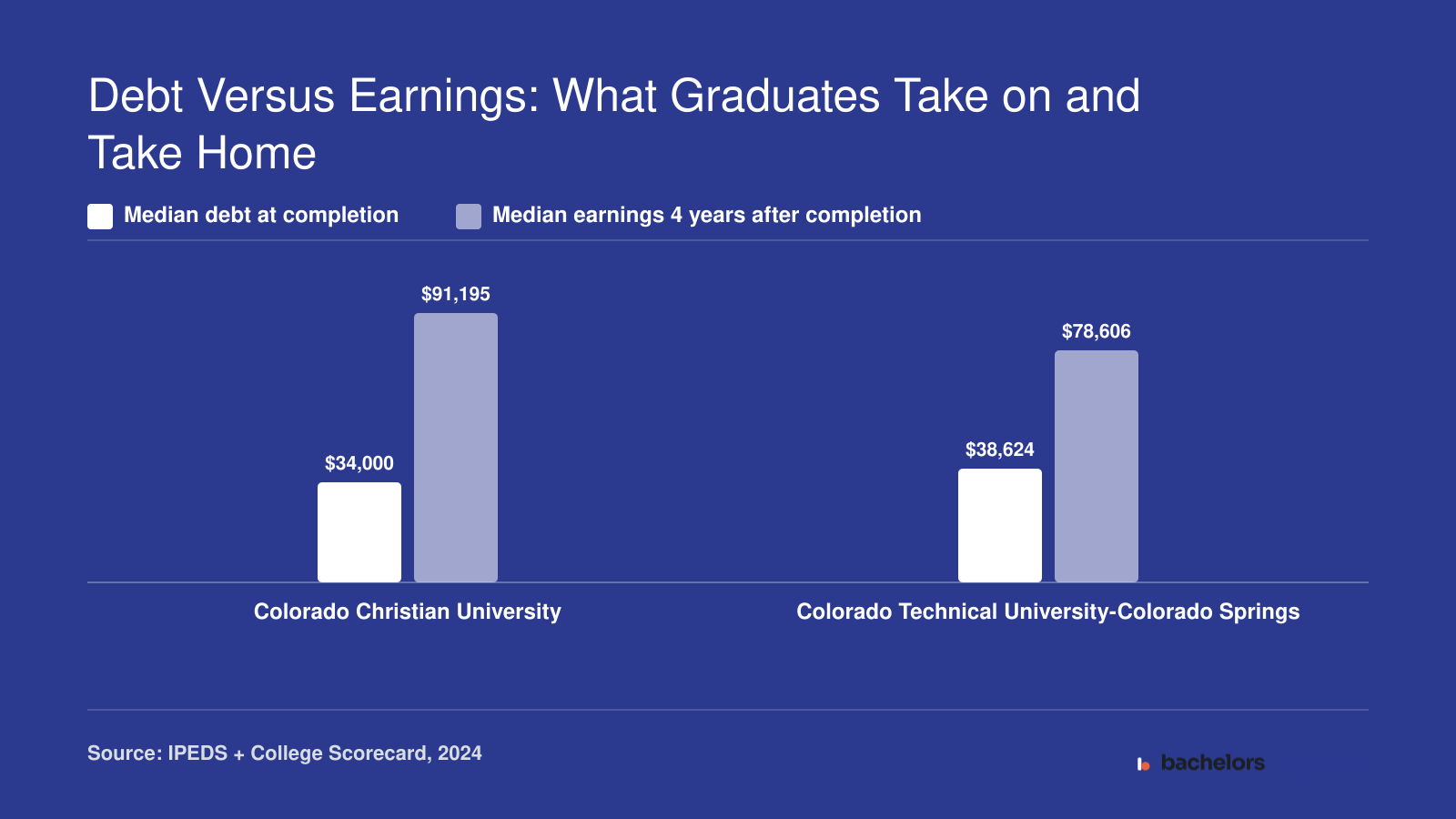
Debt Versus Earnings: What Graduates Take on and Take Home
Colorado Christian University IT bachelor's completers left with a median debt of $34,000 and earned a median $91,195 four years after finishing. Colorado Technical University-Colorado Springs completers carried $38,624 in median debt and earned $78,606 over the same four-year window. Federal data does not report program-level debt or earnings for the University of Denver or Colorado State University Pueblo IT programs, so those schools are not charted.
Related Articles
Do You Need a License to Work in IT in Colorado?
What Graduates Earn After Finishing
Colorado Christian University's IT graduates post the strongest program-level earnings among the schools ranked here. Colorado Technical University-Colorado Springs follows with a median of $78,606 at the same four-year mark.
Compare Information Technology programs on the data that matters
Explore more Computers & IT majors or browse every field of study.
All Computers & IT programs Browse every field of study