Best Online Public Policy Degree Programs
Compare 22 accredited online Public Policy programs, with net price after aid, graduation rates, earnings and debt from IPEDS and the U.S. College Scorecard.

Online public policy degrees have multiplied, but the "online" label often hides required campus residencies, weekend intensives or hybrid sessions. Every program ranked here is fully online, with no campus residency required.
Annual net price at these schools runs from $9,288 at Florida International University to $38,793 at Syracuse University, a spread far wider than most differences in coursework.
Degree level shapes the payoff too. A bachelor's fits legislative aide and research assistant roles, while many analyst titles still go to candidates holding a master of public policy.
Key Points
- Empire State University graduates earned a $52,614 median one year out.
- Florida International University's 120 online credits run about $28,268 in-state.
- Every ranked program is fully online, with no campus residencies required.
The 10 Best Fully Online Public Policy Degree Programs
Every program in this list can be completed entirely online, with no required campus visits, weekend residencies or hybrid sessions. All ten are regionally accredited public or private nonprofit universities, and each card gives you the degree level, the location, the price of the program and the share of students who finish. Read them in order, then use the tuition table and pay data further down to narrow your shortlist.
Florida International University
#1Miami, FL · ~$9,000/yr (est.)
Best for: Policy-minded career changers in government
Florida International University is a large public research university in Miami whose online Bachelor of Public Policy and Service runs through the Steven J. Green School of International and Public Affairs. The degree prepares students for government, nonprofit management, policy analysis and program evaluation roles, and online students are assigned a personal success coach. Three start terms a year give applicants flexibility about when they begin.
- Fully online degree, 120 credits required
- Starts in Fall, Spring and Summer terms
- In-state tuition $235.57 per credit, out-of-state $690.19
- Personal success coach assigned to online students
- Covers policy development, implementation and evaluation
- Includes budget management and community involvement
- Taught by faculty in the Green School of International and Public Affairs
University of Colorado Denver/Anschutz Medical Campus
#2Denver, CO · $10,000 – $15,000/yr (est.)
Best for: Students drawn to political science theory
The University of Colorado Denver houses its public policy pathway inside the political science major, so students study policy through the lens of political science theory rather than standalone policy coursework. The major runs 39 credit hours and requires both a capstone project and an experiential learning component, with room for American, comparative and political theory courses. Denver's position as a state capital gives students a natural setting for state and local policy interests.
- 39 credit hours in the major, 21 at upper division
- Minimum grade of C- required in major courses
- Capstone project and experiential learning required
- Coursework in public policy, American and comparative politics
- Explores policy issues facing U.S. decision-makers
- Builds on a political science theory foundation
Empire State University
#3Saratoga Springs, NY · ~$12,000/yr (est.)
Best for: Transfer students with prior college credit
Empire State University is the SUNY system's institution built around individualized degree plans, and students design their program with a faculty mentor rather than following a single fixed sequence. Public Affairs is offered as a B.A., B.S. or B.P.S. with a Public Policy concentration, and transfer credit plus prior learning assessment can shorten the path considerably. Courses in public administration, homeland security and emergency management give the degree a practical public-sector bent.
- B.A., B.S. and B.P.S. options available
- Public Policy concentration offered
- Individualized degree plan built with a faculty mentor
- Courses in public administration, homeland security and emergency management
- Transfer credit and prior learning assessment accepted
- Interdisciplinary foundation spanning law, economics and ethics
Liberty University
#4Lynchburg, VA · ~$29,000/yr (est.)
Liberty University is a large private nonprofit in Lynchburg, Virginia, with a long-running online division and multiple start dates across the year. Two policy-oriented bachelor's degrees are available online through the Helms School of Government: one in law and policy, one in government and politics. Both run in 8-week terms, accept up to 75% transfer credit and offer discounted military rates.
- 120 credit hours required
- Transfer up to 75% of credits
- $390 per credit for full-time undergraduates
- Military rate of $250 per credit
- $50 application fee, no standardized test scores needed
- 2.0 minimum GPA required
- Courses in logic, legal reasoning and government systems
- Electronic textbooks provided
- 8-week course format with multiple start dates
- Courses in public policy, political science and economics
- Government regulation and policy analysis coursework
- $390 per credit tuition, $250 per credit military rate
- Application fee waived for qualifying military students
- No set login times for online students
Regent University
#5Virginia Beach, VA · ~$20,000/yr (est.)
Regent University is a private Christian institution in Virginia Beach that delivers its online programs in 8-week terms. Its public policy pathway sits inside a Bachelor of Arts in Leadership Studies, pairing government and policy courses with leadership, ethics and strategic planning coursework. Graduates move into congressional offices, lobbying, nonprofits and corporate communications.
- 120+ credit hours in 8-week online terms
- Concentration in Government and Public Policy
- $415 per credit full-time, $470 per credit part-time
- $750 university services fee each semester
- Courses include The Legislative Process and Public Policy
- Constitutional law and international relations coursework
- Financial aid and scholarships available
- Next session begins January 11, 2027
University of Mount Saint Vincent
#6Bronx, NY · ~$22,000/yr (est.)
The University of Mount Saint Vincent is a private Catholic institution in the Bronx, New York, and its online Bachelor of Arts in Public Policy is built around analysis and research skills. Coursework runs from microeconomics and statistics to environmental and health policy, ending in a research project. The online format is designed for working professionals balancing other commitments.
- Fully online Bachelor of Arts program
- Core coursework in public policy, microeconomics and macroeconomics
- Applied statistics and survey research training
- Environmental policy and health policy topics
- Research project component
- Social and political philosophy coursework
Syracuse University
#7Syracuse, NY · $35,000 – $40,000/yr (est.)
Syracuse University's College of Professional Studies administers a fully online policy studies degree that draws on the university's Maxwell School partnership. Courses run in 8-week terms with six start dates a year and weekly live sessions, and a tuition incentive grant can lower the per-credit rate for eligible students. Learners can transfer up to 90 credits and study part time.
- 120 credits required
- Transfer up to 90 credits
- Six start dates a year in 8-week terms
- Weekly interactive live sessions
- Tuition incentive grant can reduce the rate to $575 per credit
- Partnership with the Maxwell School
- Part-time study option
Arizona State University
#8Scottsdale, AZ
Arizona State University operates one of the largest online degree operations in the country, and its public service and public policy degree is built for that scale: 40 classes of 7.5 weeks each. The curriculum blends economics, public management and persuasive writing with a required capstone, and the diploma does not distinguish online from campus study. Admission offers several pathways, including GED, HiSet and TASC.
- 120 credit hours across 40 classes
- 7.5-week class format
- Capstone project required
- Courses in economics, public management and persuasive writing
- Admission with 3.00 GPA in competency courses or top 25% class rank
- GED, HiSet and TASC accepted
- Diploma does not indicate online format
University of Missouri-St Louis
#9Saint Louis, MO · $15,000 – $20,000/yr (est.)
The University of Missouri-St. Louis offers an online Bachelor of Science in Public Policy and Administration with three emphasis areas: public administration, nonprofit management and public policy. Internships supply applied experience, and an accelerated dual-degree option lets strong students begin the master's in public policy administration early. The College of Arts and Sciences also offers an Honors College path and undergraduate research.
- Online BS with three emphasis areas
- Emphasis in public administration, nonprofit management or public policy
- Internship opportunities for practical experience
- Accelerated dual degree with the MPPA
- Coursework in analysis, research, decision making and communication
- Honors College option and undergraduate research
- Related politics courses in American, international and urban politics
University of Wisconsin-Superior
#10Superior, WI · $9,000 – $17,000/yr (est.)
The University of Wisconsin-Superior takes an interdisciplinary approach to public policy through its Bachelor of Science in Public Leadership and Changemaking. Core courses come from political science, First Nations studies and social work, and students round out the degree with electives and a required academic minor. An internship and a senior capstone give the program an applied finish.
- Core courses from political science, First Nations studies and social work
- Electives drawn from a range of disciplines
- Internship experience required
- Senior capstone project required
- Academic minor required
- Prepares students for public policy and changemaking work
Cost & outcomes by school
Federal data for the highest-earning Public Policy programs, independent of the ranking above. Earnings are this field's bachelor's graduates four years after completing where the Scorecard reports them, else the school's undergraduate median.
| School | Net price / yr | Grad rate | Earnings | Debt | Grads/yr | Format |
|---|---|---|---|---|---|---|
| Arizona State University AZ | $14,967 | 68% | $71,723 | $19,500 | 60 | Hybrid |
| Florida State University FL | $11,297 | 86% | $61,675 | $18,000 | — | Online or campus |
| Florida International University FL | $9,288 | 74% | $60,249 | $16,500 | — | Online |
Sources: U.S. Department of Education. Net price, graduation rate, earnings and debt: College Scorecard (earnings and debt for this field's bachelor's graduates where reported, else school-wide); graduates: IPEDS. A dash means no figure is reported.
Cost, debt & payoff
Median earnings of this field's bachelor's graduates (4 yrs after completing, else the school's undergraduate median) vs. their median federal loan debt · U.S. College Scorecard
Across these programs the median graduate earns about $66,125 and finishes with roughly $20,500 in debt — a ratio that clears a common rule of thumb (keep debt below first-year salary). Net price and debt vary widely school to school, so check the per-school figures in the table above before you shortlist.
What Made the Cut: Fully Online Delivery Plus Real Outcomes
Fully online does not always mean self-paced, and the difference matters before you enroll. Hybrid programs are excluded here. The remaining fully online options are ordered by a blend of affordability (net price), institution-wide graduation rate, and College Scorecard earnings and debt where those figures are published.
Delivery formats vary. Indiana University O'Neill, Binghamton, UMass Amherst, and Northeastern offer asynchronous online master's programs, though Indiana adds an optional residential O'Neill Online Week.1 Southern Methodist splits its coursework between asynchronous work and live weekly evening Zoom classes, and requires two Dallas immersions.2 Northern Iowa holds Tuesday-evening Zoom sessions and starts with an orientation, on campus or virtual.3
Two caveats apply. Graduation rate reflects the whole institution, not the policy program. That net price is an institution-wide figure after aid, so your own cost will differ.
Lowest-Cost Fully Online Public Policy Programs: Tuition Comparison
The most affordable online options here are public universities, and per-credit rates help you estimate the full bill. At Florida International University, 120 credits at the in-state rate of $235.57 comes to about $28,268 in tuition. Pricing for out-of-state online students varies by school: FIU charges nonresidents more, while the University of Northern Iowa and Oregon State University do not charge out-of-state online students more for their Master of Public Policy programs. Private programs cost more; Northeastern University's MPP runs $1,013 per credit. Average net price reflects what students paid on average after grants and scholarships, so treat it as a benchmark rather than a quote.
| School | Program | Degree Level | Average Net Price (per year, after aid) | Published Tuition and Fees (in-state / out-of-state, per year) | Per-Credit Tuition | Credits Required | Sector |
|---|---|---|---|---|---|---|---|
| Florida International University | Bachelor of Public Policy and Service | Bachelor's | $9,288 | $6,565 / $18,964 | $235.57 in-state; $690.19 out-of-state | 120 | Public |
| Empire State University | Public Affairs (Public Policy concentration) | Bachelor's | $11,676 | $7,648 / $17,558 | N/A | N/A | Public |
| University of Colorado Denver | Political Science, Politics and Public Policy Option, BA | Bachelor's | $11,900 | $10,383 / $29,391 | N/A | 39 (major coursework) | Public |
Related Articles
Accreditation Checks: Regional Approval and NASPAA Status
Accreditation is an outside review that confirms a school or program meets set quality standards, and two kinds matter for online public policy study. The first is institutional (regional) accreditation, granted by bodies such as HLC, MSCHE, SACSCOC, or WSCUC. Treat it as the non-negotiable baseline, since it governs federal financial aid eligibility, credit transfer, and how employers view your degree.
The second is NASPAA accreditation, which covers master's programs such as the MPP and MPA. It does not apply to bachelor's degrees. NASPAA's 2026-2027 roster lists 215 accredited programs at 200 schools, and newly accredited entries include Penn State's MPP, UConn's MPP, UMass Amherst's Master of Public Policy and Administration, and Cincinnati's MPA. Whether an online format falls under a given entry isn't clear from the roster, so confirm it with the school.
Verify It in Two Steps
- Step 1: Look up the school in its regional accreditor's directory.
- Step 2: Find the exact degree on NASPAA's roster, because accreditation is granted per program, not per school.
NASPAA membership and NASPAA accreditation are separate things.
Policy Analyst Pay at a Glance
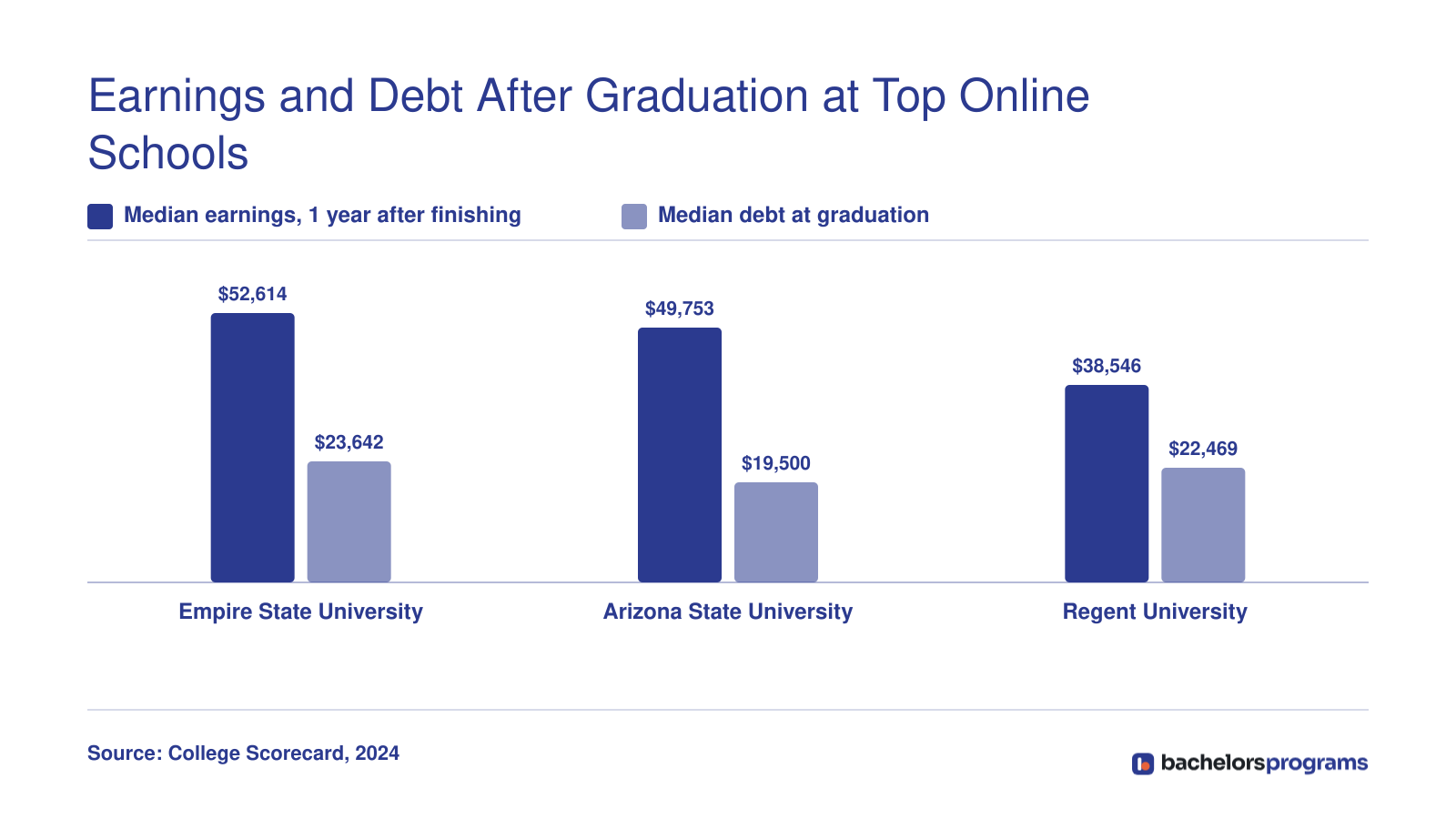
Earnings and Debt After Graduation at Top Online Schools
One year after finishing, public policy graduates of Empire State University earned a median of $52,614, ahead of Arizona State University ($49,753) and Regent University ($38,546). Median debt was $19,500 at ASU, $22,469 at Regent and $23,642 at Empire State. On a 10-year repayment plan, that works out to median monthly payments of $207, $238 and $251. Four years after finishing, program graduates earned $71,723 at ASU and $60,776 at Regent.
Questions to Ask Yourself
Do you still need a bachelor's degree, or do you already hold one?
Is your goal to study policy or to run public programs?
Can you commit to scheduled live sessions?
Is NASPAA accreditation worth a higher tuition bill to you?
Online Bachelor's in Public Policy vs. Online Master's vs. Related Degrees
Employers increasingly screen policy hires by degree level, and the gap between a bachelor's and a master's now shapes who gets analyst titles. Each credential points to a different set of roles.
- Online bachelor's: The entry-level path to legislative aide, research assistant and nonprofit roles. It usually runs 120 credits and is often transfer-friendly.
- Online MPP: The analyst credential, heavier in statistics, economics and program evaluation. It is often the gateway to senior analyst positions.
- Public administration (MPA): Centers on management, budgeting and implementation rather than analysis.
- Political science: More theoretical, built around institutions and political behavior.
- Public service degrees: Lean toward community and nonprofit practice.
Which Path Fits You
Career starters should choose the online bachelor's, ideally one that accepts transfer credits. Career changers who already hold a bachelor's should go straight to the MPP if analysis is the goal, or the MPA if they want to run programs. Working government employees should pick the MPA for a move into management, or the MPP to shift into analyst work, and should check first whether their agency offers tuition assistance.
Public Policy programs by state
Quick Answers Before You Compare Programs
These short answers cover the questions prospective students ask most often. Each one stands on its own, so you can skim now and return to the detailed sections below when you start comparing schools.
Which careers does a public policy degree lead to?
How does a public policy degree differ from public administration?
Are online public policy programs accredited the same way as campus programs?
Is earning a public policy degree online worth the investment?
Compare Public Policy programs on the data that matters
Explore more Social Work & Social Sciences majors or browse every field of study.
All Social Work & Social Sciences programs Browse every field of study