Best Public Health Schools in Arizona
Compare 7 accredited Public Health programs in Arizona, with net price after aid, graduation rates, earnings and debt from IPEDS and the U.S. College Scorecard.

The University of Arizona holds the state's only CEPH-accredited college of public health, but public health bachelor's degrees are available at several Arizona schools, and the programs differ sharply in format, price and accreditation. The common credential is the Bachelor of Science (B.S.) in Public Health, though some schools file the major under health sciences or healthcare administration.
The title on the diploma matters: it shapes the curriculum, the practicum options and how employers read the degree. Public universities in Arizona charge far less than private ones, but net price after aid narrows the gap, and Arizona public health jobs mostly rely on the degree plus experience rather than a state license.
Key Points
- The University of Arizona houses the state's only CEPH-accredited public health college.
- Median earnings four years after graduation peak at $66,937 at UArizona.
- Arizona requires no state license for general public health jobs.
Best Public Health Schools in Arizona for a Bachelor's Degree: Our Ranked List
The best public health school in Arizona for a bachelor's degree is the University of Arizona, home to the state's only CEPH-accredited college of public health. Below are six Arizona schools that award a bachelor's degree in public health or a closely related credential, spanning large research universities, a Christian institution in Phoenix, a career-focused online option, and a tribal college. Each entry is written for readers comparing program depth, cost, and format.
University of Arizona
#1Tucson, AZ · ~$17,000/yr (est.)
Best for: Students set on global health and policy work
The University of Arizona's Zuckerman College of Public Health is the state's only CEPH-accredited college of public health, and its bachelor's program reflects that standing. Undergraduates enter as pre-public health students before declaring the major, and a 2026 partnership with the Arizona Department of Health Services expands practicum placements inside state programs. The university's overall graduation rate is about 68%.
- CEPH-accredited program in the Zuckerman College of Public Health
- Seven emphasis areas, including Global Health, One Health and Health Promotion
- AI Innovation in Population Health emphasis for data-driven careers
- Available in person and online
- Coursework in health communication, environmental safety, systems and data analysis
- Prepares graduates for health educator, policy analyst and environmental health roles
Northern Arizona University
#2Flagstaff, AZ · ~$14,000/yr (est.)
Best for: Aspiring occupational therapists
Northern Arizona University teaches public health inside its Department of Health Sciences, with a 120-credit curriculum, a required capstone, and service learning threaded through the coursework. An occupational therapy track guarantees graduates an interview with NAU's doctoral OT program, and global health field schools offer credit abroad. The university's overall graduation rate is about 61%.
- 120 credit hours with a required capstone
- Three tracks: Occupational Therapy, Internship, or Coursework
- Guaranteed interview for NAU's doctoral occupational therapy program
- 6-unit internship with a public health agency
- Service learning built into coursework across the curriculum
- Global health field school experiences for credit abroad
- Some online or blended coursework required
Grand Canyon University
#3Phoenix, AZ · ~$22,000/yr (est.)
Best for: Working adults balancing jobs and school
Grand Canyon University runs its public health bachelor's through the College of Nursing and Health Care Professions, on campus in Phoenix and online in seven-week blocks built for working adults. Up to 90 transfer credits are accepted, and the capstone can be a 30-hour service placement or a research project. The university's overall graduation rate is about 43%, and its Christian mission shapes campus life.
- Offered online and on campus in Phoenix
- Online courses run in 7-week blocks with a locked tuition rate
- Up to 90 transfer credits accepted
- Capstone: 30-hour service-learning placement or research project
- Covers epidemiology, health policy, informatics and global health
- ACT or SAT entrance exam required for admission
Arizona State University
#4Scottsdale, AZ
Arizona State University's public health bachelor's sits in the College of Health Solutions at the Downtown Phoenix campus and is organized around the five pillars of the field. An internship is built into the degree, certificates can be stacked alongside it, and more than 300 global education programs open up study abroad. It is the largest of the Arizona options on this list.
- Covers the five pillars of public health, from biostatistics to policy
- Internship included for hands-on workforce experience
- Pairs with certificates in health education and health care policy
- 300+ global education options for study abroad
- Located at the Downtown Phoenix campus
- Reduced tuition for students from western states
Bryan University
#5Tempe, AZ · ~$21,000/yr (est.)
Bryan University is a career-focused online institution in Tempe, and its public health pathway is a concentration within a Bachelor of Science in Healthcare Administration. The degree is a completion program for students who already hold an associate degree or transfer credits, designed to be finished in about 20 months with personalized coaching. The university's overall graduation rate is about 41%.
- Completion degree for students with an associate degree or transfer credits
- 120 credit hours, finishable in about 20 months
- 60-credit block transfer accepted
- Capstone completed with an external health care partner
- Coursework in population health, epidemiology and health policy
- 2.0 GPA minimum for admission
Dine College
#6Tsaile, AZ · $6,000/yr (est. net price)
Diné College is a tribal college in Tsaile whose public health bachelor's is built around the health of the Navajo Nation. Students study epidemiology, health disparities, and Indigenous research methods alongside the core public health functions, with practicum work in research methods. Its overall graduation rate across all programs is about 13%, and it is the most community-rooted option on this list.
- 124-126 credits required, with a C or higher in every course
- Curriculum centered on Navajo Nation health and Indigenous research methods
- Core public health functions: assessment, policy development, and assurance
- Upper-division public health research methods practicum
- Seminars in global Indigenous health
- Asset-based approach to health promotion and community strengths
Cost & outcomes by school
Federal data for the highest-earning Public Health programs, independent of the ranking above. Earnings are this field's bachelor's graduates four years after completing where the Scorecard reports them, else the school's undergraduate median.
| School | Net price / yr | Grad rate | Earnings | Debt | Grads/yr | Format |
|---|---|---|---|---|---|---|
| University of Arizona AZ | $16,674 | 68% | $66,937 | $21,000 | 157 | Campus |
| Arizona State University AZ | $14,967 | 68% | $64,275 | $21,500 | 29 | Campus |
| Arizona State University AZ | — | — | $64,275 | $21,500 | 69 | Campus |
| Northern Arizona University AZ | $14,158 | 61% | $61,757 | $20,151 | 147 | Hybrid |
| Grand Canyon University AZ | $22,472 | 44% | $42,186 | $22,114 | 70 | Online |
| Bryan University AZ | $20,834 | 41% | $40,283 | $20,000 | — | Online |
| Dine College AZ | $6,057 | 13% | $29,188 | — | 11 | Campus |
Sources: U.S. Department of Education. Net price, graduation rate, earnings and debt: College Scorecard (earnings and debt for this field's bachelor's graduates where reported, else school-wide); graduates: IPEDS. A dash means no figure is reported.
Cost, debt & payoff
Median earnings of this field's bachelor's graduates (4 yrs after completing, else the school's undergraduate median) vs. their median federal loan debt · U.S. College Scorecard
Across these programs the median graduate earns about $61,757 and finishes with roughly $21,250 in debt — a ratio that clears a common rule of thumb (keep debt below first-year salary). Net price and debt vary widely school to school, so check the per-school figures in the table above before you shortlist.
How We Ranked Arizona's Bachelor's in Public Health Schools
What actually separates the public health programs on this list from one another?
The order below reflects four things you can verify yourself.
- Cost after aid: Net price and in-state tuition show what a bachelor's degree in public health will realistically cost, not just the advertised sticker price.
- Completion: Graduation and retention rates indicate whether students who start a program actually finish it.
- Accreditation and program outcomes: We consider whether a program holds accreditation relevant to public health and whether it publishes results for its own graduates.
- Format fit: Campus, online, and hybrid options are weighed for how well they serve students who work or live far from campus.
What the Numbers Cannot Tell You
Graduation rates and net price are reported for the whole institution, not the public health department. A university's overall completion rate can hide a stronger or weaker major, so treat those figures as context rather than a verdict. Outcomes published for the major itself carry more signal when a school makes them available.
Scope of the List
The list covers bachelor's programs based in Arizona, including online programs from Arizona schools. Compare each entry against your own priorities, because cost, location, and how you plan to use the degree matter more than a position on any list.
Online and Hybrid Bachelor's in Public Health Options at Arizona Schools
Flexibility is what draws students to online study; fieldwork is where that flexibility gets tested. At Arizona schools, most programs land somewhere between fully online and fully campus-based.
Fully online, from an Arizona-based school
Arizona's clearest online route is the University of Arizona's B.S. in Public Health, delivered through Arizona Online. The university says the online degree carries the same required courses as the Tucson campus,1 and Environmental and Occupational Health is listed at both main campus and Arizona Online.2 Grand Canyon University builds its B.S. in Public Health for online delivery, with seven-week courses at $490 per credit and a locked tuition rate. Bryan University offers an online Healthcare Administration degree with a public health concentration. All of these come from schools based in Arizona, not out-of-state providers.
Hybrid and campus-based programs
Northern Arizona University's Health Sciences - Public Health mixes formats. It lists in-person and online options and notes that some online or blended coursework is required, alongside a capstone and a 6-unit internship at a public health agency. Arizona State University's public health bachelor's is campus-based at its Downtown Phoenix location, with an internship included in the program. Dine College's B.S. Public Health in Tsaile is campus-based, and its program page does not describe an online option.
The in-person piece online students should plan around
A remote degree in this field rarely means remote everything. The Public Health Practice track requires an internship of 6 units, described as applied professional public health experience, and placements can sit in community organizations, government agencies, businesses, health care centers, hospitals, or schools. Published program pages establish the internship requirement but do not state that online students must complete it on the Tucson campus. Ask the school directly how placements are arranged where you live before you enroll.
Admission Requirements: GPA, Test Policy, and Transfer Credit
For first-year applicants, admission to an Arizona public health bachelor's program mostly runs through general university admission, with no separate program application at the start. Where a school publishes a GPA benchmark or test policy, it applies to the university as a whole. Where its admissions pages list nothing, the entry below says "No published policy" instead of guessing.
First-Year Requirements by School
- Arizona State University: Applicants need a high school diploma or equivalent and the required core courses. They must also meet at least one benchmark, such as a top 25% class rank or a 3.00 GPA in competency courses.1 SAT and ACT scores are optional, and may be submitted for course placement. The Public Health, BS page lists no program-specific minimum.
- University of Arizona: No minimum first-year GPA is published. Test policy: No published policy. Students typically start in pre-public health before moving into the professional major.
- Northern Arizona University: GPA: No published policy. Test policy: No published policy.
- Grand Canyon University: GPA: No published policy. Test policy: No published policy.
- Bryan University: GPA: No published policy. Test policy: No published policy.
- Dine College: GPA: No published policy. Test policy: No published policy.
Transfer Credit Policies
Transfer rules vary a good deal across these schools, so check each one before you enroll in prerequisites.
- Arizona State University: Students with outside credit are sent to ASU's transfer tools. MyPath2ASU shows recommended courses for the major.2 ASU's pages do not name a specific Arizona community college pathway for the Public Health, BS.
- University of Arizona: Credits are reviewed case by case to decide whether they transfer or need evaluation. The pages we reviewed do not state minimum grades, credit caps, or which degree tracks the routes cover.
- Northern Arizona University, Grand Canyon University, Bryan University, and Dine College: No published policy on transfer pathways for public health.
What to Do Before You Apply
Several cited policy pages carry update dates later in 2026, so confirm that the standard you read applies to your intended start term. If you plan to start at a community college, ask both the college and your target university's admissions office for a written course plan. Do this before you register for classes, so each credit counts toward the bachelor's degree.
What a Bachelor's Degree in Public Health Costs in Arizona
Arizona's public universities and its private colleges price a public health bachelor's degree very differently, and the sticker price rarely tells the whole story.
Tuition and Net Price
Published tuition and fees run from about $1,410 a year at Dine College to $17,850 at Grand Canyon University. Northern Arizona University (about $13,009) and the University of Arizona (about $13,900) sit in the middle, close to Bryan University at $12,219. For first-year Arizona residents starting in fall 2026, the University of Arizona publishes $13,900: $12,168 in tuition plus $1,738 in mandatory fees.1 College fees, housing, meals and books come on top of that.
Average net price after aid is a better planning number. It is an approximate average for each school's sector, not a quote for any one student. Here it runs from about $6,057 at Dine College to $14,158 at Northern Arizona University and $16,674 at the University of Arizona. The private schools are higher, at $20,834 for Bryan University and $22,472 for Grand Canyon University.
How Many Students Get Need-Based Aid
Pell grant share shows how common need-based aid is. About 41.7% of Dine College students receive Pell grants, along with 61.9% at the University of Arizona and 63.1% at Northern Arizona University. The share is 70.6% at Grand Canyon University and 91.1% at Bryan University.
Arizona Aid for Residents
The clearest state-linked program in this list is the Arizona Promise Grant at the University of Arizona. It is for Arizona-resident, Pell-eligible, first-year students.2 It can be awarded for up to four years or eight consecutive semesters. After Pell, merit scholarships and other gift aid, it covers remaining eligible tuition, mandatory fees and college fees. Current terms for Arizona Board of Regents aid or similar programs at Arizona State University and Northern Arizona University were not confirmed, so check each school's financial aid office for amounts and deadlines. Grand Canyon University advertises a locked tuition rate at $490 per credit.
One Way to Lower the Bill
Start with transfer credit. Bryan University accepts a 60-credit block transfer, and Grand Canyon University accepts up to 90 transfer credits. Finishing early coursework at a lower-cost school before moving over can shorten your time at higher per-credit pricing. File the FAFSA early either way, since Pell eligibility and the Promise Grant both depend on it.
What Arizona Bachelor's Graduates in Public Health Earn and Borrow
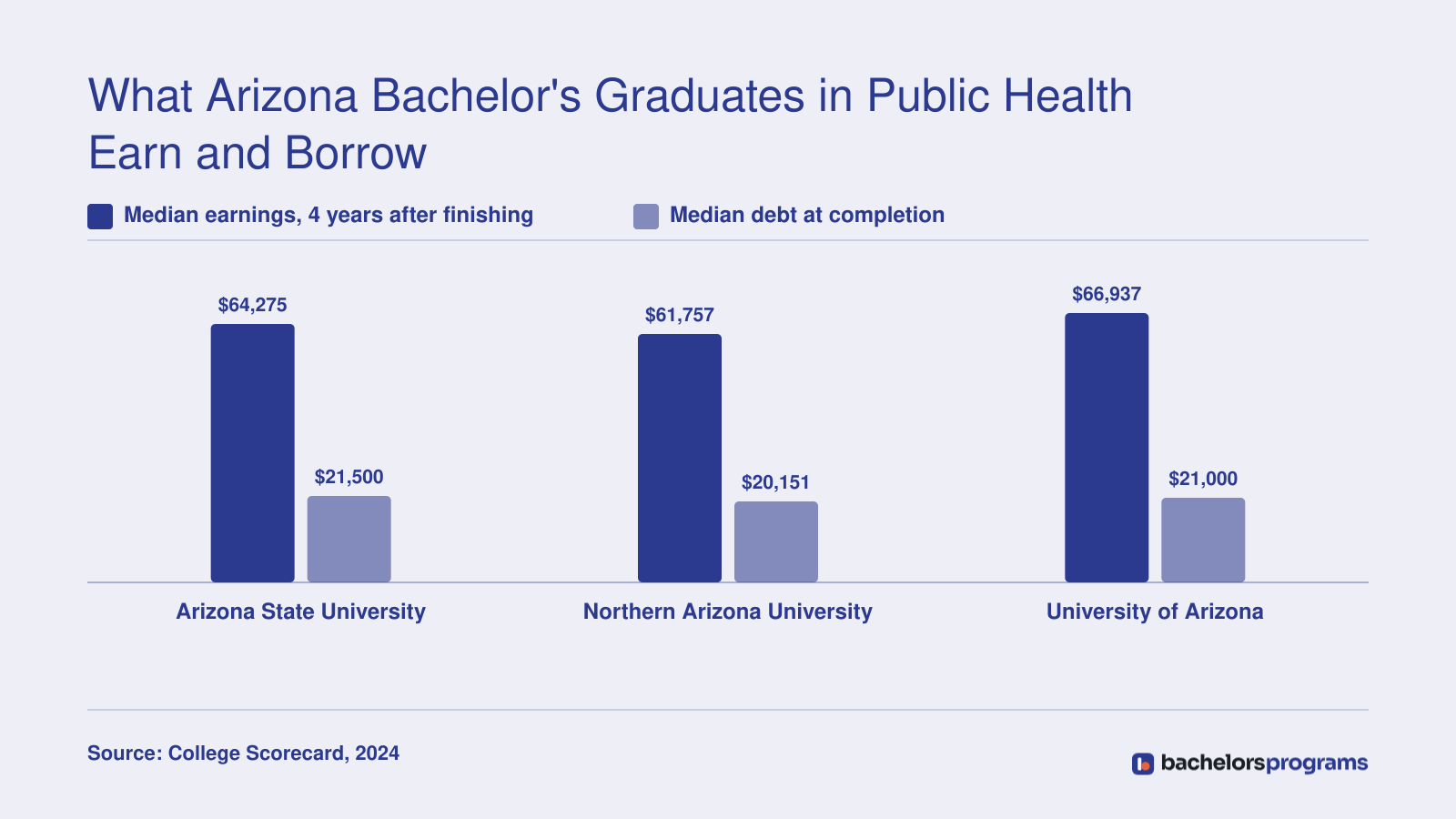
At Arizona State University, Northern Arizona University and the University of Arizona, public health bachelor's graduates earn a median of roughly three times their median federal loan debt four years after finishing. The University of Arizona leads at $66,937 against $21,000 borrowed, and all three schools keep median debt between about $20,000 and $21,500. Program-level earnings are not yet reported for Grand Canyon University, Bryan University or Dine College, so those schools are left off the chart.
Concentrations and Practicum: What the Curriculum Looks Like
What does a B.S. in Public Health at the University of Arizona require beyond classroom credits? Each student completes one emphasis worth 12 units, plus 9 units of public-health electives. The 2026 catalog names six emphases: AI Innovation in Population Health, Global Health, Health Promotion, Health Systems Theory & Practice, One Health, and Quantitative Methods. The program overview page refers to a seventh, so confirm the current list with an advisor. Public Health Practice can no longer be newly declared as of Fall 2026, though students who declared it earlier may finish it.
Internship and Practicum Hours
The University of Arizona requires an internship (HPS 493A) worth 6 units and 250 contact hours before graduation.1 You can complete it in one semester or split it across two terms at 3 units and 125 hours each.1 You must declare an emphasis before earning the internship units. A 2-credit General Education introduction and capstone requirement also applies.
Northern Arizona University (Health Sciences, Public Health) and Arizona State University (Public Health, Scottsdale) each run their own emphasis options and field requirements. Check their current catalogs for practicum hours before you compare them with Tucson's 250.
Choosing a Concentration by Career Goal
- Health education: Health Promotion fits work in program design, outreach, and wellness coaching.
- Epidemiology and data: Quantitative Methods builds the statistical skills used in disease surveillance and research.
- Policy and administration: Health Systems Theory & Practice suits students aiming at agencies, hospitals, and health policy roles.
- Community and global health: Global Health or One Health points toward community-based and cross-border work. Pick the one whose practicum placements match the setting you want.
Related Articles
Public Health Careers in Arizona for Bachelor's Graduates
Graduates can usually picture the job titles they want; the harder part is finding wage data that matches them. Federal statistics describe broad occupations; Arizona employers post specific roles with their own titles and pay bands. Closing that gap takes an afternoon of research you can run yourself.
Start With Federal Wage and Occupation Data
BLS.gov is the baseline. Use the Occupational Outlook Handbook to read entry requirements, typical duties, and work settings, then open the Occupational Employment and Wage Statistics tables and switch to the Arizona state and metro views for the same occupation codes. Three are worth looking up:
- Health education specialists (21-1091): nationally, 65,690 workers with a median of $64,070 a year, or $30.80 an hour, as of May 2025.
- Community health workers (21-1094): 61,660 workers nationally, median $56,180 a year, or $24.93 an hour1.
- Epidemiologists (19-1041): 12,090 workers nationally, median $97,890 a year2. Most epidemiologist roles expect graduate training, but it shows where a public health track can lead.
There is no single federal occupation called "public health analyst," so compare the codes above rather than searching for that title.2 BLS publishes Arizona metro estimates for areas including Tucson, Flagstaff, Yuma, Prescott Valley-Prescott, Lake Havasu City-Kingman, and Sierra Vista-Douglas2.
Check Arizona Employers Directly
National medians set expectations; live postings confirm them. Go straight to the career pages at Arizona Department of Health Services, Maricopa County Department of Public Health, and Pima County Health Department, plus tribal health systems and federally qualified health centers. Titles vary widely, so search health educator, community health worker, public health analyst, program coordinator, and outreach specialist separately. Read the minimum qualifications line on each posting to see where a bachelor's degree alone is enough.
Use Associations and People
Career services offices at the Arizona programs on this list place students into practicum sites that often hire their own interns. Beyond campus, the American Public Health Association, the Arizona Public Health Association, SOPHE, and the Arizona Alliance for Community Health Centers and NACHC maintain job boards, salary context, and local chapters. Finish by asking two or three county, tribal, or community health center staff what they were actually paid at hire.
Licensure and CHES Certification: What Arizona Public Health Graduates Need
Arizona does not license general public health or health education roles at the state level.4 There is no state exam, no state board credential, and no license to earn before you start work. Employers set their own requirements, and those requirements vary by position and by agency.
The CHES credential, explained
What you can add instead is the Certified Health Education Specialist credential, a national professional certification rather than an Arizona license. It is optional, and a bachelor's degree is enough to qualify.1
Eligibility runs through your academic record, not your work history. You need a bachelor's degree or higher from an accredited institution plus one of two pathways:
- A major explicitly in a health education discipline, such as Health Education, Community Health Education, Public Health Education, or School Health Education.
- At least 25 semester credits (or 37 quarter hours) of relevant coursework with a C or better, addressing the profession's areas of responsibility.1 At least 12 of those semester credits must sit in process-oriented courses.
A public health major with strong health education coursework can meet the second pathway. The University of Arizona's health education emphasis, for example, is built around 25 credit hours of that material.
MCHES and why CHES helps
Master Certified Health Education Specialist (MCHES) comes later, generally after five continuous years holding the CHES credential or a master's degree plus documented experience.2
Some employers prefer or require CHES for health education positions, so the credential can separate you from candidates with the same degree and no certification.3
Frequently Asked Questions About Public Health Schools in Arizona
These answers summarize the main findings on this page. Costs, formats, and program details can change, so confirm current terms with each school before you apply.
What is the best public health school in Arizona?
Which Arizona schools offer a bachelor's degree in public health?
Can you get a public health degree online in Arizona?
Are Arizona public health programs CEPH accredited?
How much does a public health bachelor's degree cost in Arizona?
What can you do with a bachelor's degree in public health?
Compare Public Health programs on the data that matters
Explore more Healthcare majors or browse every field of study.
All Healthcare programs Browse every field of study