Best Communications Degree Programs in Arizona
Compare 3 accredited Communications programs in Arizona, with net price after aid, graduation rates, earnings and debt from IPEDS and the U.S. College Scorecard.

Resident tuition and fees at Arizona's public universities run from about $11,600 to $13,900 a year, and net price after grants can land well under that, so the sticker figure rarely predicts the bill. The degree is usually a Bachelor of Arts (B.A.) in Communications, delivered on campus or fully online.
Admission rules, transfer credit and regional accreditation carry as much weight as price and format. The ranked list below weighs net price, graduation rate and what graduates earn, and median earnings one year after finishing sit within a few thousand dollars of each other.
Key Points
- Arizona State communication graduates earn a $44,571 median one year out.
- ACT and SAT scores are optional for Arizona State applicants in 2027.
- Northern Arizona University has held HLC accreditation continuously since 1930.
Best Bachelor's Degree in Communications Schools in Arizona: Our Ranked List
Arizona's three public research universities all offer a bachelor's degree in communications, and each takes a different route: one leans on interdisciplinary study, one on organizational communication, and one on a fast-paced online format. The order below reflects how well each school serves students who want to study communication in Arizona or online with an Arizona-based institution.
University of Arizona
#1Tucson, AZ · ~$17,000/yr (est.)
Best for: Online students wanting interdisciplinary flexibility
The University of Arizona in Tucson combines a full residential communication department with an online Bachelor of Arts in Communication delivered through Arizona Online. Online students are not charged an out-of-state rate, and the university extends application-fee waivers and tuition reductions to State of Arizona and City of Phoenix employees, their spouses, and dependents. The online degree requires a minor or double major, so graduates leave with a second credential alongside communication. Roughly 68 percent of undergraduates complete their degree within six years, and the average net price after aid sits near $16,700.
- $525 per credit for the online BA in Communication
- 120 total credit hours
- Requires a minor or double major alongside the major
- Covers interpersonal communication, persuasion, and media effects
- Builds skills in digital content creation and intercultural communication
- Delivered online by the College of Social and Behavioral Sciences
Northern Arizona University
#2Flagstaff, AZ · ~$14,000/yr (est.)
Best for: Aspiring organizational communication specialists
Northern Arizona University runs its communication program through the School of Communication in Flagstaff, where the Bachelor of Science in Communication Studies rests on a 42-unit core with room for a certificate, a minor, or the 18-unit Organizational Communication emphasis. The degree is also available through statewide online completion, so students elsewhere in Arizona can finish without moving to Flagstaff. The curriculum is built around communication theory, research methods, and a senior capstone, and it is designed to lead into graduate study, law school, or a teaching credential. A student-to-faculty ratio near 19 to 1 keeps upper-division communication courses relatively small.
- 120 total units, including a 42-unit communication studies core
- 60 to 67 units in the major overall
- 18-unit Organizational Communication emphasis, offered in person
- Communication theory, research methods, and a senior capstone required
- C or better required in each major course
- 2.0 cumulative GPA minimum
- Certificate, minor, or emphasis required alongside the major
- Statewide online completion available for students outside Flagstaff
Arizona State University
#3Scottsdale, AZ
Best for: Adult learners wanting accelerated online terms
Arizona State University delivers its communication bachelor's degree online through ASU Online, organizing 120 credits into 40 courses on 7.5-week terms. Students choose between two focus areas, one on communication and healthy relating and one on workplace, organizational, and leadership communication, then close with a qualitative research project. It is the largest communication program of the three by completer count, and the Earned Admission pathway gives applicants who miss standard requirements a route in through online coursework. Diplomas do not indicate online status, and faculty include Nobel laureates and Guggenheim Fellows.
- 120 credits delivered as 40 courses
- 7.5-week terms with multiple start dates
- Two focus areas: healthy relating, and workplace and leadership communication
- Qualitative research project as the capstone
- Test-optional admission with a 3.0 GPA or top 25% class rank
- Earned Admission pathway for applicants below standard requirements
- Diploma does not indicate online status
Cost & outcomes by school
Federal data for the highest-earning Communications programs, independent of the ranking above. Earnings are this field's bachelor's graduates four years after completing where the Scorecard reports them, else the school's undergraduate median.
| School | Net price / yr | Grad rate | Earnings | Debt | Grads/yr | Format |
|---|---|---|---|---|---|---|
| University of Arizona AZ | $16,674 | 68% | $72,758 | $18,910 | 276 | Online |
| Arizona State University AZ | — | — | $61,193 | $19,202 | 426 | Online |
| Northern Arizona University AZ | $14,158 | 61% | $52,957 | $17,500 | 69 | Hybrid |
Sources: U.S. Department of Education. Net price, graduation rate, earnings and debt: College Scorecard (earnings and debt for this field's bachelor's graduates where reported, else school-wide); graduates: IPEDS. A dash means no figure is reported.
Cost, debt & payoff
Median earnings of this field's bachelor's graduates (4 yrs after completing, else the school's undergraduate median) vs. their median federal loan debt · U.S. College Scorecard
Across these programs the median graduate earns about $61,193 and finishes with roughly $18,910 in debt — a ratio that clears a common rule of thumb (keep debt below first-year salary). Net price and debt vary widely school to school, so check the per-school figures in the table above before you shortlist.
How We Ranked Arizona Communications Bachelor's Programs
Five measures drive the order:
- Net price: what students typically pay once grants and scholarships are applied, not the sticker price.
- Graduation rate: the percentage of students who complete a bachelor's degree.
- Program-level earnings: what graduates of the communications field earn after leaving school.
- Debt: typical borrowing among graduates.
- Completions: how many students earn the degree, a sign of program scale.
What the Numbers Do Not Tell You
Two of these measures need a caution. Graduation rate and net price are institution-wide averages. Neither number reflects the communications program itself, so your own costs and your odds of finishing may differ. Earnings, debt and completions are the figures tied most closely to the field itself.
Who Qualified
Only bachelor's programs at Arizona-based schools were considered, and a school had to offer a communications degree to appear. Campus and online formats were both eligible.
The Scorecard says nothing about admissions rules, accreditation or online delivery. Each school's own pages cover those topics, so check them alongside the ranking before you apply.
Accreditation for Arizona Communications Bachelor's Programs
Northern Arizona University has held Higher Learning Commission (HLC) accreditation continuously since 1930.1 Its most recent reaffirmation came in 2017 to 2018, and the next review is scheduled for 2027 to 2028.1
Why Regional Accreditation Matters
The HLC is the regional accreditor for colleges in Arizona and much of the central United States.1 Institutional accreditation from a recognized body such as the HLC affects three practical things:
- Financial aid: Federal grants and loans generally require attendance at an accredited institution.
- Credit transfer: Other colleges are far more likely to accept credits earned at a regionally accredited school.
- Employer and graduate school recognition: An accredited bachelor's degree signals that the institution meets established quality standards.
The University of Arizona and Arizona State University are also HLC-accredited institutions. Check each school's current status before you enroll, since accreditation is reviewed on a cycle.
Programmatic Accreditation Is Optional
Some departments seek a second layer of review. In this field, the best-known option is the Accrediting Council on Education in Journalism and Mass Communications (ACEJMC), which focuses on journalism and mass communication units. Many communication studies programs never pursue it, and that does not weaken the degree. We could not confirm ACEJMC status for the communication bachelor's programs ranked here, so ask the department directly if this credential matters to you.
How to Verify It Yourself
Visit the school's accreditation page, usually linked from the provost's office or the site footer. Then search the institution by name in the HLC's online directory, which lists current status and upcoming review dates.1
Online and Hybrid Bachelor's Degree in Communications Options at Arizona Schools
Online delivery has become a standard way to earn a communications degree, and two of the three schools here now run fully online versions of their programs.
Format by School
- Arizona State University: The Bachelor of Arts in Communication is fully online through ASU Online, and a Bachelor of Science in Communication is also offered online. Both require 120 credits. Related online degrees, such as Mass Communication and Media Studies, are separate majors.
- University of Arizona: The Bachelor of Arts in Communication through U of A Online is fully online and requires 120 credits. The program requires a minor or double major.
- Northern Arizona University: The Communication Studies, Bachelor of Science is listed as hybrid, and the program details mention statewide online completion. Confirm the exact format with NAU before you plan around it.
Online Cost Versus Campus Cost
ASU Online's published 2026-27 undergraduate rate is $580 per credit. That is a general online rate, not a program-specific guarantee. ASU says fees vary by program and textbooks and computers are extra, so run its tuition estimator before committing. University of Arizona Online bills $525 per credit and states there is no out-of-state tuition.
For comparison, on-campus in-state tuition and fees run about $13,926 a year at the University of Arizona and $13,009 at NAU. A full-time online load of 30 credits at $525 comes to $15,750 a year. Online is not automatically cheaper for an Arizona resident who can attend in person, so weigh flexibility against price.
Pacing and Start Dates
ASU Online uses a 7.5-week course format with multiple start dates through the year, which lets you take one or two courses at a time. Pacing details and transfer rules for the other two schools were not confirmed, so ask each admissions office directly.
Who Benefits Most
- Working adults: ASU's short courses and the University of Arizona's pay-per-credit model suit a job-first schedule.
- Out-of-state students: The University of Arizona's single online rate removes the nonresident premium.
- Transfer students: Online can work well, but request a credit evaluation first, since that policy varies by school.
Admission Requirements and Transfer Pathways for Arizona Communications Programs
Arizona State University publishes the clearest admission rules for its bachelor's degree in communications. First-year applicants have several ways to qualify, and ACT or SAT scores are optional. If you are starting at an Arizona community college, the strongest way to protect your credits is to finish an associate degree from a regionally accredited institution, which lowers ASU's minimum transfer GPA from 2.50 to 2.00; confirm with admissions how each course applies to the communication major, and check transfer and first-year requirements directly with the University of Arizona and Northern Arizona University before you enroll.
| School | Admission Standard / GPA | Test Policy | Transfer Credit Pathway |
|---|---|---|---|
| Arizona State University (online B.A. in Communication) | Meet at least one: top 25% of high school graduating class; 3.00 GPA in competency courses; ACT 22 for Arizona residents or 24 for nonresidents; SAT 1120 for Arizona residents or 1180 for nonresidents | ACT/SAT not required for admission; scores may be submitted for course placement; writing portion not required | 12 or more transferable post-high-school semester credits makes you a transfer applicant. 24 or more credits: minimum 2.50 cumulative transfer GPA. 12 to 23 credits: 2.50 transfer GPA plus first-year requirements. Associate degree or higher from a regionally accredited institution: minimum 2.00 cumulative GPA |
| Arizona State University (campus B.A. in Communication) | Must meet general university admission requirements; no program-specific first-year GPA published | Test optional; ACT or SAT scores may be submitted and are encouraged for merit scholarship consideration | Transfer students must meet current university admission requirements; returning ASU students with transfer credit need a minimum 2.00 ASU cumulative GPA |
Related Articles
Questions to Ask Yourself
Do you want a hands-on media or PR track, or a broader communication theory degree?
Will you start at an Arizona community college and transfer, or enter a university as a first-year student?
Would an online format fit your schedule, or do you need campus internships and networking in Phoenix or Tucson?
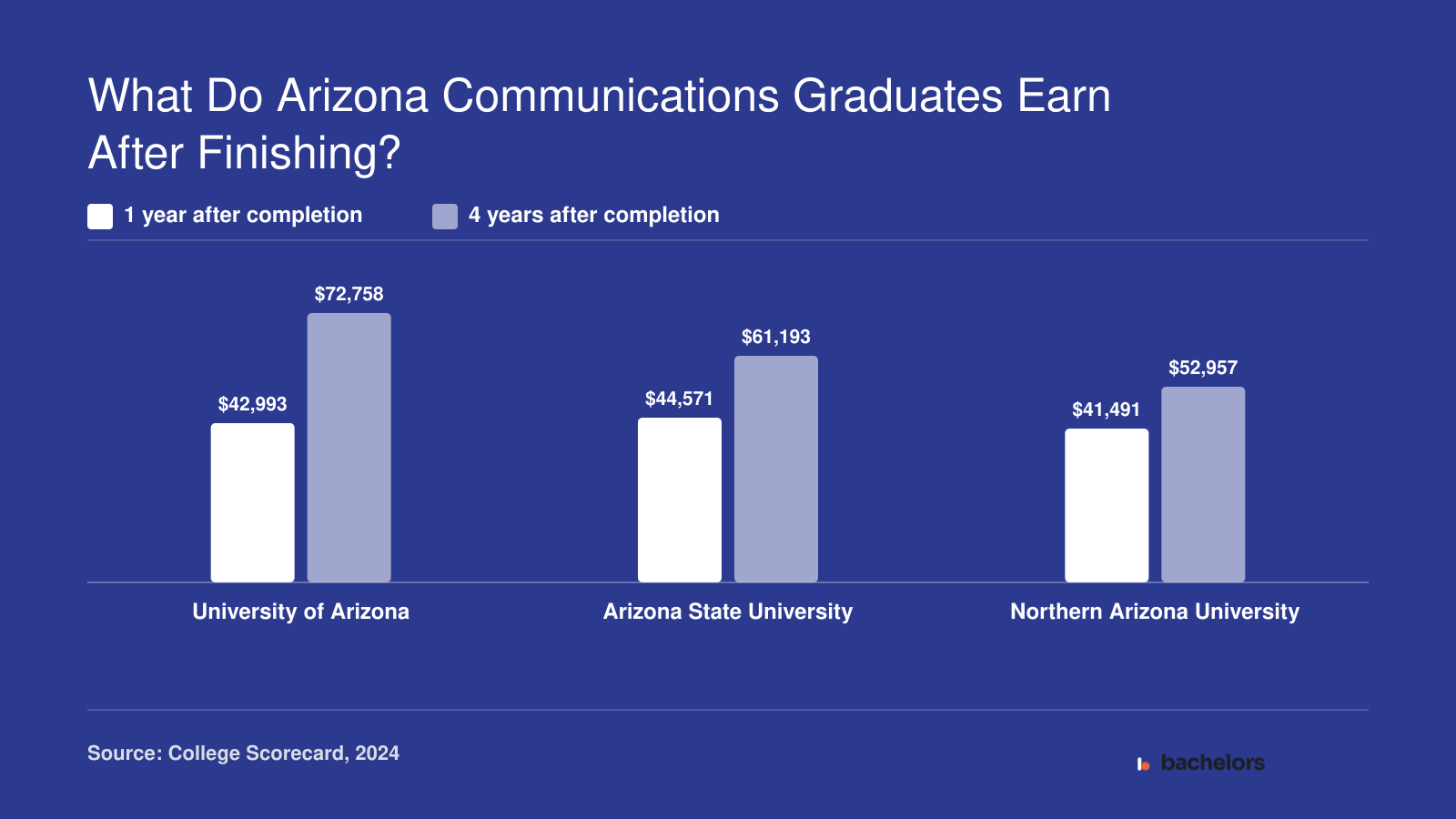
What Do Arizona Communications Graduates Earn After Finishing?
These are program-level medians for each school's communication bachelor's graduates, not campus-wide earnings. One year after completion, Arizona State University graduates lead at $44,571, followed by University of Arizona at $42,993 and Northern Arizona University at $41,491. By four years out, University of Arizona graduates pull ahead at $72,758, compared with $61,193 at Arizona State and $52,957 at Northern Arizona, so early pay differences widen as careers develop.
Compare Communications programs on the data that matters
Explore more Communications & Media majors or browse every field of study.
All Communications & Media programs Browse every field of study