Best Data Science Degree Programs in Arizona
Compare 7 accredited Data Science programs in Arizona, with net price after aid, graduation rates, earnings and debt from IPEDS and the U.S. College Scorecard.

Data science has moved from a graduate-school specialty to a standard undergraduate major, and Arizona's schools reflect that shift. A bachelor's degree in data science, typically a Bachelor of Science (B.S.) in Data Science, is offered at public research universities such as the University of Arizona and Arizona State University, and at private and online-first schools.
Arizona schools offer the degree on campus and online, and the two routes differ most in price, schedule and admissions standards.
The real tension is price against fit. Resident and non-resident tuition at the public universities can differ by more than $28,000 a year, while online programs trade campus access for scheduling flexibility.
Key Points
- University of Arizona tuition and fees: $13,926 resident, $42,278 nonresident.
- University of Phoenix-Arizona posts the lowest resident sticker price among these schools.
- Arizona State, Northern Arizona and University of Arizona hold regional HLC accreditation.
Best Bachelor's in Data Science Schools in Arizona, Ranked
Six Arizona schools award a bachelor's degree in data science, and they fall into three rough camps: the state's two large public research universities, two private institutions with very different personalities, and two online-first providers. Each entry below covers what the program emphasizes, how it is delivered, and what students pay after aid.
University of Arizona
#1Tucson, AZ · ~$17,000/yr (est.)
Best for: Tucson campus students wanting rigorous math
The University of Arizona anchors the state's data science pipeline from its Tucson campus, where the Bachelor of Science in Data Science is housed in the Department of Mathematics inside the College of Science. The curriculum leans mathematical, pairing probability and statistical theory with programming and applied analysis, and it sends graduates into analytics, risk and finance roles or on to graduate study. The institution-wide graduation rate is 68%, and average net price after aid is about $16,674.
- Offered through the Department of Mathematics
- Coursework in probability, statistics and programming
- Focus on capturing, processing and analyzing data
- Solid foundation in mathematics
- Evaluate statistical models drawn from scientific literature
- Prepares for careers in analytics and finance
- Path to graduate degrees in data science
Northern Arizona University
#2Flagstaff, AZ · ~$14,000/yr (est.)
Best for: Flagstaff undergrads seeking applied statistics
Northern Arizona University delivers its B.S. in Data Science on the Flagstaff campus, splitting 59 to 61 major units across a data science core, 18 units of statistics and 9 units of electives, finished with a senior capstone. Faculty also connect undergraduates to applied statewide work through the Arizona Data Science Corps, an NSF-funded project run with the Arizona Department of Education. The institution-wide graduation rate is 61%, and average net price after aid runs about $14,158.
- 120 total credit hours with a 2.0 GPA minimum
- Major requires 59-61 units: 32-34 core, 18 statistics, 9 electives
- Senior capstone required
- Offered in Flagstaff
- Careers: business analyst, actuary, data scientist
- Encourages a minor in another field
- General Studies coursework uses MAT and STAT prefixes
Embry-Riddle Aeronautical University-Prescott
#3Prescott, AZ · ~$40,000/yr (est.)
Best for: Aspiring aerospace data analysts
Embry-Riddle Aeronautical University's Prescott campus is the pick for students who want data science pointed at aerospace, aviation and engineering problems. Classes stay small and project-based, with collaboration across data science, engineering and cybersecurity students, and the same degree is offered fully online through the university's worldwide campus. The institution-wide graduation rate is 68%, but average net price after aid is the highest on this list at about $40,287.
- 120 total credit hours
- Fully online option available through the worldwide campus
- Prescott focus: aerospace data analytics and visualization
- Project-based learning with smaller classes at Prescott
- Collaboration with engineering and cybersecurity students
- Applied data science research with industry partners
- Qualified students can begin the M.S. in Data Science at Daytona Beach
University of Advancing Technology
#4Tempe, AZ · $29,000/yr (est. net price)
The University of Advancing Technology in Tempe is a small, technology-only campus where the B.S. in Data Science is taught in person or online with a flexible scheduling model. Coursework is hands-on and current, covering tidy data workflows in R, statistical testing, streaming data, machine learning and digital privacy, with internships and apprenticeship projects built in. The institution-wide graduation rate is 35%, and average net price after aid is roughly $28,522.
- Fully online or in-person study in Tempe
- Syncflex flexible learning option
- Emphasis on tidy data and the tidyverse in R
- Works with real-time streaming data
- Covers AI and machine learning tools plus statistical testing
- Internships, community projects and apprenticeship experiences
- Digital privacy and ethical data practice built into coursework
- Careers: machine learning engineer, AI developer
Arizona State University
#5Scottsdale, AZ
Arizona State University offers the widest menu on this list: a 120-credit B.S. in Data Science with eight focus areas, running from business analytics and computer science to biosciences and spatial sciences, available at Tempe, through ASU Online and at ASU Local sites. Students can stack a concurrent degree or an accelerated bachelor's-plus-master's path, and the program is accredited by the Higher Learning Commission. International students on F-1 visas can use the 24-month STEM OPT extension after graduating.
- 8 concentration options, from business analytics to spatial sciences
- 120 total credit hours
- Fully online through ASU Online, plus Tempe and ASU Local sites
- Accredited by the Higher Learning Commission
- STEM-OPT eligible: 24-month work extension for F-1 students
- Accelerated bachelor's plus master's option
- Concurrent degrees earn two diplomas
- 300+ global education opportunities
University of Phoenix-Arizona
#6Phoenix, AZ · $10,000 – $15,000/yr (est.)
The University of Phoenix runs its B.S. in Data Science entirely online, one five- to six-week course at a time, with no SAT, ACT or essay required and no application fee. The curriculum centers on Python, R, SQL, machine learning and predictive modeling and closes with a capstone, and electives can stack toward an undergraduate business or IT certificate. The institution-wide graduation rate is about 21%, and average net price after aid is roughly $13,520, the lowest among these six schools.
- Fully online, one 5- to 6-week course at a time
- $426 per credit under a locked-in tuition rate
- $0 application fee, no SAT, ACT or essay required
- 120 total credit hours with a data science capstone
- Coursework in Python, R, SQL, machine learning and predictive modeling
- Electives can stack toward an undergraduate business or IT certificate
- Transfer credits accepted from 5,000+ institutions
- Military benefits and employer tuition reimbursement supported
Cost & outcomes by school
Federal data for the highest-earning Data Science programs, independent of the ranking above. Earnings are this field's bachelor's graduates four years after completing where the Scorecard reports them, else the school's undergraduate median.
| School | Net price / yr | Grad rate | Earnings | Debt | Grads/yr | Format |
|---|---|---|---|---|---|---|
| Embry-Riddle Aeronautical University-Prescott AZ | $40,287 | 68% | $84,131 | $23,666 | 1 | Online or campus |
| Arizona State University AZ | $14,967 | 68% | $62,668 | $19,500 | 100 | Online or campus |
| Arizona State University AZ | — | — | $62,668 | $19,500 | 133 | Online or campus |
| University of Arizona AZ | $16,674 | 68% | $59,979 | $19,620 | 36 | Campus |
| Northern Arizona University AZ | $14,158 | 61% | $54,384 | $19,000 | 14 | Campus |
| University of Advancing Technology AZ | $28,522 | 35% | $50,719 | $28,812 | — | Online or campus |
| University of Phoenix-Arizona AZ | $13,520 | 21% | $37,752 | $31,553 | 60 | Online |
Sources: U.S. Department of Education. Net price, graduation rate, earnings and debt: College Scorecard (earnings and debt for this field's bachelor's graduates where reported, else school-wide); graduates: IPEDS. A dash means no figure is reported.
Cost, debt & payoff
Median earnings of this field's bachelor's graduates (4 yrs after completing, else the school's undergraduate median) vs. their median federal loan debt · U.S. College Scorecard
Across these programs the median graduate earns about $59,979 and finishes with roughly $19,620 in debt — a ratio that clears a common rule of thumb (keep debt below first-year salary). Net price and debt vary widely school to school, so check the per-school figures in the table above before you shortlist.
How We Ranked Arizona's Data Science Schools
Sticker price and starting salary rarely point to the same school, which is why no single number decides this list.
What Goes Into the Ranking
Each program is judged on five plain factors: what students actually pay after aid, whether they finish, how selective admission is, what graduates earn, and whether the degree can be completed on campus, online, or in a hybrid format. Selectivity is read from each school's published admission data, and where a school publishes none, we note it. Delivery matters in Arizona, where several schools let working students take data science coursework remotely.
Cost and Completion Are Institution-Wide
Graduation rate and net price describe the whole university, not the data science major alone. Net price is an average across first-year students receiving federal aid, so your bill depends on your aid package, housing, and course load. A program that looks expensive can cost less than a cheaper one once grants are applied.
Earnings Come From Federal Program Data
Salary figures come from College Scorecard program data, which reports median earnings for graduates of a specific field. Those numbers are measured in the first years after completion rather than at mid-career, and cover graduates who were working rather than enrolled in further study. Read them as a signal of early outcomes, not a promise about your own pay.
A smaller campus such as Embry-Riddle Aeronautical University-Prescott or University of Advancing Technology suits students who want close faculty contact; Arizona State University and the University of Arizona offer larger research settings.
Online and Hybrid Bachelor's in Data Science Options at Arizona Schools
Flexibility is the draw of an online degree, but the trade is less face-to-face time with faculty and classmates. Format sorts the schools into three groups:
Which Programs Are Online, Campus or Both
- Online only: University of Phoenix-Arizona.
- Campus and online: Arizona State University, Embry-Riddle Aeronautical University-Prescott and University of Advancing Technology.
- Campus only: University of Arizona and Northern Arizona University (Flagstaff).
University of Advancing Technology also promotes a Syncflex option, so check how it blends in-person and remote attendance.
How Online and Hybrid Delivery Differ
Asynchronous courses let you watch lectures and submit work on your own schedule within weekly deadlines. Synchronous courses meet at set times, online or in person. Hybrid programs mix campus sessions with remote work. Whether ASU's online data science courses are asynchronous or synchronous is not spelled out on the official program page, so confirm with an advisor.
Session length matters as much as format. ASU Online splits each semester into Session A and Session B, usually 7.5 weeks in fall and spring and 6 weeks in summer. That gives six start dates a year, with the next listed start on January 11, 2027. University of Phoenix-Arizona uses five- to six-week terms and one five-week course at a time.
Do Online Students Pay Less?
Often the per-credit rate is lower, though the comparison is not clean. ASU Online lists $580 per credit hour for most undergraduate programs in 2026-27, plus program fees, and ASU says the final price varies by program. The program page does not give an on-campus rate for the comparable degree, so a direct dollar comparison is not possible here. University of Phoenix-Arizona advertises $426 per credit with a locked tuition rate. For a 120-credit degree, the per-credit gap adds up, but transfer credits and fees change the total.
Online or Campus?
Choose online if you work full time, need to transfer credits or want to finish in short, focused terms. Choose campus if you want in-person labs, faculty access and a built-in network.
Related Articles
Admissions for Arizona Bachelor's in Data Science Programs: GPA, Test Policy, and Transfer Credit
Admission to a data science bachelor's program in Arizona comes down to high school GPA, test policy, math preparation and how prior college credits transfer. Expect a solid GPA, test-optional rules at the largest public school, and a math sequence that starts at calculus or just before it. Each entry reflects that school's own admissions page; where a school publishes no policy, the entry says so.
First-Year Requirements by School
- Arizona State University: First-year applicants must meet at least one standard, and a 3.00 GPA is one of them. ACT scores of 22 (Arizona residents) or 24 (nonresidents), or SAT scores of 1120 or 1180, are alternatives. ASU is test-optional, and scores may be used for placement. The major starts with MAT 270 or MAT 2651, and ASU expects four years of high school math. The ASU Admission FAQs and Degree Search page cover these points.
- University of Arizona: No policy published.
- Northern Arizona University: No policy published.
- Embry-Riddle Aeronautical University-Prescott: No policy published.
- University of Advancing Technology: No policy published.
- University of Phoenix-Arizona: No policy published.
Before you apply anywhere, confirm each school's current rules on its own admissions page.
Transfer Credit and Community College Pathways
ASU's transfer admission page sets tiers by credit volume. With fewer than 12 transferable semester credits, you are reviewed as a first-year applicant. With 12 to 23 credits, you need a 2.50 cumulative transfer GPA plus the first-year requirements. With 24 or more, a 2.50 transfer GPA is the standard.2
An associate degree from a regionally accredited institution carries a lower bar. ASU's FAQ lists 2.00 for Arizona residents and 2.50 for nonresidents3, while another ASU statement lists 2.00 flat, so confirm your category with an advisor. Credits must come from a regionally accredited school, be earned after high school, and carry a grade of C- or better.2 All of this must be completed by the time you apply.
ASU evaluates community college credits and offers course-mapping tools. Its materials show no data science-specific articulation agreement, guaranteed-admission deal, or required associate degree, so map your math courses early, especially calculus. Transfer rules at the other schools here: No policy published.
What a Bachelor's Degree in Data Science Costs in Arizona
Arizona residents and out-of-state students pay very different prices for the same B.S. in data science, and the gap varies by school. Arizona's residency rules decide which rate applies to you. University of Arizona, for example, recognizes pathways such as three or more years of attending an Arizona high school.
In-State vs. Out-of-State Tuition
For the data science degree itself, University of Arizona runs about $13,573 for residents and $39,903 for nonresidents. Northern Arizona University is $12,619 in-state and $20,044 out-of-state, a much smaller gap. Arizona State University's 2026-2027 resident tuition and fees average $14,8141, while a nonresident transfer student's figure is $39,2622. These are averages, and they shift by campus, college, and course load. University of Phoenix-Arizona charges $9,552 regardless of residency. University of Advancing Technology ($18,800) and Embry-Riddle Prescott ($43,974) are private and charge one rate for everyone.
Net Price After Aid
These are approximate institution-wide averages, not data science figures:
- University of Phoenix-Arizona: about $13,520
- Northern Arizona University: about $14,158
- University of Arizona: about $16,674
- University of Advancing Technology: about $28,522
- Embry-Riddle Prescott: about $40,287
Your own number depends on family income and aid eligibility.
Arizona Aid Options
- Arizona Promise: At University of Arizona, it fills tuition and fees left after gift aid. You must be an Arizona resident, Pell-eligible, a first-year student on the main campus, and enrolled in 12 or more units, and you must keep a 2.5 core GPA. ASU's version is valued up to $14,2151 for Pell-eligible students who file the FAFSA, but its conditions differ, so check each school.
- WUE: The Western Undergraduate Exchange charges 150% of resident tuition to students from participating Western states. University of Arizona limits it to Mining and Geological Engineering, Natural Resources, and Hydrology and Atmospheric Sciences, so data science is not on that list. ASU's WUE covers select majors at Downtown Phoenix, Polytechnic, and West Valley for students admitted Spring 2026 or earlier.
- Transfer pathways: Community college transfer routes can cut the cost of the first two years. Terms vary, so confirm credit acceptance with the transfer office.
Debt and Total Cost
Program-level debt figures are not available for these degrees. Institution-wide, median graduate debt is about $19,000 at Northern Arizona University and $19,620 at University of Arizona. An in-state public degree with aid is the lowest-cost route; out-of-state or private enrollment can multiply the total.
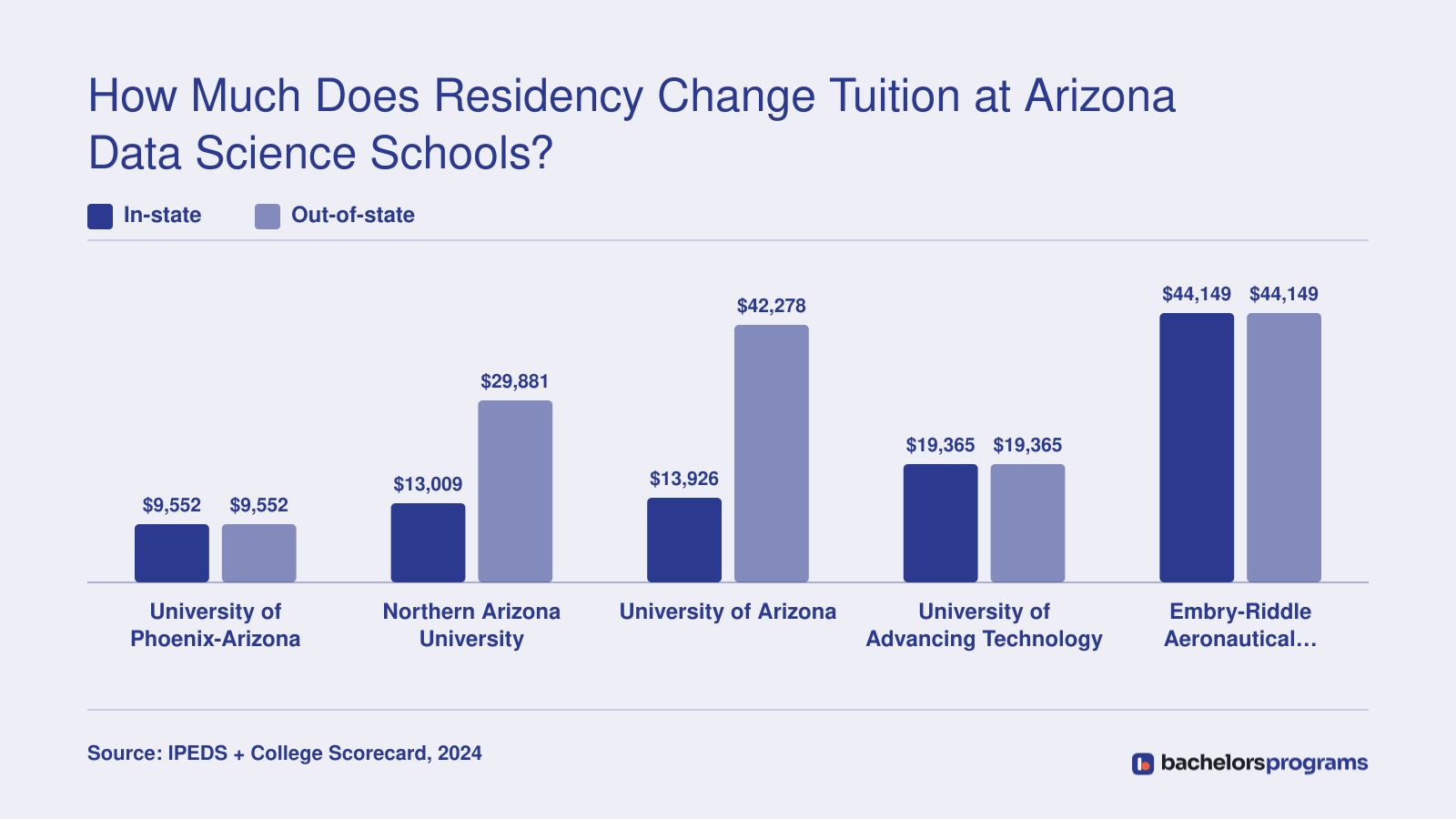
How Much Does Residency Change Tuition at Arizona Data Science Schools?
Residency matters most at Arizona's public universities. The University of Arizona shows the widest gap, charging out-of-state students $42,278 in annual tuition and fees versus $13,926 for residents, a difference of $28,352. University of Phoenix-Arizona has the lowest resident sticker price at $9,552, while Northern Arizona University is the least expensive public option at $13,009 in-state, and the private schools charge everyone the same rate.
Accreditation and Program Quality for Arizona Data Science Degrees
Accreditation tells you whether a degree will be recognized by employers, graduate schools and financial aid systems. Arizona's public universities, including Arizona State University, Northern Arizona University and the University of Arizona, are regionally accredited by the Higher Learning Commission.1 Regional accreditation is the baseline that lets students receive federal aid and transfer credits between institutions. Private institutions may be accredited by a different regional body, so verify each school individually.
Program-Level Accreditation
ABET reviews computing, engineering and applied science programs, but the bachelor's data science degrees at the Arizona schools here do not carry a separate ABET seal for data science. Some related computing or engineering degrees may. If an admissions page mentions ABET, ask whether the seal applies to the data science degree itself. A program without specialized accreditation can still be rigorous; look at the curriculum, faculty and internship ties.
How to Verify a School's Status
Check the Higher Learning Commission's online directory, the U.S. Department of Education's accreditation database, and the school's own accreditation page. Ask admissions for the exact accreditor and the last review date in writing.
Licensure in Arizona
Arizona does not require a state license to work as a data scientist. There is no state board, exam or continuing-education mandate tied to the title, so employers evaluate candidates on skills, portfolios and degrees rather than a license.
Data Science Careers and Salaries in Arizona
Data science pays well nationally, but the figure most often quoted is an occupation-wide median, not a starting salary for a new bachelor's graduate.
What the Wage Data Shows
The Bureau of Labor Statistics reports a national median of $120,230 a year ($57.80 an hour) for data scientists as of May 2025, across roughly 275,600 jobs. Half of all data scientists earned more and half earned less, and that pool includes experienced professionals and graduate-degree holders. Medians vary by industry, from $142,240 in publishing, broadcasting, and content providers to $132,380 in computer systems design and $108,650 in insurance carriers.1 These are national figures, not Arizona ones.
Program-level earnings for completers, which the federal College Scorecard measures a set number of years after graduation, are not reported for the Arizona data science programs on this page. Occupation-wide wages are therefore the best benchmark available, and you should expect early-career pay to sit below them.
The BLS metro releases cover Phoenix-Mesa-Chandler and Tucson but do not give a data scientist median for either. For general context, all-occupation average wages run about $33.48 an hour in Phoenix and $30.38 in Tucson, against $33.54 nationally.2 Those figures describe every job type, so do not read them as data scientist pay.
Who Hires in Arizona
The state's employer base is varied.2 Likely hiring contexts, not confirmed openings, include:
- Semiconductors: Intel and TSMC Arizona.
- Aerospace and defense: Honeywell Aerospace and Raytheon.
- Healthcare: Banner Health and Mayo Clinic Arizona.
- Finance and insurance: American Express, Wells Fargo, and State Farm.
- Technology and public safety tech: GoDaddy and Axon.
- Utilities and mining: APS and Freeport-McMoRan.
- Higher education: Arizona State University and the University of Arizona.
Check current postings before you plan around any one employer.
Common Entry Roles
Bachelor's graduates typically start in analyst-track positions and move toward modeling work with experience:
- Data analyst
- Junior data scientist
- Business analyst
- Business intelligence or reporting analyst
- Database developer or architect
Programs with an applied bent can shape where you land. Embry-Riddle Aeronautical University-Prescott emphasizes aerospace data analytics, and Northern Arizona University lists business analyst among its career paths. Internships, which the University of Advancing Technology highlights, often decide who gets the first interview.
Common Questions About Data Science Degrees in Arizona
These answers cover the questions Arizona data science applicants ask most often. Check each school's own pages for current deadlines, fees, and policies before you apply.
What is the best data science degree program in Arizona?
Can you get a bachelor's degree in data science online from an Arizona school?
Is ASU or University of Arizona better for data science?
How do I qualify for in-state tuition at an Arizona university?
Can I start at an Arizona community college and transfer into a data science bachelor's program?
Compare Data Science programs on the data that matters
Explore more Science & Engineering majors or browse every field of study.
All Science & Engineering programs Browse every field of study