Best Elementary Education Degree Programs in Arizona
Compare 15 accredited Elementary Education programs in Arizona, with net price after aid, graduation rates, earnings and debt from IPEDS and the U.S. College Scorecard.

Arizona's elementary classrooms lean heavily on substitutes and contracted teachers, and state certification rules decide who can stand in front of a class. A bachelor's degree in elementary education remains the standard entry point: typically a Bachelor of Science (B.S.) in Elementary Education, 120 credits, and a student-teaching placement before the K-8 certificate.
Cost separates the options more than prestige does. The community colleges here list roughly $2,400 a year in tuition; private colleges run past $30,000. Graduate earnings four years out cluster between about $50,000 and $53,000 at the state universities, a narrow band that leaves price as the deciding variable.
Key Points
- Arizona State University graduates earned a median $53,195 four years out.
- Rio Salado, Glendale and Paradise Valley list in-state tuition near $2,358.
- Expect 120 credit hours at Arizona State, Northern Arizona and Grand Canyon.
Best Bachelor's Degree in Elementary Education Programs in Arizona, Ranked
The programs below are ordered using our ranking approach, explained in full in the methodology section at the end of this article. Each card lists the credential, delivery format, in-state tuition, approximate net price after aid and one or two program specifics worth knowing before you apply. Graduation rates cited for these schools describe the whole institution, not the education department alone.
International Baptist College and Seminary
#1Chandler, AZ · $10,000 – $15,000/yr (est.)
Best for: Christian school teachers seeking local training
A small private Baptist college in Chandler, International Baptist College and Seminary keeps teacher preparation close to ministry. Undergraduates earn a Bachelor of Arts in Bible and Teacher Education and choose an Elementary Education (K-6) emphasis, with classroom practicum and a 12-week student teaching term built into the 125-credit degree. Students may transfer up to 94 credits, and co-curricular life runs through children's ministry, youth ministry and Christian school ministries.
- Elementary Education (K-6) emphasis within the Bible and Teacher Education major
- 125 credit hours across four years
- Transfer up to 94 credits into the degree
- 12-week student teaching capstone
- Classroom practicum and a teaching portfolio
- Seminars on teaching exceptional learners
- Fall and spring start terms
- Tuition $7,200 per semester
Arizona State University
#2Tempe, AZ · ~$15,000/yr (est.)
Best for: Working adults needing flexible delivery options
Arizona State University runs the state's largest elementary education pipeline, with the same 120-credit degree available at the Tempe campus, West Valley, ASU Local or fully online for U.S. residents. Candidates are in classrooms from sophomore year through a semester of full-time student teaching, and the program leads to an Arizona K-8 credential. A 90-credit, three-year pathway for 2026-27 is delivered with Gila Community College and Arizona Western College, letting students in those communities stay local.
- 120 credit hours leading to an Arizona K-8 teaching credential
- Campus options at Tempe, West Valley and ASU Local
- Fully online option for students residing in the U.S.
- ASU Sync live classes delivered over Zoom
- Clinical experience embedded from sophomore through senior year
- Internships before the final semester of student teaching
- New 90-credit, three-year pathway for 2026-27
- Accredited by the Higher Learning Commission
University of Arizona
#3Tucson, AZ · ~$17,000/yr (est.)
Best for: Aspiring bilingual and ESL teachers
The University of Arizona delivers its elementary education degree through four cohorts: Tucson main campus, a main campus bilingual option, a distance online option and the Indigenous Teacher Education Program. Online students anywhere in Arizona can study asynchronously or in live synchronous classes, while practicum and student teaching stay tied to local school sites. Graduates earn a K-8 teaching certificate with ESL and K-5 literacy endorsements, and can add a bilingual endorsement.
- Four cohorts, including Tucson, bilingual, online and ITEP tracks
- Leads to an Arizona K-8 teaching certificate
- ESL and K-5 literacy endorsements included
- Optional bilingual endorsement
- Online route takes two years full time or four years part time
- Synchronous or asynchronous online classes
- Practicum and student teaching at local school sites
- Online option open anywhere in Arizona
Northern Arizona University
#4Flagstaff, AZ · ~$14,000/yr (est.)
Northern Arizona University is the state's northern teacher preparation hub, offering a CAEP-accredited Bachelor of Science in Education in Elementary Education in Flagstaff, Yuma and online at set class times. The 120-unit degree carries 78 units in the major and six concentration choices, from math with a K-6 focus to language and cultural diversity. Candidates log 135 practicum hours across three semesters before student teaching in the fourth. The Chandler-Gilbert and NAU-North Valley sites are no longer accepting new applications.
- CAEP-accredited teacher preparation program
- 120 credit hours, 78 of them in the major
- Six concentrations, including math and language and cultural diversity
- 135 practicum hours over three semesters
- 2.5 GPA and prerequisite courses required for program admission
- IVP fingerprint clearance card required
- Campus in Flagstaff and Yuma, plus synchronous online classes
- Approved by the Arizona State Board of Education
Prescott College
#5Prescott, AZ · ~$23,000/yr (est.)
Prescott College is a small, campus-based liberal arts college in central Arizona where Education is an undergraduate major rather than a stand-alone degree. Elementary Education is one optional concentration alongside early childhood education, early childhood special education, secondary education, K-12 special education and environmental education. Classes are small, and the college also runs graduate work in education, counseling and sustainability.
- Elementary Education concentration inside the Education major
- Concentrations are optional, not required
- Related options include early childhood and K-12 special education
- Campus-based study in Prescott
Chandler, AZ · ~$8,000/yr (est.)
This Chandler institution awards a Bachelor of Arts in Educational Studies as a 120-credit, four-year campus degree taught face to face. The major takes 45 credits, alongside 59 general education credits and 16 electives, and includes 50 hours of classroom observation plus a 12-week, full-time student teaching capstone. The Arizona State Board of Education approves it as a certified Teaching College, so graduates who meet state requirements can apply for K-8 certification.
- 120 credit hours taught on campus, face to face
- 45 credits in the major, plus 59 general education and 16 elective credits
- 50 hours of classroom observation
- 12-week, full-time student teaching capstone worth 12 credits
- Leads to an Arizona K-8 teaching certificate
- Approved as an Arizona certified Teaching College
- Coursework covers early literacy, the science of reading and structured English immersion
Grand Canyon University
#7Phoenix, AZ · ~$22,000/yr (est.)
Grand Canyon University offers its Bachelor of Science in Elementary Education both on its Phoenix campus and fully online, with a locked online tuition rate of $465 per credit. The AAQEP-accredited, 120-credit program leads to Arizona initial teacher licensure and includes about 120 hours of field experience plus a 15-week student teaching placement with a mentor teacher. Four emphasis options let candidates shape the degree, and up to 90 transfer credits are accepted.
- AAQEP-accredited and approved by the Arizona State Board of Education
- 120 credit hours leading to initial Arizona teacher licensure
- Online tuition of $465 per credit at a locked rate
- 2.8 unweighted GPA, or 2.5 with ACT 19 or SAT 1000
- Up to 90 transfer credits accepted
- Emphasis options in Christian education, ESL, STEM and teaching reading
- About 120 hours of observational and practice-based field experience
- 15-week student teaching placement with a mentor teacher
Paradise Valley Community College
#8Phoenix, AZ · $12,000/yr (est. net price)
Paradise Valley Community College is a Maricopa County community college in Phoenix that awards a Bachelor of Arts in Elementary Education and Special Education among its bachelor's degrees. The college prices its bachelor's degrees at less than a third of typical university tuition, and many include transfer partnerships that carry students from a bachelor's into a master's program. It suits students who want both elementary and special education preparation without a four-year university price tag.
- Bachelor's degree combining elementary and special education preparation
- College prices bachelor's degrees under a third of university tuition
- Transfer partnerships from bachelor's into master's programs
- Campus in Phoenix
Glendale Community College
#9Glendale, AZ · $10,000 – $15,000/yr (est.)
Glendale Community College, part of the Maricopa system, offers a four-year, 120-credit Bachelor of Arts in Elementary Education and Special Education covering elementary grades K-8 and special education K-12. Graduates can pursue Standard Arizona Teaching Certificates in both areas plus the Structured English Immersion endorsement, with field experiences completed in K-12 classrooms on the public school calendar. Upper-division admission is selective and requires a fingerprint clearance card and passing Elementary Subtests 1 and 2, or a 3.0 lower-division GPA. The degree is not open to students living outside Arizona.
- 120 credit hours across four years
- Eligibility for Arizona K-8 elementary and K-12 special education certificates
- Structured English Immersion endorsement included
- 2.5 GPA for lower-division and 3.0 GPA for upper-division coursework
- IVP fingerprint clearance card required
- Two professional or academic references required
- Passing Elementary Subtests 1 and 2, or a 3.0 lower-division GPA
- Not available to students residing outside Arizona
Rio Salado College
#10Tempe, AZ · ~$8,000/yr (est.)
Rio Salado College in Tempe delivers its Bachelor of Arts in Elementary Education and Special Education online, but only to students located in Arizona. The 120-credit program combines elementary K-8 and special education K-12 preparation and adds the Structured English Immersion endorsement, with full-time and part-time schedules available. Upper-division admission requires a 2.5 GPA, two references, a valid fingerprint clearance card and passing AEPA/NES Elementary Subtests 1 and 2, or a 3.0 lower-division GPA.
- Online delivery open only to students located in Arizona
- 120 credit hours across four years
- Full-time and part-time schedules available
- Entrance exam required for admission
- Structured English Immersion endorsement included
- Eligibility for Arizona K-8 elementary and K-12 special education certificates
- 2.5 GPA minimum plus two professional or academic references
- Field experiences and student teaching in K-12 classrooms
Cost & outcomes by school
Federal data for the highest-earning Elementary Education programs, independent of the ranking above. Earnings are this field's bachelor's graduates four years after completing where the Scorecard reports them, else the school's undergraduate median.
| School | Net price / yr | Grad rate | Earnings | Debt | Grads/yr | Format |
|---|---|---|---|---|---|---|
| Arizona State University AZ | $14,967 | 68% | $53,195 | $16,238 | 540 | Online or campus |
| University of Arizona AZ | $16,674 | 68% | $51,285 | $18,000 | 159 | Online or campus |
| Northern Arizona University AZ | $14,158 | 61% | $50,738 | $16,639 | 220 | Online or campus |
| Ottawa University-Surprise AZ | $33,393 | 18% | $50,010 | $22,000 | 5 | Online or campus |
| University of Phoenix-Arizona AZ | $13,520 | 21% | $49,626 | $37,482 | 356 | Online |
| Grand Canyon University AZ | $22,472 | 44% | $49,531 | $30,921 | 1,129 | Online or campus |
| Paradise Valley Community College AZ | $12,180 | 19% | $47,196 | $6,995 | — | Online or campus |
| Arizona Christian University AZ | $32,839 | 40% | $46,205 | $23,000 | 31 | Online or campus |
| Glendale Community College AZ | $11,650 | 16% | $43,108 | $6,960 | — | Campus |
| Prescott College AZ | $22,583 | 56% | $42,359 | $16,300 | 2 | Campus |
| Rio Salado College AZ | $8,341 | 9% | $41,015 | $9,500 | — | Online |
| International Baptist College and Seminary AZ | $14,660 | 88% | $39,556 | — | 3 | Campus |
Sources: U.S. Department of Education. Net price, graduation rate, earnings and debt: College Scorecard (earnings and debt for this field's bachelor's graduates where reported, else school-wide); graduates: IPEDS. A dash means no figure is reported.
Cost, debt & payoff
Median earnings of this field's bachelor's graduates (4 yrs after completing, else the school's undergraduate median) vs. their median federal loan debt · U.S. College Scorecard
Across these programs the median graduate earns about $46,701 and finishes with roughly $16,639 in debt — a ratio that clears a common rule of thumb (keep debt below first-year salary). Net price and debt vary widely school to school, so check the per-school figures in the table above before you shortlist.
Cheapest Elementary Education Bachelor's Programs in Arizona
Among the lowest-cost elementary education bachelor's programs at Arizona schools, net price after aid runs from $6,057 a year at Dine College to $12,180 at Paradise Valley Community College, a gap of roughly $6,100 a year. In-state tuition and fees are far lower, between $1,410 and $2,358, because net price also counts housing, books, and other living costs after grants are applied. Figures come from the U.S. Department of Education's IPEDS and College Scorecard data (2024).
| School | City | Program | Format | Net Price After Aid | In-State Tuition and Fees | Pell Grant Share |
|---|---|---|---|---|---|---|
| Dine College | Tsaile | B.A. Elementary Education | Campus | $6,057 | $1,410 | N/A |
| Rio Salado College | Tempe | Elementary Education and Special Education | Online | $8,341 | $2,358 | 84% |
| Northland Pioneer College | Holbrook | Bachelor of Arts in Elementary Education | Campus | $9,240 | $2,232 | N/A |
| Glendale Community College | Glendale | Elementary Education and Special Education | Campus | $11,650 | $2,358 | 90% |
| Paradise Valley Community College | Phoenix | Bachelor of Arts in Elementary Education and Special Education | Campus and online | $12,180 | $2,358 | 83% |
Which Arizona Elementary Education Programs Have the Highest Graduate Earnings
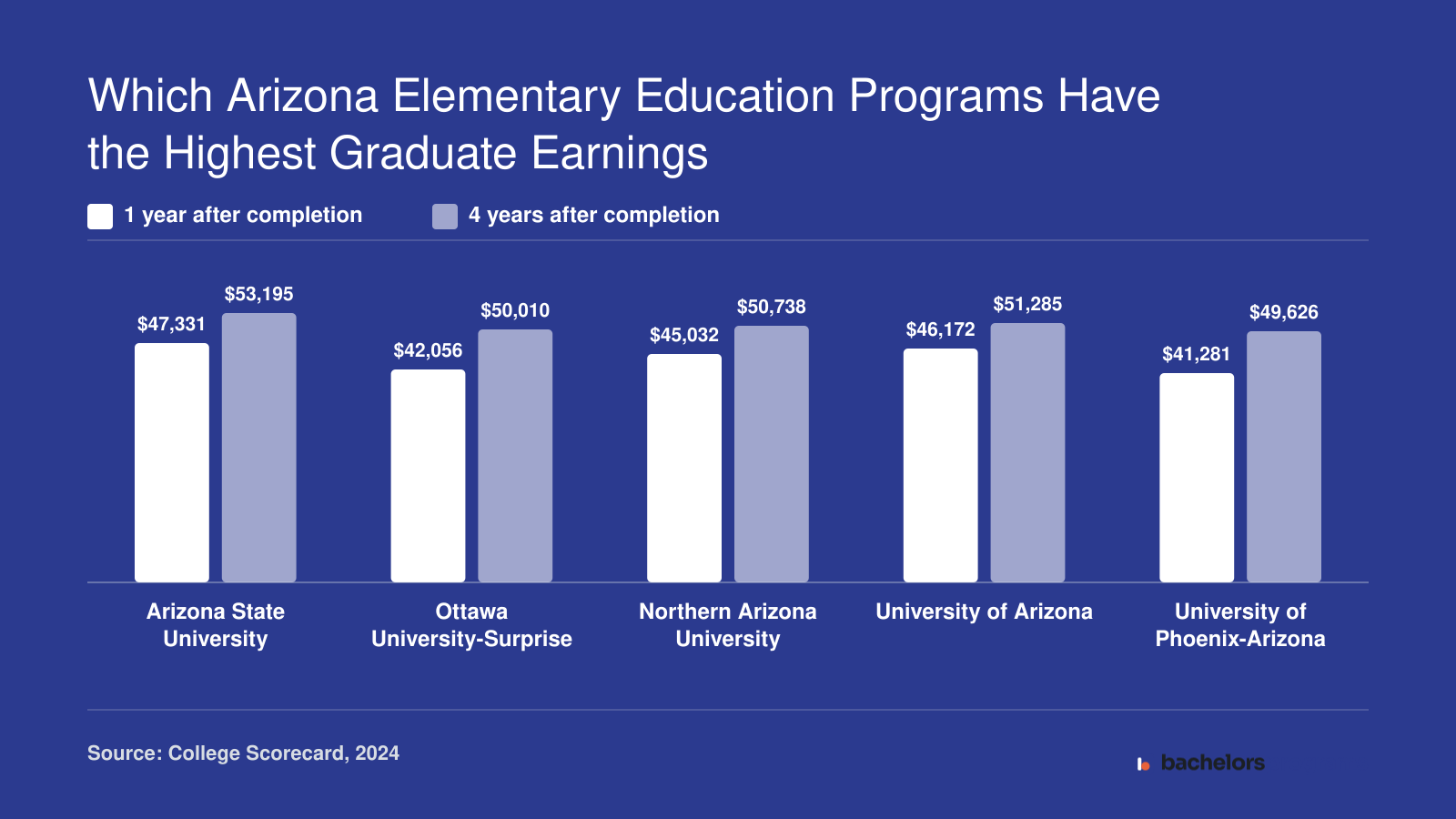
Arizona State University elementary education graduates earned a median $53,195 four years after completion. The University of Arizona followed at $51,285 and Northern Arizona University at $50,738. Ottawa University-Surprise and University of Phoenix-Arizona, both in our directory, posted $50,010 and $49,626. Treat the gap with caution: Arizona district salary schedules set public school teacher pay by experience and credits earned, not by alma mater, so differences of a few thousand dollars often reflect where graduates teach more than which program they finished.
Online and Hybrid Elementary Education Bachelor's Options at Arizona Schools
Online coursework buys flexibility, but an elementary education degree is not something you can finish entirely behind a screen. Every format eventually puts you in a real classroom; the real difference is where the coursework happens and where the teaching practice does.
Three formats, three levels of flexibility
- Fully online: Coursework is delivered remotely, but fieldwork still happens in a school. Arizona State University's BAE in Elementary Education is offered fully online with multiple enrollment sessions, and Rio Salado College lists its elementary and special education program online, limited to Arizona residents.
- Online coursework with in-person fieldwork: The most common setup. The University of Arizona, Grand Canyon University and Paradise Valley Community College list both online and campus formats.
- Campus-based: Prescott College and Glendale Community College list in-person programs, and Glendale states its program is not available outside Arizona.
Where clinical hours actually happen
ASU's online handbook assigns 20 observation hours in TEL 203, 45-hour internships in TEL 310 and RDG 413, and a 60-hour internship in EED 412.1 The final semester is full-time student teaching during teacher-contracted hours under a mentor teacher, with full classroom responsibilities.1 ASU says its advising and professional-education teams support placement. That is support, not a promise of a spot in your home district.
Residency rules come first
ASU Online requires U.S. residence throughout the program, and the live Zoom ASU Sync version requires Arizona residence, tied to state regulations and student-teaching placement. Check this before you compare tuition.
Confirm with the school
Northern Arizona University lists campus and online options, but what is available varies by location and program, so ask an advisor about fieldwork hours and placement. The same caution applies to Grand Canyon and the University of Arizona: ask where student teaching is arranged, who finds the site, and whether an out-of-state placement would be approved.
Questions to Ask Yourself
Can you commit to a full semester of full-time student teaching, and can your job and family schedule absorb it?
Does the online program place you in a school near you, or must you find your own placement?
Do you want to teach in a specific Arizona district, and does the program's student teaching network reach it?
Related Articles
Admission Requirements: GPA, Test Policy, and Transfer Credit
A first-year applicant and a community college transfer end up with the same degree, but the entry rules differ. Arizona State University publishes the most detail on both routes, so it is the clearest benchmark.
First-Year Requirements and Test Policy
ASU asks applicants to meet at least one standard: a top 25% high-school class rank, a 3.00 unweighted GPA in competency courses, an ACT of 22 (Arizona residents) or 24 (nonresidents), or an SAT of 1120 or 1180. SAT and ACT scores are not required, and no writing section is needed. Applicants also need 14 competency courses, including four years of math and four years of English.1
Other schools publish less on their admissions pages:
- Northern Arizona University: A 2.5 GPA minimum, prerequisite courses, and an Elementary Education Professional Knowledge Exam.
- Grand Canyon University: A 2.8 GPA minimum.
- Glendale Community College: A 2.5 GPA, two recommendation letters, prerequisite courses, and a C or better in all courses.
- Rio Salado College: A 2.5 GPA, two recommendation letters, prerequisites, and an entrance exam.
- University of Arizona, Prescott College, and International Baptist College and Seminary: We found no published minimum GPA or test policy for the elementary education program, so confirm with an admissions office.
Selectivity and Access
Admission rates are high at the four-year schools that report them: about 90% at ASU and NAU, 86% at the University of Arizona, 95% at Prescott College, and 79% at Grand Canyon University, the lowest of the group. Pell Grant share points to access. It runs about 62% to 63% at ASU, the University of Arizona, and NAU, roughly 71% at Prescott and Grand Canyon, and above 80% at Paradise Valley and Glendale Community Colleges and Rio Salado.
Transfer Credit Pathways
ASU's minimums depend on how much you bring. With 12 to 23 transferable credits, you need a 2.50 cumulative transfer GPA plus first-year requirements. With 24 or more, the bar is 2.50.2 A regionally accredited associate degree earned after high school lowers it to 2.00, with final grades of C- or better.3 ASU requires official transcripts from every prior college, and several Arizona community colleges, including Glendale Community College, feed its transfer pipeline, with elementary education its leading transfer destination.4
Credit caps vary by school. Grand Canyon University accepts up to 90 transfer credits, and International Baptist College and Seminary up to 94. We found no published transfer policy for the other schools.
The Second Admission Step
Getting into the university is often not the final gate. Programs such as NAU's attach GPA minimums, prerequisites, a knowledge exam, and clinical hours to the professional sequence, and Glendale Community College and Rio Salado require a fingerprint clearance card. ASU's available materials do not show a separate teacher-education GPA threshold, but ask each school when that step comes.
Cost of an Elementary Education Degree in Arizona
Tuition Versus Net Price
Published in-state tuition varies widely across the ranked schools. Glendale Community College, Paradise Valley Community College, and Rio Salado College list about $2,358, while Prescott College lists $35,685. Among the public universities, Arizona State University is about $12,1771, Northern Arizona University about $12,5352, and the University of Arizona about $13,926. Grand Canyon University, a private school, lists $17,850.
Net price after grants is a better guide, though for public schools it includes living costs and can therefore exceed tuition. Prescott College's net price drops to roughly $22,583, and Grand Canyon University's is about $22,472. The public universities fall between about $14,158 and $16,674, and the community colleges between roughly $8,341 and $12,180.
Debt and Pell Share
Program-level median debt for elementary education graduates is about $16,238 at Arizona State, $16,639 at Northern Arizona, $18,000 at the University of Arizona, and $30,921 at Grand Canyon University. Pell recipients make up roughly 62 to 71 percent of students at these four schools, so most families here are working with need-based aid.
Arizona and Federal Aid for Future Teachers
- Arizona Teachers Academy: Covers tuition and mandatory fees for Arizona residents in participating programs, in exchange for teaching in an Arizona public or charter school. Awards vary by institution, program, and enrollment. Under the University of Arizona's rules, undergraduates can be funded for up to eight semesters, must stay continuously enrolled in good standing, and must start teaching within one year of finishing. The commitment equals the academic years funded. Confirm details with your own school, since terms may differ.
- TEACH Grant: Up to $4,000 a year in exchange for four years of full-time teaching in a high-need field at a low-income school. The University of Arizona asks for a 3.25 cumulative GPA to stay eligible.3
- Arizona Teaching Fellows: The University of Arizona lists up to $4,800 for completing student teaching and serving in listed districts.
- Pell Grant: The University of Arizona lists awards of up to $6,495 based on FAFSA results.
Missing a service requirement can turn a grant into a repayable obligation, so read the agreement before signing.
Stacking Aid and Transferring
File the FAFSA first, because Pell eligibility and most teacher aid depend on it. Then layer the Arizona Teachers Academy or TEACH Grant on top, and add school scholarships. Starting at Glendale Community College, Paradise Valley Community College, or Rio Salado College cuts early-year tuition sharply. Each of them lists an elementary education bachelor's program, and credits can also transfer to a university. Ask your target school which credits count and whether the teacher aid applies to your pathway.
How Long It Takes and What Accreditation to Look For
Northern Arizona University, Arizona State University, Grand Canyon University and Glendale Community College each list 120 total credit hours for their elementary education bachelor's, the benchmark load for a U.S. four-year degree.
Four years, or fewer with transfer credit
Full-time students typically finish in four years. An associate degree or a large block of transfer credit is the main shortcut: Grand Canyon University accepts up to 90 transfer credits and International Baptist College and Seminary up to 94. Even so, the education sequence, admission to the professional program (a 2.5 GPA at Northern Arizona University, 2.8 at Grand Canyon University) and student teaching set a floor on how fast anyone can finish. Summer enrollment and part-time pacing stretch the timeline in the other direction.
CAEP accreditation vs. state approval
These are two separate stamps. CAEP accredits the educator-preparation provider and its initial-licensure offerings, not each individual degree or concentration2, so provider-level accreditation is not proof that a specific track carries separate recognition. Arizona State Board of Education approval attaches to the preparation program itself and is the piece that leads to the K-8 teaching certificate.3
What we could confirm
- Northern Arizona University: CAEP Full Accreditation at both the initial-licensure and advanced levels in CAEP's Fall 2024 decisions1, and its program page lists Arizona State Board of Education approval.
- Grand Canyon University: its program page lists AAQEP accreditation, a different national accreditor, along with Arizona State Board approval. No current CAEP decision was confirmed.
- Arizona State University and University of Arizona: no current CAEP decision or state approval status could be confirmed for the elementary education bachelor's.
- The remaining programs here: status not confirmed from available sources.
Where to check
Run each school through the CAEP provider search by institution name, then cross-check the Arizona Department of Education's list of approved educator preparation programs. Confirm both before you deposit.
Elementary Teaching Careers and Pay in Arizona
Arizona's classrooms increasingly depend on substitutes and contracted teachers, which makes pay and retention the central question for anyone entering the field. The most recent Arizona-specific federal wage release, from May 2021, listed 24,370 elementary school teachers (excluding special education) statewide at a mean annual wage of $51,150, about 1.7% of all state employment.1
Pay by Region
- Tucson metro: 3,240 elementary teaching jobs at a mean annual wage of $46,160.2
- Arizona nonmetropolitan areas: 1,510 jobs at a mean annual wage of $49,110.
- A published district schedule: Tucson Unified listed $48,400 as starting pay for a classroom teacher for 2025-26.3
District salary schedules, not state averages, set your actual offer, so compare the specific districts you would consider. Pay also climbs on a step schedule, so look at the full progression rather than the starting number alone.
Demand and Teacher Shortages
Vacancies remain the clearest signal. Arizona districts reported 4,379 teacher vacancies in October 2025, with 2,500 of them in Maricopa County.4 For 2025-26, districts planned to hire nearly 58,000 teachers and covered about 7% of vacancies with long-term substitutes, contracted staff, and student teachers; long-term substitutes alone accounted for roughly 29.6% of those coverage methods, and about 67% of Arizona teachers held certification.5 Turnover adds pressure: roughly 8,523 teachers left each year, a 14% exit rate, and departing teachers cited low pay (67%) and student behavior (64%) in a 2024 state survey.
Judging the Payoff
Line up any loan balance against a realistic first-year salary in the $46,000 to $51,000 range before you commit. Borrowing more than a first-year salary makes payments tight quickly, and the graduate earnings figures on this page show what early-career pay looks like at Arizona programs. One test: if a program's typical debt exceeds the local starting salary, the district's step schedule has to close the gap quickly.
How We Ranked Arizona Elementary Education Schools
Our ranking rests on federal data and published program listings, not school marketing. Every figure comes from the same sources for every school, so comparisons stay fair.
Where the data comes from
Only Arizona schools are ranked, and that includes both campus and online programs. All figures reflect the latest Scorecard snapshot available in 2026.
What we weighed
- Cost: In-state tuition and what families actually pay once grants and scholarships are applied.
- Outcomes: Median earnings for graduates of the program, where the federal data reports them.
- Graduation and retention: How many students finish, and how many return after the first year.
- Format: Whether a student can study on campus, online, or in a hybrid setup.
Limits to keep in mind
Graduation and net-price figures are institution-wide averages. They describe the whole school, not only education majors, so a single program's experience may differ. Program-level earnings are medians, and some programs have no reported figure because too few graduates were tracked. In those cases we relied on cost, completion, and format instead of guessing.
Treat the rankings as a starting point. Confirm current tuition, accreditation, and Arizona teacher certification pathways directly with each school before you apply.
Compare Elementary Education programs on the data that matters
Explore more Education & Teaching majors or browse every field of study.
All Education & Teaching programs Browse every field of study