Best Speech Pathology Schools in Arizona
Compare 5 accredited Speech Pathology programs in Arizona, with net price after aid, graduation rates, earnings and debt from IPEDS and the U.S. College Scorecard.

Licensure as a speech-language pathologist in Arizona requires a master's degree, so a bachelor's degree in speech pathology is the pre-professional step. For students set on studying at an Arizona campus or online through an Arizona-based school, that undergraduate choice shapes graduate admission later.
The degree is a Bachelor of Science (B.S.), though schools label the major Speech Pathology, Speech-Language Pathology or Communication Sciences and Disorders. The rankings, cost, admissions, online formats and career outlook all turn on one tension: in-state public tuition against a private option at Grand Canyon University.
Because graduate school follows the bachelor's, you take on undergraduate debt before a license is ever issued.
Key Points
- Arizona State University offers its Speech and Hearing Science bachelor's online.
- At Grand Canyon University, a 2.8 GPA or 2.5 plus ACT/SAT qualifies.
- Arizona licensure as a speech-language pathologist requires a master's degree.
Best Bachelor's in Speech Pathology Schools in Arizona
Four Arizona schools award a bachelor's degree in speech pathology, and they label the major three different ways: speech pathology, speech-language pathology, or communication sciences and disorders. Every one of them treats the bachelor's as the pre-professional step, built to lead into graduate study rather than into practice. Institution-wide, the schools on this list report graduation rates from about 43% to 68%.
University of Arizona
#1Tucson, AZ · ~$17,000/yr (est.)
Best for: Research-minded students staying in state
A public research university in Tucson where speech, language, and hearing sciences sit inside the College of Science, so students take the same math, biological, physical, and social science foundation as other science majors. Major coursework starts in the first fall semester and runs through anatomy and physiology of the speech mechanism, phonetics, hearing science, and audiology. A dedicated department advisor and catalog-year checklists keep students on track, and four years after completion, graduates of the speech program reported median earnings of about $61,500.
- 120 total credit hours, with at least 33 in the major
- Major coursework begins in the first fall semester
- Dedicated SLHS undergraduate advisor
- Advising checklists organized by catalog year
- Student handbook known as The Cactus Book
- Separate 18-unit SLHS minor, 12 of them classroom courses
Northern Arizona University
#2Flagstaff, AZ · ~$14,000/yr (est.)
Best for: Working students needing a fully online option
A public university in Flagstaff whose communication sciences and disorders degree runs on the Mountain Campus or fully online, which makes it the most portable option among the state's public schools. The core major is 49 units inside 120 total credits, with an optional 18-unit emphasis that prepares graduates to apply for speech-language pathology assistant licensure in many states. Students who want to keep moving can use the accelerated bachelor's-to-master's route, which shares 12 credits with the graduate program.
- Fully online option available
- Core major of 49 units inside 120 total credits
- Optional 18-unit SLPA emphasis
- ASHA Standard IV-A coursework: 13 units
- Capstone required for the degree
- Accelerated bachelor's-to-master's option shares 12 credits
- At least 30 upper-division units required
- Prepares for SLPA licensure in many states
Arizona State University
#3Scottsdale, AZ
Best for: Career changers targeting speech-language assistant roles
A public research university that offers the speech and hearing science major both in person and through its online arm, so students can pick the format that fits their schedule. Classes run in 7.5-week terms and coursework covers anatomy and physiology, physics, statistics, phonetics, language science, and treatment of communication disorders. The degree closes with an experiential requirement such as a research project, internship, or capstone, and the online diploma does not note the format.
- 120 credit hours across 40 courses
- 7.5-week class format
- Available fully online or in person
- Test optional: SAT or ACT scores not required
- Experiential requirement: research, internship or capstone
- Clinical partners include Mayo Clinic and Banner Health
- Prepares graduates for SLPA licensure
- Online diploma does not note the online format
Grand Canyon University
#4Phoenix, AZ · ~$22,000/yr (est.)
A private university built around online study, with a communication sciences and disorders bachelor's that runs in 7-week terms and a flat per-credit rate. The curriculum covers typical and atypical speech, language, hearing, and swallowing alongside phonetics, audiology, and neurological communication disorders, with an emphasis on ASHA-aligned professional ethics. Field experiences and a professional capstone with clinical hours are arranged locally, and applicants pay no application fee and may transfer up to 90 credits.
- $490 per credit
- 120 credit hours in 7-week online terms
- $0 application fee
- Transfer up to 90 credits
- Professional capstone includes clinical hours
- Local in-person clinical experiences arranged
- No essay or personal statement required
- Full-time and part-time enrollment options
Cost & outcomes by school
Federal data for the highest-earning Speech Pathology programs, independent of the ranking above. Earnings are this field's bachelor's graduates four years after completing where the Scorecard reports them, else the school's undergraduate median.
| School | Net price / yr | Grad rate | Earnings | Debt | Grads/yr | Format |
|---|---|---|---|---|---|---|
| University of Arizona AZ | $16,674 | 68% | $61,534 | $16,118 | 62 | Campus |
| Northern Arizona University AZ | $14,158 | 61% | $54,384 | $19,000 | 90 | Hybrid |
| Arizona State University AZ | $14,967 | 68% | $53,532 | $19,356 | 73 | Online or campus |
| Arizona State University AZ | — | — | $53,532 | $19,356 | 179 | Online or campus |
| Grand Canyon University AZ | $22,472 | 44% | $42,186 | $22,114 | — | Online |
Sources: U.S. Department of Education. Net price, graduation rate, earnings and debt: College Scorecard (earnings and debt for this field's bachelor's graduates where reported, else school-wide); graduates: IPEDS. A dash means no figure is reported.
Cost, debt & payoff
Median earnings of this field's bachelor's graduates (4 yrs after completing, else the school's undergraduate median) vs. their median federal loan debt · U.S. College Scorecard
Across these programs the median graduate earns about $53,532 and finishes with roughly $19,356 in debt — a ratio that clears a common rule of thumb (keep debt below first-year salary). Net price and debt vary widely school to school, so check the per-school figures in the table above before you shortlist.
How We Ranked Arizona Speech Pathology Schools
The order below is only as good as what it measures. The ranking weighs four things: cost and net price, graduation rate, student outcomes, and format availability (campus, online or hybrid). Only bachelor's programs at Arizona-based schools were considered, whether you attend in person or online.
Where the Numbers Come From
Figures come from the College Scorecard and federal institution data. Two limits matter when you read them:
- Net price: This is a sector-based average of what students pay after grants and scholarships, not a quote for your situation. Your own aid offer could land higher or lower.
- Graduation rate: This covers the whole institution, not the speech pathology major alone. It signals how well a school keeps students on track, but it does not isolate this program.
Read the Order With Care
The pool of Arizona schools offering this major is small, so gaps between ranks can be narrow. A school placed lower may suit you better if it offers the format you need, sits in your city, or accepts your transfer credits. Treat the order as a starting point for comparison, not a verdict on fit.
Accreditation Note
All of these schools hold institutional accreditation, which affects federal financial aid eligibility and how other institutions treat your credits. Policies and status can change, so confirm accreditation directly with each school before you apply. Ask the admissions office for the accrediting body's name and check that body's own records.
The major goes by different names across Arizona, including Speech and Hearing Science, Speech, Language, and Hearing Sciences, and Communication Sciences and Disorders. Use the name each school gives its program when you search and apply.
Compare Arizona Bachelor's Programs Side by Side
This table puts the schools ranked here next to each other on the measures that matter most when choosing a bachelor's degree in speech pathology: format, graduation rate, in-state tuition, net price after aid, and long-term earnings. Figures come from the U.S. Department of Education's IPEDS and College Scorecard (2024). Graduation rate and net price are not reported for Arizona State University's campus record. Earnings reflect all graduates of each school, not only speech pathology majors.
| School | Program Name | Location | Format | Admission Rate | Graduation Rate | Student-Faculty Ratio | In-State Tuition (per year) | Average Net Price | Median Earnings 10 Years After Entry (all majors) |
|---|---|---|---|---|---|---|---|---|---|
| University of Arizona | Speech, Language, and Hearing Sciences | Tucson | On campus | 86% | 68% | 20:1 | $13,573 | $16,674 | $59,979 |
| Northern Arizona University | Communication Sciences and Disorders, Bachelor of Science | Flagstaff | Hybrid (online or Flagstaff Mountain Campus) | 90% | 61% | 19:1 | $12,619 | $14,158 | $54,384 |
| Arizona State University | Speech and Hearing Science | Scottsdale | Online and in person | 67% | N/A | 26:1 | $11,627 | N/A | $62,668 |
| Grand Canyon University | BS in Communication Sciences and Disorders | Phoenix | Online | 79% | 43% | 20:1 | $18,508 | $22,472 | $42,186 |
Online and Hybrid Speech Pathology Bachelor's Options at Arizona Schools
Among the Arizona schools on this list, Arizona State University is the one with a confirmed online route to a bachelor's degree in speech pathology.1 ASU offers its Bachelor of Science in Speech and Hearing Science through ASU Online and in person at its Tempe campus, with ASU Local locations also listed.2 ASU calls the major Speech and Hearing Science, so search that name rather than "ASU speech pathology online." The online version requires 120 credit hours and includes a hands-on experiential component such as a research project, internship or capstone.1
ASU Online vs. the Tempe campus
ASU Online is the flexible option: you do not need to relocate or commute to Tempe, and you can study around a job or family. The program is described as entirely online, but ASU's pages do not say whether the experiential component requires a campus visit. Get that answer in writing before you enroll. The Tempe route gives you a traditional campus schedule, face-to-face contact with faculty and classmates, and easier access to campus services.
NAU and the CSD name
Northern Arizona University lists a Bachelor of Science in Communication Sciences and Disorders, based in Flagstaff. NAU's published program pages did not confirm a current online or hybrid bachelor's format, so ask the department directly before you plan on remote study. ASU's confirmed format is online or on campus; hybrid arrangements are not spelled out on its published pages.
Which format fits
- Working adults: Choose ASU Online if you need maximum flexibility, but confirm how and where you will complete the experiential requirement.
- Recent high school graduates: The Tempe campus may be the smoother transition, with structured terms, faculty office hours and classmates nearby. Online can work if you are organized and self-directed.
- Graduate school planning: Either format leads to the same bachelor's credential. What matters next is completing the required communication sciences foundation courses and keeping a strong GPA for a master's program, since Arizona licensure as a speech-language pathologist requires a master's degree.
Admissions: GPA, Test Policy and Transfer Credit
Grand Canyon University publishes the clearest admissions figures for its Communication Sciences and Disorders bachelor's: a 2.8 unweighted GPA alone, or a 2.5 GPA paired with a qualifying ACT or SAT score, plus up to 90 transfer credits. For University of Arizona, Northern Arizona University and Arizona State University, the rows below reflect general university and statewide transfer practices rather than program-specific figures, so confirm each detail on the school's own admissions page before you apply.
| School | GPA Requirement | Test Policy | Transfer Credit / Community College Pathway |
|---|---|---|---|
| Grand Canyon University (B.S. in Communication Sciences and Disorders) | 2.8+ unweighted high school GPA, or 2.5+ unweighted GPA with ACT 19 or SAT 1000 (4.0 scale) | Not test-blind. Scores are one route to admission, but students can also qualify on the minimum GPA alone. | Up to 90 transfer credits accepted. No Maricopa or Pima-specific agreement identified in the program information. |
| University of Arizona (Speech, Language, and Hearing Sciences) | No major-specific minimum published. Check university freshman requirements. | Generally test-optional for freshman admission. Confirm current policy with admissions. | Arizona public university that participates in the AZ Transfer system, including the Arizona General Education Curriculum (AGEC) used by Pima and Maricopa colleges. Confirm course equivalencies. |
| Northern Arizona University (B.S. in Communication Sciences and Disorders) | No major-specific minimum published. Check university freshman requirements. | Generally test-optional for freshman admission. Confirm current policy with admissions. | Arizona public university that participates in the AZ Transfer system, including the AGEC from Arizona community colleges. Confirm course equivalencies. |
| Arizona State University (Speech and Hearing Science) | No major-specific minimum published. Check university freshman requirements. | Generally test-optional for freshman admission. Confirm current policy with admissions. | Arizona public university that participates in the AZ Transfer system and offers transfer pathway programs for Maricopa community college students. Confirm course equivalencies. |
Cost of a Bachelor's Degree in Speech Pathology in Arizona
Sticker price and what families actually pay are two different numbers for a speech pathology bachelor's degree in Arizona. That gap often decides whether a public university in Tucson or Flagstaff makes more sense than a private option in Phoenix.
Tuition Versus Net Price
In-state tuition and mandatory fees run about $12,619 a year at Northern Arizona University, $13,573 at the University of Arizona and $18,508 at Grand Canyon University, which is private and charges Arizona residents the same rate as out-of-state students.1 Average net price after grants and scholarships tells a different story: roughly $14,158 at NAU, $16,674 at Arizona and $22,472 at GCU. Net price lands above tuition because it folds in books and living costs, so treat it as the fuller annual budget rather than a tuition quote.
What Graduates Owe
Federal program-level data put median debt for graduates near $19,000 at NAU, $19,620 at Arizona and $22,114 at GCU. At the University of Arizona, that debt load translates to a median monthly payment of about $171 under a standard 10-year repayment plan.
Arizona Aid That Lowers the Bill
- Arizona Promise: covers tuition and mandatory fees, after Pell and other gift aid, at ASU, NAU and Arizona.2 You need Arizona residency, an Arizona high school diploma, a 2.5 GPA, Pell eligibility, at least 12 credits a semester and a FAFSA filed by the April 1 priority date. Housing, meals, parking and books are not covered.
- Earn to Learn (University of Arizona): matches $500 in savings with $4,000, built up over at least six months before you enroll, renewable for up to three years.3
- All-Arizona Academic Team: 71 community college students earned in-state tuition at ASU, NAU and the University of Arizona in 2026, with a 3.5 GPA among the requirements.4
A Cheaper Route In
Start at an Arizona community college. Transferring with at least 36 credits clears the Earn to Learn threshold, the Academic Team award pays in-state tuition, and GCU accepts up to 90 transfer credits.
Related Articles
Careers in Arizona and Arizona Speech-Language Pathology Licensure
A bachelor's degree in speech pathology qualifies you for entry-level support work in Arizona, but it is not a license to practice. Licensure as a speech-language pathologist in Arizona requires a master's degree, so the bachelor's is the pre-professional step that builds your science foundation and prepares you for graduate study.
How Arizona Licensure Works
The Arizona Department of Health Services (ADHS) issues the Speech-Language Pathologist License.1 Applicants need a qualifying master's in speech-language pathology from a program accredited by a U.S. Department of Education-recognized accreditor, plus supervised clinical rotations. ADHS then accepts one of two proofs of competence:
- Praxis exam: a passing Praxis SLP score, which ADHS lists as 162.1
- ASHA certification: CCC-SLP documentation that is current or expired no more than 3 years before ADHS receives the application.1
Applicants also complete at least 1,080 clock hours of postgraduate professional experience (30 hours a week for 36 weeks) under a licensed SLP or CCC-SLP holder, and they submit lawful-presence documentation.2 SLPs licensed in another state may have education and rotation requirements waived case by case if ADHS finds that state's standards equivalent.3
The ASHA Certification Path
The American Speech-Language-Hearing Association awards the national Certificate of Clinical Competence in Speech-Language Pathology (CCC-SLP). Under its 2020 standards, candidates need a graduate degree from a CAA-accredited program, at least 400 supervised clinical hours (25 observation, 375 direct contact), a passing national exam score, and a clinical fellowship of at least 36 weeks and 1,260 hours.4 ASHA applies the standards in effect when it receives an application, and new changes take effect August 1, 2027, so current undergraduates should track updates.5
Roles Open With a Bachelor's
- Speech-language pathology assistant: carries out treatment activities and records progress under a licensed SLP's supervision, often in schools.
- Rehabilitation or therapy aide: prepares materials and supports clinicians in hospitals and outpatient clinics.
- Special education paraprofessional: helps students with communication needs in the classroom.
- Early intervention support staff: works alongside therapists and families on young children's communication goals.
Is the Bachelor's Worth It?
For students committed to clinical practice, the answer is generally yes. Programs such as Northern Arizona University's Communication Sciences and Disorders B.S. or Arizona State University's Speech and Hearing Science major supply the coursework and observation hours graduate admissions committees expect. The trade-off is time: the bachelor's alone does not lead to SLP licensure. If you might stop after four years, weigh the pay in assistant and aide roles against what the degree costs you, using the net price comparisons in the cost section above.
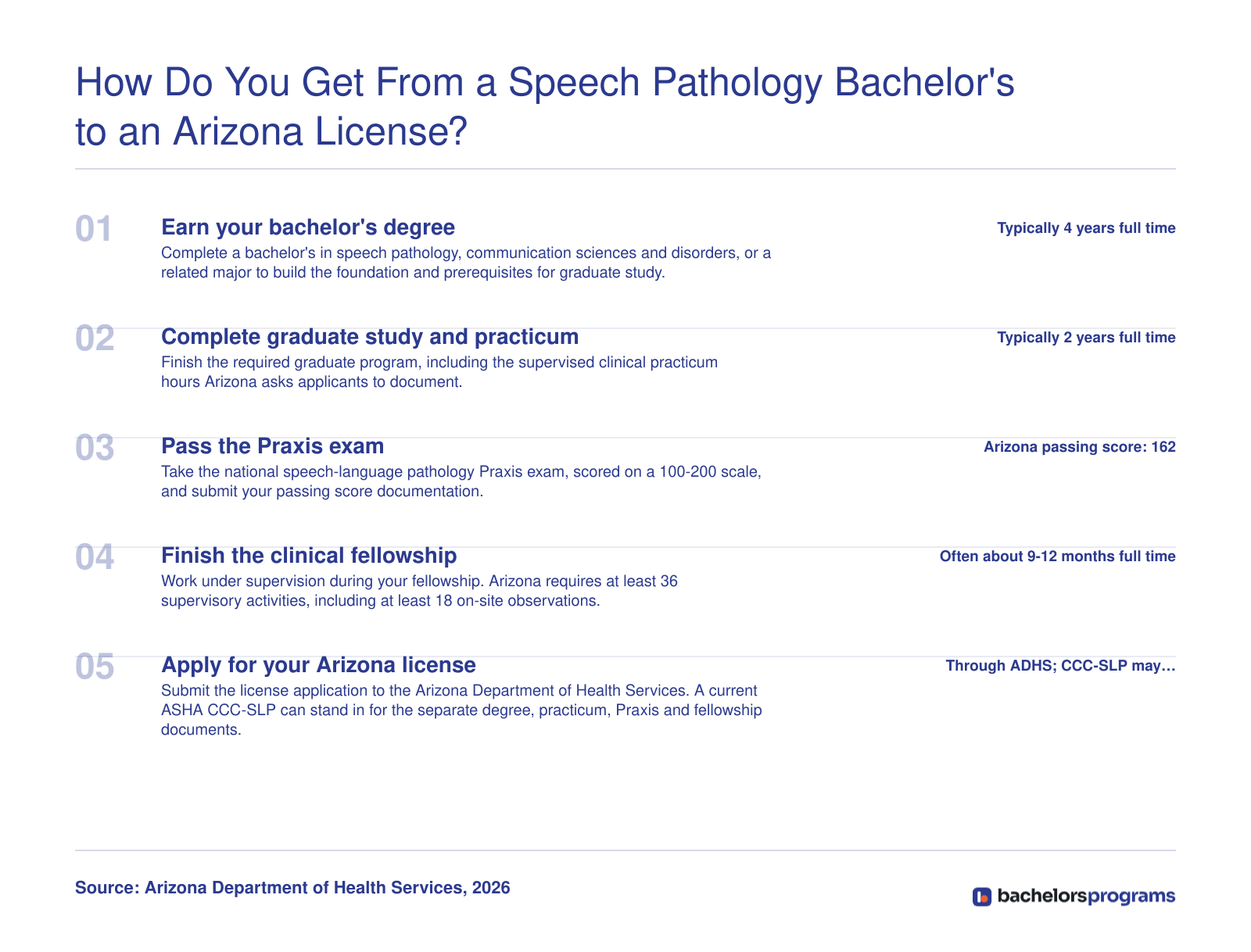
How Do You Get From a Speech Pathology Bachelor's to an Arizona License?
The bachelor's degree is the first of several steps toward licensure. For full-time students the full path typically takes about seven years from the first college semester, though timing varies by program, fellowship schedule and processing.
Choosing the Right Arizona School for Your Goals
Start With Your Situation
- Arizona resident watching the budget: The public options, the University of Arizona, Northern Arizona University and Arizona State University, typically carry lower in-state tuition than private alternatives, and each publishes a net price after aid.
- Want a traditional campus setting: Northern Arizona University in Flagstaff and the University of Arizona in Tucson offer residential campuses, while Arizona State University places you in the Phoenix metro.
- Private, faith-based preference: Grand Canyon University in Phoenix is the private choice among these schools.
- Balancing work or family: Ask each school directly whether its bachelor's in speech pathology runs on campus, online or in a hybrid format, and how clinical observation hours are arranged.
If Graduate School Is the Plan
Arizona licensure as a speech-language pathologist requires a master's degree, so the bachelor's is the pre-professional step. Look at how each program prepares you for that next application: whether it covers common prerequisite courses, whether it builds in guided observation hours, and what its advisors say about graduates moving into graduate study. Ask the department, not a general recruiter.
Next Steps
- Compare net price after aid, not sticker tuition.
- Confirm admissions requirements and transfer credit policies in writing before you apply.
- Talk with a department advisor about course sequence and fieldwork timing.
When one school's format, cost and preparation match your plans, request information from that school and start a conversation with its admissions office. That single step usually answers more than another hour of searching.
Common Questions About Speech Pathology Schools in Arizona
What is the best school for speech pathology in Arizona?
How much does speech pathology school cost in Arizona?
Can you get a speech pathology degree online in Arizona?
What bachelor's degree do you need to become a speech-language pathologist in Arizona?
How long does it take to become a speech-language pathologist in Arizona?
Compare Speech Pathology programs on the data that matters
Explore more Communications & Media majors or browse every field of study.
All Communications & Media programs Browse every field of study