Best Cybersecurity Schools in Arizona
Compare 10 accredited Cybersecurity programs in Arizona at 6 colleges, with net price after aid, graduation rates, earnings and debt from IPEDS and the U.S. College Scorecard.

Which Arizona schools offer a bachelor's degree in cybersecurity, on campus or online, with federal recognition behind it? Arizona State University, Northern Arizona University and Grand Canyon University each hold NSA/DHS designations in both cyber defense and cyber operations. That credential carries weight with the state's growing base of defense and aerospace employers.
The Bachelor of Science (B.S.) in Cybersecurity is the most common credential, yet degree titles vary. Embry-Riddle Aeronautical University-Prescott emphasizes cyber intelligence. University of Advancing Technology teaches technology forensics. ASU builds cybersecurity into computer science and engineering degrees.
Those differences matter. Similar-sounding degrees can lead to different first jobs, and tuition at public and private campuses differs sharply.
Key Points
- ASU, NAU and Grand Canyon hold NSA defense and operations designations.
- Embry-Riddle Prescott cyber intelligence graduates earned a $55,259 median after one year.
- Fully online: ASU's 120-credit IT bachelor's includes a cybersecurity concentration.
Best Cybersecurity Schools in Arizona: Ranked Bachelor's Programs
Arizona's undergraduate cybersecurity options run from a large engineering school in Tempe to a small forensics-focused campus, and the six entries below cover campus, online, and hybrid formats. Each one names the specific bachelor's degrees you can actually enroll in, what the coursework emphasizes, and the kind of student who tends to thrive there.
Northern Arizona University
#1Flagstaff, AZ · ~$14,000/yr (est.)
Best for: Arizona residents wanting mentored project-based classes
A Flagstaff public university whose cybersecurity bachelor's program leans on small classes, industry mentors, and more than 200 hours of hands-on project work. Students pair a security core with engineering principles, ethics, and data analysis, then finish with a capstone or an internship. It suits students who want a traditional residential campus and a program built around supervised practice rather than lecture alone.
- 200+ hours of hands-on experience before graduation
- Small classes with faculty who connect students to industry mentors
- Capstone projects and internship opportunities built in
- Covers engineering principles, ethics, and data analysis
- Taught by the School of Informatics, Computing and Cyber Systems
Embry-Riddle Aeronautical University-Prescott
#2Prescott, AZ · ~$40,000/yr (est.)
Best for: Aerospace and aviation security specialists
A Prescott campus built around aviation and aerospace, where cyber intelligence and security sit alongside flight and engineering programs. The degree is ABET accredited and holds the NSA's Center of Academic Excellence designation, with a dedicated Cyber Lab and a Global Security Operations Center for hands-on work. Few programs prepare students as directly to defend aircraft, drones, and mission systems against attack.
- ABET accredited, 120 credit hours over eight semesters
- NSA/DHS Center of Academic Excellence in Cyber Defense designation
- Hands-on work in the Cyber Lab and Global Security Operations Center
- Coursework in ethical hacking, malware analysis, and big data analytics
- Thesis or capstone option, plus CyberCorps Scholarship for Service eligibility
- Employer partners include Amazon, Microsoft, and NASA
Grand Canyon University
#3Phoenix, AZ · ~$22,000/yr (est.)
Best for: Working adults needing flexible online terms
A private Christian university in Phoenix that runs three separate undergraduate cyber tracks: a B.S. in Cybersecurity, an IT degree with a cybersecurity emphasis, and an applied cybersecurity management degree. Online students take seven-week classes, and up to 90 transfer credits can count toward the degree. It is the most flexible of the large Arizona options for adults balancing work and school.
- NCAE-CD designated cyber defense program
- 120 credit hours with a required capstone
- Up to 90 transfer credits accepted
- Seven-week online sessions or 15-week campus sessions
- Prepares for CompTIA Security+, Cisco CCNA, and AWS Cloud Practitioner exams
- Rooted in a Christian worldview, with industry experts visiting campus
- NCAE-CD accredited emphasis inside the IT degree
- ACT or SAT scores required for admission
- Cyber Center of Excellence lab with hands-on forensics training
- Offered both on campus and online
- Prepares students for CompTIA certification exams
- Management and leadership focus in the Colangelo College of Business
- 3.0 GPA minimum for admission
- Eight-week online terms or on-campus classes
- STEM-designated program with a pathway to a cybersecurity master's
- Covers cyber law and privacy alongside security operations
University of Advancing Technology
#4Tempe, AZ · $29,000/yr (est. net price)
A small Tempe technology school where the cyber offering is a Bachelor of Science in Technology Forensics rather than a general security degree. Coursework centers on evidence collection, network forensics, incident response, and the legal side of investigations, taught in small classes with the tools examiners actually use. The campus hosts the FBI Cyber Academy for Arizona high school students, which keeps investigative and public-sector ties close to the classroom.
- On-campus Tempe program focused on digital investigations
- Training with industry-standard forensic tools
- Coursework in computer and network forensics and incident response
- Legal and investigative sides of evidence handling covered
- Small class sizes built around real-world problem solving
- Campus hosts the FBI Cyber Academy for Arizona high schoolers
University of Phoenix-Arizona
#5Phoenix, AZ · $10,000 – $15,000/yr (est.)
An online-first university headquartered in Phoenix, built around working adults who take one five- to six-week class at a time. The cybersecurity bachelor's covers network defense, ethical hacking, cloud security, and computer forensics, with three ethical hacking courses aimed at EC-Council certification. Tuition is locked for continuing students, and prior learning plus transfer credit from thousands of institutions can shorten the degree.
- 120 credits, completable in about 47 months
- One five- to six-week class at a time, no application fee
- Three ethical hacking courses aligned to EC-Council Certified Ethical Hacker
- No SAT or ACT required for admission
- Prior learning credit and transfers from 5,000+ institutions
- Locked tuition rate plus military and employer reimbursement benefits
Arizona State University
#6Tempe, AZ · ~$15,000/yr (est.)
The largest public university in Arizona, with cybersecurity taught inside the Ira A. Fulton Schools of Engineering on the Tempe campus. Undergraduates can pursue computer science with a cybersecurity concentration or computer systems engineering with the same focus, and both sit alongside coursework certified to federal information assurance standards. It is the strongest fit for students who want a rigorous, math-heavy engineering path with research and scholarship support.
- 120 credits in the Ira A. Fulton Schools of Engineering, ABET accredited
- Cybersecurity concentration layered onto a full computer science core
- Coursework certified to NSTISSI 4011 and CNSSI 4012 standards
- NSF CyberCorps Scholarship for Service open to domestic students
- First-year admission: 3.00 GPA, 1210 SAT, or 24 ACT
- Capture-the-flag competitions and an accelerated bachelor's to master's path
- Cybersecurity concentration within the computer systems engineering degree
- Network security focus from the School of Computing and Augmented Intelligence
- Builds secure information systems and protects data integrity
- Tempe campus, undergraduate level
Cost & outcomes by school
Federal data for the highest-earning Cybersecurity programs, independent of the ranking above. Earnings are this field's bachelor's graduates four years after completing where the Scorecard reports them, else the school's undergraduate median.
| School | Net price / yr | Grad rate | Earnings | Debt | Grads/yr | Format |
|---|---|---|---|---|---|---|
| Embry-Riddle Aeronautical University-Prescott AZ | $40,287 | 68% | $98,996 | $19,500 | 23 | Campus |
| Arizona State University AZ | $14,967 | 68% | $62,668 | $19,500 | — | Campus |
| Grand Canyon University AZ | $22,472 | 44% | $57,384 | $27,000 | 43 | Online |
| Northern Arizona University AZ | $14,158 | 61% | $54,384 | $19,000 | — | Campus |
| University of Advancing Technology AZ | $28,522 | 35% | $50,719 | $28,812 | — | Campus |
| University of Phoenix-Arizona AZ | $13,520 | 21% | $37,752 | $31,553 | — | Online |
Sources: U.S. Department of Education. Net price, graduation rate, earnings and debt: College Scorecard (earnings and debt for this field's bachelor's graduates where reported, else school-wide); graduates: IPEDS. A dash means no figure is reported.
Cost, debt & payoff
Median earnings of this field's bachelor's graduates (4 yrs after completing, else the school's undergraduate median) vs. their median federal loan debt · U.S. College Scorecard
Across these programs the median graduate earns about $57,384 and finishes with roughly $23,250 in debt — a ratio that clears a common rule of thumb (keep debt below first-year salary). Net price and debt vary widely school to school, so check the per-school figures in the table above before you shortlist.
What Went Into Our Arizona Cybersecurity Rankings
A good Arizona cybersecurity program is one where students finish, pay a fair price, and move into paid work, so those three outcomes drive the ranking.
Four inputs shaped the list:
- Outcomes: College Scorecard results, including how many students complete their degree at each school.
- Net price: What students actually pay after grants and scholarships, which often differs sharply from published tuition.
- Delivery format: Whether a program is offered on campus, online, or both.
- Program-level earnings: What graduates of the specific field earn, where the federal data reports it.
Two of these measures need a caveat. Graduation rate and net price are institution-wide averages. They describe a school's whole undergraduate body, not the students in one cybersecurity major: a general signal of how a school performs, not a promise about a single program. Earnings are the exception, because they are tied to the program itself when reported.
Scope is simple. Only Arizona bachelor's programs appear here, whether you attend on campus or online through a school based in Arizona. Online programs from schools headquartered elsewhere are left out, even if they enroll Arizona residents.
Which Bachelor's Degree in Cybersecurity Fits Your Goals?
The job you want matters more than the school, because degree titles that sound alike can train for quite different work.
Broad Versus Specialized Degrees
A B.S. in Cybersecurity, offered by Northern Arizona University, Grand Canyon University and University of Phoenix-Arizona, is the broadest route. It covers defense, risk and security fundamentals, which keeps SOC analyst, cloud security and penetration testing roles open.
Embry-Riddle's B.S. in Cyber Intelligence and Security leans toward operations. The program lists a Global Security Operations Center lab, a natural fit for SOC analyst work. University of Advancing Technology's Technology Forensics degree points toward digital forensics, including evidence recovery, reporting and the legal side of investigations. IT-flavored options, such as Grand Canyon's B.S. in Information Technology with a cybersecurity emphasis, favor securing and administering systems over building them.
Inside ASU's Options
Arizona State University offers the widest range of options, and each title reflects its home discipline:
- Computer Science (Cybersecurity), BS: Tempe campus. Secure systems, network security, forensics and information assurance make it the most technical route.
- Computer Science (Cybersecurity), BA: West Valley campus. It is positioned around practical computer science.
- Information Technology (Cybersecurity), BS: Polytechnic campus, online or ASU Local. It focuses on IT security, risk assessment, network forensics, cloud security and mobile security.
- Computer Systems Engineering (Cybersecurity), BSE: An engineering degree centered on secure, reliable information systems and networks.
The Applied Computing (Cybersecurity), BS at West Valley is closed to new students, and ASU points interested applicants to the Computer Science (Cybersecurity), BA. Listed in-state tuition and fees at ASU come to $12,223, which sits close to Northern Arizona University's $13,009.
A Simple Rule of Thumb
Choose a broad B.S. in Cybersecurity if you are still deciding where to focus, and an operations- or forensics-focused degree once you know you want to work incident response or investigations.
NSA-Designated Cybersecurity Schools in Arizona
Arizona State University, Northern Arizona University and Grand Canyon University each hold current NSA/DHS designations as both a CAE in Cyber Defense (CAE-CD) and a CAE in Cyber Operations (CAE-CO), while our research did not confirm a designation for Embry-Riddle Aeronautical University-Prescott, the University of Advancing Technology or University of Phoenix-Arizona. CAE-CD recognizes accredited schools whose cybersecurity degrees or certificates meet national standards, and CAE-CO marks deeply technical programs rooted in computer science or engineering with hands-on labs, so employers, federal agencies and federally funded cybersecurity scholarship programs treat either one as a sign of a vetted curriculum. Designations belong to the institution and can be tied to specific programs, so confirm your intended bachelor's program on the NSA's current CAE list before you enroll.
| School | CAE-CD (Cyber Defense) | CAE-CO (Cyber Operations) | Notes |
|---|---|---|---|
| Arizona State University | Yes, current designation | Yes, current designation | Offers a B.S. in Computer Science (Cybersecurity) and a BSE in Computer Systems Engineering (Cybersecurity). An NSA fact sheet listed ASU as a CAE-R (research) school for 2009-2014, which does not by itself confirm a current research designation. |
| Northern Arizona University | Yes, current designation | Yes, current designation | Offers a Bachelor of Science in Cybersecurity at its Flagstaff campus. |
| Grand Canyon University | Yes, current designation | Yes, current designation | The NSA recognized GCU among newly designated or re-designated CAE schools at the November 2019 NICE conference. Offers a B.S. in Cybersecurity, a BSIT with a Cybersecurity Emphasis and a B.S. in Applied Cybersecurity Management. |
Related Articles
Online and Hybrid Cybersecurity Bachelor's Paths at Arizona Schools
ASU Online offers a 120-credit Bachelor of Science in Information Technology with a Cybersecurity concentration, delivered fully online, with a next start date of January 11, 2027. It is one of several ways to earn a cybersecurity bachelor's without relocating.
Which Programs Are Online, Campus, or Both
Formats vary across the schools here:
- Online: University of Phoenix-Arizona (B.S. in Cybersecurity) and Grand Canyon University (B.S. in Cybersecurity) are listed as online programs. GCU also runs 15-week campus sessions alongside its 7-week online sessions, so it works as an online or on-campus choice.
- Campus: Northern Arizona University, Embry-Riddle Aeronautical University-Prescott, and University of Advancing Technology are campus-based.
- Both: Arizona State University teaches its Computer Science (Cybersecurity) degree on campus in Tempe, while ASU Online delivers the IT degree with a cybersecurity concentration.
Is a Fully Online Bachelor's Possible?
Yes. ASU Online, Grand Canyon University, and University of Phoenix-Arizona each let you complete coursework online. Confirm each school's current format on its program page, since delivery details can change.
Tuition and Fees Online
ASU says 2026-27 undergraduate online tuition for most programs is $580 per credit hour plus program fees, which vary by program. The cybersecurity concentration's exact fee isn't something we can state here, so check ASU's cost page. One benefit: ASU charges no out-of-state tuition for up to 11 credit hours each semester, so residency matters less online.
A clean online-versus-campus comparison isn't possible from our figures, because ASU's campus tuition is published as an annual in-state amount rather than a per-credit rate. For reference, the program listings show $490 per credit at Grand Canyon University and $398 per credit at University of Phoenix-Arizona. Ask each school about technology or course fees before you compare totals.
A Practical Tip on Labs and Proctoring
Before enrolling, ask how hands-on labs are delivered (virtual labs are common online) and how exams are proctored. Some courses may require a webcam, a stable connection, and a quiet space for remote proctoring, so test your setup early in the first term.
Admission Requirements: GPA, Test Policy, and Transfer Credit
Arizona's cybersecurity programs publish admission rules, but which one applies to you depends on how many college credits you already hold.
What Arizona State University Publishes
ASU is the most explicit of the schools here. First-year applicants need a 3.00 cumulative high school GPA in ASU competency courses or a class rank in the top 25%, with no math or science competency deficiencies. A 1210 SAT (evidence-based reading and writing plus math) or a 24 ACT can stand in for the GPA or rank route. For the online Information Technology, Cybersecurity BS, the standard is top 25% of the graduating class or a 3.00 competency GPA; SAT and ACT are not required and are used for course placement, with ACT 22 or SAT 1120 for Arizona residents and ACT 24 or SAT 1180 for nonresidents.
Program-level transfer rules run tighter than the university's. Below 24 transferable credits, expect a 3.00 transfer GPA plus the first-year criteria. At 24 or more, the main route is a 3.00 transfer GPA, with a secondary route at 2.75 plus a 2.75 in CSE 110, CSE 205, MAT 265 and MAT 266. University transfer admission itself sits lower: 2.50 with 12 to 23 credits plus first-year requirements, 2.50 at 24 or more, and 2.00 with an associate degree or higher.1 ASU reviews transfer credit only after you apply and submit transcripts.2
Where Nothing Specific Is Published
For the other schools on this list, the admissions material we reviewed does not state a program-specific first-year GPA or SAT/ACT cutoff for the cybersecurity bachelor's. That means no policy is published at the program level, so confirm the general university standard in writing with an admissions counselor.
Transferring With an Associate Degree or Credits
Start with Arizona's statewide transfer framework. The Arizona General Education Curriculum blocks and the Course Equivalency Guide on AZTransfer let you check, course by course, what Maricopa or Pima credit counts for at a four-year school. Order official transcripts, match your completed courses against the guide, and request a written credit evaluation before you enroll.
What a Cybersecurity Bachelor's Degree Costs in Arizona
Sticker price is the published in-state tuition and fees. Average net price is what students paid after grants and scholarships, averaged across the whole institution, so treat it as a benchmark rather than a quote for the cybersecurity major or your own aid package. University of Phoenix-Arizona is the lowest-cost option here, with a $13,520 average net price. Arizona State University is the strongest value once earnings are considered: its $14,967 net price sits against $62,668 in median earnings ten years after entry, the highest earnings-to-cost ratio in the table.
| School | Program Format | Sticker Price (In-State Tuition and Fees) | Average Net Price After Aid (Institution-Wide) | Median Earnings 10 Years After Entry (All Programs) | Aid Worth Checking (Eligibility) |
|---|---|---|---|---|---|
| University of Phoenix-Arizona | Online | $9,552 ($398 per credit) | $13,520 | $37,752 | School scholarships available. Military benefits and employer tuition reimbursement are accepted. |
| Northern Arizona University | Campus | $13,009 | $14,158 | $54,384 | Access2Excellence: full tuition for Arizona residents with household income of $65,000 or less. Transfer awards: Jacks Transfer Award up to $4,000 a year, Phi Theta Kappa Award up to $4,000, Earn to Learn up to $4,000, 2NAU Scholarship $2,000, All Arizona Academic Team Scholarship 100% of tuition. |
| Arizona State University | Campus | $12,223 | $14,967 | $62,668 | Arizona Promise: covers remaining tuition and fees after other gift and merit aid, up to $14,215 a year for 2026-27, for Pell-eligible students. |
| Grand Canyon University | Online | $17,850 ($490 per credit) | $22,472 | $42,186 | School scholarships available. |
| University of Advancing Technology | Campus | $19,365 | $28,522 | $50,719 | N/A |
| Embry-Riddle Aeronautical University-Prescott | Campus | $44,149 | $40,287 | $84,131 | Military benefits accepted. |
What Arizona Cybersecurity Graduates Earn After Finishing
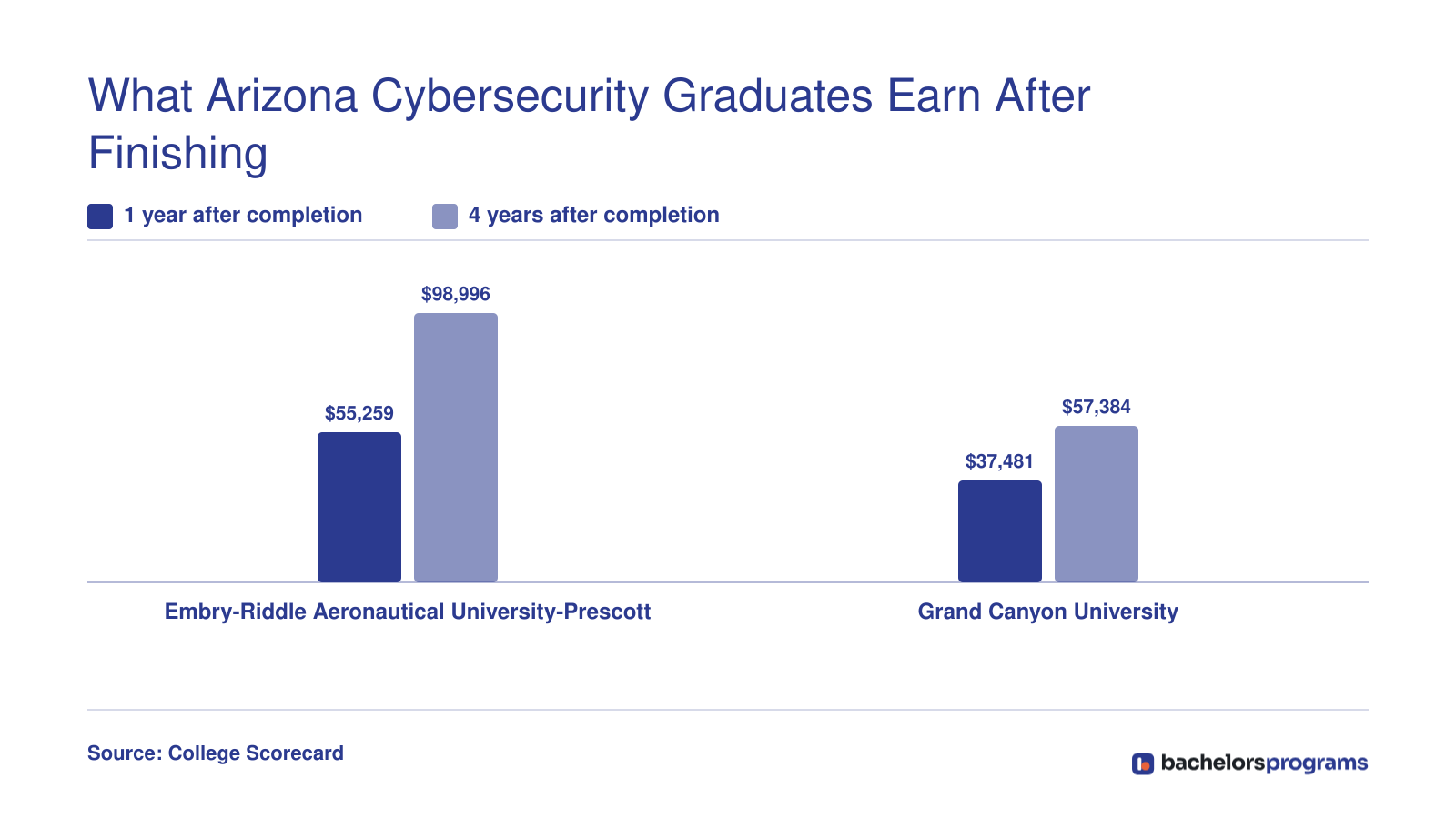
These figures come from federal College Scorecard data and track graduates of specific cybersecurity bachelor's programs, not the universities as a whole. Embry-Riddle Aeronautical University-Prescott's cyber intelligence and security graduates earned a median $55,259 one year after completion and $98,996 four years after completion. Grand Canyon University's cybersecurity graduates earned a median $37,481 at one year and $57,384 at four years, a sign that pay in this field tends to climb quickly in the first few years of a career.
Cybersecurity Careers and Pay in Arizona
Who Hires in Arizona
Arizona's cybersecurity employers span several sectors, so graduates have more than one route in.
- Defense and aerospace: Boeing is one example on Built In's 2026 list of Arizona cybersecurity companies. Entry roles include junior security analyst and vulnerability analyst, often tied to government contracts.
- Advisory and IT services: Phoenix-based firms such as Phoenix Cyber, which advises federal agencies and enterprises, and PK Tech, an independent IT-services provider, hire for SOC analyst and help desk roles with a security focus.
- Semiconductors, healthcare and finance: Chip manufacturers, health systems and banks typically hire for security operations, identity and access management, and compliance (GRC) analyst positions.
- State and local government: Public agencies recruit for network security and incident response support roles.
What the Pay Data Shows
The BLS Occupational Employment and Wage Statistics program tracks information security analysts (SOC 15-1212) for the Phoenix-Mesa-Chandler metro (Maricopa County) and the Tucson metro (Pima County). The May 2025 release is the latest, but we cannot quote the occupation-level median for each metro reliably here, so check the BLS data search directly. For context, Tucson's mean hourly wage across all occupations was $30.38 in May 2025, against $33.54 nationally. That figure covers every job, not security analysts, so treat it as a rough backdrop only.
Certifications and Where Your Degree Fits
- CompTIA Security+: The usual first credential. It has no formal prerequisites, though CompTIA recommends about two years of IT experience. Vouchers ran roughly $425 to $439 in October 2026, and one 2026 industry list says it appears in about 70% of entry-level postings. Treat that percentage as an estimate.
- CISSP: Not an entry-level credential. Most people pursue it after building security experience.
- GIAC (such as GSEC): No prerequisites, about $999 per exam attempt in 2026, and generally pitched at hands-on practitioners with some experience.
A bachelor's degree in cybersecurity gets you through résumé screens and builds the broad technical base. Certifications then show specific, verifiable skills.
No State License, but Clearances Matter
Arizona does not license cybersecurity professionals. Credentials come from certifications and, for defense work, security clearances, which an employer typically sponsors after hiring.
Quick Answers on Arizona Cybersecurity Degrees
These short answers draw on the ranked schools' published figures and federal program-level data. Check each school's current numbers before you apply.
Which Arizona cybersecurity school is best overall?
How much does a cybersecurity bachelor's degree cost in Arizona?
What is the difference between cybersecurity, cyber defense, and cyber operations degrees?
Compare Cybersecurity programs on the data that matters
Explore more Computers & IT majors or browse every field of study.
All Computers & IT programs Browse every field of study