Best Public Health Schools in California
Compare 40 accredited Public Health programs in California, with net price after aid, graduation rates, earnings and debt from IPEDS and the U.S. College Scorecard.

California's 61 local health departments hire graduates who mostly hold one credential: the Bachelor of Science (B.S.) in Public Health. The bachelor's degree in public health covers epidemiology, biostatistics, health policy, and environmental health, and most programs require a practicum in an agency.
The same major carries different net prices across UC and CSU campuses, and CEPH accreditation is granted program by program, so identical degree titles are not identical credentials.
Public health hiring in California runs through county departments and nonprofit clinics, whether the degree was earned on campus or online, and a practicum placement often carries more weight than the diploma itself.
Key Points
- San Jose State's online Public Health, BS is a degree completion route.
- The University of California sets a 3.0 minimum GPA for residents.
- CEPH accreditation reviews the public health program itself, not the whole university.
Best Schools for a Bachelor's Degree in Public Health in California
The strongest bachelor's programs in public health in California share a few traits: a curriculum that covers epidemiology, biostatistics, health policy, and environmental health; a required practicum or capstone that puts students inside real agencies; and a clear route into either entry-level public health work or graduate study. Six of the ten schools below hold CEPH accreditation for the public health major, and the rest follow ASPPH-aligned coursework. Net price and graduation rates on each card are the school's average across the whole institution, not results for the public health major.
University of California-Berkeley
#1Berkeley, CA · ~$13,000/yr (est.)
Best for: Future researchers drawn to honors thesis work
UC Berkeley anchors this list with a CEPH-accredited public health major inside a large, research-intensive school of public health. Undergraduates complete a senior capstone, may add an honors thesis, and can apply to a 4+1 pathway that leads to a Master of Public Health. Admission is the most selective here, and the campus reports the school's average net price and graduation rate for the whole university rather than the major.
- CEPH-accredited public health major
- Senior capstone required, with several capstone options
- Optional undergraduate honors thesis
- 4+1 pathway into the Master of Public Health
- Study abroad coursework counts toward electives
- Student-facilitated DeCal courses for peer teaching
University of California-San Diego
#2La Jolla, CA · $10,000 – $15,000/yr (est.)
Best for: Pre-health students seeking a health sciences focus
UC San Diego offers its public health bachelor's through the Herbert Wertheim School of Public Health and Human Longevity Science, and it is the only undergraduate major offered by UC San Diego Health Sciences. Students pair coursework with internships, research placements, study abroad, and a capstone or honors practicum. Net price and graduation figures are the school's averages for the entire campus.
- Only undergraduate program in UC San Diego Health Sciences
- Internships, research placements, and study abroad available
- Honors Practicum option alongside the standard capstone
- Capstone and honors posters recognized with awards
- Advising from orientation through graduation
- Quarterly course enrollment and offerings
University of California-Los Angeles
#3Los Angeles, CA · $13,000/yr (est. net price)
Best for: Health equity advocates wanting a science-intensive BS
UCLA's Fielding School of Public Health runs a four-year, cohort-based Bachelor of Science built on the Life Sciences Core, which separates it from a Bachelor of Arts route. A two-quarter capstone and a required community engagement course put students in working public health settings before graduation. Admission is highly selective, and the net price and graduation rate shown are the university's averages.
- Four-year, cohort-based program of 180 credit hours
- Two-quarter capstone experience required
- Required community engagement course links theory to practice
- Science-intensive Life Sciences Core distinguishes it from the B.A.
- 2.0 GPA minimum plus prerequisite coursework
- Onsite weekday classes
University of California-Irvine
#4Irvine, CA · $14,000/yr (est. net price)
UC Irvine teaches public health sciences inside the Joe C. Wen School of Population and Public Health, pairing biology and chemistry with epidemiology, biostatistics, health policy, and environmental health. A 100-hour practicum places every student in an agency, nonprofit, or laboratory. Premedical students can shape electives toward professional school requirements.
- CEPH-accredited public health sciences major
- Required community practicum of 100 hours
- Multidisciplinary training across epidemiology and policy
- Premedical preparation possible within the major
- Student organizations and honors research available
- Peer academic advisors and career advising
California Polytechnic State University-San Luis Obispo
#5San Luis Obispo, CA · ~$17,000/yr (est.)
Cal Poly runs its public health bachelor's on the university's Learn by Doing model, with field experience, hands-on classes, and undergraduate research alongside faculty. Four concentrations let students aim at community health, culture and society, physical activity, or worksite and university health promotion. The degree prepares students for the CHES credential and for graduate study in public health, nursing, physician assistant studies, or occupational therapy.
- Four concentration options, from community health to worksite wellness
- Learn by Doing field experience and hands-on classes
- Undergraduate research with faculty
- Prepares students for the CHES exam
- Curriculum aligns with ASPPH undergraduate criteria
- Springboard to MPH, nursing, PA, and occupational therapy
California State University-Fullerton
#6Fullerton, CA · $7,000 – $20,000/yr (est.)
Cal State Fullerton's CEPH-accredited program centers on health education and promotion for vulnerable populations, with cultural competency built into the coursework. The 120-unit degree includes 55 units of major coursework and an applied internship. The school's average net price is among the lowest of the ten, and its graduation rate is a campus-wide figure.
- CEPH-accredited public health major
- Health Education and Promotion concentration
- 120 units total, including 55 units of major coursework
- Applied internship in health science required
- Emphasis on vulnerable populations and cultural competency
- Socioecological approach to planning and evaluating programs
University of California-Merced
#7Merced, CA · $16,000 – $50,000/yr (est.)
UC Merced offers both a Bachelor of Arts and a Bachelor of Science in Public Health, and the B.S. track includes a pre-med emphasis for students heading into clinical careers. The major requires at least 56 units and covers epidemiology, biostatistics, health communication, environmental health, and the U.S. health care system. Transfer students can follow the IGETC pattern, and the campus admits most applicants.
- Major requires at least 56 units
- B.S. pathway includes a pre-med emphasis
- Core covers epidemiology, biostatistics, and health communication
- Transfer students can follow the IGETC pattern
- Electives span health policy, social epidemiology, and nutrition
- Prerequisite courses required
San Jose State University
#8San Jose, CA · ~$14,000/yr (est.)
San José State offers the fully online route on this list: a CEPH-accredited Bachelor of Science in Public Health designed as a degree completion program for students who bring at least 60 transferable units. Core courses run in both synchronous and asynchronous formats, which suits working adults. The curriculum centers on documenting and improving community health and on closing health disparities.
- Degree completion program for students with 60+ transferable units
- Synchronous and asynchronous class formats
- Core courses require a grade of C or better
- Focus on eliminating health disparities
- Capstone required within 120 total credit hours
- Option to add a minor or electives
California State University-Stanislaus
#9Turlock, CA · ~$6,000/yr (est.)
Stanislaus State awards a Bachelor of Science in Public Health Promotion built on an ecological framework that ties health outcomes to social and physical conditions. A final-semester practicum and behavior-change coursework prepare students for the national CHES exam. The campus admits most applicants, and the school's average net price is among the lowest of the ten.
- Prepares students for the national CHES exam
- Final-semester practicum in a real-world setting
- Behavior-change theory applied to program design
- Ecological framework covering social and physical determinants
- Program planning, implementation, and evaluation coursework
- Faculty advisors focused on social justice and advocacy
California State University-Northridge
#10Northridge, CA · ~$7,000/yr (est.)
Cal State Northridge's CEPH-accredited Bachelor of Science in Public Health trains students to plan, implement, and evaluate health and human service programs. The degree sits in the Department of Health Sciences within the College of Health and Human Development, and the coursework leans on practical application. Its Northridge location puts students near a wide range of Southern California public health agencies and community organizations.
- CEPH-accredited public health major
- Plan, implement, and evaluate health and human service programs
- Offered by the Department of Health Sciences
- Housed in the College of Health and Human Development
- Curriculum emphasizes practical, real-world application
- Access to public health organizations across Southern California
Cost & outcomes by school
Federal data for the highest-earning Public Health programs, independent of the ranking above. Earnings are this field's bachelor's graduates four years after completing where the Scorecard reports them, else the school's undergraduate median.
| School | Net price / yr | Grad rate | Earnings | Debt | Grads/yr | Format |
|---|---|---|---|---|---|---|
| Santa Clara University CA | $50,062 | 88% | $109,183 | $24,500 | 72 | Campus |
| West Coast University-Anaheim-Orange County CA | $32,879 | 60% | $102,672 | $32,946 | 5 | Online |
| West Coast University-Center for Graduate Studies CA | — | — | $102,672 | $32,946 | — | Online |
| West Coast University-Ontario CA | $49,590 | 39% | $102,672 | $32,946 | — | Online |
| California Polytechnic State University-San Luis Obispo CA | $16,665 | 86% | $90,768 | $18,500 | 55 | Campus |
| Loma Linda University CA | — | — | $89,816 | $20,854 | — | Campus |
| University of San Francisco CA | $41,431 | 70% | $89,812 | $23,000 | 7 | Campus |
| Charles R Drew University of Medicine and Science CA | $35,558 | 30% | $83,438 | $18,750 | 5 | Campus |
| University of California-Los Angeles CA | $12,548 | 93% | $82,511 | $14,000 | 32 | Campus |
| San Jose State University CA | $13,760 | 69% | $78,988 | $15,000 | 162 | Online |
| Saint Mary's College of California CA | $30,378 | 70% | $78,812 | $23,691 | — | Campus |
| University of the Pacific CA | $25,447 | 69% | $78,445 | $19,500 | 9 | Campus |
Sources: U.S. Department of Education. Net price, graduation rate, earnings and debt: College Scorecard (earnings and debt for this field's bachelor's graduates where reported, else school-wide); graduates: IPEDS. A dash means no figure is reported.
Cost, debt & payoff
Median earnings of this field's bachelor's graduates (4 yrs after completing, else the school's undergraduate median) vs. their median federal loan debt · U.S. College Scorecard
Across these programs the median graduate earns about $68,077 and finishes with roughly $16,907 in debt — a ratio that clears a common rule of thumb (keep debt below first-year salary). Net price and debt vary widely school to school, so check the per-school figures in the table above before you shortlist.
Most Affordable Bachelor's in Public Health Schools in California
The net price below is the average amount full-time undergraduates paid in a year after grants and scholarships, as reported in the U.S. Department of Education's IPEDS and College Scorecard data. Because it is an average across students at every income level, your own cost could be higher or lower once your financial aid offer arrives. Tuition and fees are the published in-state rates, and graduation rates are for each school overall, not the public health major alone.
| School | City | Average Net Price | In-State Tuition and Fees | Graduation Rate | Format |
|---|---|---|---|---|---|
| California State University-Los Angeles | Los Angeles | $3,967 | $7,160 | 53% | Campus |
| California State University-San Bernardino | San Bernardino | $4,564 | $8,093 | 55% | Campus |
| California State University-Bakersfield | Bakersfield | $5,652 | $8,090 | 50% | Campus |
| California State University-Stanislaus | Turlock | $6,067 | $8,246 | 53% | Campus |
| California State University-Fullerton | Fullerton | $6,555 | $7,470 | 70% | Campus |
Which California Public Health Bachelor's Programs Are CEPH-Accredited?
Program-level accreditation from the Council on Education for Public Health (CEPH) is a separate credential from a university's regional accreditation, and many applicants confuse the two. Regional accreditation covers the whole institution. CEPH reviews a specific public health program against professional standards for curriculum and outcomes. At the bachelor's level it signals that the degree meets a recognized benchmark, which can matter if you plan to pursue graduate study or certain employers' hiring preferences.
Programs With Bachelor's-Level Accreditation
CEPH's accredited list and university announcements identify these ranked schools as having an accredited undergraduate program:
- California State University-Chico: Its standalone baccalaureate program (listed under health education) is accredited through December 31, 2028.
- California State University-Northridge: The B.S. in Public Health was accredited in 2019,1 with the list showing July 1, 2026. The university reports a May 2026 site visit has been completed.
- California State University-San Bernardino: The B.S. in Public Health appears on the CEPH list through September 30, 2026, and the university identifies the four-year degree as CEPH-accredited.
Because the Northridge and San Bernardino dates have now passed, confirm their current status before you apply.
Where Undergraduate Accreditation Is Not Listed
UC Berkeley and UCLA are home to CEPH-accredited schools of public health, but a bachelor's-level program is not established in the listing.3 The same goes for UC Irvine. San Jose State's CEPH accreditation applies to its graduate program, not its B.S.2 This does not mean these degrees are weak. It means CEPH accreditation is not confirmed for the undergraduate major.
How to Verify Before Applying
Search CEPH's own list of accredited schools and programs, and check the degree level and the accreditation end date. If a school is not listed, ask its admissions office directly whether the bachelor's program is accredited or in the process of applying.
Related Articles
Online and Hybrid Bachelor's in Public Health Options at California Schools
Fully Online: San Jose State University
Among the schools ranked here, San Jose State University offers the fully online route to a bachelor's degree in public health. Its Public Health, BS is a degree completion program. You bring 60 transferable units and finish the remaining 60 online, normally in about two years. Courses run in 8-week blocks across five terms a year, with both synchronous and asynchronous options, and a capstone is required. Expect a 2.0 GPA minimum, prerequisite courses, and a C or better in core courses.
Hybrid: Cal State San Bernardino
California State University-San Bernardino offers its Public Health BS in a hybrid format tied to the San Bernardino campus. The school does not spell out how often hybrid students must attend in person. Ask the department for a term-by-term schedule before you commit.
Campus Programs with In-Person Requirements
Every other ranked program is campus-based, and several build in-person work into the degree:
- UC Irvine: Requires a community practicum and lists 100 clinical hours.
- UCLA: Holds onsite weekday classes.
- Cal State Fullerton: Includes an internship.
- Stanislaus State: Places a practicum in the final semester.
Who Online Suits and What to Confirm
SJSU's format fits working adults and community college transfer students who have already finished their general education. It is not a starting point for first-time freshmen.
Before enrolling, confirm these points with the program:
- Whether the capstone involves local fieldwork or any in-person component
- How your existing units count toward the 60-unit transfer requirement
- Whether SJSU can accept students from your state if you live outside California
Admissions for California Bachelor's in Public Health Programs
Admission to a California public health program depends on the system you apply to and the campus's own major requirements, not just a statewide GPA floor.
GPA and Test Policy
The University of California sets a minimum 3.0 GPA for California-resident first-year applicants and 3.4 for nonresidents.1 Meeting it does not guarantee admission, and individual campuses often admit well above it. Some programs add their own floor: UCLA's public health major lists a 2.0 minimum, and San Jose State's online degree-completion program lists the same. UC states no current first-year SAT/ACT policy; the Entry Level Writing requirement can be met with an ACT English Language Arts score of 30 or an SAT EBRW of 680 (digital SAT Reading/Writing is not approved for it).3 For CSU campuses and private schools, no comparable GPA or test policy surfaced, so check each admissions page directly.
Selectivity by System
Admission rates differ sharply. UCLA admits about 9 percent and Berkeley about 11 percent, while UC San Diego (27 percent), UC Irvine (29 percent) and Cal Poly San Luis Obispo (31 percent) are somewhat more open. CSU campuses such as Fullerton (91 percent), Northridge (93 percent), San Jose State (85 percent) and Stanislaus (98 percent) admit most applicants, as does UC Merced at 91 percent. Even so, some majors at CSU and UC campuses are impacted or carry extra requirements, so confirm the major-specific rules. UC's fall filing window has traditionally closed at the end of November, so verify current dates now.5
Transfer Pathways
California community college students receive priority consideration for UC junior-level transfer.6 UC requires 60 semester units, good academic standing, and a seven-course pattern with a C or better in each course, and publishes minimum GPAs of 2.4 for residents and 2.8 for nonresidents.2 A D can count toward units but not the pattern. Use ASSIST to see which courses transfer4; IGETC is not a minimum admission requirement. UC Merced's quick reference lists a 3.0 GPA for Public Health transfer, so confirm it with the campus. UC Transfer Pathways may not cover every public health major. San Jose State's online program requires 60 transferable units.
One Practical Tip
Complete the major's prerequisite courses, typically biology and statistics, with strong grades before you apply. They signal readiness and are often the deciding factor.
Cost of a Bachelor's in Public Health in California
The published tuition price is not what most California students pursuing a bachelor's degree in public health pay, and comparing sticker prices without net price is the most common cost mistake.
Sticker Price vs. Net Price
Private schools show how far the two numbers can diverge. Santa Clara University publishes tuition of $61,293, but its average net price after aid is about $50,062. Biola University lists $48,984 and lands near $31,495. Public universities generally post lower in-state tuition and lower net prices than private ones, but the sector gap is an approximate average, not a promise: a strong aid package at a private campus can beat a thin one at a public campus.
California Aid That Lowers the Bill
Cal Grant A pays up to $15,588 at UC, $6,838 at CSU, $9,358 at qualifying nonprofit institutions, and $8,056 at WASC-accredited for-profits for 2026-27, for up to four years.1 It requires a 3.0 GPA and, for 2025-26, a dependent family-of-four income below $135,900. Cal Grant B uses a 2.0 GPA and a $71,500 income cap; its access award is $1,648 for students without dependents and $6,000 for those with dependents or foster youth, alongside the tuition award in later years.1 The Middle Class Scholarship covers 23% of remaining need for most eligible students for up to four years, with an income ceiling up to $234,000.3 UC and CSU campuses also award their own institutional grants.
Practical Ways to Lower the Cost
- Meet the priority deadline: File the FAFSA or California Dream Act Application by March 2.2 The September 2 Cal Grant deadline is only for community college students enrolled by that date.
- Start at a community college: Complete transfer requirements, then finish the bachelor's at a CSU or UC campus.
- Protect your GPA and apply locally: Cal Grant A needs a 3.0, and campus or departmental scholarships often require a separate application.
Public Health Bachelor's Careers and Salaries in California
A public health bachelor's can lead straight into a county health department or toward a management track, and the two paths differ in title, pay, and how soon graduate study matters.
Common California Job Paths
- Health education specialist: Plans and delivers prevention programs for county health departments, nonprofits, hospitals, and health plans. A bachelor's degree is the typical entry credential.1
- Community health worker: Provides outreach, navigation, and health coaching through community clinics, nonprofits, and public agencies. BLS lists a high school diploma as typical, so treat this as a related entry role rather than a bachelor's-only job.2
- Program coordinator: Manages schedules, budgets, and outreach for public health programs at county agencies, health systems, and community organizations.
What the Wage Data Shows
National BLS medians for May 2025 put health education specialists at $64,070, community health workers at $51,850, and medical and health services managers at $123,860. The manager figure covers the full occupation, not entry-level pay. BLS projects 6% growth for health education specialists, 13% for community health workers, and 24% for medical and health services managers from 2025 to 2035. California-specific data are thinner: the BLS state extract reports 8,270 health education specialist jobs at a May 2022 average of $74,700.3 That is an older state average, not a current median, so use it as a broad benchmark. Pay also varies by region and employer.
Graduate Earnings vs. Occupational Wages
The earnings figures in the ranking above are graduate outcomes, measured for people who completed a particular program. Occupational wages describe everyone in a job title, from new hires to veterans. Use the graduate figures to compare programs and the occupational medians to understand a role's pay range; do not treat them as the same number.
Some graduates go on to a master's in public health or a related field, especially for epidemiology, biostatistics, or management roles.
California Wages for Public Health Education Roles
This page does not report a California statewide median for health education specialists. Use the national figure below as a reference point, then look up the state number yourself.
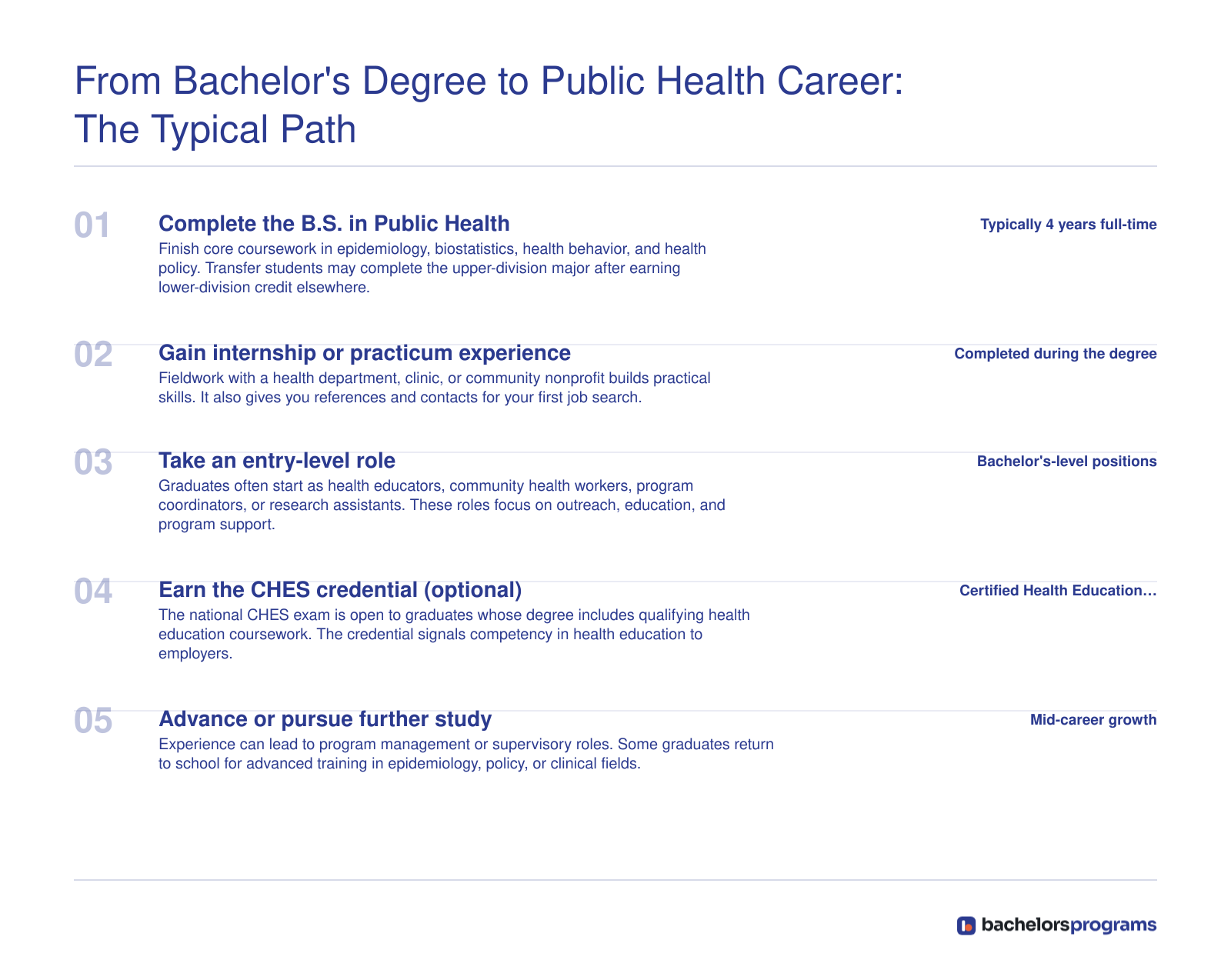
From Bachelor's Degree to Public Health Career: The Typical Path
Most public health careers in California follow a similar order, whether you study on campus or online. The path below shows how a bachelor's degree in public health typically turns into a first job and a long-term career.
Compare Public Health programs on the data that matters
Explore more Healthcare majors or browse every field of study.
All Healthcare programs Browse every field of study