Best Criminal Justice Schools in California
Compare 40 accredited Criminal Justice programs in California at 34 colleges, with net price after aid, graduation rates, earnings and debt from IPEDS and the U.S. College Scorecard.

California's criminal justice field is credential-specific: a degree does not license a peace officer, the POST academy does. What a bachelor's degree in criminal justice in California does is clear the education requirement for policing, probation, corrections, forensic and legal-support work, usually as a Bachelor of Science (B.S.) in Criminal Justice.
The practical question is cost against format. A CSU campus and a private college can both get you there; net price after aid is what separates them, sometimes by tens of thousands over four years.
Whatever the campus, the hiring standard sits outside the classroom.
Key Points
- San Diego State University ranks first among California criminal justice schools.
- California State University-Los Angeles leads on net price at $3,967 a year.
- Want online study? Point Loma Nazarene and California Baptist offer criminal justice B.A.s.
Best Bachelor's Degree in Criminal Justice Schools in California: Our Top 10
San Diego State University takes the top spot as the best criminal justice school in California, and it is also the strongest CSU option here: a Bachelor of Science in Criminal Justice from the School of Public Affairs, a 76 percent institution-wide graduation rate, and an average net price after aid of roughly $15,400 a year. Below are the ten California programs that stood out, each with the details that matter most, from delivery format and concentrations to what students actually pay.
San Diego State University
#1San Diego, CA · $15,000/yr (est. net price)
Best for: High-achieving students targeting a selective university
The strongest overall package in the state for this major. Criminal justice here is a Bachelor of Science housed in the School of Public Affairs, and the same degree runs at the San Diego campus, SDSU Imperial Valley and SDSU Global Campus, so transfer students can finish without coming to campus. It is the most selective CSU in this group, admitting about 36 percent of applicants, and the institution-wide graduation rate is 76 percent. The average net price after aid is about $15,400 a year.
- Bachelor of Science from the School of Public Affairs
- Also offered at SDSU Imperial Valley and SDSU Global Campus
- Global Campus completion pathway can take as little as 15 months
- Sample courses include Crime, Law, and Justice and Juvenile Justice
- Exchanges at Edinburgh Napier and Berlin School of Economics and Law
- Internships available; graduates enter law enforcement, probation and corrections
- Prepares students for law school or graduate study
California State University-Fullerton
#2Fullerton, CA · $7,000 – $20,000/yr (est.)
Best for: Cost-focused students wanting a straightforward degree map
Fullerton runs a Bachelor of Arts in Criminal Justice with an unusually clear unit map: 120 units total, 18 in required criminal justice courses and 15 in electives, at least nine of them at the 400 level. It is the most accessible of the large CSU programs here, admitting about 90 percent of applicants, and its institution-wide graduation rate of 70 percent is second only to San Diego State on this list. The average net price after aid is about $6,600 a year.
- 120 units total, including 18 units of required criminal justice courses
- 15 units of electives, at least 9 at the 400 level
- 12 units of related fields, waived for a minor or second major
- 3-unit upper-division writing requirement
- C- or better in every criminal justice course
- Minimum 2.0 GPA in the major
California State University-Long Beach
#3Long Beach, CA · $7,000 – $20,000/yr (est.)
Best for: Working adults in the online completion track
Long Beach offers a Bachelor of Science in Criminology and Criminal Justice whose online completion track is built for working students: a cohort-based, asynchronous program of 61 units over 21 months at $425 per unit. Admission requires 60 transferable lower-division units, the lower-division general education pattern and a 3.0 GPA, and the track does not enroll out-of-state students. The institution-wide graduation rate is 69 percent and the average net price after aid is about $10,400.
- $425 per unit; total program cost about $22,100 to $25,925
- 61 units over 21 months in a full-time cohort
- Asynchronous online classes year round; no campus attendance required
- Requires 60 transferable units, lower-division general education and a 3.0 GPA
- April 1 application deadline with a fall start
- Military benefits accepted; out-of-state students not eligible
Humphreys University
#4Stockton, CA · $6,000/yr (est. net price)
A small private university in Stockton, Humphreys keeps its Bachelor of Science in Criminal Justice practical: 11-week quarters, four start dates a year, and classes in person, online or virtual, with faculty drawn from law enforcement, the courts and corrections. Students who transfer in an associate degree can finish in about two years, and some agencies reimburse tuition for employees pursuing a degree. Undergraduate tuition is $375 per unit, and the average net price after aid is about $35,500, the highest on this list. The institution-wide graduation rate is 62 percent.
- $375 per unit; 12 to 16 units billed at the 12-unit rate
- 11-week quarters with four start dates a year
- Transfer an associate degree and finish in roughly two years
- On-campus, online and virtual formats
- Employer tuition reimbursement supported; FAFSA code 001212
- Faculty drawn from law enforcement, the courts and corrections
- Credit given for officer experience
California State University-Sacramento
#5Sacramento, CA · $8,000 – $21,000/yr (est.)
Sacramento State's B.S. in Criminal Justice is a 60-unit major inside a 120-unit degree, and it is officially impacted, which means students complete the lower-division prerequisites before they apply. The upper-division core covers research methods, courts, law of arrest and search and seizure, corrections and police in society, with 24 elective units drawn from five areas including investigation, corrections and law. The institution-wide graduation rate is 56 percent and the average net price after aid is about $9,300.
- 60 units in the major within a 120-unit degree
- Complete CRJ 1, 2, 4 and 5 with a C or better before applying
- Program is officially impacted; faculty advisor assigned at admission
- 24 elective units across five areas, including investigation and law
- C- or better in upper-division major courses and a 2.0 major GPA
- Approved minor replaces 12 elective units
- Four-year and two-year roadmaps published
California State University-Northridge
#6Northridge, CA · ~$7,000/yr (est.)
CSUN's degree is a Bachelor of Arts in Criminology and Justice Studies: 49 units in the major, 43 in general education, and an internship or applied research course built in. Coursework runs from criminal law and ethics to criminological theory, statistics and cross-cultural perspectives on crime, and the campus accepts the AA-T in Administration of Justice for transfer. Admissions are broad, with about a 93 percent acceptance rate, the institution-wide graduation rate is 57 percent, and the average net price after aid is about $7,000.
- 49 units in the major, 43 in general education, 120 total
- Applied research or internship course required
- AA-T in Administration of Justice accepted for transfer
- Coursework in criminal law and ethics, theory, statistics and victimization
- Cross-cultural and global crime perspectives
- Cannot double major with the Sociology criminology option
California State University-Los Angeles
#7Los Angeles, CA · ~$4,000/yr (est.)
Cal State LA awards a B.S. in Criminal Justice at its main campus, with 60 of the 120 units inside the major: a 21-unit lower-division core, 24 upper-division units and 15 units of electives. Upper-division courses are restricted to declared majors and CRIM 3010 is the gate, and two grades of C- or lower in core courses force a change of major. The average net price after aid is about $4,000, the lowest on this list, and the institution-wide graduation rate is 53 percent.
- 60 units in the major, 120 total
- 21-unit lower-division core plus 24 upper-division criminal justice units
- 9 units of selected electives and 6 units of directed electives
- CRIM 3010 is a prerequisite for all upper-division courses
- Upper-division courses restricted to declared criminal justice majors
- Two grades of C- or lower in core courses force a change of major
California State University-San Bernardino
#8San Bernardino, CA · $4,600/yr (est. net price)
Cal State San Bernardino delivers its Bachelor of Arts in Criminal Justice completely online through the College of Extended and Global Education, with 45 of the 120 units in the major and electives covering victimology, gangs, white collar crime and domestic violence. The department also runs a separate B.S. in Intelligence and Crime Analysis for students who want an analytics-focused route into public safety. Admissions are close to open, with about a 94 percent acceptance rate; the institution-wide graduation rate is 55 percent and the average net price after aid is about $4,600.
- Delivered fully online through the College of Extended and Global Education
- 45 units in the major within a 120-unit degree
- Electives include victimology, gangs, white collar crime and domestic violence
- C or better required in core courses
- Up to 9 transfer units may count toward electives
- Internship, independent study and senior honors project options
- A required course may be taken three times before changing majors
California State University-Stanislaus
#9Turlock, CA · ~$6,000/yr (est.)
Stanislaus State offers the widest menu of specializations in this group: a B.A. in Criminal Justice with concentrations in corrections, criminal legal studies, juvenile justice, law enforcement and forensic science, plus a criminal justice minor. Faculty can waive up to nine upper-division units for documented coursework or work experience, which matters for students arriving from a police academy or a community college. The average net price after aid is about $6,100 and the institution-wide graduation rate is 53 percent.
- Five concentrations: corrections, criminal legal studies, juvenile justice, law enforcement, forensic science
- Up to 9 upper-division units waived for documented coursework or work experience
- 23 units of core coursework plus 43 units of general education
- Internships in forensic science and law enforcement
- Criminal justice minor available
- 19-unit concentration covering corrections administration and juvenile corrections
- Constitutional rights of prisoners plus probation and parole courses
- 6 units of electives from domestic violence, organized crime and terrorism
- 15 lower-division prerequisite units before the core
- Two electives, 6 units minimum, paired with the 23-unit core
- 43 units of general education required
- 30 semester units must be completed at Stanislaus State
- 120 total credit hours to graduate
- 19 units of concentration coursework
- Minor not required to graduate
- Recommended general education courses for criminal justice majors
- Graduation requires advisor and department chair approval
- 65-unit major, the largest of the department's concentrations
- 25 to 27 units in the forensic science concentration
- 48 upper-division units required
- C- or better in every major course; 2.0 GPA
California State University-Chico
#10Chico, CA · ~$14,000/yr (est.)
Chico State's B.A. in Criminal Justice is taught on campus in small, discussion-based classes that run from ethics and crime prevention to restorative justice, and the department pairs with political science for students aiming at law or policy work. Undergraduates can join the Criminal Justice Student Association, take volunteer and internship placements, and work as faculty research assistants presenting at the department's biannual symposium. The institution-wide graduation rate is 63 percent and the average net price after aid is about $14,500.
- Small, discussion-based classes
- Topics include ethics, crime prevention and restorative justice
- Pairs with political science for pre-law and policy pathways
- Criminal Justice Student Association for undergraduates
- Faculty research assistant positions and a biannual Research Symposium
- Volunteer and internship placements available
Cost & outcomes by school
Federal data for the highest-earning Criminal Justice programs, independent of the ranking above. Earnings are this field's bachelor's graduates four years after completing where the Scorecard reports them, else the school's undergraduate median.
| School | Net price / yr | Grad rate | Earnings | Debt | Grads/yr | Format |
|---|---|---|---|---|---|---|
| National University CA | $22,878 | 43% | $81,299 | $25,000 | 131 | Online or campus |
| Mount Saint Mary's University CA | $21,413 | 53% | $72,379 | $25,949 | — | Online or campus |
| Sonoma State University CA | $12,885 | 58% | $66,892 | $20,000 | 52 | Campus |
| Azusa Pacific University CA | $22,212 | 62% | $66,677 | $20,375 | 19 | Campus |
| University of Massachusetts Global CA | $32,654 | 43% | $65,703 | $24,276 | 11 | Online |
| Woodbury University CA | $33,692 | 60% | $65,668 | $26,960 | 3 | Campus |
| California Baptist University CA | $26,285 | 62% | $65,603 | $26,000 | 65 | Campus |
| California State University-East Bay CA | $9,320 | 48% | $64,835 | $15,000 | 117 | Campus |
| San Francisco State University CA | $12,278 | 50% | $63,764 | $14,992 | 176 | Campus |
| California Lutheran University CA | $30,109 | 70% | $63,433 | $20,000 | 5 | Campus |
| California State University-San Marcos CA | $10,229 | 55% | $62,908 | $17,350 | — | Online |
| California State University-Sacramento CA | $9,338 | 56% | $62,583 | $13,138 | 471 | Online or campus |
Sources: U.S. Department of Education. Net price, graduation rate, earnings and debt: College Scorecard (earnings and debt for this field's bachelor's graduates where reported, else school-wide); graduates: IPEDS. A dash means no figure is reported.
Cost, debt & payoff
Median earnings of this field's bachelor's graduates (4 yrs after completing, else the school's undergraduate median) vs. their median federal loan debt · U.S. College Scorecard
Across these programs the median graduate earns about $58,305 and finishes with roughly $17,350 in debt — a ratio that clears a common rule of thumb (keep debt below first-year salary). Net price and debt vary widely school to school, so check the per-school figures in the table above before you shortlist.
How We Ranked California Bachelor's in Criminal Justice Programs
A ranking is only useful if you know what it measures. The order rests on four measures, and knowing which one applies to your situation is the point.
Where the numbers come from
Cost, completion, earnings and retention figures come from the federal College Scorecard and the IPEDS data collection. The Scorecard figures are a snapshot from the most recent federal release, which trails the current year, so earnings and completion describe recent graduating classes rather than a live 2026 reading. Expect small year-to-year shifts when the next release lands.
What the order reflects
Four measures carry the weight: what students actually pay, whether they finish, what they earn after graduating, and whether first-year students come back. No single measure decides the order on its own. The pool covers only bachelor's-level criminal justice and closely related programs at California schools, taught on campus or online.
Two caveats worth knowing
- Institution-wide figures: Graduation rate and net price are reported for the whole university, not the criminal justice department. A strong program inside a large public university inherits that university's overall numbers.
- Net price is a sector average: It reflects the typical student in that type of school after grant aid, so treat it as a benchmark rather than a quote for your own bill.
How to use it
Sort by the measure that matches your situation. If you are paying your own way, cost and net price should outweigh a few places in the order. If you are aiming at a state or local agency, completion and earnings deserve more weight. The most affordable list and the earnings list each pull out a different slice of the same schools, so check both before you commit. Think of the top spot as one strong option, not a verdict for every student.
Most Affordable Criminal Justice Schools in California
Net price, what a student actually pays after grants and scholarships, is the clearest way to compare cost, and California State University-Los Angeles leads at $3,967 a year. Most of these lower-cost options are California State University campuses charging roughly $7,000 to $8,300 in annual in-state tuition and fees, while private Humphreys University lists higher tuition but still lands near the CSU campuses on net price. Figures come from the U.S. Department of Education's IPEDS and College Scorecard data (2024), with earnings reported for each school's criminal justice bachelor's graduates.
| School | Degree | Format | In-State Tuition and Fees | Average Annual Net Price | Median Earnings 4 Years After Graduation | Graduation Rate |
|---|---|---|---|---|---|---|
| California State University-Los Angeles (Los Angeles) | Criminal Justice, B.S. | Campus | $7,160 | $3,967 | $54,695 | 53% |
| California State University-San Bernardino (San Bernardino) | Bachelor of Arts in Criminal Justice | Online | $8,093 | $4,564 | $54,275 | 55% |
| Humphreys University (Stockton) | Bachelor of Science in Criminal Justice | Campus and online | $13,500 | $5,524 | $60,478 | 62% |
| California State University-Bakersfield (Bakersfield) | Criminal Justice | Campus | $8,090 | $5,652 | $53,715 | 50% |
| California State University-Stanislaus (Turlock) | Criminal Justice | Campus | $8,246 | $6,067 | $51,740 | 53% |
Related Articles
Online and Hybrid Bachelor's in Criminal Justice Options at California Schools
You can earn a bachelor's degree in criminal justice online from a California-based school, and several of the programs ranked here are built for working adults and community college transfers.
Fully Online Programs
California State University-Long Beach offers its B.S. in Criminology and Criminal Justice as a fully online, asynchronous, cohort-based program that runs about 21 months and starts in fall.1 California State University-San Bernardino offers an online degree-completion track for its B.A. in Criminal Justice, aimed at students who already hold some college credit.2 Humphreys University in Stockton offers a fully online B.S. in Criminal Justice with four start dates a year and 11-week quarters; students transferring an associate degree can finish in roughly two years.
Hybrid and Campus-Based Options
California State University-Sacramento and San Diego State University list both campus and online formats for their criminal justice bachelor's programs, so ask which courses actually meet in person.1 California State University-Fullerton, California State University-Northridge, California State University-Los Angeles, California State University-Stanislaus and California State University-Chico appear as campus-based programs here; individual online sections may exist, but confirm with the department.
What to Check Before Enrolling
- In-person requirements: internships, proctored exams, labs or cohort meetings can pull an online program back to campus.
- Start dates and transfer credit: Cal State Long Beach uses a fall cohort; Humphreys starts four times a year. Ask how many transfer units count toward the major.
- Tuition: CSU lists one systemwide undergraduate tuition rate, $6,838 for 2026-27, plus campus mandatory fees, and does not publish a separate online-student discount.3 Self-support degree-completion programs can instead charge per unit, in the $400 to $500 range.4 Ask which model applies.
- Unit load and residency: CSU students taking more than 6 units per term generally pay full systemwide tuition.5 Nonresident students pay $471 per semester unit on top of the base and should ask whether the program waives it.
Questions to Ask Yourself
Are you starting from a California community college or entering as a first-year student?
Do you need an online or hybrid schedule around police academy prep or a current job?
Would a lower-cost public CSU or a private school with smaller classes serve you better?
Steps to Becoming a California Peace Officer
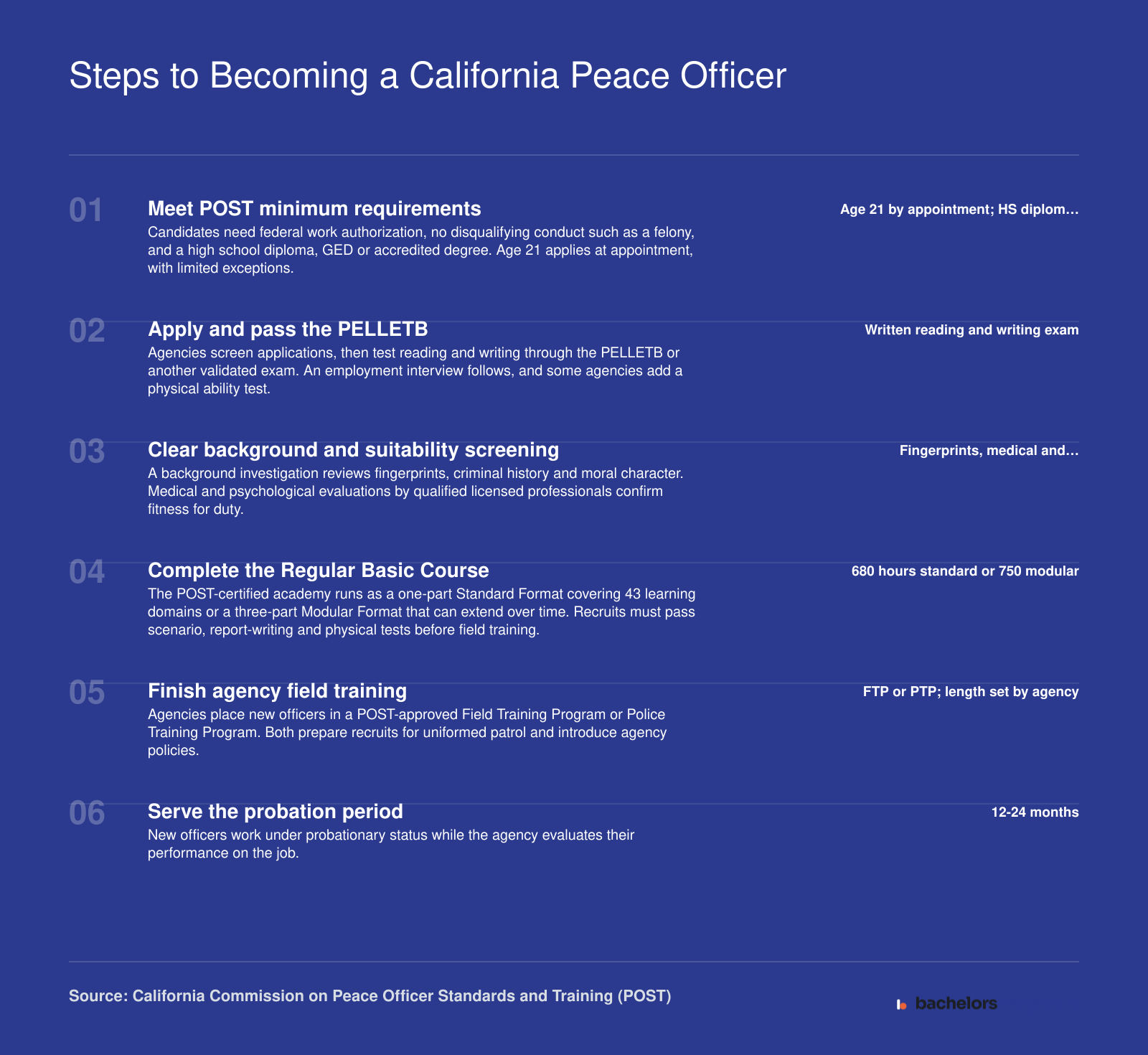
California POST sets the statewide path to a peace officer job, though each agency runs its own hiring and may add or rearrange steps. Some agencies hire candidates as trainees before the academy and formally appoint them afterward. A bachelor's degree in criminal justice satisfies POST's education requirement, but the minimum is a high school diploma or GED.
What You Can Do With a Bachelor's in Criminal Justice in California: Careers and Pay
The California wage and employment figures below come from the Bureau of Labor Statistics May 2023 state survey, the most recent California-specific data available, and are not directly comparable to newer national figures. For two roles without California data, national 2025 figures are available: forensic science technicians earn a median of $72,060, with 13% projected growth and about 2,800 openings a year from 2025 to 2035, and probation officers and correctional treatment specialists earn a national median of $66,270. A bachelor's degree in criminal justice can support any of these paths, but each employer and agency sets its own hiring standards.
| Occupation | California Median Annual Wage | California Employment | Typical Entry Education |
|---|---|---|---|
| Detectives and Criminal Investigators | $115,910 | 10,980 | N/A |
| Police and Sheriff's Patrol Officers | $111,770 | 68,010 | N/A |
| Correctional Officers and Jailers | $88,550 | 33,740 | N/A |
| Paralegals and Legal Assistants | $79,210 | 39,220 | N/A |
Compare Criminal Justice programs on the data that matters
Explore more Criminal Justice & Law majors or browse every field of study.
All Criminal Justice & Law programs Browse every field of study