Best Forensic Science Schools in Indiana
Compare 14 accredited Forensic Science programs in Indiana at 8 colleges, with net price after aid, graduation rates, earnings and debt from IPEDS and the U.S. College Scorecard.
Forensic science is a credential-sensitive field, and in Indiana the sharpest dividing line is accreditation.
The degree is awarded as a Bachelor of Science (B.S.) or a Bachelor of Arts (B.A.), and the programs here, on campus and online, lean toward the B.S. because crime labs hire on chemistry, biology and statistics coursework.
Cost after aid and graduate earnings spread widely, and FEPAC-accredited coursework is scarce here. The binding constraint is sequencing: internships at Indiana labs go to students who clear analytical chemistry early, so the first-year course plan matters more than a familiar name.
Key Points
- IU Indianapolis's B.S. holds FEPAC accreditation, continued in February 2026.
- IU Indianapolis graduates earn a median $55,794 five years out.
- Indiana University-Northwest and Purdue University Northwest rank among the cheapest after aid.
Best Bachelor's Degree in Forensic Science Programs in Indiana, Ranked
Indiana offers a compact but varied set of forensic science bachelor's degrees, from a nationally accredited program in downtown Indianapolis to concentration-heavy degrees in Muncie and Gary. Most are campus-based and lab-intensive, and several build internships with state or local crime laboratories directly into the curriculum.
Indiana University-Indianapolis
#1Indianapolis, IN · $11,000 – $35,000/yr (est.)
Best for: Aspiring DNA analysts
IU Indianapolis runs Indiana's only FEPAC-accredited forensic science bachelor's program, a 120-credit degree on its downtown campus. Students choose between forensic biology and forensic chemistry, and both routes require internships at approved crime laboratories or investigative agencies. The campus sits close to courts, crime labs and city agencies, which makes part-time work and shadowing realistic alongside classes.
- FEPAC-accredited, 120-credit, four-year program in downtown Indianapolis
- Concentration covers molecular biology, population genetics and statistics
- DNA and biological sample analysis courses required for DNA analyst roles
- Internships at approved crime laboratories or investigative agencies
- Faculty-guided research using advanced instrumentation and microscopy
- First-year research immersion available to incoming students
- Second concentration within the same accredited 120-credit degree
- Forensic chemistry analyzes drugs, explosives and fire debris
- Internships in crime labs and coroner offices
- Coursework combines biology, chemistry, physics, math and criminal justice
- Campus proximity to city crime labs, courts and law enforcement agencies
Trine University
#2Angola, IN · ~$25,000/yr (est.)
Best for: Hands-on learners wanting instrument-heavy labs
Trine University's Angola campus offers a 120-credit forensic science B.S. in the Rinker-Ross School of Health Sciences, with internships written into the curriculum rather than added on. Lab access is a real selling point: students work with atomic absorption and liquid chromatography instruments, a gas chromatography-mass spectrometer, and comparison microscopes for ballistics and hair or fiber evidence. Graduates have moved into latent print examination, arson investigation, DNA analysis and drug chemistry, and the program also prepares students for graduate study.
- 120 credit hours in the Rinker-Ross School of Health Sciences
- Internships are integral to the curriculum, not optional
- Students use atomic absorption and liquid chromatography instruments
- Gas chromatography-mass spectrometer and comparison microscopes on site
- Coursework covers crime scenes, expert testimony and criminal procedure
- Alumni work as latent print examiners, arson investigators and DNA specialists
- Lifetime Guarantee offered as a program feature
Indiana State University
#3Terre Haute, IN · $11,000/yr (est. net price)
Best for: Students choosing between lab science and broader study
Indiana State's Terre Haute campus awards a B.S. in Forensics with a forensic science concentration built on molecular biology, genetics, analytical and organic chemistry, and biochemistry. A lighter-credit forensic studies option serves students who want the field without the full science sequence. Mock crime scene spaces, laboratory coursework and internships with local and regional agencies give students applied practice, and the university accepts transfer credit for military training.
- Forensic Science concentration built on advanced science courses and lab work
- Required courses in molecular biology, genetics and biochemistry
- Electives include forensic biology, forensic geology and advanced chemistry
- Forensic Studies option requires fewer total credits
- Mock crime scene spaces and modern laboratory facilities
- Internships with local and regional agencies
- Transfer credit accepted for military training
Indiana Institute of Technology
#4Fort Wayne, IN · ~$23,000/yr (est.)
Indiana Tech's Fort Wayne campus offers a 122 to 123 credit criminalistics-focused B.S. that leans heavily on crime scene work: bloodstain pattern analysis, fingerprints, firearms and toolmarks. Students work through realistic casework and then present evidence in a mock trial. Internship placements reach the Indiana State Police Laboratory Division, the Fort Wayne Police Department laboratory, the Indiana Department of Toxicology and Parkview Health hospital labs.
- 122 to 123 credits spanning biology, chemistry, physics and statistics
- Criminalistics courses cover crime scene investigation and bloodstain patterns
- Fingerprint analysis plus firearms and toolmarks coursework
- Students present evidence in a mock trial
- Internships with the Indiana State Police Laboratory Division
- Placements also include the Fort Wayne Police Department laboratory
- Faculty bring 20 or more years of forensic experience
Ball State University
#5Muncie, IN · $10,000 – $15,000/yr (est.)
Ball State offers the state's broadest set of forensic science concentrations, with four tracks under one B.S.: behavioral forensics, digital forensics, forensic biology and forensic chemistry. Coursework draws on five academic departments, from psychological science to computer science, and every student completes an internship or capstone. The behavioral track, essentially forensic psychology, prepares students for probation, corrections, case management and victim advocacy as well as graduate study.
- Forensic psychology track on human behavior in criminal investigations
- Covers risk, need and responsivity assessment instruments
- Prepares for probation, corrections, case management and victim advocacy
- Thesis or capstone option completes the degree
- Coursework draws on five academic departments
- Digital evidence collection and analysis concentration
- Prepares for cybercrime and identity theft investigation
- Required internship or capstone
- Credits range from 65 to 81 depending on the track
- DNA evidence analysis focus within the B.S. in Forensic Science
- Laboratory work in evidence collection and interpretation
- Advanced forensic analysis sequence required
- Chemical analysis of evidence used to identify suspects
- Track blends chemistry with criminal justice coursework
- Prepares students for forensic laboratories and law enforcement
Purdue University Northwest
#6Hammond, IN · ~$6,000/yr (est.)
Purdue Northwest awards its forensic science concentration inside a B.S. in Physical Sciences, combining chemistry, criminalistics, evidence handling and physics with practice at testifying in court. The Hammond campus hosts a Lake County High Tech Crime Unit run with the Lake County Prosecutor's Office, and students in relevant disciplines may assist with evidence processing. Students have also built a virtual reality crime scene and presented research at international conferences.
- Concentration housed in the B.S. in Physical Sciences
- Coursework in chemistry, criminalistics, evidence handling and physics
- Students learn how forensics applies in court and how to testify
- Virtual reality crime scene developed by students
- Research presented at international conferences
- Beulah Inc. Science Scholarship available to science students
Indiana University-Northwest
#7Gary, IN · ~$5,000/yr (est.)
IU Northwest launched its forensic science B.S. in 2023 on its Gary campus, developed with the Indiana State Police laboratory system and designed around FEPAC standards. Students choose forensic biology, forensic chemistry or criminalistics, then finish with a capstone that ties legal concepts to laboratory practice. The criminalistics path is one of the few undergraduate routes of its kind, and graduates target local, state and federal crime labs.
- DNA analysis focus within a four-year B.S. program
- Program launched in 2023 with Indiana State Police laboratory input
- Designed to align with FEPAC standards
- Chemistry applied to evidence such as carpet fiber and explosives
- Prepares students for local, state and federal crime laboratories
- Capstone ties legal concepts to forensic practice
- One of few undergraduate criminalistics paths in the country
- Covers fingerprint analysis and blood spatter analysis
- Careers include arson investigator, DNA analyst and toxicologist
Calumet College of Saint Joseph
#8Whiting, IN · ~$22,000/yr (est.)
Calumet College of St. Joseph in Whiting awards a 126-credit forensic science B.S. that pairs a biology and chemistry core with criminal justice coursework in criminology and criminal procedure. Students work mock crime scenes, analyze biological evidence in lab and field settings, and present evidence in court. The college is a small private institution in northwest Indiana, and graduates move into federal, state, local or private laboratories or continue to graduate study.
- 126 credit hours, including 32 upper-level credits
- Built on a biology and chemistry foundation
- Includes forensic biology, forensic chemistry and molecular biology
- Instrumentation analysis and organic chemistry coursework
- Mock crime scenes with evidence presented in court
- Criminal justice courses in criminology and criminal procedure
Cost & outcomes by school
Federal data for the highest-earning Forensic Science programs, independent of the ranking above. Earnings are this field's bachelor's graduates four years after completing where the Scorecard reports them, else the school's undergraduate median.
| School | Net price / yr | Grad rate | Earnings | Debt | Grads/yr | Format |
|---|---|---|---|---|---|---|
| Trine University IN | $25,355 | 64% | $57,165 | $25,000 | 10 | Campus |
| Indiana University-Indianapolis IN | $11,668 | 55% | $55,988 | $27,000 | 41 | Campus |
| Ball State University IN | $14,940 | 62% | $51,833 | $23,250 | — | Campus |
| Indiana State University IN | $10,873 | 43% | $48,387 | $24,000 | 13 | Campus |
| Purdue University Northwest IN | $6,079 | 43% | $48,318 | $21,229 | — | Campus |
| Indiana Institute of Technology IN | $23,206 | 48% | $47,327 | $26,391 | 2 | Campus |
| Calumet College of Saint Joseph IN | $22,451 | 23% | $46,945 | $21,534 | — | Campus |
| Indiana University-Northwest IN | $5,130 | 37% | $43,361 | $21,710 | — | Campus |
Sources: U.S. Department of Education. Net price, graduation rate, earnings and debt: College Scorecard (earnings and debt for this field's bachelor's graduates where reported, else school-wide); graduates: IPEDS. A dash means no figure is reported.
Cost, debt & payoff
Median earnings of this field's bachelor's graduates (4 yrs after completing, else the school's undergraduate median) vs. their median federal loan debt · U.S. College Scorecard
Across these programs the median graduate earns about $50,110 and finishes with roughly $23,250 in debt — a ratio that clears a common rule of thumb (keep debt below first-year salary). Net price and debt vary widely school to school, so check the per-school figures in the table above before you shortlist.
How We Ranked Indiana Forensic Science Schools
Low cost and strong results do not always come from the same school, so this ranking weighs both rather than rewarding either one alone.
What Shaped the Order
Five factors decided where each school landed:
- Cost: what a student is likely to pay after aid, not just the posted tuition.
- Graduation rate: how many students at the school finish their degree.
- Program-level earnings: what graduates of the forensic science program itself go on to earn.
- Completions: how many students earn the degree each year, a sign of an established program.
- Program depth: the range of concentrations, labs and coursework within the major.
Limits Worth Knowing
Net price and graduation rate are school-wide averages. They describe the whole school, not forensic science students specifically, so a program may do better or worse than its campus figure. Earnings are the exception, since they are tied to the program. Use the school-wide numbers as a starting point, then ask each department for its own outcomes.
The ranking covers only bachelor's programs offered by Indiana-based schools, whether on campus or online. Programs at schools based elsewhere fall outside its scope, even if they enroll Indiana residents.
How Accreditation Fits In
School pages make conflicting claims about FEPAC accreditation, so we do not take them at face value. The FEPAC section below explains how accreditation is treated and how the programs differ.
Most Affordable Bachelor's Programs in Forensic Science in Indiana
These Indiana forensic science programs are sorted by average annual net price, the cost after grants and scholarships, from 2024 federal IPEDS and College Scorecard data. Indiana University-Northwest in Gary and Purdue University Northwest in Hammond both come in near or below about $6,000 a year after aid, roughly half the net price at the other schools shown. Cost is only part of the value picture, though: Ball State University and Indiana University-Indianapolis cost more but post the highest graduation rates here, which can lower the real price of finishing a bachelor's degree on time.
| School | City | Program | In-State Tuition & Fees | Out-of-State Tuition & Fees | Average Net Price After Aid | Graduation Rate | Median Debt at Graduation |
|---|---|---|---|---|---|---|---|
| Indiana University-Northwest | Gary | Bachelor of Science in Forensic Science | $8,424 | $22,811 | $5,130 | 37% | $21,710 |
| Purdue University Northwest | Hammond | Physical Sciences, Concentration: Forensic Science | $8,675 | $16,094 | $6,079 | 43% | $21,229 |
| Indiana State University | Terre Haute | Forensics (BS) | $10,258 | $22,322 | $10,873 | 43% | $24,000 |
| Indiana University-Indianapolis | Indianapolis | Forensic & Investigative Sciences | $10,762 | $34,891 | $11,668 | 54% | $20,000 |
| Ball State University | Muncie | Forensic Science | $11,082 | $29,630 | $14,940 | 62% | $23,250 |
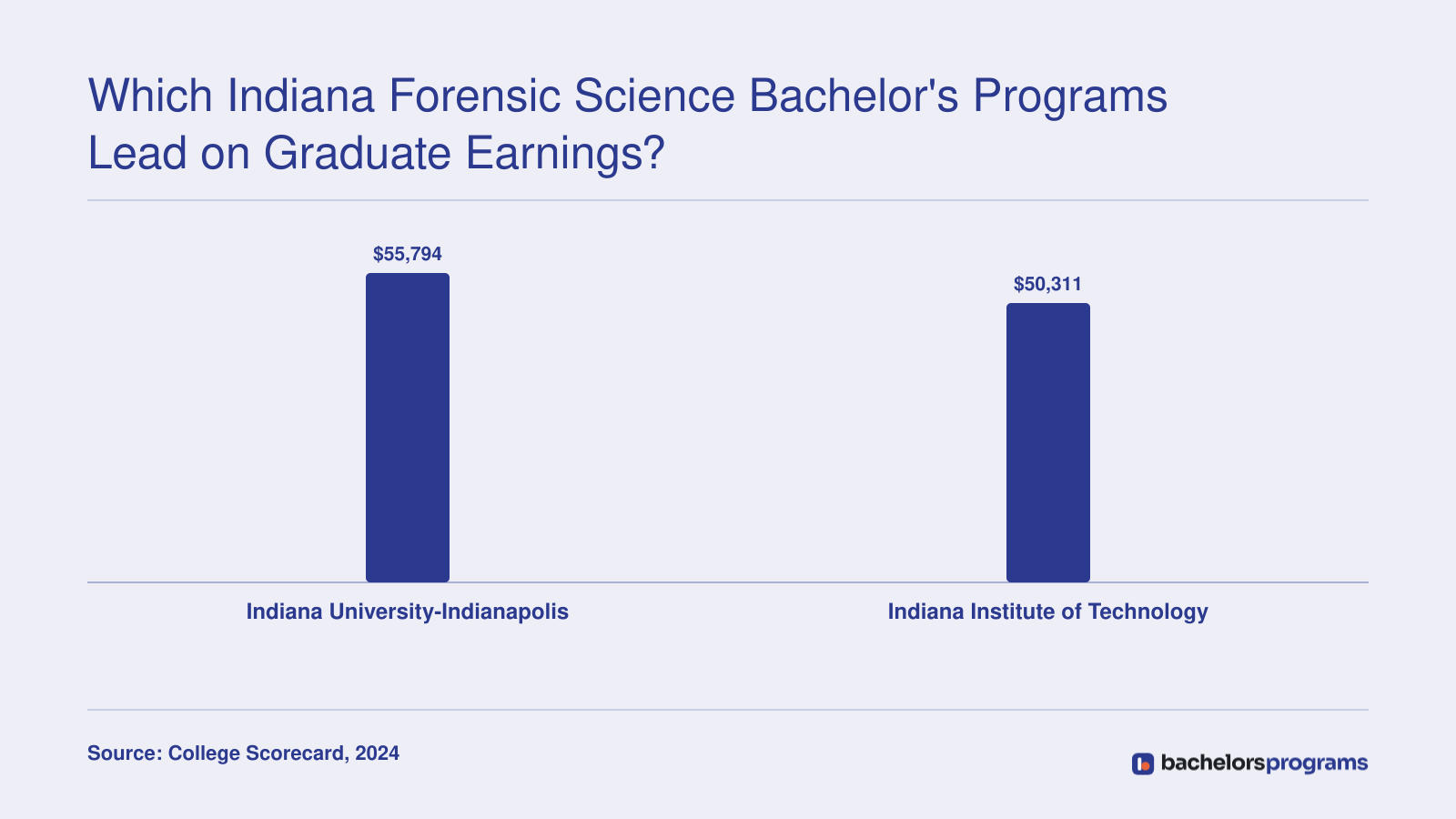
Which Indiana Forensic Science Bachelor's Programs Lead on Graduate Earnings?
Five years after completing a bachelor's degree in forensic science, graduates of IU Indianapolis's Forensic & Investigative Sciences program earn a median $55,794, compared with $50,311 for Indiana Tech's Forensic Science - Criminalistics B.S. Program-level earnings are not reported for Trine, Ball State or Indiana State, so those schools are left out of the chart rather than represented by school-wide figures. The roughly $5,500 gap widens in practical terms once cost is counted: IU Indianapolis's average net price after aid is $11,668 a year, compared with $23,206 at Indiana Tech, so the higher-paying program here is also the less expensive one.
FEPAC Accreditation and Concentrations: How Indiana Bachelor's Programs Differ
Which Indiana forensic science bachelor's programs are actually FEPAC-accredited? Among the schools here, one: the B.S. in Forensic and Investigative Sciences at IU Indianapolis. The FEPAC directory and its February 2026 accreditation actions show continued full accreditation for five years, March 1, 2026 to March 1, 2031.1 We checked that listing in November 2026. Programs can be reviewed or change status, so confirm it with FEPAC before you apply.
Sorting Out the "Only Program in Indiana" Claims
Two schools use similar language, and they mean different things. IU Indianapolis calls its degree Indiana's only FEPAC-accredited forensic science program, and the FEPAC listing supports that.1 IU Northwest's program materials describe its B.S. in Forensic Science as the only forensic science degree in the state. That cannot be literal, since Trine, Indiana State, Ball State and others here offer forensic science bachelor's programs. Read it as a marketing line about that campus, not an accreditation claim. For accreditation, FEPAC's directory is the authority.
What FEPAC Means for Crime Lab Hiring
FEPAC reviews programs against set standards for curriculum, laboratory instruction and faculty. Crime labs may treat a FEPAC degree as a marker of a standardized, credible education. It is not a hiring guarantee, and no source we reviewed shows labs universally requiring it. Each lab posts its own coursework, internship, background-check and competency requirements, and those decide who gets hired. A non-accredited degree can still lead to a lab job if the right science courses are on the transcript.
How Concentrations Compare
- IU Indianapolis: Forensic Biology and Forensic Chemistry, with internships at crime labs and agencies.
- IU Northwest: Three options, including forensic biology (DNA analysis) and a criminalistics path.
- Indiana State: Two concentration options, with a Forensic Science track aimed at crime labs.
- Indiana Tech: Criminalistics, covering crime scene work, fingerprints, firearms and toolmarks.
- Ball State: Four tracks, including Behavioral Forensics, which suits probation, law enforcement or later law and psychology study.
- Purdue Northwest: A forensic science concentration within a Physical Sciences degree.
- Trine and Calumet College of Saint Joseph: A single forensic science track, with Calumet built on a biology and chemistry foundation.
Digital forensics does not appear as a named concentration in these schools' program details. If that is your goal, check each curriculum closely. For crime lab work, the biology and chemistry tracks are the more direct route.
Related Articles
Questions to Ask Yourself
Do you want a lab-heavy chemistry or biology track, or crime scene, digital, or behavioral work?
Will the employers you are targeting expect a FEPAC-accredited degree?
Can you attend in person, or do you need an online or hybrid format from an Indiana school?
Does the program place students in internships with Indiana crime labs or police agencies?
Indiana Forensic Science Degree FAQs
Are there FEPAC-accredited forensic science programs in Indiana?
Can you get a forensic science degree online in Indiana?
Do you need a forensic science major to become a crime scene investigator in Indiana?
Is a B.S. or a B.A. in forensic science better for crime lab jobs?
Compare Forensic Science programs on the data that matters
Explore more Criminal Justice & Law majors or browse every field of study.
All Criminal Justice & Law programs Browse every field of study