Best Early Childhood Education Schools in Indiana
Compare 15 accredited Early Childhood Education programs in Indiana at 13 colleges, with net price after aid, graduation rates, earnings and debt from IPEDS and the U.S. College Scorecard.

A bachelor's degree in early childhood education is the standard route into Indiana's preschool, pre-K, and early-grade classrooms, and the license attached to it matters as much as the diploma. Most programs here award the Bachelor of Science (B.S.) in Early Childhood Education; a few award a B.A. or a child development degree instead.
Ball State University and Purdue University Fort Wayne each offer both a licensure and a non-licensure version of the major. Only the licensure track prepares graduates to lead a public school classroom; the other fits child care, program administration, and family services work.
That choice shapes cost and career options more than campus versus online delivery does.
Key Points
- Indiana University-Indianapolis posts the lowest average net price here.
- Median debt: $17,500 at Purdue University, $22,828 at Purdue University Fort Wayne.
- Ball State University and Purdue University Fort Wayne offer non-licensure tracks too.
Best Bachelor's in Early Childhood Education Schools in Indiana: Ranked
Ten Indiana colleges award a bachelor's degree in early childhood education, and they differ sharply in price, delivery and what the credential prepares you to do. Some lead straight to Indiana teaching licenses covering birth through grade 3, while others are non-licensure degrees for students who want to run child care or early-learning programs. Each entry lists in-state tuition, average net price after aid and the school's graduation rate; net price is a sector-average estimate, not a quote for every student.
Purdue University
#1West Lafayette, IN · ~$15,000/yr (est.)
Best for: Future special educators seeking dual licensure
Purdue University's West Lafayette campus runs one of Indiana's most direct routes into both general and special education for young children, awarding a degree in early childhood education and exceptional needs. The major combines coursework, practicum hours and a full semester of student teaching, and graduates leave eligible to apply for two Indiana licenses at once. Students can add interdisciplinary study in applied behavior analysis, gerontology or public health, and the surrounding Greater Lafayette area supplies early-learning centers and Head Start sites for fieldwork.
- Dual Indiana licensure: Early Childhood Generalist and Exceptional Needs
- Both licenses cover birth through grade 3
- Semester of full-time student teaching in a child development center or school
- Practicum work with typically developing children and children with disabilities
- Coursework aligned to NAEYC Professional Standards and Competencies
- Optional HDFS study in gerontology, applied behavior analysis, or public health
- Prepares for early intervention, Head Start, prekindergarten and K-3 classrooms
Indiana University-Bloomington
#2Bloomington, IN · $12,000 – $42,000/yr (est.)
Best for: Residential students wanting a research university
Indiana University Bloomington awards its early childhood degree through the School of Education, on a four-year path that ends in dual Indiana licenses for infant, toddler, preschool and K-3 settings. Every candidate takes a concentration in early intervention and special education, so the degree prepares graduates for inclusive classrooms rather than general education alone. Field experiences and student teaching run across the full age range the license covers, from infants through third grade.
- Four-year program leading to dual Indiana teaching licenses
- Licenses cover infant and toddler, preschool, and K-3 settings
- Required concentration in early intervention and special education
- Field experiences and student teaching with infants through third graders
- Coursework in curriculum development, learning environments and educational theory
- Inclusive teaching preparation for work with young children and families
- Offered by the IU School of Education at Bloomington
Oakland City University
#3Oakland City, IN · $15,000/yr (est. net price)
Best for: Cost-conscious students wanting a private college
Oakland City University is a small private institution in southwestern Indiana whose early childhood education major is delivered on campus rather than online. Classes are small, with a student-faculty ratio of 13 to 1, and the university's education programs appear on Indiana's approved Transition to Teaching list for elementary, secondary and special education. It is a practical option for students who want a private-college setting without a large residential campus.
- Campus-based early childhood education major
Ball State University
#4Muncie, IN · $10,000 – $15,000/yr (est.)
Ball State University gives students two ways to study early childhood education: a licensure track on the Muncie campus and a fully online, non-licensure track for adults already working with young children. The campus program is built around field placements in elementary schools and early childhood centers, an Urban Experience term taught in Indianapolis, and student teaching that can take candidates to Texas or Germany. The online version runs asynchronously and is taught by the same faculty who teach on campus.
- CAEP-accredited, 120-credit, four-year program on the Muncie campus
- Semester of student teaching, with placements in Indiana, Texas or Germany
- Urban Experience courses taught off campus in Indianapolis
- Living-learning community for early childhood majors
- Field placements in elementary schools and early childhood centers
- Study abroad option in England
- Prepares for teaching children from birth to third grade
- Fully online, asynchronous classes with the same professors as on campus
- Online track designed for ages birth through five
- 90 major credits with a 2.5 GPA minimum for admission
- T.E.A.C.H. scholarship can cover tuition and books
- Adult Student Grant worth up to $2,000
- In-state tuition rate extended to Kentucky and Ohio residents
- Free application after registering for a webinar
Indiana University-Indianapolis
#5Indianapolis, IN · $11,000 – $35,000/yr (est.)
IU Indianapolis splits its early childhood degree into a licensure track for pre-K through grade 3 and a non-licensure track for birth-to-pre-K settings, so students can aim at public school teaching or at leading early-learning programs. Professional education courses run in a four-semester block sequence at Marion County partner schools, and the final block is 16 weeks of full-time student teaching. Evening, Saturday and hybrid formats make the program workable for students already employed in Indianapolis early-childhood settings.
- Two completion options: non-licensure (birth to pre-K) and licensure (grades P-3)
- Licensure track prepares for the Indiana Early Childhood license and ETS tests
- 120 credit hours, including 60 credits of professional education
- Four-semester block sequence taught at Marion County partner schools
- Block IV is 16 weeks of full-time student teaching
- Evening, Saturday and online-hybrid course options
- 12-credit state-approved concentration or a 15-21 credit minor required
- Fall-only admission with a June 15 deadline and a 2.5 GPA standard
University of Southern Indiana
#6Evansville, IN · ~$13,000/yr (est.)
The University of Southern Indiana in Evansville builds its early childhood program around clinical placements, with field experiences in local child care centers and public schools woven through the coursework. Classes are small, and the curriculum emphasizes research-based practice for diverse communities rather than a single scripted approach. Students complete core courses first and then apply for admission to the Teacher Education program before the upper-level sequence.
- Clinical placements link coursework to observation and classroom practice
- Field experiences in local child care centers and public schools
- Small class sizes across the program
- Students apply for admission to the Teacher Education program after core courses
- Research-based pedagogical practice for diverse and global settings
- Field work spans children at different age levels
Bethel University
#7Mishawaka, IN · $19,000/yr (est. net price)
Bethel University in Mishawaka gives education majors unusually early classroom exposure: students begin working in schools during their freshman year, logging hundreds of hours before they graduate. Student teaching runs 12 to 15 weeks and includes a full-day kindergarten placement arranged with the School City of Mishawaka. The student-faculty ratio is 12 to 1, and the university says every enrolled student receives some form of financial aid.
- Four-year Bachelor of Arts program
- 12- to 15-week student teaching with a full-day kindergarten placement
- Partnership with the School City of Mishawaka for classroom placement
- Classroom work begins in the freshman year, hundreds of hours total
- Student-faculty ratio of 12 to 1
- Next Generation Hoosier Educators Scholarship available
- Indiana license recognized in most states under a compact agreement
University of Indianapolis
#8Indianapolis, IN · $22,000/yr (est. net price)
The University of Indianapolis runs its early childhood degree through a school that reports 100% job placement for education graduates over the past several years, measured by alumni survey. Students enter either a four-year traditional route that pairs an elementary education major with early childhood coursework and a Mild Intervention minor, or a four-semester 2+2 track for Ivy Tech associate degree holders. Candidates student teach in both a preschool and a primary classroom, and the program covers major early-childhood traditions from Montessori to Reggio Emilia.
- Ivy Tech 2+2 TSAP track: four semesters for associate degree holders
- Traditional route pairs an elementary education major with 21 early childhood credits
- Leads to licensure for pre-K (age 3) through grade 3
- Mild Intervention minor included in the traditional route
- Student teaching in both a preschool and a primary classroom
- Field placements in urban, suburban, rural, charter and private schools
- Coursework covers Froebel, Montessori, Steiner, Reggio Emilia and Vygotsky
- School of Education reports 100% job placement by alumni survey
Purdue University Fort Wayne
#9Fort Wayne, IN · $10,000 – $15,000/yr (est.)
Purdue University Fort Wayne offers two distinct early childhood paths: a bachelor-completion program in early childhood for birth to age 5 that is available online, and a campus-based degree that leads to Preschool to Grade 3 licensure. The completion program is built for students arriving with an associate degree, most often from Ivy Tech, and finishes with a capstone practicum. Both sit within CAEP-accredited education programs, and licensure candidates can student teach beyond northeast Indiana.
- Bachelor-completion program for students arriving with an associate degree
- Requires at least 60 transfer credits; most entrants come from Ivy Tech
- 120 total credits, including 9 capstone credits with an applied preschool practicum
- Fully online option available, with some courses also on campus
- 2.70 GPA and C- or better in each course to enter the practicum
- Annual criminal history background reports required
- Coursework in child growth and development and infant and toddler curriculum
- CAEP-accredited education programs
- CAEP-accredited Preschool to Grade 3 licensure track
- Student teaching placements available beyond northeast Indiana
- Coursework in child observation, assessment and developmentally appropriate practice
- Covers family and community relationships and professional ethics
Indiana Institute of Technology
#10Fort Wayne, IN · ~$23,000/yr (est.)
Indiana Tech in Fort Wayne approaches early childhood through a Bachelor of Science in Child Development rather than a teaching license, which suits students aiming at child-life work, program administration or graduate study in child psychology. The degree is available online and on campus, and internships place students with the Autism Society of Indiana, Bowen Center, YMCA and Fort Wayne Community Schools. A partnership with the University of Saint Francis Transition to Teaching program gives graduates a separate route to licensure if they decide to teach.
- Offered fully online and on campus
- 120 to 121 credit hours
- Covers development from infancy through adolescence
- Internships with Autism Society of Indiana, Bowen Center, YMCA and Fort Wayne Community Schools
- Partnership with University of Saint Francis Transition to Teaching for licensure
- Psychology coursework foundation; prepares for child psychology graduate study
- Advocacy for children built into the curriculum
Cost & outcomes by school
Federal data for the highest-earning Early Childhood Education programs, independent of the ranking above. Earnings are this field's bachelor's graduates four years after completing where the Scorecard reports them, else the school's undergraduate median.
| School | Net price / yr | Grad rate | Earnings | Debt | Grads/yr | Format |
|---|---|---|---|---|---|---|
| Indiana University-Bloomington IN | $16,264 | 80% | $52,269 | $21,500 | 179 | Campus |
| University of Indianapolis IN | $21,602 | 56% | $49,861 | $25,886 | 37 | Online or campus |
| Indiana University-Indianapolis IN | $11,668 | 55% | $49,540 | $21,267 | 103 | Hybrid |
| Purdue University IN | $14,600 | 83% | $48,502 | $17,500 | 119 | Campus |
| Ball State University IN | $14,940 | 62% | $48,344 | $21,954 | 125 | Campus |
| Indiana Wesleyan University IN | $16,898 | 35% | $47,578 | $22,830 | 35 | Campus |
| Indiana Institute of Technology-College of Professional Studies IN | $20,473 | 28% | $47,327 | $26,391 | — | Online or campus |
| Indiana Institute of Technology IN | $23,206 | 48% | $47,327 | $26,391 | 4 | Online or campus |
| Purdue University Fort Wayne IN | $13,171 | 36% | $45,525 | $22,828 | 90 | Online or campus |
| University of Southern Indiana IN | $12,923 | 48% | $45,245 | $22,500 | 77 | Campus |
| Bethel University IN | $18,610 | 53% | $45,222 | $27,000 | 15 | Campus |
| Oakland City University IN | $15,210 | 66% | $43,283 | $16,758 | 20 | Campus |
Sources: U.S. Department of Education. Net price, graduation rate, earnings and debt: College Scorecard (earnings and debt for this field's bachelor's graduates where reported, else school-wide); graduates: IPEDS. A dash means no figure is reported.
Cost, debt & payoff
Median earnings of this field's bachelor's graduates (4 yrs after completing, else the school's undergraduate median) vs. their median federal loan debt · U.S. College Scorecard
Across these programs the median graduate earns about $47,453 and finishes with roughly $22,664 in debt — a ratio that clears a common rule of thumb (keep debt below first-year salary). Net price and debt vary widely school to school, so check the per-school figures in the table above before you shortlist.
How We Ranked Indiana Early Childhood Education Schools
The rankings draw on federal College Scorecard data, which reports costs, graduation, and earnings both for whole institutions and for individual fields of study. Alongside it we weigh program completion counts, how many students finish the degree each year. Everything reflects the latest Scorecard snapshot available in 2026.
What We Weighed
- Cost: in-state tuition and net price after grant aid.
- Outcomes: graduation and earnings for graduates, where reported.
- Completions: how many students finish the degree, a rough signal of program scale and stability.
- Format: campus, online, or hybrid delivery.
Scope
Only Indiana bachelor's programs were considered, including campus programs and online programs at Indiana-based schools. Associate degrees, certificates, and graduate study were left out.
Limits to Keep in Mind
The graduation rate and net price describe the whole institution rather than the early childhood program, so an education major's experience may differ from the school-wide figure. Earnings windows also differ by row: some programs report earnings a year after graduation, others two or four years out, so compare those numbers with care. Where a figure is not reported for a program, we left it out rather than estimate it. Confirm current tuition and licensure details on each school's own pages before you apply.
Online and Hybrid Bachelor's Options at Indiana Schools
An on-campus cohort and a fully online program can lead to the same Indiana license, but they ask very different things of your week.
Which schools list an online route
Purdue University Fort Wayne lists a fully online option for its early childhood program, and Indiana Institute of Technology lists one for its B.S. in Child Development. University of Indianapolis appears with both campus and online formats. Indiana University-Indianapolis runs a hybrid model, with evening, Saturday, and online-hybrid courses held at Marion County partner schools. Purdue University, Indiana University-Bloomington, Oakland City University, University of Southern Indiana, and Bethel University are campus programs.
Can you earn it fully online?
Yes, at the schools that publish an online route. The catch is the license itself. Indiana's birth-through-grade-3 preparation includes field experiences and a student teaching semester, so even online students usually spend part of the degree in a real classroom. Working adults and transfer students should ask two questions before enrolling: does the school arrange placements near your community, and how does student teaching fit around a full-time job?
A rule of thumb
- Choose online if you already work in an early childhood setting and need to keep earning while you study.
- Choose hybrid if you want licensure but need evening or weekend classes plus local placements.
- Choose campus if you want supervised observation early, such as Purdue's work at the Miller Child Development Laboratory School, and a cohort that meets in person.
Admissions: GPA, Test Policy, and Transfer Credit
What GPA do you need to transfer into an early childhood education bachelor's program in Indiana, and does the SAT still matter? The answer depends on whether you enter as a first-year student or with an associate degree in hand, and on which school you apply to.
GPA Minimums: What the Programs Publish
Ball State University sets the clearest bar for its online non-licensure major: a 2.5 cumulative GPA in transferable credit, plus either an early childhood associate degree that includes a practicum or at least 45 applicable credits from an accredited institution.
Indiana University-Bloomington's transfer pathway requires a 2.5 cumulative GPA at the two-year institution and a C or better in every course. It also sets separate GPA minimums for content-area and professional education coursework, with a 2.0 in the content area, and transcripts are due by July 1.1
Indiana University-Indianapolis admits early childhood education students for fall only and competitively: the deadline is June 15, and the listed GPA for 2026-2027 is 2.5.2 Transfer applicants through the state pathway there need a 2.0 and enter with junior standing.3 Purdue University, Oakland City University, the University of Southern Indiana, Bethel University, the University of Indianapolis, Purdue University Fort Wayne and Indiana Institute of Technology publish general university admission standards on their sites rather than a separate early childhood entry GPA.
Test Scores
None of these programs list a program-level SAT or ACT cutoff. Where a test score matters, it comes from the university's general freshman admission policy, not from an early childhood requirement, so confirm the current rule on the admissions page of the school you are applying to.
Transfer Routes and Time to Finish
Indiana's Transfer Single Articulation Pathway (TSAP) is the main transfer route. A completed, approved associate degree in education from Ivy Tech fulfills the first two years of the bachelor's, including a general education core of at least 30 credits, so you do not repeat lower-division coursework.1
IU Bloomington requires 60 credits to graduate through the pathway and states that it guarantees on-time completion within two years of full-time study. That is a planning benchmark, not a fixed two calendar years: how long you actually take depends on how many credits the receiving school accepts and whether you enroll full time.
Cost of a Bachelor's Degree in Early Childhood Education in Indiana: Cheapest Options
The schools below are ordered by average net price, the yearly cost after grants and scholarships, using the most recent IPEDS and College Scorecard data from the U.S. Department of Education (2024). Indiana University-Indianapolis has the lowest net price at $11,668 a year, while Purdue University Fort Wayne has the lowest in-state tuition at $9,532. Out-of-state tuition varies far more than in-state rates, so Indiana residents get the clearest savings at these public universities.
| School | City | Format | In-State Tuition and Fees (per year) | Out-of-State Tuition and Fees (per year) | Average Net Price (per year) |
|---|---|---|---|---|---|
| Indiana University-Indianapolis | Indianapolis | Hybrid | $10,762 | $34,891 | $11,668 |
| University of Southern Indiana | Evansville | Campus | $10,066 | $22,907 | $12,923 |
| Purdue University Fort Wayne | Fort Wayne | Campus and online | $9,532 | $22,887 | $13,171 |
| Purdue University | West Lafayette | Campus | $9,992 | $28,794 | $14,600 |
| Ball State University | Muncie | Campus | $11,082 | $29,630 | $14,940 |
Indiana State Aid and Scholarships for Education Majors
Need-based grants follow your FAFSA results, while merit-based scholarships reward grades and a commitment to teach. Indiana offers both, and an early childhood education major may qualify for more than one. The terms described here come from the Indiana Commission for Higher Education. Confirm current terms before you apply, because award rules change from year to year.
Frank O'Bannon Grant
This is Indiana's main need-based grant, and it pays toward tuition and regularly assessed fees. There is no single fixed statewide award amount. Your award is set from your FAFSA and your Student Aid Index.
- Who qualifies: Indiana residents (by December 31 of the year before you apply) who are U.S. citizens or eligible non-citizens, hold a high school diploma or GED, and enroll full time in a first bachelor's or an associate program at an eligible Indiana school.
- Staying eligible: You must maintain satisfactory academic progress and meet annual credit-completion requirements.
- Deadline: File the FAFSA by April 15.
Next Generation Hoosier Educators Scholarship
This merit award targets future teachers. It pays up to $10,000 a year for four academic years and can be renewed as long as you meet program requirements.
- Who qualifies: Indiana residents who are high school seniors or current college students and meet at least one academic standard: a top 20% class rank, a top 20% ACT or SAT score, or a cumulative GPA of at least 3.0.
- Deadline: Applications for 2027-2028 open in November 2026 and close February 28, 2027, with notification by email in April 2027.
21st Century Scholars and the Workforce Ready Grant
21st Century Scholars is a state aid program for eligible Indiana students attending approved Indiana colleges. Current award amounts and eligibility rules were not clear in the sources we reviewed, so check directly with the Commission.
The Workforce Ready Grant is unlikely to help with a bachelor's degree. It covers tuition for high-value certificate programs in fields such as advanced manufacturing, health sciences and IT, for up to two years.
Practical Tip
File the FAFSA well before April 15, then ask your school's aid office how state grants and scholarships stack with institutional aid.
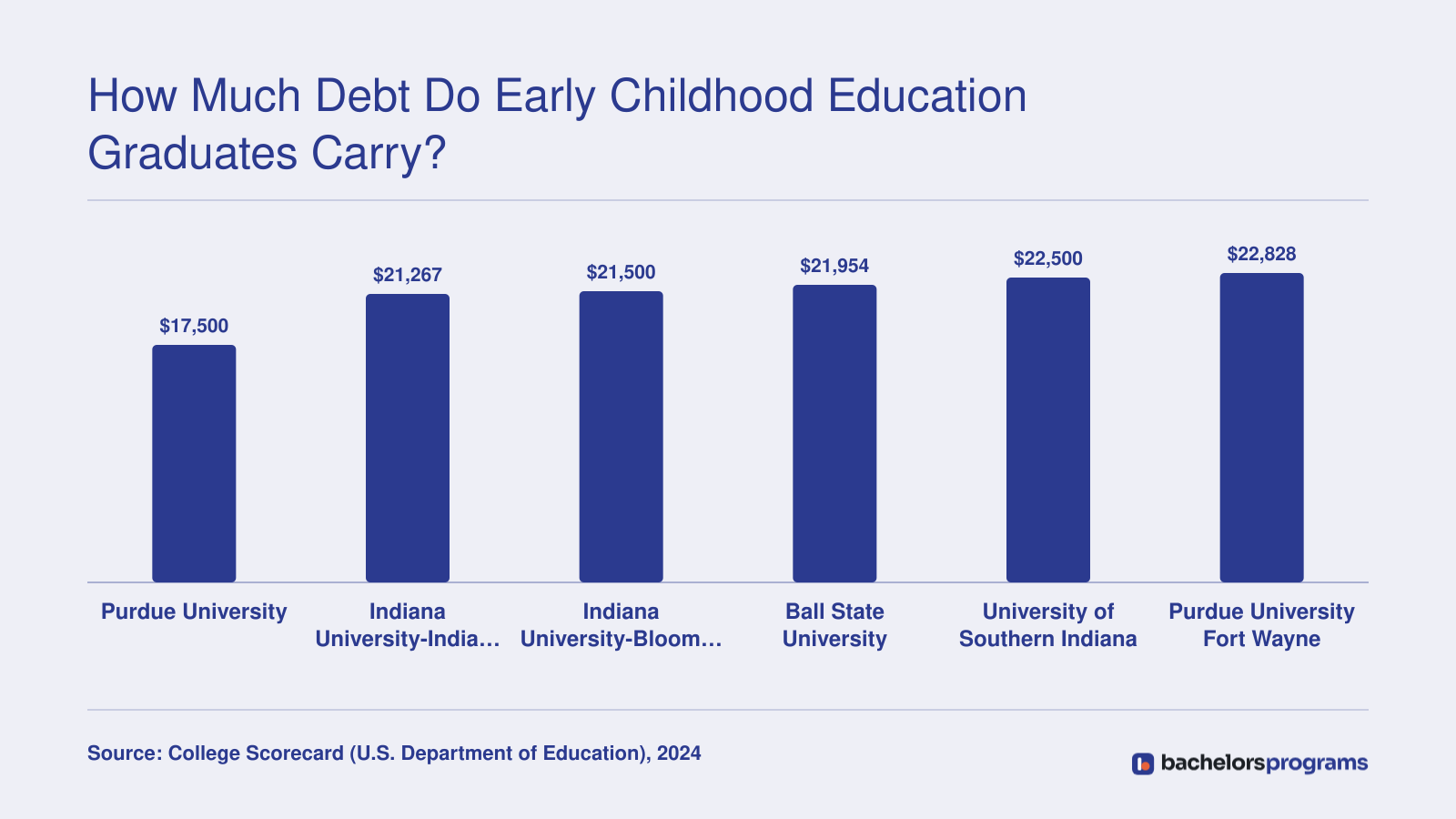
How Much Debt Do Early Childhood Education Graduates Carry?
Median federal loan debt at completion for early childhood education bachelor's graduates ranges from $17,500 at Purdue University to $22,828 at Purdue University Fort Wayne. These are program-level College Scorecard figures for each school's early childhood program, not campus-wide averages. On a standard 10-year repayment plan, that works out to about $186 a month at Purdue University and $225 to $242 a month at the other schools shown.
Related Articles
Compare Early Childhood Education programs on the data that matters
Explore more Education & Teaching majors or browse every field of study.
All Education & Teaching programs Browse every field of study