Best Finance Schools in Indiana
Compare 42 accredited Finance programs in Indiana at 32 colleges, with net price after aid, graduation rates, earnings and debt from IPEDS and the U.S. College Scorecard.

A bachelor's degree in finance from an Indiana school can cost $12,144 a year in in-state tuition and fees at Indiana University-Bloomington or $65,025 at the University of Notre Dame. The usual credential is the Bachelor of Science (B.S.) in Finance.
Price and payoff do not track neatly. Notre Dame finance graduates report median earnings of $99,222 a year after finishing. Purdue University graduates report $59,938, at an average net price after aid of $14,600.
Every school here is Indiana-based, with campus and online routes. Outcomes, selectivity, net price and concentrations get equal weight. Net price after grants, not sticker tuition, usually decides how heavy the loan balance gets.
Key Points
- Purdue University Northwest stands out for low net price after aid.
- At several small private colleges, finance students manage real endowment money.
- Purdue University Global offers a fully online Bachelor of Science in Finance.
Best Schools for a Bachelor's Degree in Finance in Indiana: Our Top 10
Indiana's finance landscape runs from a giant public business school with a CFA-partnered major to small private colleges where undergraduates manage real endowment money. The ten schools below all award a bachelor's degree in finance, and several give students Bloomberg terminals, live portfolios and internship requirements rather than case studies alone. Read each entry for what the program actually puts in your hands.
Indiana University-Bloomington
#1Bloomington, IN · $12,000 – $42,000/yr (est.)
Best for: Career-focused students targeting investment management
Indiana University's Kelley School of Business gives finance majors a deep grounding in corporate finance, investments, banking and international finance, and it is a CFA Program Partner, so students can work toward the charter while enrolled. The Bloomington campus pairs that curriculum with a large alumni network and a broad slate of business majors, minors and student organizations. Finance graduates move into analyst, brokerage, lending and insurance roles.
- Finance major inside the Kelley School of Business
- Study areas include corporate finance, investments, banking and international finance
- CFA Program Partner: work toward the CFA charter while enrolled
- Prepares students for analyst, broker, loan officer and insurance roles
Purdue University
#2West Lafayette, IN · ~$15,000/yr (est.)
Best for: Aspiring investment bankers wanting hands-on training
Purdue's Mitch Daniels School of Business awards a Bachelor of Science in Finance built on accounting and economics, then advancing into financial analytics, investment management and venture capital. Students can run a real portfolio through the Student Managed Investment Fund, train in the Investment Banking Academy and join the Purdue Finance Workshop for alumni mentoring. Study abroad, added concentrations and a structured path into graduate study round out the options.
- Bachelor of Science in Finance at the Mitch Daniels School of Business
- Student Managed Investment Fund runs a real investment portfolio
- Investment Banking Academy and Purdue Finance Workshop for specialized training
- Coursework in financial analytics, investment management and venture capital
- Study abroad or add a concentration or minor
- AACSB-accredited business school
University of Notre Dame
#3Notre Dame, IN · ~$27,000/yr (est.)
Best for: Ethics-minded students drawn to global investing
Notre Dame's Mendoza College of Business offers a STEM-designated undergraduate finance degree that combines investment theory, corporate financial reporting and managerial economics with an explicit ethical framework. Students can add a finance or real estate minor and tap the Notre Dame Institute for Global Investing, while the Clark Lecture Series brings working practitioners to campus. The result is a small, selective program with a strong network in investment management and corporate finance.
- STEM-designated finance degree through the Mendoza College of Business
- Coursework in investment theory, corporate financial reporting and managerial economics
- Clark Lecture Series brings practitioners to campus
- Notre Dame Institute for Global Investing available to students
- Add a finance or real estate minor alongside the major
Taylor University
#4Upland, IN · ~$25,000/yr (est.)
Taylor University's Bachelor of Science in Finance covers corporate finance, investments, risk management, security analysis and personal financial planning, with ethics and business law built in. The Finance Hub houses 10 Bloomberg Terminals, and students manage close to $5 million through the Investing Excellence Club. The program is a CFP Registered Program and a CFA Partner University, and it aligns with SIE and Series 65 licensing.
- Bachelor of Science in Finance with an emphasis on stewardship
- Finance Hub equipped with 10 Bloomberg Terminals and professional software
- Investing Excellence Club manages a portfolio of nearly $5 million
- CFP Registered Program and CFA Partner University
- Curriculum aligns with SIE and Series 65 licensing
- Reports 97% of graduates employed or in graduate school
Ball State University
#5Muncie, IN · $10,000 – $15,000/yr (est.)
Ball State's Bachelor of Science in Finance is a 120-credit, AACSB-accredited degree with two concentration options and heavy hands-on trading work. Students use Bloomberg terminals in the A. Umit Taftali Center for Capital Markets and Investing and manage a $1.1 million equity portfolio through the Student Managed Investment Fund. The program is approved by the CFP Board and participates in the CFA Institute University Recognition Program.
- 120-credit Bachelor of Science in Finance, AACSB accredited
- Bloomberg terminals in the A. Umit Taftali Center for Capital Markets and Investing
- Student Managed Investment Fund with a $1.1 million equity portfolio
- CFP Board approved program
- CFA Institute University Recognition Program participant
- Two concentration options: Business Finance and Financial Analyst
Grace College and Theological Seminary
#6Winona Lake, IN · ~$20,000/yr (est.)
Grace College offers a finance major with a Financial Analyst concentration, taught on its Winona Lake campus with a Christian worldview woven through the business curriculum. Coursework covers personal financial planning, capital market simulations and international finance, and it includes preparation for the Securities Industry Exam. Internships in banking, financial planning and corporate finance give students applied experience before graduation.
- Finance major with a Financial Analyst concentration
- Coursework includes capital market simulations and international finance strategies
- Prepares students for the Securities Industry Exam (SIE)
- Five educational focuses include data analytics and financial modeling
- Internships in banking, financial planning and corporate finance
Butler University
#7Indianapolis, IN · $36,000/yr (est. net price)
Butler University's Lacy School of Business builds its finance program around required internships and a student-managed fund that invests more than $3 million of the university endowment. Coursework maps to the CFA Candidate Body of Knowledge, and students also work with a $2 million private equity fund and compete in the CFA Research Challenge. A 122-credit curriculum with a strategy capstone and an annual New York trip to investment banks rounds out the degree.
- 122-credit program with a strategy capstone and two required internships
- Student Managed Investment Fund invests more than $3 million of the endowment
- Coursework mapped to the CFA Candidate Body of Knowledge
- Access to a $2 million private equity fund and the CFA Research Challenge
- Annual trip to New York investment banks
- Tracks: Corporate Finance, Investments
Indiana Wesleyan University
#8Marion, IN · ~$23,000/yr (est.)
Indiana Wesleyan University offers a Bachelor of Arts in Finance on its Marion campus with a faith-integrated business curriculum. The 124-credit degree builds on economics, statistics, accounting and international business, then adds advanced accounting, cash flow, tax and investment topics. Students complete an internship in a real business setting and work on career-focused projects drawn from real scenarios.
- 124-credit Bachelor of Arts in Finance
- Foundation in economics, statistics, accounting and international business
- Topics include the time value of money, cash flow, taxes and investments
- Internship in a real business setting required
- Faith and biblical worldview integrated into business practice
Valparaiso University
#9Valparaiso, IN · ~$19,000/yr (est.)
Valparaiso University houses its finance major inside the Bachelor of Science in Business Administration, combining a 56-credit business core with a 38-credit general education core. Advanced coursework covers financial markets, corporate finance theory, investment management, international finance and financial strategy. The AACSB-accredited College of Business requires a cooperative education experience or internship, and the full degree takes 124 credits.
- Finance major inside the Bachelor of Science in Business Administration
- 56-credit business core plus a 38-credit general education core
- 124 total credits with advanced courses in financial markets and investment management
- AACSB-accredited College of Business
- Cooperative education experience or internship required
- Career readiness class plus internship before graduation
Bethel University
#10Mishawaka, IN · $19,000/yr (est. net price)
Bethel University awards a Bachelor of Arts in Economics & Finance that can be taken as a major or a minor, blending accounting, calculus, macro and microeconomics, money and banking, and investments. The program prepares students for business, finance and public policy work as well as law school or graduate study. Students have interned at the Acton Institute, the Charles Koch Foundation and the Federal Deposit Insurance Corporation.
- Bachelor of Arts in Economics & Finance, available as a major or minor
- Coursework in money and banking, international economics and principles of investments
- Prepares students for business, finance and public policy roles, or law school
- Students have interned at the Acton Institute, Charles Koch Foundation and FDIC
- Christian faith integrated with economics
Cost & outcomes by school
Federal data for the highest-earning Finance programs, independent of the ranking above. Earnings are this field's bachelor's graduates four years after completing where the Scorecard reports them, else the school's undergraduate median.
| School | Net price / yr | Grad rate | Earnings | Debt | Grads/yr | Format |
|---|---|---|---|---|---|---|
| University of Notre Dame IN | $26,780 | 95% | $160,313 | $19,000 | 307 | Campus |
| University of Indianapolis IN | $21,602 | 56% | $86,923 | $25,017 | 57 | Campus |
| Purdue University IN | $14,600 | 83% | $85,924 | $21,500 | 334 | Campus |
| Butler University IN | $36,041 | 80% | $81,344 | $23,250 | 98 | Campus |
| Marian University IN | $24,018 | 67% | $77,771 | $27,500 | 27 | Campus |
| Valparaiso University IN | $18,578 | 70% | $73,880 | $26,613 | 18 | Campus |
| Ball State University IN | $14,940 | 62% | $70,833 | $23,000 | 48 | Campus |
| DePauw University IN | $22,264 | 75% | $70,527 | $27,000 | — | Campus |
| University of Southern Indiana IN | $12,923 | 48% | $70,473 | $21,298 | 45 | Campus |
| Indiana Wesleyan University IN | $22,866 | 67% | $70,007 | $25,000 | 24 | Campus |
| Indiana Wesleyan University IN | $16,898 | 35% | $70,007 | $25,000 | 4 | Campus |
| Indiana State University IN | $10,873 | 43% | $67,937 | $19,500 | 19 | Campus |
Sources: U.S. Department of Education. Net price, graduation rate, earnings and debt: College Scorecard (earnings and debt for this field's bachelor's graduates where reported, else school-wide); graduates: IPEDS. A dash means no figure is reported.
Cost, debt & payoff
Median earnings of this field's bachelor's graduates (4 yrs after completing, else the school's undergraduate median) vs. their median federal loan debt · U.S. College Scorecard
Across these programs the median graduate earns about $57,165 and finishes with roughly $24,803 in debt — a ratio that clears a common rule of thumb (keep debt below first-year salary). Net price and debt vary widely school to school, so check the per-school figures in the table above before you shortlist.
How We Ranked Indiana's Bachelor's in Finance Schools (And Why AACSB Matters)
A famous name and a good fit do not always point to the same school, so this ranking weighs several measures rather than leaning on reputation alone.
What We Looked At
Only bachelor's programs with a verified finance program page are included. Each one was judged on four inputs:
- Outcomes: College Scorecard results, including graduation and earnings.
- Selectivity: how competitive admission is.
- Net price: what students pay after grant aid.
- Concentrations: the finance tracks on offer, such as banking or financial analyst.
Why AACSB Accreditation Counts
AACSB International accreditation is a peer-reviewed designation.1 It shows a business school has met standards covering strategic management, learner success, quality assurance, and continuous improvement. Many employers read it as a signal that the curriculum has been independently vetted.2
In AACSB's accredited-school directory, Indiana State University, Indiana University-Kokomo, Purdue University, and the University of Southern Indiana all appear as accredited.3 Indiana State and Southern Indiana each offer a B.S. in Finance that includes a Banking option. Purdue offers a B.S. in Finance as well.5 At Kokomo, finance is a concentration within the B.S. in Business, and the business degree is also available online.4
That directory check does not prove the list is complete; other Indiana schools may also hold AACSB accreditation for their business programs. Before you apply, look up any other school you are considering in AACSB's directory.
A Caveat on the Numbers
Graduation rates and net price are institution-wide averages. They describe a school as a whole, not its finance majors specifically, so treat them as a guide rather than a prediction.
Most Affordable Bachelor's in Finance Schools in Indiana
This table sorts Indiana finance programs by average annual net price, the amount students typically pay after grants and scholarships, using 2024 IPEDS and College Scorecard data from the U.S. Department of Education. Purdue University Northwest pairs a net price near $6,000 with in-state tuition and fees under $9,000. Purdue University Global offers the only fully online program in the table, with the lowest out-of-state sticker price at $14,412. Graduation rates and median debt are school-wide figures, not finance-specific ones, so compare them alongside net price rather than in isolation.
| School | City | Format | Average Annual Net Price | In-State Tuition and Fees | Out-of-State Tuition and Fees | Graduation Rate | Median Debt at Graduation |
|---|---|---|---|---|---|---|---|
| Indiana University-Kokomo | Kokomo | Campus | $3,968 | $8,424 | $22,811 | 46% | $16,961 |
| Purdue University Northwest | Hammond | Campus | $6,079 | $8,675 | $16,094 | 43% | $21,229 |
| Purdue University Global | West Lafayette | Online | $7,770 | $10,101 | $14,412 | 50% | $26,078 |
| Indiana State University | Terre Haute | Campus | $10,873 | $10,258 | $22,322 | 43% | $24,000 |
| Indiana University-Indianapolis | Indianapolis | Campus | $11,668 | $10,762 | $34,891 | 54% | $20,000 |
Related Articles
Online and Hybrid Bachelor's in Finance Options at Indiana Schools
An online bachelor's degree in finance means you complete the same business core (accounting, economics, corporate finance, investments) through recorded lectures, discussion boards, and timed assignments instead of sitting in a classroom in Muncie or West Lafayette. Fully online options do exist from Indiana-based schools, though not from every program here.
Which Schools Teach Online
Most of the finance programs in this ranking are campus-based: Indiana University-Bloomington, Purdue University, Notre Dame, Taylor, Ball State, Grace College, Butler, Valparaiso, and Bethel all deliver finance face to face. Indiana Wesleyan University is the exception among them, offering its finance bachelor's on campus, online, or in a hybrid schedule across 124 credit hours with a 2.0 minimum GPA.
Beyond that group, the online choices widen. Purdue University Global runs a fully online Bachelor of Science in Finance built from 33 courses and 180 quarter credits, with concentrations in FinTech, general finance, real estate, and wealth management and financial planning.3 Trine University's online business administration degree with a finance major is fully asynchronous, 120 credits, and accepts up to 90 transfer credits.1 Indiana University-Kokomo offers its business degree in fully online and hybrid formats.5
Tuition and Accreditation Checks
Online tuition is often priced per credit rather than by residency. Trine charges $299 per credit for 2026-2027, dropping to $250 for active-duty military students.2 Purdue Global lists $371 per quarter credit for 20264 and requires orientation before classes begin. Indiana Wesleyan reports average online bachelor's tuition and fees of $10,440 and does not price by residency.
One practical check: confirm the online version sits inside the same accredited business school as the campus degree. Ask the admissions office directly whether your transcript and diploma distinguish the two.
Admission Requirements for a Bachelor's Degree in Finance in Indiana
Finance admissions in Indiana vary by school, especially on testing and on whether you enter the business school as a freshman. Check each item against the school's current admissions page before you apply.
- Purdue University: holistic freshman reviewPurdue weighs GPA, course rigor, ACT/SAT scores, activities and essays. Its finance page recommends four years each of math (calculus encouraged) and English, three of lab science, three of social studies and two of world language, with no minimum GPA listed.
- Purdue University: direct-to-major entryBusiness applicants apply to the Daniels School of Business and choose a major such as finance at the time of application.
- Purdue University: transfer creditFinance transfers need a 3.0 GPA and a B or better in college calculus. Credits transfer without a cap, but at least 32 upper-division hours must be earned at Purdue.
- Indiana University-Indianapolis (Kelley): test-inclusive direct admissionKelley requires a 3.20 high school GPA plus an SAT of 1170 (math 530 or higher) or an ACT of 24 (math 21 or higher). Kelley admission is separate from university admission, and GPA is the primary factor.
- Indiana University-Indianapolis (Kelley): test-optional direct admissionThis route requires a 3.50 GPA. For 2026-2027, Indiana students need an Academic Honors or Academic Technical Honors diploma, and out-of-state students need pre-calculus or higher.
- Indiana University-Indianapolis (Kelley): transferTransfers need 30 credits with a 3.00 GPA or 60 credits with a 2.50. Ivy Tech and Vincennes business associate graduates need a 2.00. Kelley materials cite a 90-credit transfer cap.
- University of Southern IndianaApplicants pay a $40 fee and send official transcripts from every high school and college attended. Confirm GPA, testing and business-school entry rules with the admissions office.
- University of Notre Dame, Taylor University and Butler UniversityContact each admissions office directly. We could not verify a published finance-specific policy on GPA, testing, transfer credit or business-school entry for these schools.
Questions to Ask Yourself
Do you want direct admission to a business school, or are you comfortable applying after a year of general coursework?
Is AACSB accreditation important for the finance roles you're targeting?
Would you qualify for Indiana state aid that only applies at in-state schools?
Do you need an online or hybrid format, or can you live near campus?
What a Bachelor's Degree in Finance Costs in Indiana
The real cost question in Indiana is not public versus private sticker price but what you pay after aid. A private campus with a $40,000 list price can land closer to a public school once grants are applied, and the state's aid programs are generous enough to change the math for income-eligible students.
In-State Tuition and Net Price
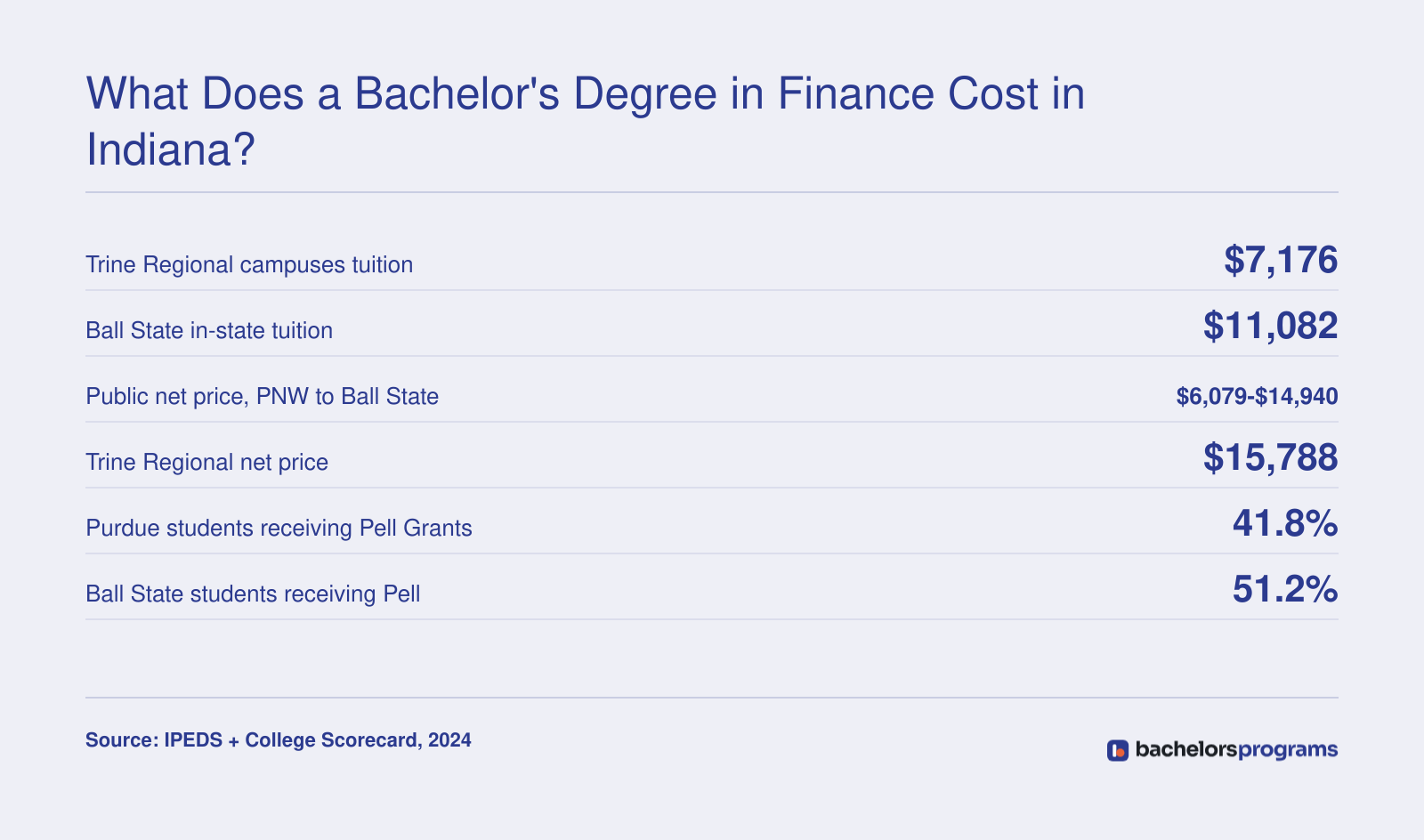
Among Indiana publics, in-state tuition and fees for a bachelor's degree in finance cluster tightly. Purdue University lists about $9,992 a year, Ball State University about $11,082, and Indiana State University about $10,258. Net price, which estimates what a typical aided student actually pays for tuition, fees, housing, and living costs, runs higher: roughly $14,600 at Purdue and $14,940 at Ball State. On the private side, Trine University-Regional/Non-Traditional Campuses posts tuition near $7,176 with a net price around $15,788, a reminder that private discounting can close the gap.
Treat net price as a sector-level average, not a quote. Your family income, residency, and merit awards can move the figure by thousands in either direction.
Indiana State Aid
Two programs do most of the heavy lifting:
- 21st Century Scholars: Income-eligible Hoosier students who enroll by June 30 of their eighth-grade year can earn up to four years of paid tuition at an eligible Indiana college, applied toward a first bachelor's degree.1
- Frank O'Bannon Grant: Indiana's main need-based award, made up of the Higher Education Award and Freedom of Choice Award. For 2026-27, maximums reach $10,600 at eligible private institutions and $5,300 at eligible publics, with public awards set at half the private figure by statute.2 You must be an Indiana resident, enroll full-time, and earn 24 to 29 credits a year to renew (30 or more for the maximum award).3
Fast Track adds aid for qualified recipients who complete 30 credits.4 Beyond state money, most business schools here award departmental scholarships, and many finance programs note institutional aid directly.
File the FAFSA by April 15 for state aid; no separate application exists for the O'Bannon Grant.3 Across four years, budget roughly $58,000 to $63,000 at these net price levels before state grants reduce it further.
What Does a Bachelor's Degree in Finance Cost in Indiana?
These figures come from federal cost data for finance programs at Indiana public universities and one private campus. Tuition and net price after aid do not always rank schools in the same order. Compare what you will actually pay after grants, not the advertised tuition, when weighing public and private options.
What You Can Do With a Bachelor's Degree in Finance in Indiana
A finance degree in Indiana points toward two quite different working lives: client-facing advisory, where you manage relationships and money for individuals, or an analytical seat inside an organization, where you build models, forecast, and support decisions. The coursework overlaps heavily. The day-to-day work does not.
Where Graduates Get Hired
Common entry-level titles include financial analyst, associate advisor or paraplanner, loan officer, credit analyst, and corporate finance or treasury analyst. Banking, insurance, and wealth management employment clusters in Indianapolis, while finance teams sit inside manufacturers, health systems, and universities across the rest of the state. Internships taken during the degree are the usual route into those teams.
What the Pay Looks Like
Indiana wage data gives a rough sense of scale. Personal financial advisors in the state averaged about $115,170 a year, loan officers about $67,970, and analysts and related specialists about $75,010.1 In the Indianapolis metro, personal financial advisors averaged about $191,350, though that figure and the statewide numbers come from different survey years.2 All of these are averages rather than medians, and none reflect the newest release, so read them as directional.
No State License for Finance Itself
Indiana does not license finance as a profession, so no state credential is required to graduate or to hold a finance job title. Licensing attaches to specific activities instead: giving investment advice usually means passing a securities exam such as the Series 65, selling insurance requires a state producer license, and mortgage lending requires loan originator registration. Employers typically sponsor that first step.
Compare Finance programs on the data that matters
Explore more Business & Management majors or browse every field of study.
All Business & Management programs Browse every field of study