Best Cybersecurity Schools in Indiana
Compare 22 accredited Cybersecurity programs in Indiana at 19 colleges, with net price after aid, graduation rates, earnings and debt from IPEDS and the U.S. College Scorecard.

Costs at Indiana's public universities differ sharply: average net price after aid, measured across the whole institution, runs from $6,079 at Purdue University Northwest to $12,923 at the University of Southern Indiana. The degree is typically a Bachelor of Science (B.S.) in Cybersecurity, though some schools label it applied cybersecurity or house it inside computer science.
Before applying, weigh NSA Center of Academic Excellence designation, ABET accreditation of the computing program underneath, and tuition after Frank O'Bannon Grant aid. Portability into defense and federal contracting often turns on those stamps, not the degree title.
Key Points
- Purdue University Northwest leads on affordability, at $6,079 average net price.
- Ball State's Applied Cybersecurity is a fully online bachelor's option.
- Frank O'Bannon Grant and 21st Century Scholars both require a yearly FAFSA.
Best Bachelor's Degree in Cybersecurity Programs in Indiana: 10 Schools Ranked
Ten Indiana bachelor's programs, ordered by what most affects a student's four years and first job: net price after aid, institution-wide graduation rate, reported earnings, delivery format and available specializations. Each card names how the degree is delivered and what it concentrates on, then the approximate net price and the school-wide completion rate, followed by one honest reason to pick it.
Purdue University
#1West Lafayette, IN · ~$15,000/yr (est.)
Best for: In-state students wanting a research campus
Purdue's West Lafayette campus runs a Bachelor of Science in Cybersecurity through an ABET-accredited computing curriculum, also offered at its Indianapolis and Kokomo locations. Coursework covers secure coding, cryptography, digital forensics, UNIX administration, network security and cyber criminology, with hands-on vulnerability testing and industry internships. Graduates step into security analyst, penetration tester and incident response roles, and Purdue sits inside Indiana's statewide cybersecurity network, including work with the Indiana National Guard and state agencies.
- ABET accredited computing program
- 120 total credit hours with a sample four-year plan
- 2.0 GPA minimum, C- required in prerequisites
- Secure coding, cryptography and digital forensics coursework
- Hands-on vulnerability testing and secure network building
- Industry partnerships for internships
- Available at West Lafayette, Indianapolis and Kokomo
Indiana University-Indianapolis
#2Indianapolis, IN · $11,000 – $35,000/yr (est.)
Best for: Urban campus students seeking applied labs
IU Indianapolis offers a Bachelor of Science in Cybersecurity built on a cyber core plus specialized concentration tracks and a required RISE experiential learning component. Students take 120 credits, including 36 upper-level hours and 32 residence credits, and can plug into IU's Center for Applied Cybersecurity Research, which assesses local-government security across Indiana. The campus format gives access to labs and faculty, and the program feeds roles such as security analyst, network defender and information security officer.
- 120 total credit hours, 36 upper-level
- RISE experiential learning requirement
- 32 residence credits and 12 upper-level cyber credits
- 30-hour general education core
- 2.0 GPA minimum
- Cyber core plus specialized concentration tracks
- Reported median earnings near $56,000 four years after entry
Trine University
#3Angola, IN · ~$25,000/yr (est.)
Best for: Hands-on learners wanting a cyber range
Trine University's Bachelor of Science in Cybersecurity sits in the Allen School of Engineering and Computing in Angola and teaches both offensive and defensive security across 120 credit hours. Labs include simulation environments and a dedicated cyber range for training, testing and research, and every student completes a year-long senior design project. The curriculum maps toward CISSP, CEH and CompTIA Security+ credentials and roles from ethical hacker to security architect.
- 120 total credit hours
- Cyber range for training, testing and research
- Offensive and defensive security curriculum
- Year-long senior design project
- Prepares for CISSP, CEH and Security+
- Labs with simulation environments
- Scholarships available
Indiana State University
#4Terre Haute, IN · $11,000/yr (est. net price)
Indiana State University's Bachelor of Science in Cybercriminology and Security Studies blends criminal justice with technical security, offering a Cybercrime concentration of 51 credits alongside a Physical Security option. The School of Criminology and Security Studies holds National Center of Academic Excellence in Cyber Defense designation and was among the first programs to earn FAIR certification. Students get paid High-Tech Crime Unit internships and a Cyber/Intel Lab, and the Cybercrime concentration runs on campus, online or hybrid.
- Cybercrime concentration of 51 credits
- Two concentration options: Cybercrime or Physical Security
- 21 credits of core criminology and criminal justice
- NSA/DHS Cyber Defense Center of Excellence
- Fully online, hybrid or on-campus delivery
- Paid High-Tech Crime Unit internships
- Prepares for CompTIA A+, Net+, Security+ and SSCP/CISSP
Indiana Institute of Technology
#5Fort Wayne, IN · ~$23,000/yr (est.)
Indiana Tech in Fort Wayne pairs a technology core with criminal justice coursework in its Bachelor of Science in Cybersecurity, spanning 120 to 121 credit hours and available both online and on campus. Students work in a security operations center, digital forensics lab and interactive data center, covering network penetration, digital forensics and CyberOps. The program carries CAE-CD designation from the NSA and DHS and places interns with regional employers.
- 120 to 121 credit hours
- On-campus and online delivery options
- Security operations center and digital forensics lab
- CAE-CD designation from NSA and DHS
- Blends technical security with criminal justice
- Internships with leading companies
- Small class sizes with experienced instructors
Indiana Institute of Technology-College of Professional Studies
#6Fort Wayne, IN · ~$20,000/yr (est.)
Indiana Tech's College of Professional Studies delivers the same Bachelor of Science in Cybersecurity structure with lower published tuition and a more career-focused, adult-learner orientation. The curriculum covers network security, digital forensics and defensive CyberOps alongside criminal investigation fundamentals, with hands-on work in the security operations center and forensics lab. It holds CAE-CD designation and places interns with employers such as Bosch and Parkview Health.
- CAE-CD designation from NSA and DHS
- Hands-on programming and networking coursework
- Security operations center and digital forensics lab
- Combines technology core with criminal justice
- Internships with Bosch and Parkview Health
- Small class sizes and personal faculty interaction
Indiana University-Bloomington
#7Bloomington, IN · $12,000 – $42,000/yr (est.)
IU Bloomington's Bachelor of Science in Cybersecurity and Global Policy is an interdisciplinary degree shared by the Luddy School, the College of Arts and Sciences and the Hamilton Lugar School. Students study programming, data structures and security protocols alongside privacy law, diplomacy and the global policy consequences of networked systems. It suits students who want to shape cybersecurity rules and strategy, not only configure defenses, and connects to IU's statewide security assessment work.
- Joint degree across three IU schools
- Technical coursework in programming and data structures
- Policy, privacy and legal issue coursework
- Global social policy and diplomacy focus
- Communication and policy-making skill development
- Campus-based, in-person delivery
Oakland City University
#8Oakland City, IN · $15,000/yr (est. net price)
Oakland City University launched a hands-on Bachelor of Science in Cybersecurity aimed squarely at practical, low-code and no-code security roles. The 54-credit major covers ethical hacking, risk management, network security and digital forensics through lab-based training, with supporting courses in business, computer science and psychology. Graduates can move into cybersecurity, IT, business analysis or criminal justice work, and the program is one of the newest in the state.
- 54 credit hours in the major
- Lab-based training in ethical hacking
- Courses in network and system security
- Security operations coursework
- Supporting courses in business, computer science and psychology
- Prepares for low-code and no-code security roles
Ball State University
#9Muncie, IN · $10,000 – $15,000/yr (est.)
Ball State University's online Bachelor of Science in Applied Cybersecurity is built for working adults, with asynchronous courses that follow the NICE Framework and NIST standards. The 71-credit major prepares students for CompTIA Security+ and Certified Ethical Hacker credentials, includes a hands-on internship and accepts transfer credit generously. Indiana residents may qualify for the Adult Student Grant, and a student success specialist supports students throughout.
- 100 percent online, asynchronous format
- 71 major credits required
- Follows the NICE Framework and NIST standards
- Prepares for Security+ and Certified Ethical Hacker
- Hands-on internship included
- Transfer credits accepted
- Adult Student Grant eligibility for Indiana residents
Grace College and Theological Seminary
#10Winona Lake, IN · ~$20,000/yr (est.)
Grace College in Winona Lake offers a computer science major with a cybersecurity concentration through its School of Science and Engineering, covering network security, ethical hacking, digital forensics, incident response and cloud security. Coursework blends on-campus classes with online courses from a national consortium of accredited institutions, and includes internships and simulated cyberattacks. Courses were developed with input from Google, and the program frames security study within a faith-informed ethics context.
- Cybersecurity concentration within the CS major
- Network security, ethical hacking and digital forensics
- Security operations, incident response and cloud security
- On-campus classes plus consortium online courses
- Internships and simulated cyberattacks
- Courses developed with Google input
- Five concentration options across the department
Cost & outcomes by school
Federal data for the highest-earning Cybersecurity programs, independent of the ranking above. Earnings are this field's bachelor's graduates four years after completing where the Scorecard reports them, else the school's undergraduate median.
| School | Net price / yr | Grad rate | Earnings | Debt | Grads/yr | Format |
|---|---|---|---|---|---|---|
| Purdue University IN | $14,600 | 83% | $72,424 | $19,500 | — | Campus |
| Indiana University-Bloomington IN | $16,264 | 80% | $63,742 | $19,509 | — | Campus |
| Indiana Wesleyan University IN | $22,866 | 67% | $59,986 | $24,250 | — | Online |
| Indiana Wesleyan University IN | $16,898 | 35% | $59,986 | $24,250 | — | Online |
| Trine University IN | $25,355 | 64% | $57,165 | $25,000 | 10 | Campus |
| Trine University-Regional/Non-Traditional Campuses IN | $15,788 | — | $57,165 | $25,000 | — | Campus |
| Indiana University-Indianapolis IN | $11,668 | 55% | $55,988 | $27,000 | 41 | Campus |
| University of Evansville IN | $18,499 | 65% | $53,770 | $24,606 | — | Campus |
| Ball State University IN | $14,940 | 62% | $51,833 | $23,250 | — | Online |
| Anderson University IN | $25,021 | 54% | $48,899 | $27,000 | — | Campus |
| Bethel University IN | $18,610 | 53% | $48,860 | $25,000 | — | Online |
| Indiana State University IN | $10,873 | 43% | $48,387 | $24,000 | 13 | Hybrid |
Sources: U.S. Department of Education. Net price, graduation rate, earnings and debt: College Scorecard (earnings and debt for this field's bachelor's graduates where reported, else school-wide); graduates: IPEDS. A dash means no figure is reported.
Cost, debt & payoff
Median earnings of this field's bachelor's graduates (4 yrs after completing, else the school's undergraduate median) vs. their median federal loan debt · U.S. College Scorecard
Across these programs the median graduate earns about $48,880 and finishes with roughly $24,250 in debt — a ratio that clears a common rule of thumb (keep debt below first-year salary). Net price and debt vary widely school to school, so check the per-school figures in the table above before you shortlist.
ABET Accreditation and NSA Designations at Indiana Campuses
ABET's accredited-program database lists five Indiana institutions with accredited computing programs, and Purdue University at West Lafayette, Purdue University Northwest and Trine University are among them. That listing is a starting point, not a guarantee: the search is a category result, so it does not confirm that the specific cybersecurity bachelor's program you are applying to carries the stamp.
What ABET Accreditation Signals
ABET reviews a program, not a whole college. Accreditation means the curriculum, faculty and facilities were measured against a discipline standard, which matters if you later apply for federal positions, graduate school or employer tuition benefits that ask for an accredited degree. ABET describes this credential as separate from, and complementary to, the NSA designation.1
What the CAE-CD Designation Signals
The National Centers of Academic Excellence in Cyber Defense designation is institutional and awarded jointly by the NSA and the Department of Homeland Security. It signals alignment with federal cyber defense curriculum standards and can open scholarship and internship pipelines. Current status is not always posted on a program page, so verify it against the NSA's own list before applying, and ask the department directly if a school appears on neither list.
The Baseline: Regional Accreditation
Neither credential replaces regional accreditation, which is what makes a school eligible for federal financial aid and keeps credits transferable. Confirm that first, then layer the specialized designations on top.
Cheapest Cybersecurity Bachelor's Programs in Indiana: Public vs. Private Net Price
Every school with the lowest average net price is a public university, so no private school makes this cut. Net price runs from $6,079 at Purdue University Northwest to $12,923 at the University of Southern Indiana, a gap of $6,844 a year, and it can exceed tuition because it also counts housing, books and other costs. These figures come from IPEDS and College Scorecard (2024) and are each school's institution-wide average after grants and scholarships, not a personal quote, so run each school's net price calculator for your own estimate.
| School | City | Sector | Program | Format | In-State Tuition and Fees | Average Net Price After Aid |
|---|---|---|---|---|---|---|
| Purdue University Northwest | Hammond | Public | Bachelor of Science in Cybersecurity | Campus | $8,675 | $6,079 |
| Purdue University Global | West Lafayette | Public | Cybersecurity | Online | $10,101 | $7,770 |
| Indiana State University | Terre Haute | Public | Cybercriminology and Security Studies (BS) | Campus and online | $10,258 | $10,873 |
| Indiana University-Indianapolis | Indianapolis | Public | Bachelor of Science in Cybersecurity | Campus | $10,762 | $11,668 |
| University of Southern Indiana | Evansville | Public | Applied Studies, BPS - Cybersecurity | Online | $10,066 | $12,923 |
Studying Cybersecurity Online or Hybrid From an Indiana School
Online and on-campus are not the only two formats in Indiana; several programs blend the two.
Who offers what format
Ball State University's Applied Cybersecurity is the clearest fully online option among the schools ranked here, delivered asynchronously with 71 major credits and transfer credit accepted. Indiana State University lists a fully online option for its Cybercriminology and Security Studies degree, and Grace College and Theological Seminary runs its cybersecurity concentration in a hybrid format, with some coursework offered online through an accredited national consortium. Indiana Tech publishes both on-campus and online cost schedules for its Cybersecurity, B.S., including through its College of Professional Studies. Purdue University, Indiana University-Bloomington, Indiana University-Indianapolis, Trine University and Oakland City University deliver their cybersecurity degrees on campus.
Pacing and completion time
Asynchronous courses let working adults move through terms without fixed class meetings, and Ball State notes flexible pacing plus an application deadline roughly two weeks before each term starts. Most bachelor's programs here require 120 credits, so full-time students typically finish in four years; part-time learners should plan on longer. Confirm term length and course load directly with the program, since schools do not all publish these details.
Starting at Ivy Tech
Ivy Tech's A.S. in Cybersecurity runs 60 credits across four semesters, and its classes may be online, in person or hybrid. Completers can move on through a 2+2 TSAP or Guaranteed Admissions Pathway and enter a partner bachelor's program as juniors; Indiana Tech publishes course equivalencies for this route specifically1. Each partner sets its own GPA and eligibility rules.
Trade-offs to weigh
Online study can limit access to physical labs, Indiana Tech's security operations center and digital forensics lab, or Trine's cyber range. Expect proctored exams, and ask whether any residency, internship or in-person component applies.
Getting in: GPA, Test Policy and Transfer Credit for Indiana Programs
Getting into an Indiana cybersecurity bachelor's program usually takes two steps: admission to the university, then any extra requirements for the major. Policies vary widely, and several schools publish very little.
First-Year GPA and Test Policy
Indiana University-Bloomington is test-optional for first-year applicants and publishes no minimum GPA for its cybersecurity program. The 2.3 to 3.0 GPA figures you may see are intercampus transfer standards, not program minimums. Indiana University-Indianapolis lists a 2.0 GPA minimum for its B.S. and publishes no SAT/ACT policy. Purdue University publishes no SAT/ACT policy on the pages we reviewed.
Several other schools publish no clear GPA or test policy on their program pages: Trine University, Indiana State University, Indiana Institute of Technology, Oakland City University, Ball State University, Grace College and Theological Seminary, Purdue University Northwest, Purdue University Global and the University of Southern Indiana. Check each admissions office directly before you apply.
Transfer Credit
Purdue University is the strictest published case: a 3.2 GPA to transfer into the cybersecurity major, plus a coding course and Calculus 1, each at B- or better. Indiana University-Bloomington reviews credit course by course after admission and publishes no maximum. Indiana University-Indianapolis uses a Transfer Rule Catalog and may award experiential credit. Ball State University's online program says it accepts transfer credits.
An associate degree from an Indiana community college can shorten the path by covering general education and early technical courses. Indiana University-Indianapolis lists a cybersecurity associate degree as a pathway toward bachelor's study in computer science or informatics, so confirm that your credits count toward your target major, not just toward graduation.
Selectivity Signal
The College Scorecard admission rate is a rough guide. Purdue University admits about half of applicants. Most other schools here sit between roughly 70 and 85 percent, so program requirements and prerequisites often matter more than the front door.
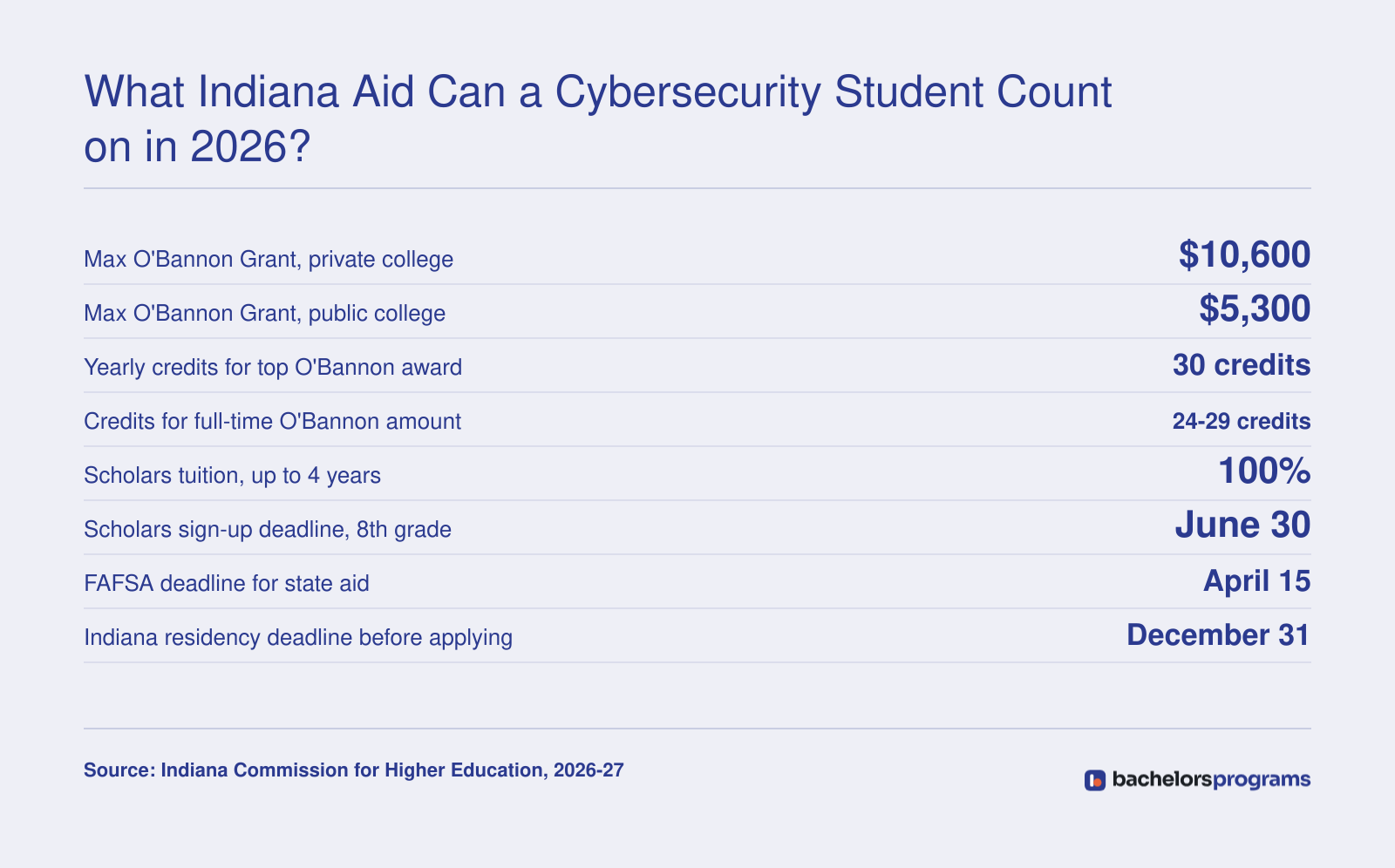
What Indiana Aid Can a Cybersecurity Student Count on in 2027?
Indiana's two main state aid programs for bachelor's students are the need-based Frank O'Bannon Grant and the income-based 21st Century Scholars program, and both require a FAFSA every year. O'Bannon amounts are maximums for on-time students and vary with financial need, school type and enrollment. The Workforce Ready Grant pays only for short-term certificate programs, so it does not fund a bachelor's degree in cybersecurity.
Related Articles
Indiana Cybersecurity Degree Questions, Answered Fast
These quick answers cover the questions Indiana students ask most about choosing a bachelor's degree in cybersecurity. Figures come from published school pages and recent sources, and they vary by school and format, so confirm details with each admissions office.
What is the best school for cybersecurity in Indiana?
How much does a bachelor's degree in cybersecurity cost in Indiana?
Can you get a bachelor's degree in cybersecurity online from an Indiana school?
How much do cybersecurity graduates earn in Indiana?
Are Indiana cybersecurity programs accredited or NSA-designated?
Will my community college associate credits count toward a cybersecurity bachelor's?
Does Indiana require a license to work in cybersecurity?
Is Security+ worth earning before I graduate?
Compare Cybersecurity programs on the data that matters
Explore more Computers & IT majors or browse every field of study.
All Computers & IT programs Browse every field of study