Best Computer Science Schools in Indiana
Compare 57 accredited Computer Science programs in Indiana at 36 colleges, with net price after aid, graduation rates, earnings and debt from IPEDS and the U.S. College Scorecard.
Entry-level software hiring has tightened in recent years, and employers now screen new graduates more closely on projects, internships, and fundamentals. A bachelor's degree in computer science, offered in Indiana as a Bachelor of Science (B.S.) or Bachelor of Arts (B.A.) in Computer Science, therefore carries different weight depending on where it is earned.
Options run from large public research universities like Purdue University and Indiana University-Bloomington to small private colleges such as Taylor University, DePauw University, and Goshen College, plus online and hybrid routes from Indiana-based schools.
The differences that matter most are ABET accreditation, internship access, and what you actually pay.
Key Points
- Indiana University-Kokomo has the lowest net price here: $3,968 a year.
- Indiana University-Bloomington tuition runs $12,144 in-state but $41,891 out-of-state.
- Grace College and Theological Seminary offers a blended, not fully remote, route.
Best Bachelor's in Computer Science Schools in Indiana: Our Top 10
Indiana's computer science landscape runs from a department that calls itself the nation's first to small liberal arts programs where seniors build a capstone with a faculty mentor. The ten bachelor's programs below cover public flagships, regional campuses, private universities, and one hybrid option, so you can weigh scale against class size and cost against outcomes. Every entry awards a Bachelor of Science or a Bachelor of Arts in Computer Science.
Purdue University
#1West Lafayette, IN · ~$15,000/yr (est.)
Best for: Students targeting AI and software engineering careers
Purdue's computer science department describes itself as the nation's first, and it remains the benchmark program in the state. Undergraduates study algorithms, systems, software engineering, data science, and cybersecurity at campuses in West Lafayette and Indianapolis, with electives reaching into artificial intelligence, robotics, and computational biology. Transfer applicants face a 3.3 GPA bar plus specific computer science and calculus coursework, and freshman admission expects four years of math and English. It suits students who want scale, deep industry ties, and a very large elective catalog.
- Bachelor of Science in Computer Science from the College of Science
- Tracks: Machine Learning and Artificial Intelligence, Software Engineering
- Transfer applicants need a 3.3 GPA plus computer science and calculus courses
- Admission expects four years of math, four of English, three of lab science
- Campus locations in West Lafayette and Indianapolis
- Coursework spans algorithms, systems, software engineering, data science, security
- Electives in artificial intelligence, robotics, and computational biology
- Department describes itself as the nation's first computer science department
Indiana University-Bloomington
#2Bloomington, IN · $12,000 – $42,000/yr (est.)
Best for: Transfer students seeking streamlined pathways
Indiana University Bloomington awards its Bachelor of Science in Computer Science through the Luddy School, with eight specializations that let students tilt the degree toward software engineering, artificial intelligence, computer security, game development, data science, or theory. Research, internships, and class projects are built into the experience, and the campus pairs the degree with a makerspace, a living learning center, and accelerated master's options. IU has also been expanding transfer pathways, cross-disciplinary AI programs, and student access to generative AI tools.
- Bachelor of Science in Computer Science through the Luddy School
- Eight specializations, including AI, security, game development, and data science
- Hands-on research, internships, and class projects built into the degree
- Accelerated master's options and a computer science minor available
- Makerspace, living learning center, and student organizations on campus
- Graduates report a high employment rate and strong starting salaries
Taylor University
#3Upland, IN · ~$25,000/yr (est.)
Best for: Faith-driven students interested in computing for missions
Taylor University is a Christian liberal arts campus in Upland that awards both a B.A. and a B.S. in Computer Science through its Computer Science and Artificial Intelligence Department. Students choose from seven concentrations, including AI and machine learning, cybersecurity, digital media, information systems and analytics, and theory, and the department reports that 100% of graduates are employed within six months. The Roth Center for Missions and Computing and electives in computing for missions give the program an unusual focus for students who want technology to serve work abroad.
- B.A. and B.S. in Computer Science with seven concentration options
- Concentrations include AI and machine learning, cybersecurity, digital media, theory
- Department reports 100% of graduates employed within six months
- Roth Center for Missions and Computing; electives in computing for missions
- Computer Science Scholarship application due February 28
- Extended programming practicums and research projects
- Careers cited: software engineer and systems analyst
DePauw University
#4Greencastle, IN · $20,000 – $25,000/yr (est.)
DePauw University is a private liberal arts campus in Greencastle where computer science sits inside a small, writing-intensive curriculum. The major runs 11 courses, from introductory programming through a faculty-mentored senior project, and students gather in groups to present their work and discuss ethics in computing. Internships and research are encouraged rather than required, which leaves room for double majors and off-campus study.
- Major requires 11 courses, including nine in computer science and MATH 123
- Core includes CSC 121, 125, 231, 235, 236 and a senior capstone, CSC 498
- Faculty-mentored senior project with a written proposal and presentation
- Writing in the Major requirement spans 200-, 300- and 400-level courses
- Internships and research encouraged but not required
- Core curriculum updated in fall 2024; a minor takes five courses
Ball State University
#5Muncie, IN · $10,000 – $15,000/yr (est.)
Ball State University in Muncie offers a B.A. or B.S. in Computer Science with several concentrations, including a general track that goes deep into networks, operating systems, database design, and programming languages. The 120-credit degree ends in a senior capstone where teams work with local businesses, nonprofits, and campus offices on applied projects. Students can add a second computer science concentration or a second major in math, physics, or business.
- B.A. or B.S. in Computer Science, General Computer Science concentration
- 120 total credit hours; core 33 to 36 credits, concentration 27 credits
- Coursework in networks, operating systems, database design, programming languages
- Senior capstone pairs students with community partners on applied projects
- Immersive Learning projects with organizations such as Accutech and Minnetrista
- Can pair with a second computer science concentration or a second major
Grace College and Theological Seminary
#6Winona Lake, IN · ~$20,000/yr (est.)
Grace College in Winona Lake delivers its computer science major in a hybrid format that mixes online courses with on-campus instruction, developed through the Lower Cost Models for Independent Colleges Consortium with input from companies including Google. The Application Development focus covers mobile, web, UX and UI design, cloud and DevOps, and backend systems, with supporting work in mathematics and business. Courses are taught through a biblical worldview, and projects and internships are part of the mix.
- Hybrid format combining online courses with on-campus instruction
- Application Development focus: mobile, web, UX and UI, cloud and DevOps, backend
- Courses developed with input from companies including Google
- Delivered through the Lower Cost Models for Independent Colleges Consortium
- Support coursework in mathematics and business alongside programming
- Taught through a biblical worldview; internships and team projects included
Indiana University-Indianapolis
#7Indianapolis, IN · $11,000 – $35,000/yr (est.)
IU Indianapolis launched a dedicated computer science department and its undergraduate degrees in fall 2024, giving students a new program backed by the Luddy School's established Indianapolis presence. Learners choose a Bachelor of Arts or a Bachelor of Science, or an online version of the B.S., and coursework connects computing with AI, data science, and user-experience design. Luddy Indianapolis students have also taken part in an industry co-op partnership with Lilly, which puts the program close to the city's tech and life-sciences employers.
- 120-credit Bachelor of Arts with core programming, data structures, and theory
- Requires a C- or better in all courses and a 2.0 cumulative GPA to graduate
- An area of specialization such as a minor or certificate customizes the degree
- Experiential learning options include an internship or senior project
- Transfer students should consult an advisor about course exceptions
- 120-credit Bachelor of Science with core computer science coursework
- Internship or senior project satisfies the experiential learning requirement
- Some courses are offered only once a year, so plan ahead with an advisor
- C- or better in every course and a 2.0 cumulative GPA required to graduate
- Fully online Bachelor of Science in Computer Science, 120 credits
- Core A courses 37 credits; general education 42 credits; electives 30 credits
- Includes programming, data structures, operating systems, databases, algorithms
- Internship or capstone available for the experiential learning component
- Math and statistics plus arts, humanities, and social science requirements
Goshen College
#8Goshen, IN · ~$14,000/yr (est.)
Goshen College is a small Mennonite-affiliated campus in northern Indiana where the computer science major runs 51 credits and includes a required internship and a senior seminar. The sequence moves from Programming I and II through data structures, operating systems, and algorithm analysis, with database design, networking and security, and human-computer interaction alongside. Discrete math, calculus, and linear algebra round out the major, and students can double major with information technology.
- 51-credit major with a minor also available
- Sequence runs from Programming I and II into data structures and algorithm analysis
- Coursework in database design, networking and security, human-computer interaction
- Required internship in the computer field plus a senior seminar capstone
- Discrete math, calculus, and linear algebra round out the major
- Double major option with information technology
Indiana University-Kokomo
#9Kokomo, IN · ~$4,000/yr (est.)
IU Kokomo is a regional Indiana University campus that keeps its computer science degree applied, with an emphasis on big data: acquiring, storing, modeling, and analyzing information to solve real problems. Classes are small and the program is campus based, which suits students who want a commutable public option in north central Indiana. Minors and a postbaccalaureate certificate in informatics are available for students who want computing skills without the full major.
- Bachelor of Science in Computer Science offered on campus
- Curriculum emphasizes big data: acquisition, storage, modeling, and analysis
- Builds skills in collecting, storing, and analyzing data to solve real problems
- Minors and a postbaccalaureate certificate in informatics also available
Valparaiso University
#10Valparaiso, IN · ~$19,000/yr (est.)
Valparaiso University offers both a B.A. and a B.S. in Computer Science in the College of Arts and Sciences, with the B.S. requiring 36 credits and reserving about two-thirds of coursework for exploratory electives chosen with a faculty advisor. A seminar in professional practices covers ethics, privacy, liability, and technology's global impact, and internships with the Naval Surface Warfare Center and the Federal Reserve give students real-world exposure. The college reports that 97.5% of its graduates are employed or in graduate school within nine months.
- B.A. requires at least 32 credits; the B.S. requires 36
- Two-thirds of B.S. courses are exploratory electives chosen with an advisor
- Coursework in algorithms, programming languages, data structures, discrete math
- Seminar in professional practices covers ethics, privacy, and liability
- Internships with the Naval Surface Warfare Center and the Federal Reserve
- College reports 97.5% employed or in graduate school within nine months
Cost & outcomes by school
Federal data for the highest-earning Computer Science programs, independent of the ranking above. Earnings are this field's bachelor's graduates four years after completing where the Scorecard reports them, else the school's undergraduate median.
| School | Net price / yr | Grad rate | Earnings | Debt | Grads/yr | Format |
|---|---|---|---|---|---|---|
| Purdue University IN | $14,600 | 83% | $146,685 | $19,136 | 791 | Campus |
| Rose-Hulman Institute of Technology IN | $42,513 | 78% | $123,753 | $24,500 | 114 | Campus |
| DePauw University IN | $22,264 | 75% | $120,076 | $26,500 | 55 | Campus |
| Indiana University-Bloomington IN | $16,264 | 80% | $114,199 | $19,366 | 192 | Campus |
| Taylor University IN | $24,865 | 74% | $108,812 | $20,500 | 12 | Campus |
| Indiana University-Southeast IN | $7,888 | 39% | $102,250 | $19,684 | 21 | Online |
| Purdue University Fort Wayne IN | $13,171 | 36% | $101,396 | $25,500 | 56 | Campus |
| University of Notre Dame IN | $26,780 | 95% | $99,980 | $19,000 | — | Hybrid |
| Indiana University-South Bend IN | $8,653 | 40% | $99,574 | $21,355 | 11 | Campus |
| Indiana University-Indianapolis IN | $11,668 | 55% | $94,380 | $21,500 | 15 | Campus |
| Valparaiso University IN | $18,578 | 70% | $94,111 | $25,125 | 17 | Campus |
| Purdue University Northwest IN | $6,079 | 43% | $88,158 | $21,229 | 28 | Campus |
Sources: U.S. Department of Education. Net price, graduation rate, earnings and debt: College Scorecard (earnings and debt for this field's bachelor's graduates where reported, else school-wide); graduates: IPEDS. A dash means no figure is reported.
Cost, debt & payoff
Median earnings of this field's bachelor's graduates (4 yrs after completing, else the school's undergraduate median) vs. their median federal loan debt · U.S. College Scorecard
Across these programs the median graduate earns about $59,986 and finishes with roughly $24,250 in debt — a ratio that clears a common rule of thumb (keep debt below first-year salary). Net price and debt vary widely school to school, so check the per-school figures in the table above before you shortlist.
How We Ranked Indiana Bachelor's Programs in Computer Science
Reputation scores and student reviews show how a school is perceived. Net price, graduation rates, and graduate earnings show what a bachelor's degree is likely to cost and deliver. This ranking leans on the second set.
What the Ranking Measures
Only undergraduate programs count here. Each school was judged on its bachelor's degree in computer science, using four plain measures:
- Net price: what students pay once grants and scholarships are applied, not the sticker tuition.
- Graduation rate: the portion of students who complete their degree.
- Completions: how many students earn a computer science bachelor's at the school, a rough signal of program size and stability.
- Earnings outcomes: federal College Scorecard data on what graduates earn after leaving school.
What the Numbers Do and Don't Show
Graduation rates and net price are institution-wide averages. They describe the whole undergraduate student body, not computer science majors alone, so a computer science student's cost or odds of finishing may run higher or lower than the figure shown. Treat them as a starting point, then ask each school's computer science department for program-level detail before you commit.
How This Differs From Other Lists
Much of U.S. News's computer science coverage centers on graduate programs and peer reputation, which says little about what a bachelor's student pays or earns. Niche lists lean heavily on student reviews. This ranking stays focused on cost and outcomes for undergraduates.
The ranking covers only the schools listed here. Campus, online, and hybrid programs were all eligible, so delivery format did not affect whether a school could place.
Most Affordable Computer Science Bachelor's Programs in Indiana
Indiana University-Kokomo, one of the schools ranked here, has the lowest net price below at $3,968 a year. Purdue University Northwest, Indiana University-Southeast and Indiana University-South Bend, all in our directory, also come in under $9,000. Figures come from the U.S. Department of Education's IPEDS and College Scorecard data (2024); net price is an average for aided students, an estimate rather than a quote for any one student, and median debt is school-wide.
| School | City | Format | Net Price After Aid (per year) | In-State Tuition and Fees (per year) | Median Debt at Graduation |
|---|---|---|---|---|---|
| Indiana University-Kokomo | Kokomo | Campus | $3,968 | $8,424 | $16,961 |
| Purdue University Northwest | Hammond | Campus | $6,079 | $8,675 | $21,229 |
| Indiana University-Southeast | New Albany | Online | $7,888 | $8,424 | $19,684 |
| Indiana University-South Bend | South Bend | Campus | $8,653 | $8,424 | $21,355 |
| Indiana University-Indianapolis | Indianapolis | Campus | $11,668 | $10,762 | $20,000 |
Questions to Ask Yourself
Do you qualify for Indiana in-state tuition and state aid?
How much debt can you accept against the earnings figures shown above?
Do you want a large research university or a smaller program with closer faculty contact?
Online and Hybrid Bachelor's in Computer Science Options at Indiana Schools
Can you earn a bachelor's degree in computer science online from an Indiana-based school? Among the schools ranked here, the main flexible route is a blended one rather than a fully remote one. Grace College and Theological Seminary runs its computer science major in a hybrid format. The other ranked programs are delivered on campus.
Campus-Based Programs
Purdue University, Indiana University-Bloomington, Taylor University, DePauw University, Ball State University, Indiana University-Indianapolis, Goshen College, Indiana University-Kokomo and Valparaiso University all list their computer science bachelor's as campus programs. Ball State specifies on-campus delivery through its College of Sciences and Humanities, and IU Kokomo describes its program as offered on campus.
If you need flexibility at one of these schools, ask the department whether individual courses run online or in evening sections. A campus program can still include some online coursework, even when the degree itself is not offered remotely.
Grace College's Hybrid Option
Grace's major combines online courses with on-campus instruction, so plan on regular time in Winona Lake. A partnership with the LCMC consortium shapes the program, its courses draw on input from Google, and it includes internships and collaborative coursework. Application development is one of its concentrations.
Before you enroll, ask Grace's admissions office three questions:
- Campus time: How often must hybrid students attend in person?
- Class format: Do online courses meet at set times, or can you work through them on your own schedule?
- Credential: Is the hybrid major the same degree that campus students earn?
How Tuition Works for Online and Hybrid Students
Grace lists program tuition of $29,645, the same for Indiana residents and out-of-state students. Private colleges often charge one rate regardless of where you live. Public universities set separate rates by residency. Purdue, for example, charges $9,992 in-state and $28,794 out-of-state for its campus program.
Online and hybrid coursework at any school may carry its own per-credit rate or distance-education fees that differ from the in-state campus price. Request a written cost breakdown for the exact format you plan to take before you compare schools.
Related Articles
Admissions for a Bachelor's Degree in Computer Science in Indiana
Indiana's most selective computer science programs and its broader-access campuses set very different bars, so your odds depend heavily on where you apply. These admit rates are school-wide figures, not computer science-specific ones.
Selectivity and GPA
Purdue University admits about 50 percent of applicants overall, and its program information describes admission as competitive. DePauw University admits about 57 percent. Taylor University (about 74 percent), Indiana University-Indianapolis (about 76 percent) and Indiana University-Bloomington (about 78 percent) sit in the middle. Grace College and Theological Seminary (about 82 percent), Goshen College (about 84 percent), Ball State University (about 86 percent), Indiana University-Kokomo (about 86 percent) and Valparaiso University (about 89 percent) admit the largest shares.
IU Bloomington publishes no minimum GPA or middle-50% range for first-year applicants.1 Reviewers weigh grades in academic coursework, including honors, dual-credit, IB and AP classes, along with the essay and extracurriculars. For the other schools here, we found no published GPA benchmark, so check each admissions page directly.
Test policy and entry into the major
IU Bloomington is test-optional for 2026.1 You choose whether SAT or ACT scores are considered, and you can receive full consideration without them. Transfer applicants there are not required to submit scores either.1 We did not find test policies for the other schools, so confirm them before you apply.
IU Bloomington does not publish whether admission to its Computer Science B.A., which also offers an honors option, is direct or requires a separate internal application after general admission.2 The same gap applies to the other schools, so ask admissions counselors about it.
Transfer credit and Ivy Tech
Purdue's program information lists a 3.3 minimum GPA for transfer applicants, along with required computer science and calculus coursework. Treat that as a starting point and verify it with the school. IU Indianapolis tells transfer students to consult an advisor, which is sensible advice at any campus. IU Bloomington has no published computer science transfer-credit policy, and no Ivy Tech agreement is published for it.2
For Ivy Tech or another Indiana community college, we found no published pathway at any school here, so do not assume your credits will count toward the major. Request a written course-by-course evaluation before you enroll. Programming and calculus sequences are the courses most likely to be scrutinized.
Cost of a Computer Science Bachelor's Degree in Indiana
The number that decides whether an Indiana computer science degree is affordable is rarely the one printed on the tuition page. Sticker price and the average net price after grants and scholarships can differ by five figures at the same university, so comparing schools on published tuition alone leads to the wrong conclusion.
Sticker Price vs. Average Net Price
Public universities in Indiana held in-state undergraduate tuition and mandatory fees flat for 2026-27, the second straight year without an increase. That freeze covers all IU and Purdue campuses and the state's other public institutions.
- Purdue University (West Lafayette): $9,992 in-state tuition and fees, $28,794 out-of-state, with an average net price of about $14,600 after aid.
- Indiana University-Indianapolis: $10,762 in-state, $34,891 out-of-state, average net price about $11,668.
- Ball State University: $11,082 in-state, $29,630 out-of-state, average net price about $14,940.
- Indiana University-Kokomo: $8,424 in-state, $22,811 out-of-state, average net price about $3,968.
- Goshen College: a private option listing $38,890 in tuition, with an average net price near $14,493.
- Indiana University-Bloomington: $12,142 in tuition and mandatory fees for a full-time Indiana undergraduate, and roughly $30,574 in total cost of attendance once housing, books, and transportation are added.1
Those net figures are averages across all aided students at each campus, not a quote for your family. Run each school's net price calculator with your own financial details before you treat any of them as your price.
Indiana Aid Worth Filing For
Two state programs do most of the work for Hoosier families. The 21st Century Scholars award requires enrolling in 7th or 8th grade and covers up to four years of tuition at an eligible Indiana college, with the dollar value depending on the institution. The Frank O'Bannon Grant is need-based, awarded through the FAFSA, and ran from $400 to $10,600 in 2026 depending on the college and demonstrated need. It requires Indiana residency by December 31 of the prior year, U.S. citizenship or eligible noncitizen status, a high school diploma or GED, and full-time enrollment. Renewing at 30 credit hours per year keeps the full on-time amount; 24 to 29 credits drops you to a reduced full-time award.
The Deadline That Moves the Math
Indiana sets an annual FAFSA priority deadline, and aid is committed in the order applications are received. File early, confirm the form processes without errors, and verify the date with the Indiana Commission for Higher Education rather than assuming last year's calendar still applies.
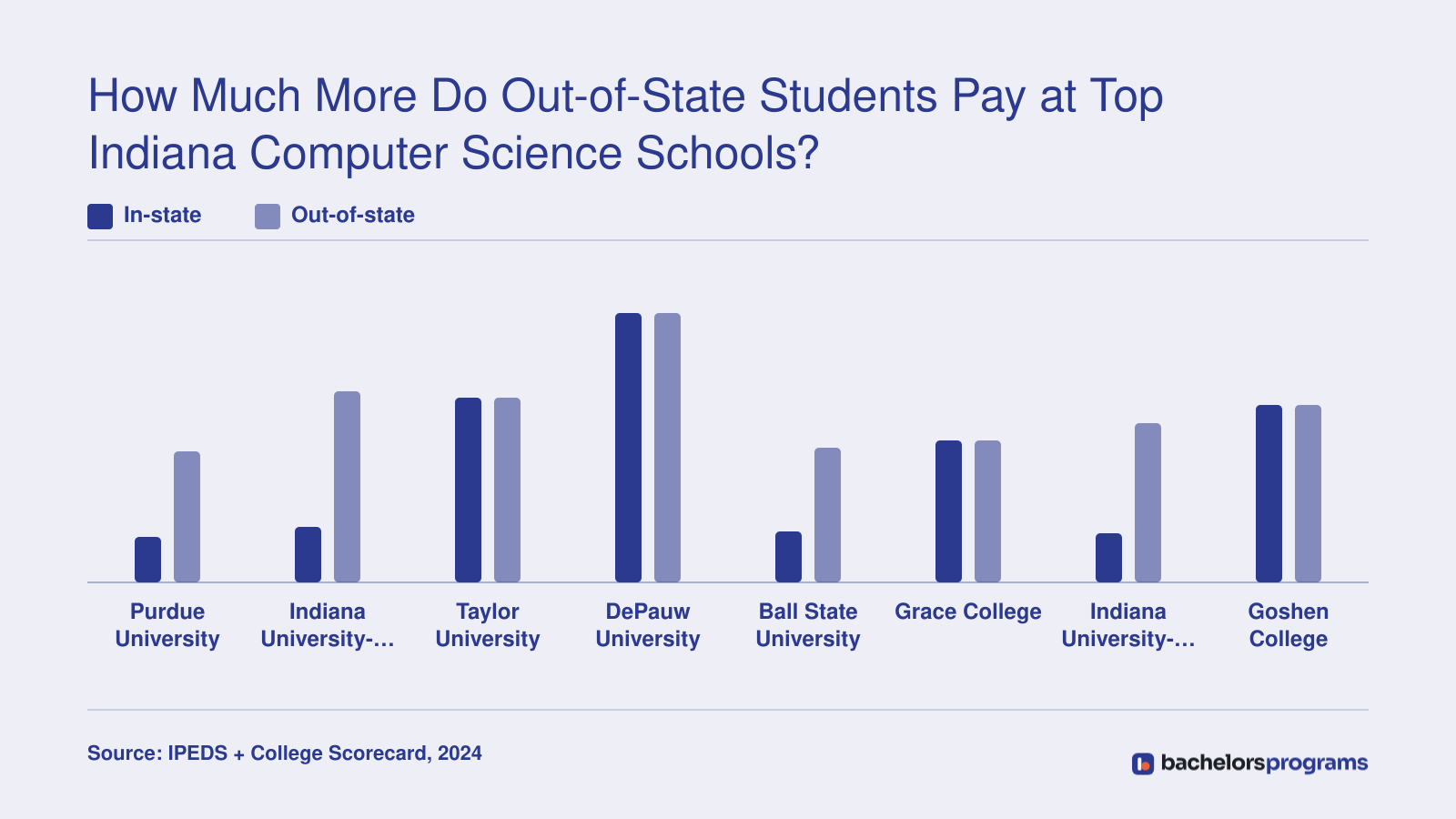
How Much More Do Out-of-State Students Pay at Top Indiana Computer Science Schools?
These are published tuition and fees before financial aid. The out-of-state premium is largest at Indiana University-Bloomington ($12,144 in-state vs. $41,891 out-of-state) and Indiana University-Indianapolis ($10,762 vs. $34,891). Private schools such as Taylor, DePauw, Grace and Goshen charge one rate to all students, so residency adds nothing to the bill.
ABET Accreditation, Specializations, and Internships at Indiana Schools
A program's ABET stamp and its list of specializations answer two different questions: whether the degree meets a recognized technical standard, and whether the coursework matches the job you want.
What ABET Confirms
ABET's Computing Accreditation Commission accredits computing programs at the associate, bachelor's and graduate levels.1 Its directory lists Indiana campuses including Purdue University at West Lafayette, Purdue University Fort Wayne and Purdue University Northwest, but the public listing does not identify which of their accredited programs is specifically a bachelor's degree in computer science rather than another computing or engineering program.2 Confirm the exact program on the department's page before you apply.
ABET matters because employers and graduate committees use it as a quick signal that a program has been reviewed against a recognized standard, and some federal hiring and credentialing pathways reference accredited degrees.
AI, Cybersecurity and Data Science
IU Bloomington lists artificial intelligence, computer security, data science and game development among eight specializations. Purdue offers electives in AI, cybersecurity and data science, plus robotics and computational biology. Taylor lists electives in AI, graphics and cybersecurity across seven concentrations. Ball State offers five concentrations, IU Indianapolis requires an area of specialization, Goshen covers networking, security and database design, and IU Kokomo foregrounds data acquisition and big data mining. Valparaiso builds its B.S. around exploratory electives, so students can assemble a de facto specialization.
Internships and Co-op Access
Goshen requires an internship in the computer field; DePauw encourages one but does not require it; IU Bloomington and Grace list internship opportunities. Valparaiso points to placements with the Naval Surface Warfare Center and the Federal Reserve. Co-op access is less standardized than the specialization menus: the program pages in our data describe internships, practicums and capstones, so ask each department whether a multi-term placement can count toward the degree. Those placements connect to Indiana's defense, finance and software employers, where many graduates build their first professional network.
Questions to Ask Yourself
Does ABET accreditation matter for the employers or graduate programs you are targeting?
Do you want a paid co-op or internship built into the degree, and can you handle the schedule it requires?
Are you leaning toward AI, cybersecurity, or general software development?
Compare Computer Science programs on the data that matters
Explore more Computers & IT majors or browse every field of study.
All Computers & IT programs Browse every field of study