Best Accounting Schools in Indiana
Compare 40 accredited Accounting programs in Indiana at 36 colleges, with net price after aid, graduation rates, earnings and debt from IPEDS and the U.S. College Scorecard.

A bachelor's degree in accounting is the standard entry point to Indiana accounting jobs and to the CPA license, but it does not license you on its own. Indiana requires 150 semester hours, 30 more than a typical bachelor's.
The Bachelor of Science (B.S.) in Accounting is the most common credential. The programs ranked here include campus and online options at Indiana-based schools, from large research universities to small private colleges.
Tuition and CPA preparation separate them more than name recognition does. The practical question is whether a program's upper-level accounting courses map to the hours Indiana's Board requires beyond graduation.
Key Points
- Indiana University-Kokomo has the lowest net price here: $3,968 yearly.
- Indiana CPA licensure requires 150 semester hours, 30 beyond a bachelor's.
- Mean pay for Indiana accountants and auditors reaches $84,011 a year.
Best Bachelor's Degree in Accounting Schools in Indiana: Top 10 Ranked
All ten schools below award a bachelor's degree in accounting, but they separate on three things: how completely the curriculum sets students up for Indiana CPA requirements, how much internship and recruiting access students actually get, and how far the degree stretches a dollar after aid. The strongest programs combine all three, and several add a specialty, from forensic accounting to data analytics, that gives graduates a head start in one corner of the field.
Purdue University
#1West Lafayette, IN · ~$15,000/yr (est.)
Best for: In-state students targeting public accounting
Purdue's West Lafayette campus builds its accounting major on a full business core in finance, marketing and operations, so students see how the numbers drive decisions rather than memorizing entries in isolation. Big 4 and Fortune 1000 recruiters are regular visitors, and coursework in forensic and international accounting lets students specialize before graduation. About 83 percent of undergraduates complete their degree, institution-wide.
- 120 total credit hours
- Core covers financial, managerial, tax and audit accounting
- Coursework also spans operations, finance, marketing and organizational behavior
- Specialized courses in forensic and international accounting
- Prepares graduates for CPA and CMA certification
- Graduates place with Big 4 firms and Fortune 1000 companies
- Clubs: Beta Alpha Psi and Purdue Accounting Association
- Built-in career management coursework
University of Notre Dame
#2Notre Dame, IN · ~$27,000/yr (est.)
Best for: High achievers seeking an accelerated master's path
Notre Dame's Mendoza College of Business runs a small, selective accountancy program built around a data analytics course that covers data mining and simulation modeling. Students receive individual CPA licensure guidance across varying state requirements, and a 3+1 option lets high achievers finish a bachelor's and a Master of Science in Accountancy in four years. The institution-wide graduation rate is about 95 percent.
- 3.0 GPA minimum to declare the major
- Accelerated 3+1 path to a Master of Science in Accountancy
- Data Analytics in Accounting course covers mining and simulation modeling
- Coursework in strategic cost management, ethics and federal taxation
- Personalized CPA licensure guidance across state requirements
- Minor restricted to non-Mendoza majors
Indiana University-Bloomington
#3Bloomington, IN · $12,000 – $42,000/yr (est.)
Best for: Students wanting a broad business school network
Indiana University Bloomington houses accounting inside the Kelley School of Business, where enrollment reached roughly 2,300 accounting students in 2026 and coursework stretches from audit and tax into consulting and information systems. Kelley also opened an accounting certificate in 2024 for students outside the business school who want a pathway into the field. Institution-wide, about 80 percent of students graduate.
- Housed in the Kelley School of Business
- Coursework in audit, tax, consulting, financial analysis and IT systems
- Covers all essential business functions alongside accounting
- Builds skills in analysis, planning and communication
Taylor University
#4Upland, IN · ~$25,000/yr (est.)
Taylor University in Upland blends accounting with a Christian liberal arts foundation and awards either a B.A. or a B.S., so students can weight the degree toward finance or toward the broader liberal arts. Accounting majors work with ten Bloomberg Terminals and professional financial software in the Finance Hub, and the curriculum builds toward both CPA and CMA credentials. The institution-wide graduation rate is about 74 percent.
- Both a B.A. and a B.S. in accounting
- Ten Bloomberg Terminals and professional financial software in the Finance Hub
- Curriculum covers auditing, data analytics, business law and federal taxes
- Prepares graduates for the CPA exam
- Optional CMA exam prep track
- Offers CPA exam prep courses
- Christian liberal arts foundation
- Emphasis on ethical financial analysis and stewardship
Grace College and Theological Seminary
#5Winona Lake, IN · ~$20,000/yr (est.)
Grace College in Winona Lake runs an ACBSP-accredited accounting major built around labs in nearly every accounting class, a required semester-long internship, and an annual career fair that brings more than 30 employers to campus. Students prepare tax returns for Kosciusko County residents through the VITA program, and a blended route reaches 150 credit hours in four years. The institution-wide graduation rate is about 69 percent.
- ACBSP accredited
- Three concentration options
- Labs in nearly every accounting class
- Required semester-long internship
- Annual accounting career fair with 30+ companies
- Students prepare tax returns through the VITA program
- Blended M.B.A. route reaches 150 credit hours in four years
- Prepares students for CPA and CMA credentials
Ball State University
#6Muncie, IN · $10,000 – $15,000/yr (est.)
Ball State in Muncie offers its AACSB-accredited accounting degree two ways: small on-campus classes in the Miller College of Business, or an asynchronous online version that uses the same curriculum. Internships and hands-on projects are built into both routes, and an accelerated master's option lets students keep moving toward the 150 credit hours. The institution-wide graduation rate is about 62 percent.
- AACSB accredited
- 120 total credit hours
- Small class sizes with faculty mentorship
- Hands-on projects, internships and leadership opportunities
- Accelerated master's program option
- Covers economics, business law, finance and information systems
- Asynchronous online classes
- Same curriculum as the on-campus accounting degree
- More than half of faculty are CPAs
- Dedicated advisor from application to graduation
- Internships and real-world learning encouraged
- Work at your own pace
Goshen College
#7Goshen, IN · ~$14,000/yr (est.)
Goshen College pairs a B.A. in accounting with deliberately small classes: 91 percent of courses enroll fewer than 30 students. A paid senior internship is required and often turns into a job offer before graduation, three top-10 accounting firms recruit on campus, and scholarship packages average nearly $26,000. The institution-wide graduation rate is 65 percent.
- Paid senior internship required before graduation
- Three top-10 accounting firms recruit on campus
- 150 credit hours satisfy CPA exam eligibility
- 91 percent of classes have fewer than 30 students
- Scholarship packages average nearly $26,000
- Strong foundation in GAAP, financial analysis and tax preparation
- Study-service term abroad
- Coursework in ethics and social responsibility
Butler University
#8Indianapolis, IN · $36,000/yr (est. net price)
Butler University in Indianapolis compresses its accounting major into a three-year bachelor's degree for students who want to reach the workforce sooner without giving up firm recruiting. A mandatory internship places students inside national firms, and faculty work individually with students on CPA designation and on careers in public or corporate accounting. The institution-wide graduation rate is about 80 percent.
- Three-year bachelor's degree option
- Mandatory internship with top national firms
- Prepares students for CPA designation
- Individualized faculty attention
- Courses run from microeconomics and accounting information systems to federal taxation
Indiana University-Indianapolis
#9Indianapolis, IN · $11,000 – $35,000/yr (est.)
IU Indianapolis delivers accounting through Kelley Indianapolis on a downtown campus where internships can start as early as the first year. Degree maps spell out the route to Indiana CPA eligibility, and a plus-one program adds a master's in accounting to reach the 150 semester hours most states require. Institution-wide, about 54 percent of students graduate.
- Accounting major at Kelley Indianapolis
- Meets Indiana CPA exam eligibility requirements
- 150 semester hours required; plus-one master's available
- Internships as early as the first year
- Degree maps for each accounting concentration
- Career paths: auditor, tax accountant, financial analyst
Indiana University-Kokomo
#10Kokomo, IN · ~$4,000/yr (est.)
IU Kokomo delivers its accounting bachelor's entirely online through a consortial model taught across five IU campuses, so students learn from a wider faculty roster than any single campus could offer. The curriculum covers cost and financial accounting, auditing and systems, and taxation, with an emphasis on data-driven analysis and sound ethics. The institution-wide graduation rate is about 46 percent.
- Fully online bachelor's degree
- Consortial model taught across five IU campuses
- Covers cost accounting, financial accounting, auditing and systems, taxation
- Emphasis on data-driven solutions and sound ethics
- Learn from faculty across multiple IU campuses
Cost & outcomes by school
Federal data for the highest-earning Accounting programs, independent of the ranking above. Earnings are this field's bachelor's graduates four years after completing where the Scorecard reports them, else the school's undergraduate median.
| School | Net price / yr | Grad rate | Earnings | Debt | Grads/yr | Format |
|---|---|---|---|---|---|---|
| University of Notre Dame IN | $26,780 | 95% | $115,909 | $19,000 | 72 | Campus |
| Saint Mary's College IN | $25,292 | 69% | $98,107 | $27,000 | 13 | Campus |
| Butler University IN | $36,041 | 80% | $93,584 | $23,250 | 45 | Campus |
| Purdue University IN | $14,600 | 83% | $90,119 | $19,500 | 174 | Campus |
| Marian University IN | $24,018 | 67% | $76,780 | $27,500 | 10 | Campus |
| Ball State University IN | $14,940 | 62% | $75,559 | $23,172 | 45 | Campus |
| Manchester University IN | $18,805 | 46% | $75,295 | $27,000 | 9 | Campus |
| University of Evansville IN | $18,499 | 65% | $74,569 | $20,695 | 7 | Campus |
| Anderson University IN | $25,021 | 54% | $74,525 | $27,000 | 6 | Campus |
| Valparaiso University IN | $18,578 | 70% | $71,848 | $26,000 | 10 | Campus |
| University of Southern Indiana IN | $12,923 | 48% | $70,953 | $20,721 | 32 | Campus |
| Indiana Wesleyan University IN | $22,866 | 67% | $67,767 | $26,562 | 11 | Campus |
Sources: U.S. Department of Education. Net price, graduation rate, earnings and debt: College Scorecard (earnings and debt for this field's bachelor's graduates where reported, else school-wide); graduates: IPEDS. A dash means no figure is reported.
Cost, debt & payoff
Median earnings of this field's bachelor's graduates (4 yrs after completing, else the school's undergraduate median) vs. their median federal loan debt · U.S. College Scorecard
Across these programs the median graduate earns about $63,173 and finishes with roughly $23,073 in debt — a ratio that clears a common rule of thumb (keep debt below first-year salary). Net price and debt vary widely school to school, so check the per-school figures in the table above before you shortlist.
How We Ranked Indiana Accounting Schools
Every program ranked here is a bachelor's degree in accounting at an Indiana school, on campus or online. Graduate study is not part of it.
What Goes Into the Order
The figures come from College Scorecard and IPEDS, two federal databases that track college outcomes. Four factors drive the order:
- Earnings: What graduates of the accounting program typically earn after leaving school.
- Cost: Tuition and the estimated net price, meaning what students pay after grants and scholarships.
- Completion: The share of students who finish their degrees.
- Outcomes: Whether graduates are employed and earning above a basic income threshold.
Limits to Keep in Mind
Two of these figures are broader than they sound. Net price is a sector-average estimate, not a quote based on any one school's aid offers. Graduation rate is school-wide, so it reflects every major at the school, not only accounting students.
The ranking also cannot measure teaching quality, faculty access, campus culture, internship connections, or how well a program fits your goals. It cannot predict the aid you will personally receive, either.
Use the list as a starting point. Build a shortlist from it, then check each school's admissions page, talk with an advisor, and request a personalized net price estimate before you decide.
Most Affordable Accounting Bachelor's Programs in Indiana
Indiana University-Kokomo has the lowest average net price in our data, at $3,968 a year for its online Bachelor of Science in Accounting. The IU regional campuses below all list in-state tuition and fees of $8,424, so grants and scholarships account for the gap between that sticker price and what students actually pay. Indiana's Frank O'Bannon Grant gives full-time students with financial need between $400 and $10,600 a year, depending on the college and the student's need. The 21st Century Scholars program covers up to 100% of tuition for four years at eligible Indiana public, private and proprietary colleges. To qualify, students must enroll in 7th or 8th grade (income limits apply, such as $61,050 for a household of four in 2026-2027), graduate high school with at least a 2.5 GPA, and file the FAFSA by April 15. Net price is an average across students who receive aid, so your own cost depends on the aid package you are offered.
| School | City | Program | Format | In-State Tuition and Fees | Average Net Price |
|---|---|---|---|---|---|
| Indiana University-Kokomo | Kokomo | Accounting | Online | $8,424 | $3,968 |
| Indiana University-Northwest | Gary | Bachelor of Science in Accounting | Online | $8,424 | $5,130 |
| Purdue University Global | West Lafayette | Bachelor of Science in Accounting and Analytics | Online | $10,101 | $7,770 |
| Indiana University-Southeast | New Albany | Bachelor of Science in Business, Accounting | Campus | $8,424 | $7,888 |
| Indiana University-South Bend | South Bend | Bachelor of Science in Business (Accounting) | Campus | $8,424 | $8,653 |
Related Articles
Online and Hybrid Bachelor's in Accounting Options at Indiana Schools
Most Indiana accounting programs are built around the classroom, but students who cannot relocate can still earn the degree online. Most of the programs in our ranking list their format as campus-based. Indiana University-Kokomo is the exception: its accounting bachelor's degree is delivered fully online through a cross-campus consortial model, with courses taught across multiple IU campuses and a focus on analytical, data-driven work.
Fully Online and Hybrid Options
Ball State University lists an online accounting bachelor's degree alongside its campus program, built on 120 credit hours. Purdue University and Grace College and Theological Seminary run their campus versions on 120 credit hours as well, a useful benchmark if you are weighing an online start against a later move to campus. Notre Dame, IU-Bloomington, Taylor, Goshen, Butler and IU-Indianapolis present their accounting degrees as campus programs.
Who Benefits, and What You Give Up
Online suits working adults with full-time jobs, students arriving with credits from a two-year school, and anyone who lives too far from Muncie, Kokomo or Indianapolis to commute. The trade-off is recruiting. Goshen requires a paid senior internship before graduation, Butler builds mandatory internships with national firms into the degree, and Purdue's program points to Big 4 hiring. Those pipelines run through campus career fairs and local employer relationships, and they are harder to replicate at a distance.
Per-credit online tuition and transfer-credit limits are not broken out on these program pages, so confirm both with each admissions office before you apply.
Accounting Careers in Indiana: Jobs, Wages and Top Employers
Accountants and auditors in Indiana earn a mean annual wage of $84,011, according to the Indiana Department of Workforce Development, which lists a bachelor's degree as the typical education for the role.1 Here are the takeaways that matter most.
- Wages: The Indiana figure is a mean, not a median, so it is not a like-for-like match with the national benchmark. Nationally, the Bureau of Labor Statistics reports a 2025 median of $83,680 a year ($40.23 an hour).2 The two are close, which suggests Indiana pay roughly tracks the U.S. norm.
- Demand: Nationally, about 1,595,200 people worked as accountants and auditors in 2025.2 BLS projects 5% growth from 2025 to 2035, faster than average, with roughly 115,300 openings a year.3 Indiana employers report taking an average of 61 days to fill these roles.
- Where the jobs are: Expect the most opportunity in the Indianapolis area, Fort Wayne, South Bend, and Evansville, where public accounting offices, manufacturers, health systems, and local and state government all hire accountants. Nationally, 21% of these jobs sit in accounting, tax preparation, bookkeeping, and payroll firms, and 8% in finance and insurance.2
- Entry-level pay versus Scorecard earnings: The wages above cover all working accountants, including experienced staff, managers, and CPAs. New graduates typically start below that average. The graduate earnings shown for individual schools in the ranking come from a separate federal data source that tracks alumni outcomes, so do not compare the two as if they measure the same thing.
- Credentials: A B.S. in Accounting meets the entry requirement; the CPA license is what typically moves pay and responsibility higher over time.
How Many Credit Hours Do You Need to Become a CPA in Indiana?
Indiana requires 150 semester hours for CPA licensure, which is 30 more than the 120 credits in a typical bachelor's degree in accounting.1 The 150 hours must include a Board-approved accounting concentration, and the degree itself must be a baccalaureate or higher.1 Completing 120 hours generally qualifies you to sit for the Uniform CPA Examination, but it does not qualify you for a license.2
Ways to Reach 150 Hours
Students usually close the 30-credit gap in one of three ways:
- Five-year integrated program: Some schools build the extra coursework into a single plan of study, so you finish with the credits already counted.
- Extra undergraduate coursework: Adding summer terms, overloads or electives during your bachelor's degree can bring you to 150 before you graduate.
- Post-bachelor's route: You can earn the remaining credits after graduating, as long as the Board accepts them.
The exact mix of upper-level accounting, auditing, tax, business law and other business courses is set by the Board's evaluation rules, so check them against your plan before you register for classes.
Exam and Experience
Beyond education, you need to pass the Uniform CPA Examination and an ethics exam.3 Work experience is also required. The licensing packet lists two years for initial licensure, while some statutory pathways list one year, and the details can depend on your route.3 Experience does not have to be earned directly under a licensed CPA, but an active CPA must verify it.3
You may see proposals to change how exam eligibility works. Legislation discussed for 2026 and 2027 has not been confirmed as removing the 150-hour requirement for initial licensure, so plan around the current rule.
Confirm Before You Plan
The Indiana Professional Licensing Agency, through the Indiana Board of Accountancy, is the authority on these rules. Rulemaking and legislative changes can shift details such as coursework distribution and experience length. Confirm the current requirements with the agency before you map out your credits.
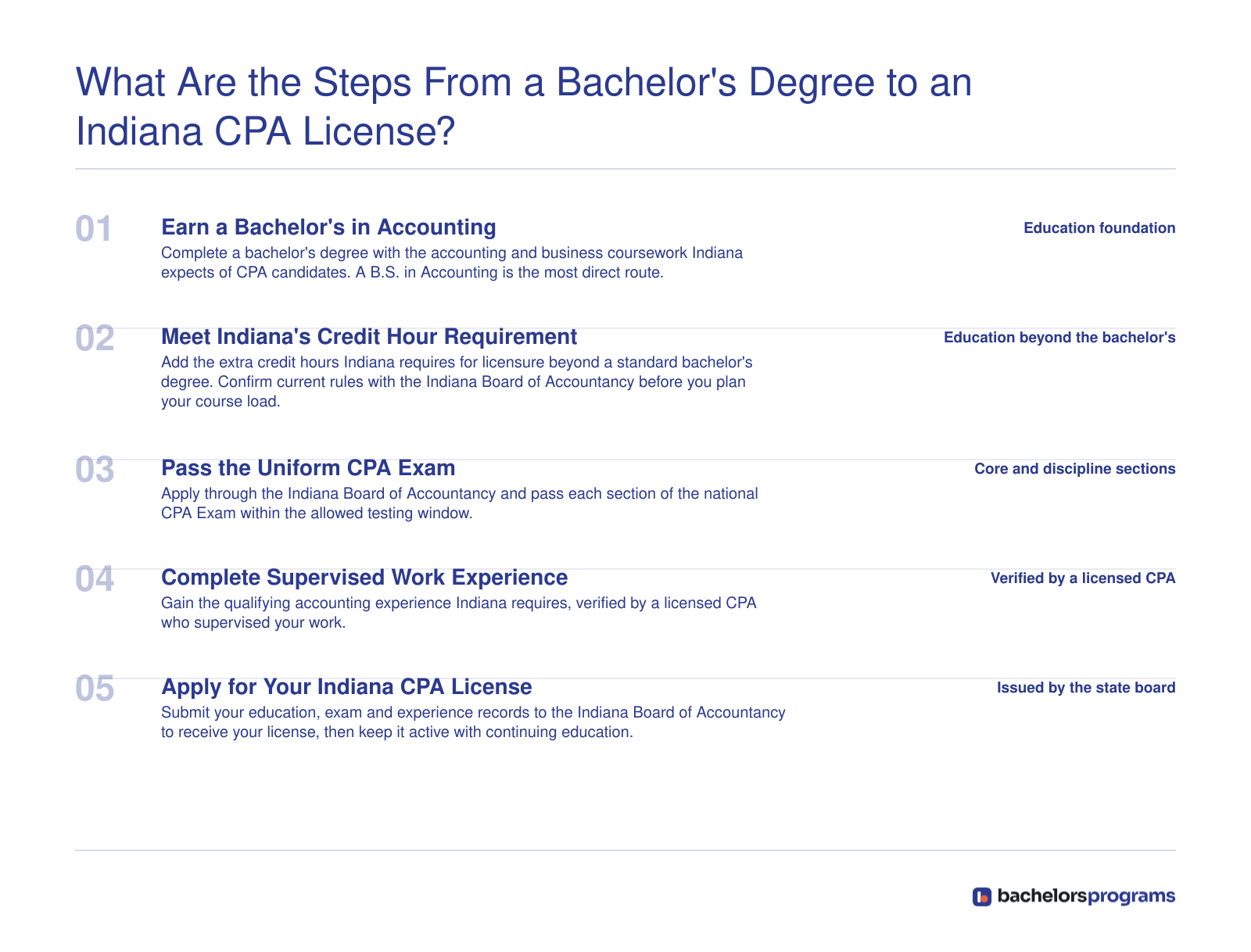
What Are the Steps From a Bachelor's Degree to an Indiana CPA License?
Becoming a CPA in Indiana follows a set order: education first, then the exam, then supervised experience, then the license itself. Each step builds on the one before it, so planning your bachelor's degree with the CPA path in mind saves time later.
Which Indiana Colleges Have the Highest CPA Exam Pass Rates?
The CPA Exam's shift to a core-plus-discipline structure has changed how schools present results, so trace any pass-rate claim back to its source. At Purdue University, the University of Notre Dame and Indiana University-Bloomington, the accounting department page and the program advising office are where a published first-time pass rate would live, so start there rather than with a third-party ranking.
Ask What the Number Actually Measures
Before comparing Butler University with Ball State University, ask each for the cohort year and the methodology behind its first-time pass rate. Confirm whether the figure covers the entire accounting program or only candidates who sat for every section, and line up the same testing windows on both sides. Put the same questions to Taylor University and Goshen College. A program that publishes no rate has told you something too, and it belongs in your notes alongside the ones that do.
A Source Checklist for Verification
- Indiana CPA Society: state exam and licensure context for Indiana candidates.
- NASBA and AICPA: the exam's current structure and jurisdiction rules.
- BLS.gov Occupational Outlook Handbook: career and outlook information for accountants and auditors.
- Program pages: check Grace College and Theological Seminary, Indiana University-Kokomo and Indiana University-Northwest for program-specific disclosures.
For every program on your shortlist, including Purdue University Global and Indiana University-Indianapolis, search "school name plus CPA exam pass rate" and confirm the page belongs to the school, not to a consultant's summary of it.
How to Choose an Indiana Accounting School
Indiana's CPA license requires 150 semester hours of coursework, so the accounting bachelor's degree you choose is the first step in a longer plan, not a standalone credential.
Start With the Career, Not the Campus
- Public accounting and the CPA track: Prioritize schools with a defined 150-credit pathway, such as Purdue University, Indiana University-Bloomington and Ball State University.
- Corporate or industry accounting: Look for managerial and cost accounting depth, plus internship pipelines into Indianapolis employers.
- Forensic accounting: Check for auditing and fraud examination electives, and whether local firms place interns in a forensic practice.
- Data analytics: Purdue University Global's Bachelor of Science in Accounting and Analytics builds the analytics side directly into the accounting credential.
Verify AACSB Status and Real Cost
AACSB accreditation influences which firms recruit on campus. The association accredits business schools and, separately, accounting programs, so confirm a school's status in the AACSB directory instead of trusting a brochure. Then compare net price after aid and median debt for graduates, not published tuition. A higher sticker price paired with strong aid can end up costing less than a cheaper school that leaves students borrowing more.
Three Questions Before You Commit
- Does the format (campus, hybrid or online) fit your schedule?
- What is your hard cost ceiling after grants and scholarships?
- Does the school offer a 150-credit pathway to the Indiana CPA license?
If any answer is unclear, ask admissions in writing before you deposit.
Indiana Accounting Degree FAQs
These answers cover the questions students ask most about earning a bachelor's degree in accounting in Indiana. Figures match the sections above.
What are the best accounting schools in Indiana?
Which Indiana colleges have the highest CPA exam pass rates?
How much does an accounting degree cost in Indiana?
Can you get an accounting bachelor's degree online from an Indiana school?
How many credit hours do you need to become a CPA in Indiana?
Compare Accounting programs on the data that matters
Explore more Business & Management majors or browse every field of study.
All Business & Management programs Browse every field of study