Best Criminal Justice Schools in Maine
Compare 5 accredited Criminal Justice programs in Maine, with net price after aid, graduation rates, earnings and debt from IPEDS and the U.S. College Scorecard.

A bachelor's degree in criminal justice typically runs about 120 credits and four years of full-time study, yet cost and structure vary widely across Maine. The Bachelor of Science (B.S.) in Criminal Justice is the standard credential here, though some schools award a B.A. or a justice studies degree.
The practical question is which school gives the best value and fit, on campus or online. Tuition, admissions rules, and the Maine Criminal Justice Academy path all weigh on the answer.
Most Maine policing and corrections jobs are with public agencies, and Academy certification, not the degree alone, qualifies a graduate for patrol.
Key Points
- Husson University graduates earn $46,523 one year after finishing the program.
- UMaine Presque Isle considers transfer credit for courses graded C- or higher.
- FAME's need-based Maine State Grant helps residents cover bachelor's tuition.
Best Bachelor's in Criminal Justice Schools in Maine: Our Ranked List
Five Maine institutions award a bachelor's degree in criminal justice or a closely related justice studies degree, and each takes a different route into the field. Some build Maine Criminal Justice Academy training straight into the credit load, while others lean on long internships, stacked concentrations, or fully online delivery. Here is our ranked list of the best criminal justice schools in Maine, ordered the way we would recommend them to a prospective student.
Husson University
#1Bangor, ME · $20,000 – $25,000/yr (est.)
Best for: Future police officers seeking employer connections
Husson University, in Bangor, pairs its Bachelor of Science in Criminal Justice with unusually direct access to Maine law enforcement training. Students can apply Maine Criminal Justice Academy Pre-Service, Basic Corrections, and Basic Law Enforcement Training coursework toward the degree, and the program closes with a capstone. An annual legal studies career fair brings dozens of agencies and employers to campus, and internships with police departments and related agencies are encouraged.
- 120 credit hours with a criminal justice capstone
- MCJA Pre-Service Training adds six college credits
- MCJA Basic Corrections Program adds six college credits
- Basic Law Enforcement Training in senior year adds 15 credits
- Coursework spans criminal procedure, evidence, and investigations
- Internships with law enforcement agencies are encouraged
- Covers ethics, juvenile justice, crisis intervention, and management
- Prepares graduates for entry-level roles and leadership advancement
University of Maine at Presque Isle
#2Presque Isle, ME · ~$7,000/yr (est.)
Best for: Working adults needing an online option
The University of Maine at Presque Isle awards a Bachelor of Arts in Criminal Justice on campus and online, laid out as a 120-credit four-year academic map. Service learning is woven into the requirements, and a senior portfolio plus an agency internship give students documented field experience before graduation. The program is also listed as a WIOA-approved training program through Maine JobLink, which can help eligible Maine workers tap workforce-development funding.
- 120-credit, four-year academic map
- Senior portfolio completed in the fall of senior year
- Three service learning courses required for graduation
- At least one criminal justice elective must be service learning
- Offered both on campus and online
- Schedule map is a planning aid; course offerings vary
Thomas College
#3Waterville, ME · $19,000/yr (est. net price)
Best for: Students wanting a specialization track
Thomas College, in Waterville, offers a Bachelor of Science in Criminal Justice with six concentrations, from Law Enforcement and Corrections to Cybersecurity, Forensics, Homeland Security, and Conservation Law Enforcement. The 121-credit degree can be completed in three years, and an agreement with the Maine Criminal Justice Academy and the Maine Department of Public Safety lets eligible students attend the academy's 18-week Basic Law Enforcement Course. Internships and a career-focused curriculum are built in, and faculty have worked in the field.
- 121 credit hours with an optional three-year finish
- Concentrations include Law Enforcement, Corrections, and Forensics
- Also Cybersecurity, Homeland Security, Conservation Law Enforcement
- Coursework in criminology, public policy, and constitutional law
- Internships built into the career-focused curriculum
- Faculty have worked in the criminal justice field
- Eligible students may attend the MCJA Basic Law Enforcement Course
Saint Joseph's College of Maine
#4Standish, ME · $25,000 – $30,000/yr (est.)
Saint Joseph's College of Maine, in Standish, blends a liberal arts core with a professional criminal justice curriculum and an unusually long field placement. Seniors spend a full year interning 16 hours a week with partners such as the Portland and Westbrook police departments, the Cumberland County Sheriff, MEMA, and Legal Aid. An optional Forensic Psychology concentration adds coursework in criminal profiling, jury selection, and mental health treatment for offenders.
- Full-year senior internship, 16 hours per week
- Internship partners include Portland and Westbrook police departments
- Also places interns with Cumberland County Sheriff and MEMA
- Optional Forensic Psychology concentration
- Hands-on work with mock crime scenes and moot courts
- Coursework in criminology, race and ethnic relations, and ethics
- Field trips, demonstrations, and ride alongs
- Graduates have entered law school and federal government
University of Maine at Augusta
#5Augusta, ME · $10,000 – $15,000/yr (est.)
The University of Maine at Augusta awards a Bachelor of Science in Justice Studies with a Criminal Justice concentration, alongside Legal Studies/Pre-Law and general tracks. Students can study in Augusta, in Bangor, at university centers, or fully online, and the degree closes with a senior capstone portfolio. UMA also stacks shorter credentials onto the degree, including certificates in corrections, crime analysis and GIS, forensic science, and mediation, plus a 3+3 agreement with the University of Maine School of Law.
- Criminal Justice concentration within the Justice Studies B.S.
- Also offers Legal Studies/Pre-Law and no-concentration tracks
- Fully online option available
- Senior capstone portfolio required
- Attend in Augusta, Bangor, at university centers, or online
- Certificates in corrections, crime analysis and GIS, and forensic science
- 3+3 agreement with the University of Maine School of Law
- Affiliation with the Maine Community Policing Institute
Cost & outcomes by school
Federal data for the highest-earning Criminal Justice programs, independent of the ranking above. Earnings are this field's bachelor's graduates four years after completing where the Scorecard reports them, else the school's undergraduate median.
| School | Net price / yr | Grad rate | Earnings | Debt | Grads/yr | Format |
|---|---|---|---|---|---|---|
| Saint Joseph's College of Maine ME | $27,555 | 66% | $59,045 | $27,000 | 10 | Campus |
| Husson University ME | $21,005 | 59% | $55,315 | $27,000 | 48 | Campus |
| Thomas College ME | $18,885 | 54% | $54,649 | $27,000 | 14 | Campus |
| University of Maine at Augusta ME | $10,924 | 27% | $42,812 | $27,010 | 6 | Online or campus |
| University of Maine at Presque Isle ME | $7,035 | 52% | $40,956 | $16,000 | 12 | Online or campus |
Sources: U.S. Department of Education. Net price, graduation rate, earnings and debt: College Scorecard (earnings and debt for this field's bachelor's graduates where reported, else school-wide); graduates: IPEDS. A dash means no figure is reported.
Cost, debt & payoff
Median earnings of this field's bachelor's graduates (4 yrs after completing, else the school's undergraduate median) vs. their median federal loan debt · U.S. College Scorecard
Across these programs the median graduate earns about $54,649 and finishes with roughly $27,000 in debt — a ratio that clears a common rule of thumb (keep debt below first-year salary). Net price and debt vary widely school to school, so check the per-school figures in the table above before you shortlist.
How We Ranked Maine Criminal Justice Schools
What separates one criminal justice program in Maine from another when the course titles look almost identical?
Four factors shape the order of the list below.
- Cost and net price: The average price students actually pay after federal, state, and institutional aid, which swings widely among Maine schools.
- Outcomes: Graduation rates and the share of former students out-earning a high school diploma say something about whether people finish the degree and whether it pays off.
- Delivery format: Evening, online, and hybrid options matter for students fitting coursework around a full-time job or a family.
- Concentrations: Coursework in corrections, juvenile justice, or homeland security can match your goals better than a broad general track.
Two caveats apply to everything below. Graduation rates are reported for the whole institution, not for the criminal justice major alone, so read them as a rough signal of student support. Net price figures are averages for a sector of schools rather than a personalized quote, and your own aid package may come in higher or lower.
Every program ranked here is a bachelor's degree at a Maine school, including online programs offered by institutions based in the state.
What a Bachelor's Degree in Criminal Justice Covers in Maine
Criminal justice curricula at the schools here balance a broad foundation against an early specialty, and that tradeoff changes what you should look for. Most bachelor's degrees run about 120 credits and take four years of full-time study, with roughly half in general education and half in the major.
B.S. vs. B.A.
A Bachelor of Science usually leans on research methods, statistics, and data analysis. A Bachelor of Arts adds foreign language or broader liberal arts coursework. Among the schools here, University of Maine at Presque Isle awards a B.A. in Criminal Justice, while Saint Joseph's College of Maine and Thomas College award the B.S. Husson University offers a criminal justice major, and University of Maine at Augusta titles its program Justice Studies, a broader frame that can suit students aiming at courts, policy, or social services.
Concentrations and transfer pathways
Concentrations vary by school and can include law enforcement, corrections, cybersecurity, forensics, and pre-law; not every program here publishes named tracks, so ask whether a concentration appears on the transcript or is built from electives. Students who enter with an associate degree often finish the remaining requirements in about two more years of full-time study.
How long it takes
Full-time students typically finish in four years. Part-time students spread the same 120 credits over five or more years, and accelerated formats compress terms or accept more transfer credit. Online and hybrid delivery can shorten the calendar only if you can carry a full load.
Online and Hybrid Criminal Justice Bachelor's Options at Maine Schools
An online criminal justice bachelor's degree delivers coursework through the internet instead of a campus classroom, and some Maine-based schools now offer it. You can earn the entire degree online through a Maine school. The University of Maine at Augusta and the University of Maine at Presque Isle are the schools here with online delivery.
Which Schools Offer What
- University of Maine at Augusta: Its Justice Studies bachelor's is listed as both campus and online, and the program notes a fully online option. A capstone is required, and the school also offers concentrations.
- University of Maine at Presque Isle: The Criminal Justice, B.A. is listed as both campus and online. It is a 120-credit, four-year program, and students complete three service learning courses. Ask the admissions office how those courses are handled for online students.
- Husson University, Saint Joseph's College of Maine, and Thomas College: All three are campus-based. Husson builds in Maine Criminal Justice Academy training credits and law enforcement internships. Saint Joseph's requires a full-year senior internship at 16 hours a week. Thomas also includes internships.
How Pacing Differs
Term-based programs follow a semester calendar, with set start dates, weekly deadlines and a predictable course load. That structure suits students who like routine or are moving straight from a community college with transfer credits. Self-paced and competency-based formats let students advance as they show mastery of the material, which can appeal to working adults who need to study around shifts. Not every Maine program uses that model. UMPI notes that course availability varies by enrollment date, so confirm which pacing your chosen program follows before you apply.
In-Person Requirements to Check
"Online" rarely means every requirement happens on a screen. Internships, service learning and capstones can all involve time in the field, and some courses mix asynchronous work with live sessions. Before enrolling, ask each school whether any course, internship or training component must be completed in person. Students who want police academy training credits alongside the degree will likely find Husson's campus model a better fit than a fully online route.
Admission Requirements for Maine Criminal Justice Bachelor's Programs
Transfer students at the University of Maine at Presque Isle can have courses considered for credit when they earn a C- or higher at a regionally accredited college, which helps associate degree holders moving into a bachelor's degree in criminal justice. Before you apply, ask each admissions office how many associate credits will count toward the bachelor's, whether a credit cap applies, and how many credits you must complete at that school. The table below lists the admissions details we confirmed for each school, so contact admissions directly to fill in the rest.
| School | Minimum GPA | Test Policy | Transfer-Credit Rules |
|---|---|---|---|
| University of Maine at Presque Isle | No published policy | No published policy | Courses with a C- or higher from regionally accredited colleges or universities are considered. Some programs may require higher grades in particular courses. |
| Husson University | Confirm with admissions | Confirm with admissions | Confirm with admissions |
| Thomas College | Confirm with admissions | Confirm with admissions | Confirm with admissions |
| Saint Joseph's College of Maine | Confirm with admissions | Confirm with admissions | Confirm with admissions |
| University of Maine at Augusta | Confirm with admissions | Confirm with admissions | Confirm with admissions |
Related Articles
Maine Grants, Scholarships, and Veteran Aid for Undergraduates
What financial aid can a Maine resident use for a bachelor's degree in criminal justice?
Start With the Maine State Grant
The Maine State Grant, run by the Finance Authority of Maine (FAME), is the state's main need-based undergraduate award.1 For 2026-27 it pays up to $2,500 a year to full-time students and up to $1,250 at half- or three-quarter time.1 You need Maine residency for at least one calendar year, at least half-time enrollment in a first bachelor's at an eligible Maine school, and a Student Aid Index of $10,000 or less.2 There is no separate application; FAME uses your FAFSA.3 The published 2026-27 deadline is Nov. 13, 2026, though earlier guidance listed May 1, so confirm with FAME or your school.4 Roughly 12,400 Maine students receive the grant each year.5
Waivers and Veteran Aid
FAME also funds about 30 tuition waivers a year for former foster youth and eligible adoptees who are Maine residents.5 The University of Maine System offers several tuition waivers6, including a Veteran's Dependent Waiver under Administrative Policy IX-G. Ask each campus financial aid office about amounts, forms, and deadlines.
Four Ways to Cut the Bill
- File the FAFSA well before the deadline; aid can run out.
- Ask every financial aid office about its own scholarships.
- Price out veteran benefits before you enroll.
- Compare net price after aid at public and private schools, since a private package can shrink the sticker gap.
What Do Maine Criminal Justice Bachelor's Graduates Earn and Owe?
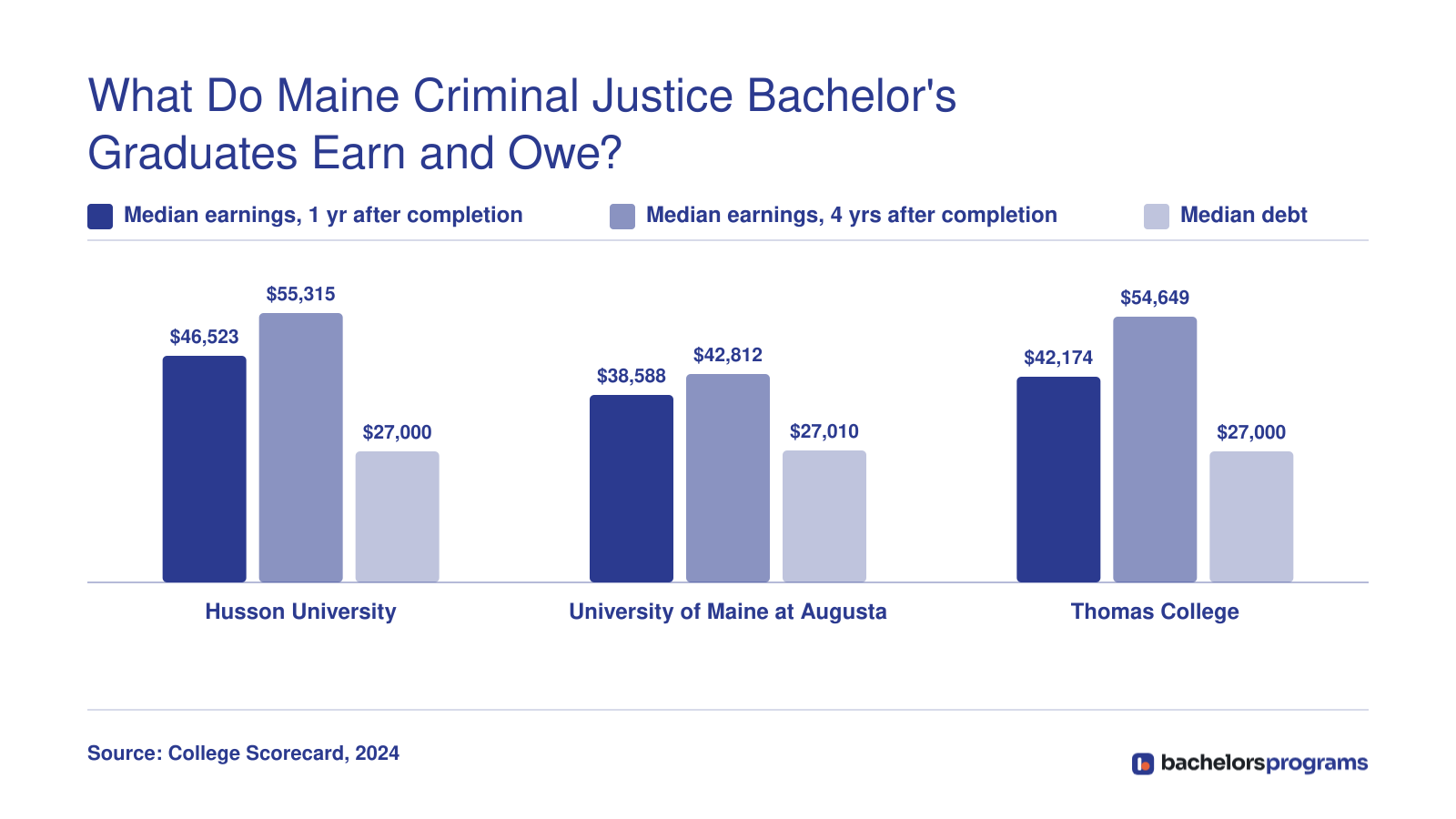
These federal figures follow graduates of each school's criminal justice bachelor's program, not the whole campus. Among programs with published figures, Husson University graduates earn the most one year after completion ($46,523) and four years after completion ($55,315). Median debt is about $27,000 at Husson University, the University of Maine at Augusta and Thomas College. Program-level earnings and debt are not reported for Saint Joseph's College of Maine or the University of Maine at Presque Isle.
Criminal Justice Careers in Maine: Employers, Wages, and Outlook
Some criminal justice graduates move straight into patrol work, while others start in corrections or community supervision and transfer later. Either way, many Maine openings sit with public agencies rather than private employers.
Who Hires in Maine
Municipal police departments and county sheriff's offices are the largest local employers, alongside the Maine State Police. The Maine Department of Corrections runs the state's adult correctional facilities, and federal agencies such as the FBI, DEA, and Border Patrol hire from Maine and nationwide. Probation and community supervision roles sit with state and county agencies. Each sets its own hiring timeline, physical standards, and background checks.
What the Roles Pay
Maine police and sheriff's patrol officers held about 2,000 jobs in 2024, with a 2025 median annual wage of $67,100.1 Correctional officers and jailers in Maine held about 1,100 jobs, with a 2025 median of $52,700.1 Nationally, probation officers and correctional treatment specialists earned a 2025 median of $66,270.4 Local medians vary with agency size, shift differentials, and overtime.
Outlook
Nationally, BLS projects patrol officer employment to grow 3.5% from 2025 to 20352, adding about 24,200 jobs, and probation roles to grow 3%, with roughly 7,900 openings a year.4 The national correctional officer and bailiff group is projected to shrink 7% over the same window, so Maine correctional hiring may be more about replacing departures than expansion.3
These are occupational medians for experienced workers, not starting salaries for new graduates. What graduates actually earn is a separate measure, so keep the two apart. Use these figures to compare occupations, not to forecast a first-year offer.
What Maine Police Officers Earn
Patrol work is the most common destination for criminal justice graduates in Maine.
Maine Criminal Justice Academy Certification at a Glance
Compare Criminal Justice programs on the data that matters
Explore more Criminal Justice & Law majors or browse every field of study.
All Criminal Justice & Law programs Browse every field of study