Best Forensic Science Schools in Mississippi
Compare 8 accredited Forensic Science programs in Mississippi at 6 colleges, with net price after aid, graduation rates, earnings and debt from IPEDS and the U.S. College Scorecard.
A bachelor's degree in forensic science, awarded as a Bachelor of Science (B.S.) or Bachelor of Arts (B.A.) in Forensic Science, is a scarce credential in Mississippi. William Carey University, Delta State University, Blue Mountain Christian University and Rust College name the degree outright. Jackson State University and Mississippi State University instead attach a forensic concentration to another science program.
That split is the central decision. A named degree signals intent, but lab employers generally care more about the chemistry and biology coursework behind the title than the title itself. A concentration inside a stronger science major can carry as much weight, and sometimes more.
Key Points
- Delta State ($8,605) and Jackson State ($8,965) charge the lowest in-state tuition.
- FEPAC accredits individual programs, so check each school's forensic degree status.
- Mississippi forensic science technicians earned a median $52,850 in May 2025.
Best Bachelor's Degree in Forensic Science Schools in Mississippi
Every program below is a bachelor's degree in forensic science or a related degree with a forensic track, and all of them sit at Mississippi institutions. William Carey and Rust College list a forensic science degree by name, while the others fold forensics into chemistry, biochemistry or criminal justice. Read the concentration names closely, because that is what separates a lab-oriented degree from a casework-oriented one.
William Carey University
#1Hattiesburg, MS · ~$14,000/yr (est.)
Best for: Community college transfers continuing in forensics
William Carey University offers the most direct route to a forensic science bachelor's degree in the state: a dedicated B.S. in Forensic Science built around 120 credit hours, with Biology, Chemistry and Criminal Justice concentrations. Classes run on-site and in hybrid format at the Hattiesburg and Tradition campuses, and incoming freshmen can finish in under four years while community college transfers can finish in under two. Faculty include former investigators, crime scene analysts and mobile lab directors, and coursework covers forensic photography, crime scene documentation, firearms analysis and death investigation. The university reports an institution-wide graduation rate of about 60 percent.
- Biology concentration within the 120-credit forensic science B.S.
- Hybrid and on-site classes at Hattiesburg and Tradition campuses
- Incoming freshmen can finish in under four years
- Chemistry concentration housed in the Criminal Justice Department
- Prepares graduates for crime lab analyst roles
- Coursework includes firearms analysis and forensic photography
- Criminal Justice concentration, one of three available options
- Community college transfers can finish in under two years
- Faculty include former investigators and mobile lab directors
Mississippi State University
#2Mississippi State, MS · ~$18,000/yr (est.)
Best for: Future DNA and crime lab analysts
Mississippi State University houses forensics as a concentration inside its B.S. in Biochemistry and Molecular Biology, a 120-hour degree accredited by the American Society for Biochemistry and Molecular Biology. Students pair cell biology, genetics and advanced forensic science with criminology, deviant behavior and electives such as human osteology, computer forensics or forensic entomology. The university also holds a working agreement with the Mississippi Department of Public Safety covering human remains recovery, exhumations and skeletal identification, which is unusual access for students aiming at forensic anthropology or public-sector casework. Its institution-wide graduation rate is about 67 percent.
- Forensic Sciences concentration inside a 120-credit biochemistry B.S.
- Biochemistry degree accredited by the American Society for Biochemistry
- Electives include human osteology and forensic entomology
- Criminology and criminal justice coursework built into the plan
- Internships encouraged for concentration students
- State agreement covers human remains recovery and exhumations
Delta State University
#3Cleveland, MS · ~$14,000/yr (est.)
Best for: Delta-region students seeking an in-state public option
Delta State University lists Forensic Science as an undergraduate program under Criminal Justice and Criminology, with academic maps published for students entering in the 2026-2027 academic year. Those maps are planning guides toward degree completion, so students confirm final requirements with an academic advisor and the undergraduate catalog. It is a campus-based option in Cleveland for students who want a public university with a criminal justice home for forensic coursework. The university reports an institution-wide graduation rate of about 48 percent.
- Forensic Science listed under Criminal Justice and Criminology
- Academic maps published for 2026-2027 entrants
- Maps serve as undergraduate degree completion guides
- Advisors and the catalog confirm final requirements
Blue Mountain Christian University
#4Blue Mountain, MS · ~$24,000/yr (est.)
Blue Mountain Christian University treats forensic science as one of five tracks inside its B.S. in Criminal Justice, alongside Law Enforcement, Cybersecurity, Legal Studies and Forensic Psychology. The track covers the scientific side of casework: collecting, examining and analyzing physical evidence such as chemical residue, blood spatter and DNA, with graduates heading toward crime scene technician and criminalist roles. Criminal justice faculty include a retired FBI special agent. The university's institution-wide graduation rate is about 55 percent.
- Forensic science track inside a B.S. in Criminal Justice
- Five tracks include Cybersecurity and Forensic Psychology
- Evidence work covers DNA, blood spatter and chemical residue
- Taught partly by a retired FBI special agent
- Prepares students for crime scene technician and criminalist roles
Jackson State University
#5Jackson, MS · $24,000/yr (est. net price)
Jackson State University places forensic science inside its chemistry department, offering it as one of six concentrations in the B.S. in Chemistry through the College of Science, Engineering, and Technology. That structure suits students who want heavier laboratory and instrumentation training before moving into a crime laboratory or graduate study, and it sits alongside tracks such as Biomedical Science and Pre-Health Careers. The university is accredited by SACSCOC and reports an institution-wide graduation rate of about 51 percent.
- Forensic Science concentration within the Chemistry B.S.
- One of six chemistry concentrations offered
- Delivered by the College of Science, Engineering, and Technology
- Sister tracks include Biomedical Science and Pre-Health Careers
Rust College
#6Holly Springs, MS · ~$13,000/yr (est.)
Rust College lists a B.S. in Forensic Science among the degrees awarded by its Division of Science and Mathematics, alongside biology, chemistry, mathematics and computer science. The division runs teaching and research labs plus a STEM lab in the McDonald Science Building, and a chair of chemistry and forensic science oversees the subject area. Students can tap STEM research projects, grant-funded work, internships and service-learning. The college reports an institution-wide graduation rate of about 12 percent.
- Standalone B.S. in Forensic Science
- Housed in the Division of Science and Mathematics
- STEM lab located in the McDonald Science Building
- Led by a chair of chemistry and forensic science
- Internships and service-learning supported
Cost & outcomes by school
Federal data for the highest-earning Forensic Science programs, independent of the ranking above. Earnings are this field's bachelor's graduates four years after completing where the Scorecard reports them, else the school's undergraduate median.
| School | Net price / yr | Grad rate | Earnings | Debt | Grads/yr | Format |
|---|---|---|---|---|---|---|
| Mississippi State University MS | $17,595 | 67% | $51,513 | $22,142 | — | Campus |
| William Carey University MS | $14,258 | 60% | $43,087 | $20,832 | 1 | Hybrid |
| Delta State University MS | $13,540 | 48% | $41,991 | $20,390 | — | Campus |
| Blue Mountain Christian University MS | $24,016 | 55% | $40,421 | $18,534 | — | Campus |
| Jackson State University MS | $23,836 | 51% | $39,060 | $30,470 | — | Campus |
| Rust College MS | $12,587 | 12% | $32,275 | $26,159 | — | Campus |
Sources: U.S. Department of Education. Net price, graduation rate, earnings and debt: College Scorecard (earnings and debt for this field's bachelor's graduates where reported, else school-wide); graduates: IPEDS. A dash means no figure is reported.
Cost, debt & payoff
Median earnings of this field's bachelor's graduates (4 yrs after completing, else the school's undergraduate median) vs. their median federal loan debt · U.S. College Scorecard
Across these programs the median graduate earns about $42,539 and finishes with roughly $20,832 in debt — a ratio that clears a common rule of thumb (keep debt below first-year salary). Net price and debt vary widely school to school, so check the per-school figures in the table above before you shortlist.
How We Ranked Mississippi Forensic Science Schools
The hardest choice in this field is rarely about prestige. It is whether you want forensic science on the transcript or a broader science major with a forensic concentration, and whether that concentration is worth the tuition and time.
What Counts Most
- A dedicated forensic degree. A program built around forensic science, rather than a general science major with a single elective attached, carries the most weight in this ranking.
- Accreditation. FEPAC accreditation signals a curriculum built to national standards for forensic science education. A program without it can still be strong, but it is a fair question to ask an advisor.
- Cost and net price. Published tuition matters less than what students actually pay after institutional aid and state grants.
- Graduation rate and outcomes. How many students finish, plus federal College Scorecard completions and earnings figures for the institution.
What These Numbers Are and Are Not
Graduation rate and net price are institution-wide averages. They describe the whole college, not the forensic science department, so read them as context for the school rather than a verdict on the major. For program-level detail, the degree requirements and course sequence tell you more than any single statistic.
Only bachelor's programs at Mississippi-based schools are in scope, whether you plan to attend on campus or online. Certificates, associate degrees, graduate programs and coursework at out-of-state institutions fall outside this list.
FEPAC Accreditation and Forensic Science Pathways: Crime Scene, Biology and Chemistry
Which Mississippi forensic science bachelor's degrees are FEPAC-accredited? Very few. The Forensic Science Education Programs Accreditation Commission (FEPAC) reviews individual programs, not whole universities, so a school's institutional accreditation does not count.2 Sources identify only one FEPAC-accredited bachelor's program in the state, a B.S. in forensic chemistry at a university that is not ranked on this page.1
Where the Ranked Schools Stand
- Mississippi State University: The Forensic Sciences Concentration sits inside a B.S. in Biochemistry. It is not on the FEPAC list. The university is accredited by SACSCOC, which is institutional accreditation only.
- Jackson State University: The forensic science concentration is part of a B.S. in Chemistry. We found no FEPAC listing for it.
- William Carey University, Delta State University, Blue Mountain Christian University and Rust College: Each offers a Forensic Science degree. None appears among the accredited Mississippi programs we found.
What Accreditation Signals to Employers
FEPAC accreditation tells a crime lab that a program meets national standards for natural science foundations and laboratory training.1 For lab-based roles such as drug chemistry or DNA analysis, that can make a résumé easier to screen. Its absence is not disqualifying for every job. Many agencies hire on the strength of chemistry or biology coursework, internships and the agency's own training, and crime scene and evidence roles often weigh those factors more heavily than program accreditation.
Comparing the Pathways
- Chemistry: Jackson State's chemistry-based concentration fits students aiming at instrument-heavy lab work, such as controlled substances and trace evidence. Expect a heavy load of chemistry courses.
- Biology and biochemistry: Mississippi State's concentration emphasizes hands-on lab work, particularly DNA analysis, alongside forensic psychology, computer forensics and correctional systems. It suits DNA and serology lab roles and gives some range toward investigative careers.
- General forensic science: At the schools offering a Forensic Science degree by that name, review the course list for lab science depth versus criminal justice content. Crime scene and evidence technician work tends to fit programs with broader coursework and field experience.
Confirm Before You Enroll
Accreditation status can change, and program names and concentrations shift.3 Check the FEPAC accredited programs list directly, then ask each admissions office which degree title and concentration appear on your diploma.
Questions to Ask Yourself
Do you picture yourself at a lab bench or at a crime scene?
Do the labs you hope to work for expect a FEPAC-accredited degree?
Would you rather earn a forensic science degree or a chemistry degree with a forensic concentration?
Do you plan to stay in Mississippi for work, or relocate?
Online and Hybrid Bachelor's Options at Mississippi Schools
An online or hybrid bachelor's degree in forensic science moves some lecture coursework off campus; hybrid formats still bring students in for labs and hands-on training. In Mississippi, those options are limited, so plan on spending real time on campus.
The Hybrid Option: William Carey University
William Carey University offers its Bachelor of Science in Forensic Science in both on-site and hybrid formats at its Hattiesburg and Tradition campuses. The 120-credit program offers concentrations in criminal justice, biology or chemistry, and the school says transfer students can finish in under two years.1 Hybrid here means a mix of remote and campus coursework, not a fully remote degree.
Campus-Based Programs
The forensic science programs at Mississippi State University, Delta State University, Blue Mountain Christian University, Jackson State University and Rust College are delivered on campus. We did not find a fully online forensic science bachelor's at any of these schools.
Why Labs Keep Students on Campus
Forensic science is a laboratory discipline. Courses in chemistry, biology, DNA analysis and evidence handling depend on supervised work with instruments and samples that can't be replicated at home. Hiring labs generally look for graduates with that hands-on practice, which is why programs keep these courses in person.
Alternatives If You Need Online Flexibility
- Online criminal justice: Mississippi State University Online offers a fully online, asynchronous Bachelor of Applied Science in Criminal Justice. It is open only to students who already hold an A.A.S. in criminal justice or a related field, and its program page does not list a forensic concentration.2
- Transfer route: Finish general education credits first, then transfer into a campus or hybrid program such as William Carey's.
- Ask before you apply: Confirm with admissions which courses require campus attendance and how often.
Admissions for Mississippi Bachelor's in Forensic Science Programs: GPA, Test Policy and Transfer Credit
What GPA and test score do you need for a bachelor's degree in forensic science in Mississippi?
Where the Admission Decision Actually Happens
At the schools ranked here, the forensic science pages describe coursework, concentrations and labs, not a separate entrance exam, portfolio or interview. Your acceptance comes through the university's general freshman or transfer review, and you declare the major once you are in. The GPA and test rules that decide your application are therefore campus-wide, so read them on the admissions site rather than assuming the program page covers them. Where a school publishes no major-specific standard, treat the university freshman requirement as the bar.
GPA, Test Scores and Selectivity
Admit rates give a rough sense of how competitive each campus is. Rust College reports about 49% and William Carey about 60%, while several of the schools here report rates above 85%, including Delta State at an effectively open 100%. Pell shares run from roughly 63% at Mississippi State to 94% at Rust College, a reminder that need-based aid shapes the decision at most of these campuses.
Test policy varies most from campus to campus. Some Mississippi universities publish GPA-only pathways that admit students without a score, while others still expect an ACT or SAT.1 Where an admissions page says nothing about test-optional review, plan to submit a score. Where it lists no minimum GPA beyond the university standard, that standard is the requirement.
Prerequisites and Transfer Credit
Mississippi's public universities build freshman admission on the state College Preparatory Curriculum, which already includes lab science and math.1 Expect chemistry to be assumed from your first semester even where the admissions page does not spell out a high school science prerequisite.
For transfer students, confirm that your credit comes from a regionally accredited college, ask for a written evaluation before you enroll, and keep syllabi for lab science courses, since those are the ones most often questioned.
One Practical Move
Take chemistry and calculus as early as you can. Chemistry-based tracks, such as Jackson State's B.S. in Chemistry with a forensic science concentration, expect both, and calculus readiness decides whether you start the sequence in year one or spend a semester catching up.
Cost of a Forensic Science Bachelor's Degree in Mississippi
According to the U.S. Department of Education's IPEDS and College Scorecard (2024), Delta State University ($8,605) and Jackson State University ($8,965) have the lowest in-state tuition. Rust College has the lowest average net price after aid ($12,587), and Blue Mountain Christian University graduates carry the lowest median debt ($18,534). Keep in mind that net price is an average across aided students, not a personal quote. Mississippi residents enrolled full-time (12 credit hours per semester) can cut costs further with three state grants: the Mississippi Tuition Assistance Grant (MTAG) pays $500 a year for freshmen and sophomores and $1,000 for juniors and seniors and requires a 2.5 GPA, a 15 ACT and not qualifying for the maximum Pell Grant; the Mississippi Eminent Scholars Grant (MESG) pays up to $2,500 a year, capped at tuition and mandatory fees, for students with a 3.5 GPA and a 29 ACT; and the Higher Education Legislative Plan (HELP) covers full tuition for up to four years for Pell-eligible students who meet income limits, hold a 2.5 GPA and a 20 ACT, and complete the HELP college-preparatory core. These grants no longer stack, so a student who qualifies for more than one receives only the larger award, and deadlines are September 15 for MTAG and MESG and March 31 for HELP.
| School | City | Sector | In-State Tuition and Fees | Out-of-State Tuition and Fees | Average Net Price After Aid | Median Graduate Debt |
|---|---|---|---|---|---|---|
| Rust College | Holly Springs | Private nonprofit | $13,265 | $13,265 | $12,587 | $26,159 |
| Delta State University | Cleveland | Public | $8,605 | $8,605 | $13,540 | $20,390 |
| William Carey University | Hattiesburg | Private nonprofit | $15,480 | $15,480 | $14,258 | $20,832 |
| Mississippi State University | Mississippi State | Public | $10,202 | $27,637 | $17,595 | $22,142 |
| Jackson State University | Jackson | Public | $8,965 | $11,965 | $23,836 | $30,470 |
| Blue Mountain Christian University | Blue Mountain | Private nonprofit | $20,180 | $20,180 | $24,016 | $18,534 |
Related Articles
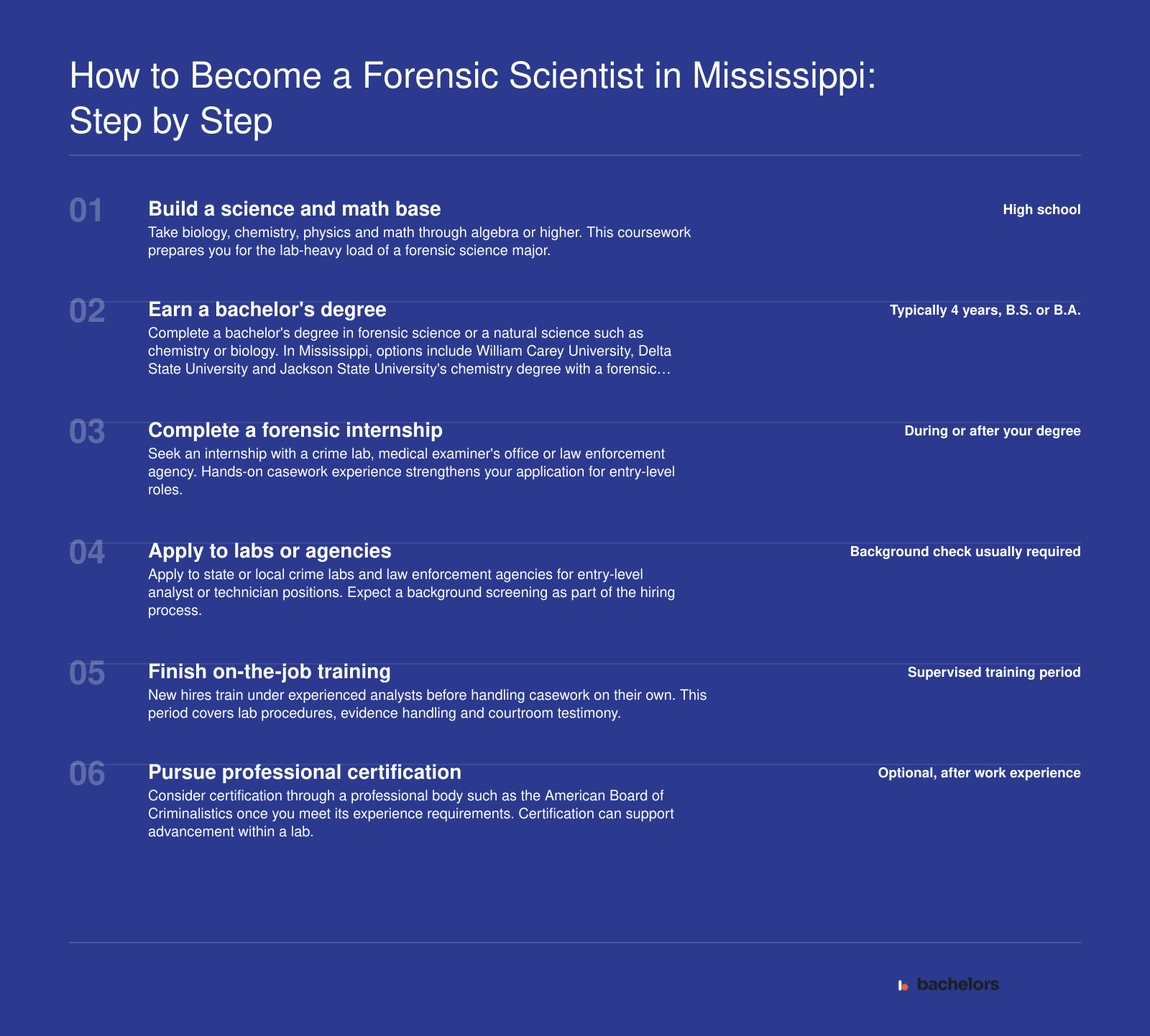
How to Become a Forensic Scientist in Mississippi: Step by Step
Most forensic scientists reach the crime lab through the same basic sequence, starting with strong science preparation and ending with supervised training on the job. The steps below show that path for Mississippi students, from high school coursework through optional professional certification.
Forensic Science Careers, Salary and Licensure in Mississippi
Staying in Mississippi after graduation means trading pay for proximity. Forensic science technicians in the state earned a median of $52,850 a year as of May 2025, about $19,210 below the national median of $72,060, or roughly 27 percent less.1 The spread is wide: the bottom tenth of Mississippi technicians earned around $36,820, while the top tenth reached about $84,260. The job market is also small: roughly 140 technicians work statewide.1 Graduates who want volume and higher pay often look outside the state; those who want to work the cases they grew up reading about tend to stay.
Where Mississippi Graduates Work
The Mississippi Forensics Laboratory, operated under the state Department of Public Safety, is the anchor employer for lab-based work in Mississippi. Entry-level scientist postings tied to the state lab system have listed a Forensic Laboratory Scientist I salary band of $33,600 to $57,330, with a typical minimum of a bachelor's degree in a forensic, chemical, physical or biological science plus zero to two years of experience.2 Requirements shift by unit, so a DNA section and a toxicology section may ask for different coursework or certifications. Technician-level classifications generally start lower, at an associate degree plus zero to two years.3 Beyond the state lab, graduates also move into law enforcement agencies, medicolegal death investigation and related public safety roles, though the specific openings vary year to year.
Internships at the State Lab
Mississippi Forensics Laboratory internships are unpaid and limited in number, but they are the clearest route into state lab hiring. You need upper-level standing at an accredited institution (junior completed, senior, or graduate student), a GPA of at least 3.0, and enrollment during the internship term. Most placements run in the summer after junior year, depending on staffing. Deadlines fall on March 1 for summer, August 1 for fall and November 1 for spring. The application package includes a Department of Public Safety application, a birth certificate copy, a resume, a recommendation from your advisor or major professor, official transcripts and the lab's undergraduate agreement form. A background check follows a complete application, and an interview panel from the relevant discipline makes the call.
Licensure and Certification
Mississippi does not issue a general state license for forensic scientists.3 Hiring turns instead on your degree, your laboratory coursework and background screening. Professional certification, awarded by national boards in disciplines such as criminalistics, crime scene investigation and latent prints, is typically earned after you are working, and employers often treat it as a promotion credential rather than an entry requirement. Keep your GPA at or above 3.0 if the state lab internship is part of your plan.
Compare Forensic Science programs on the data that matters
Explore more Criminal Justice & Law majors or browse every field of study.
All Criminal Justice & Law programs Browse every field of study