Best Criminal Justice Schools in Mississippi
Compare 14 accredited Criminal Justice programs in Mississippi at 12 colleges, with net price after aid, graduation rates, earnings and debt from IPEDS and the U.S. College Scorecard.
A bachelor's degree in criminal justice rarely points to one job title, and in Mississippi the price of earning it varies more than the curriculum does. The common credential is the Bachelor of Science (B.S.) in Criminal Justice, yet in-state tuition runs from $8,605 at Delta State University to $30,250 at Belhaven University.
The ranking weighs Mississippi-based schools, on campus and online, by cost, graduate outcomes, and graduation rate. It also picks out the cheapest and highest-earning programs, online options, admissions, state aid, and in-state career paths.
For police work, the diploma alone is not enough: state certification still decides who is hired.
Key Points
- William Carey University pairs law enforcement academy credit with a 45-credit major.
- Graduate median earnings range from $46,968 to $54,929, led by Strayer University-Mississippi.
- In Mississippi, detectives earn a $58,640 median; correctional officers earn $38,720.
Best Bachelor's Degree in Criminal Justice Programs in Mississippi, Ranked
Ten Mississippi schools award a bachelor's degree in criminal justice, and they are far from interchangeable: one is built for officers who already hold academy training, another spreads classes across six locations, and a third exists only online for associate-degree holders. The ranking below starts with the programs that pair strong completion numbers with the clearest path into Mississippi law enforcement, courts and corrections work.
William Carey University
#1Hattiesburg, MS · ~$14,000/yr (est.)
Best for: Working officers seeking academy credit
A private university in Hattiesburg whose criminal justice department also houses forensic science, giving students a natural second option on the investigative side. The major runs 45 credit hours inside a 120-credit degree, and prior training at recognized law enforcement academies can count toward graduation. Coursework supports careers in law enforcement, corrections, investigations and the courts. The institution-wide graduation rate is about 60%.
- 45 credit major: 36 to 39 core hours plus 6 to 9 elective hours
- 120 total credit hours, general education included
- Credit for training at recognized law enforcement academies
- Classes meet at the Hattiesburg and Tradition campuses
- Forensic science degree sits in the same department
- Prepares for law enforcement, corrections and investigations
- Admission needs an online application and official transcripts
University of Mississippi
#2University, MS · $10,000 – $15,000/yr (est.)
Best for: Students wanting multiple class locations
Mississippi's flagship public university, with a criminal justice department offering three emphases and the widest choice of class locations in the state, from Oxford to Tupelo, DeSoto and online. An internship program and a built-in route for community college transfers give students professional experience and a clear way in. Its institution-wide graduation rate of about 72% is the highest in this group.
- Three emphases: Corrections, Homeland Security, Law Enforcement
- 42 credit hours across eight semesters
- Class locations include Oxford, Online, Tupelo, Grenada, Booneville and DeSoto
- Internship program for majors
- Transfer-friendly route for community college students
- 18-credit criminal justice minor
Mississippi Christian University
#3Clinton, MS · $28,000/yr (est. net price)
Best for: Future loss prevention specialists
A private university in Clinton whose justice program carries three emphases and runs in traditional classrooms or fully online. The 130-credit degree pairs a large university core with a compact justice core, electives and a minor, and the curriculum follows cases from police to prosecutors, courts and corrections. A 3+3 pathway with the university's own law school suits students aiming at a legal career. The institution-wide graduation rate is about 59%.
- Three emphases: Administration of Justice, Homeland Security, Loss Prevention
- Offered in traditional and fully online formats
- 130 total hours, including a 46-hour university core
- 12-hour justice core plus 12 hours of electives and an 18-hour minor
- 3+3 pathway with the MC School of Law
- Coursework covers police, prosecutors, courts and corrections
Alcorn State University
#4Alcorn State, MS · ~$13,000/yr (est.)
A public historically Black university in Alcorn State with a criminal justice degree built on a broad social science base. Students take required work in political science and sociology alongside criminal justice courses, and a social science internship is required before graduation. A 2.5 cumulative GPA and a 3.0 in major courses keep the standard firm. The institution-wide graduation rate is about 57%.
- 122 to 124 semester hours, including 50 hours of core courses
- At least 27 hours in criminal justice
- 2.5 cumulative GPA and 3.0 in major courses required
- Social Science internship required for graduation
- Coursework in criminal law, criminal investigation and corrections
- Supporting work in political science and sociology
Belhaven University
#5Jackson, MS · $15,000 – $20,000/yr (est.)
A private Christian university in Jackson offering a Bachelor of Arts in Criminal Justice with a published four-year plan of study. The degree blends criminology, juvenile delinquency and corrections with coursework in business, psychology, social work and political science, which suits students who want a justice degree inside a liberal arts frame. Classes stay small, with a 13:1 student-to-faculty ratio. The institution-wide graduation rate is about 49%.
- Bachelor of Arts with a published four-year plan of study
- Coursework in criminology, juvenile delinquency and corrections
- Adds business, psychology, social work and political science
- 13:1 student-to-faculty ratio
- The school's own conditional offer covers a fifth year of tuition when freshmen add a second major
- Campus program in Jackson
Delta State University
#6Cleveland, MS · ~$14,000/yr (est.)
A public university in Cleveland whose criminal justice and criminology degree splits into a general criminal justice track and a forensic science track. The 120-credit program includes a required practicum, so students leave with field experience, and there are no extra program-level admission hurdles beyond the university's own requirements. Courses run in a web-enhanced format with part-time study available. The institution-wide graduation rate is about 48%.
- 120 credits total, 48 in the major
- Concentrations in Criminal Justice and Forensic Science
- Required practicum worth 3 to 6 credits
- No extra program admission requirements beyond university admission
- Minimum grade of C in required major courses
- Web-enhanced courses with part-time study available
- Applications accepted year round
Blue Mountain Christian University
#7Blue Mountain, MS · ~$24,000/yr (est.)
A private Christian university in Blue Mountain that awards both a Bachelor of Arts and a Bachelor of Science in Criminal Justice, including a fully online B.S. option. Newer tracks reach beyond traditional policing into cybersecurity, forensic science, legal studies and forensic psychology, so students can specialize early. The curriculum covers criminal investigation, police agency administration, juvenile justice and corrections. The institution-wide graduation rate is about 55%.
- Bachelor of Arts and Bachelor of Science options
- Fully online B.S. option available
- Tracks in Law Enforcement, Cybersecurity, Forensic Science, Legal Studies and Forensic Psychology
- 18-semester-hour criminal justice minor
- Coursework in criminal investigation, police administration and corrections
- Institutionally accredited by SACSCOC
University of Southern Mississippi
#8Hattiesburg, MS · ~$22,000/yr (est.)
A public research university in Hattiesburg with a Bachelor of Arts in Criminal Justice taught through lecture, seminar and online courses. Internships carry academic credit and place students with federal, state and local agencies, including the FBI, U.S. Probation and Parole, community corrections and prosecutor and defense offices. Faculty act as academic advisors and mentors, and the department gives annual awards to its most competitive undergraduates. The institution-wide graduation rate is about 49%.
- Bachelor of Arts taught at the Hattiesburg campus
- Internships carry academic credit
- Placements include the FBI, U.S. Probation and Parole and prosecutor offices
- Coursework in criminal law and procedure, juvenile justice and ethics
- Annual awards for the most competitive undergraduates
- Lecture, online and seminar course formats
Jackson State University
#9Jackson, MS · $24,000/yr (est. net price)
A public historically Black university in Jackson that delivers its Bachelor of Science in Criminal Justice entirely online. The 122-credit degree focuses on how the justice system works, the ethical choices inside it and how justice is administered in a democratic society. Graduates have taken roles with federal agencies such as Homeland Security, the U.S. Marshals Service, ICE and TSA, and in probation, parole and institutional corrections. The institution-wide graduation rate is about 51%.
- 122 credit hours, delivered fully online through JSU Online
- Coursework on justice system institutions, ethics and decision making
- Graduates have entered Homeland Security, U.S. Marshals, ICE and TSA roles
- Prepares for probation, parole and institutional corrections
- Separate admission routes for freshmen, transfers and international students
Mississippi State University
#10Mississippi State, MS · ~$18,000/yr (est.)
A public university in Mississippi State with a fully online Bachelor of Applied Science in Criminal Justice built for students who already hold an associate degree in the field. The 120-credit degree covers criminology, criminal justice policy and research, and it extends community college coursework rather than repeating it. Two start dates a year and a fixed per-credit tuition make the cost predictable. The institution-wide graduation rate is about 67%.
- Fully online Bachelor of Applied Science in Criminal Justice
- Requires an Associate of Applied Science in criminal justice or a related field
- 120 credit hours across about 40 courses
- $452 per credit hour plus a $25 per credit instructional support fee
- Fall deadline August 1, spring deadline December 1
- Coursework in criminology, criminal justice policy and research
Cost & outcomes by school
Federal data for the highest-earning Criminal Justice programs, independent of the ranking above. Earnings are this field's bachelor's graduates four years after completing where the Scorecard reports them, else the school's undergraduate median.
| School | Net price / yr | Grad rate | Earnings | Debt | Grads/yr | Format |
|---|---|---|---|---|---|---|
| Mississippi Christian University MS | $27,712 | 59% | $55,832 | $24,250 | 13 | Online or campus |
| Strayer University-Mississippi MS | — | — | $53,916 | $41,562 | 14 | Online |
| University of Mississippi MS | $13,314 | 72% | $52,874 | $19,689 | 129 | Online or campus |
| Mississippi State University MS | $17,595 | 67% | $51,513 | $22,142 | — | Online |
| William Carey University MS | $14,258 | 60% | $51,430 | $23,500 | 4 | Online or campus |
| Jackson State University MS | $23,836 | 51% | $46,799 | $29,267 | 61 | Online |
| Belhaven University MS | $15,676 | 49% | $46,440 | $26,333 | 7 | Campus |
| University of Southern Mississippi MS | $21,708 | 49% | $46,109 | $20,183 | 45 | Campus |
| Delta State University MS | $13,540 | 48% | $41,991 | $24,394 | 9 | Hybrid |
| Alcorn State University MS | $13,265 | 57% | $41,908 | $27,000 | 13 | Online or campus |
| Blue Mountain Christian University MS | $24,016 | 55% | $40,421 | $18,534 | 5 | Online or campus |
| Rust College MS | $12,587 | 12% | $32,275 | $26,159 | — | Campus |
Sources: U.S. Department of Education. Net price, graduation rate, earnings and debt: College Scorecard (earnings and debt for this field's bachelor's graduates where reported, else school-wide); graduates: IPEDS. A dash means no figure is reported.
Cost, debt & payoff
Median earnings of this field's bachelor's graduates (4 yrs after completing, else the school's undergraduate median) vs. their median federal loan debt · U.S. College Scorecard
Across these programs the median graduate earns about $49,115 and finishes with roughly $25,277 in debt — a ratio that clears a common rule of thumb (keep debt below first-year salary). Net price and debt vary widely school to school, so check the per-school figures in the table above before you shortlist.
How We Ranked Mississippi Criminal Justice Schools
Reputation-based lists tell you which schools are well known. Outcome-based lists show what students pay, whether they finish, and what they earn. Our ranking takes the second approach. Every school here is based in Mississippi and offers a bachelor's degree in criminal justice, on campus or online, so you are comparing programs you can actually enroll in.
Four measures drive the order:
- Net price: what students pay after grants and scholarships, not sticker tuition.
- Graduation rate: how often students who start at a school go on to finish.
- Program-level earnings and debt: median pay and borrowing for graduates of the criminal justice program itself.
- Program availability: whether the school offers a criminal justice bachelor's, including variations such as the sociology degree with a criminal justice concentration at Rust College.
What the Data Can and Cannot Tell You
Graduation rate and net price are institution-wide averages. They describe the whole school, not the criminal justice major alone. Earnings come from College Scorecard medians, which reflect past graduates and shift as new cohorts are added. Treat every figure as a starting point, then confirm details with each school's financial aid office.
Competing lists tend not to publish their criteria. The inputs are published, so you can see why each school placed where it did.
Cheapest Criminal Justice Degree in Mississippi: 5 Lowest-Cost Bachelor's Programs
Average net price, what students actually pay after grants and scholarships, is the clearest measure of a bachelor's degree in criminal justice's real cost, so the schools below are ordered by that figure from IPEDS and College Scorecard (2024) data. Rust College, a private school in our directory, posts a net price of $12,587. Among ranked schools, Alcorn State University is the most affordable at $13,265, while Delta State University carries the lowest in-state sticker price at $8,605.
| School | City | Program | Format | In-State Tuition and Fees | Average Net Price | Graduation Rate |
|---|---|---|---|---|---|---|
| Rust College | Holly Springs | Sociology with Criminal Justice Concentration | Campus | $13,265 | $12,587 | 11.8% |
| Alcorn State University | Alcorn State | Criminal Justice | Campus and online | $8,785 | $13,265 | 57.4% |
| University of Mississippi | University | Criminal Justice, B.S.C.J. | Campus and online | $9,772 | $13,314 | 71.7% |
| Delta State University | Cleveland | Bachelor of Science in Criminal Justice and Criminology | Hybrid | $8,605 | $13,540 | 48.1% |
| William Carey University | Hattiesburg | Criminal Justice | Campus and online | $15,480 | $14,258 | 59.8% |
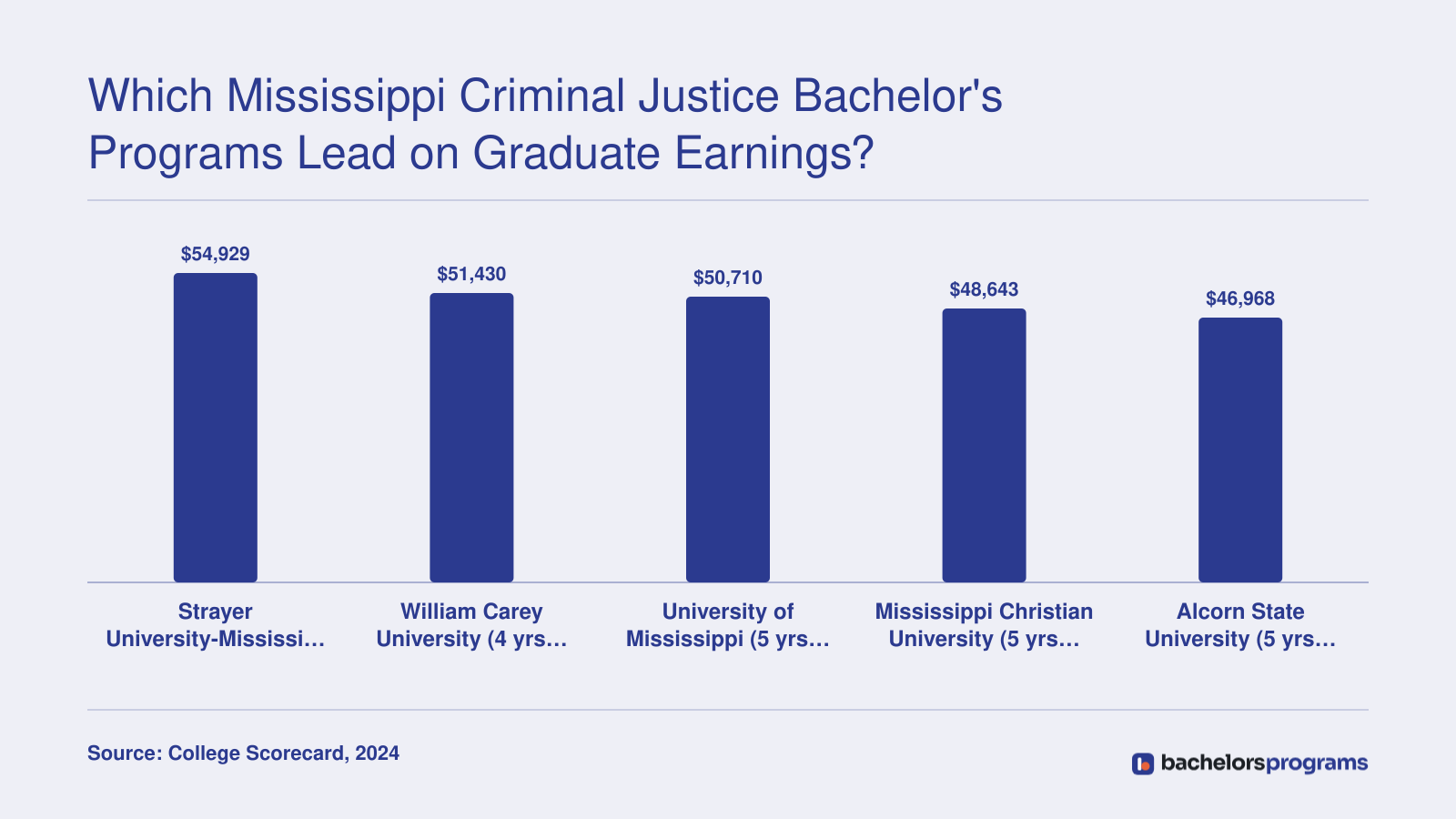
Which Mississippi Criminal Justice Bachelor's Programs Lead on Graduate Earnings?
Median earnings for graduates of these criminal justice bachelor's programs range from $46,968 to $54,929, measured four or five years after finishing. Strayer University-Mississippi, an online program in our directory, posts the highest figure at $54,929 five years out. Among the ranked schools, William Carey University leads at $51,430 four years out. Each figure reflects the program's own graduates, and the time window appears beside each school so you can compare like with like.
Online and Hybrid Criminal Justice Bachelor's Options at Mississippi Schools
Can you earn a criminal justice bachelor's degree online in Mississippi? Yes. Several Mississippi schools deliver the degree online, and some pair it with a traditional campus route.
Formats at a Glance
- Online and on campus: William Carey University, the University of Mississippi and Alcorn State University offer the criminal justice bachelor's both online and on campus. Mississippi Christian University and Blue Mountain Christian University also list a fully online option alongside campus study.
- Fully online: Jackson State University (B.S., 122 credit hours) and Mississippi State University (Bachelor of Applied Science) deliver their programs online.
- Hybrid: Delta State University uses a web-enhanced course format for its B.S. in Criminal Justice and Criminology, with full-time and part-time options.
- Campus-based: Belhaven University and the University of Southern Mississippi list on-campus delivery.
The Transfer-Oriented BAS Path
Mississippi State's Bachelor of Applied Science in Criminal Justice is a fully online degree-completion program totaling 120 credits. It requires an Associate of Applied Science in criminal justice, law enforcement, corrections or a closely related field, so it builds on community college coursework you have already finished. It suits community-college graduates and working adults who want a bachelor's without starting over.
Jackson State also notes admission routes for transfer students, and the University of Mississippi describes its program as transfer-friendly for community college students.
Pacing and Start Dates
Mississippi State publishes two start dates a year: applications open August 1 for summer and fall entry and August 5 for spring, with a rolling deadline. Delta State lists both full-time and part-time enrollment, and Ole Miss structures its program as eight semesters. Most of the other schools do not publish accelerated terms, so ask each admissions office about course length and part-time pacing before you apply.
A Gap in Many Mississippi Searches
Most online criminal justice listings for Mississippi point to graduate programs. All of these options are bachelor's degrees, so you can compare formats at the level you are actually pursuing.
Related Articles
Admission Requirements: GPA, Test Policy, and Deadlines
Some Mississippi schools admit nearly every qualified applicant, while others screen more tightly. The admissions rates show where each school sits: Delta State University (100%), the University of Southern Mississippi (99%), the University of Mississippi (97%) and Jackson State University (93%) are effectively open-admission. Mississippi State University (78%) is moderately selective. Alcorn State University (45%) and Mississippi Christian University (29%) admit a smaller share of applicants.
Schools With Published Policies
- Mississippi State: First-year applicants complete the College Preparatory Curriculum (CPC)2 and submit a high school transcript. Mississippi residents need at least a 2.0 GPA on the CPC.1 ACT or SAT scores are optional for admission but encouraged for scholarships and placement.1 Non-residents need a 2.50 GPA, or an ACT or SAT score of at least 20 if they fall short.1 Admission is rolling, and applications open August 1 for summer and fall and August 5 for spring.3 The online Bachelor of Applied Science in Criminal Justice lists its own fall deadline of August 1 and spring deadline of December 1, and requires an associate of applied science.
- Southern Miss: Applicants complete the CPC, submit a transcript and send an ACT or SAT score, so it is not test-optional. Its admissions page lists a January 15 application deadline. It states no minimum GPA.
- Ole Miss: Applicants are reviewed on the application, CPC completion, unweighted high school GPA and an ACT or SAT score if provided. The admissions page states no minimum GPA, no clear test-optional rule and no deadline.
Where No Policy Is Published
For Jackson State, Alcorn State and the other schools here, no official admissions page publishes a first-year minimum GPA, test policy or deadline, so confirm each one directly before you plan around a date. Delta State's program page does describe rolling admissions with no extra program requirements.
What to Expect
Most applicants need a high school diploma or GED, a transcript and a completed application. Test scores and GPA cutoffs matter most at Southern Miss and for out-of-state applicants at Mississippi State. Apply early, since rolling and January deadlines favor students who file in the fall of senior year.
Transfer Credit and Community College Pathways Into a Mississippi Criminal Justice Bachelor's
Statewide articulation now governs most Mississippi transfer students, but the details still decide whether a semester's work counts.1 Under the statewide agreement, a Mississippi community college student can generally bring up to 60 of the 120 credits a bachelor's degree requires, with a C or better in each course, and a completed 30-credit IHL core travels to other public institutions.2
The 2+2 Route and Applied Associate Degrees
The University of Mississippi requires 120 hours for its criminal justice B.S. and holds formal 2+2 agreements with two Mississippi community colleges.3 Courses taken elsewhere need prior approval from the dean's office; without it, a course can be refused for lacking equivalency. Mississippi State University's Bachelor of Applied Science in Criminal Justice suits an AAS: up to 60 community college credits transfer, no more than 45 of them technical, with an 86-credit overall transfer ceiling and 30 hours finished at MSU. Its published AAS pathway example is an out-of-state partner, so Mississippi students should confirm coverage directly.4 The University of Southern Mississippi builds its guide around 2+2 and limits criminal justice credit in the major to 15 hours.
Practical Tips
- Meet a transfer advisor at the four-year school before registering for associate courses, and keep the credit evaluation in writing.
- Protect residency: upper-level criminal justice courses rarely transfer, so save them for the four-year campus.
- Bring syllabi for technical courses; applicability turns on the degree audit, not the statewide agreement alone.
Where a school publishes no transfer policy, ask the registrar to confirm the rule in writing.
Criminal Justice Careers and Salaries in Mississippi
The latest Bureau of Labor Statistics state wage data shows a wide pay spread across Mississippi criminal justice paths: a $38,720 median for correctional officers, $58,640 for detectives and investigators, $59,860 for police supervisors, and $78,520 for postsecondary criminal justice teachers. This state data set does not report Mississippi figures for patrol officers or probation officers, so treat the following as national context only: BLS puts the national probation officer median at $66,270 and projects 3% growth for that occupation from 2025 to 2035, with about 7,900 openings a year. Many probation and federal agent roles expect a bachelor's degree in criminal justice or a related field, and many agencies consider a degree for detective and supervisor promotions, which are the higher-paying rows below.
| Occupation | Career Path | Mississippi Employment | 25th Percentile Wage | Median Annual Wage | 75th Percentile Wage | Mean Annual Wage |
|---|---|---|---|---|---|---|
| Correctional Officers and Jailers | Corrections | 4,040 | $30,730 | $38,720 | $44,640 | $40,550 |
| Detectives and Criminal Investigators | Investigations | 810 | $49,270 | $58,640 | $78,230 | $71,020 |
| First-Line Supervisors of Police and Detectives | Police leadership | 2,060 | $50,150 | $59,860 | $71,680 | $64,330 |
| Life, Physical, and Social Science Technicians, All Other | Forensic and lab support (broad category) | 330 | $46,970 | $59,490 | $68,320 | $63,040 |
| Criminal Justice and Law Enforcement Teachers, Postsecondary | Teaching and training | 110 | $65,140 | $78,520 | $130,560 | $88,360 |
What Mississippi Criminal Justice Professionals Earn
Investigative work is one of the better-paying paths for graduates with a bachelor's degree in criminal justice in Mississippi.
Requirements to Become a Police Officer in Mississippi
Criminal justice has no single license. Police officers in Mississippi are certified by the state Board on Law Enforcement Officer Standards and Training (BLEOST), which sets these minimums:
- Age and citizenshipYou must be at least 21 years old and a U.S. citizen.
- EducationA high school diploma, GED, or HiSET meets the standard. So does an associate's, bachelor's, or master's degree in an acceptable program, or an ACT composite of at least 15. Career, technical, and occupational diplomas do not qualify.
- Bachelor's degreeA bachelor's degree is not required for certification. Any advantage it gives for promotion or specialized roles depends on the hiring agency.
- Background and characterApplicants must show good moral character and pass a background screening. Certain criminal history disqualifies you.
- Medical and psychological examsA licensed physician must verify that you are in good physical and mental condition.
- Basic academyYou must complete a BLEOST-approved academy. The University of Southern Mississippi runs a 480-hour residential academy that requires a score of at least 50% on its physical fitness entry test. Full-time officers must finish training within one year of hire, and part-time officers within two years.
Compare Criminal Justice programs on the data that matters
Explore more Criminal Justice & Law majors or browse every field of study.
All Criminal Justice & Law programs Browse every field of study