Best Public Health Schools in Mississippi
Compare 7 accredited Public Health programs in Mississippi, with net price after aid, graduation rates, earnings and debt from IPEDS and the U.S. College Scorecard.

Most Mississippi programs require 120 to 124 credit hours for a bachelor's degree in public health, which works out to roughly four years of full-time study. That investment matters in a state with major health challenges and real demand for people trained to work on them. The Bachelor of Science (B.S.) in Public Health is the common credential.
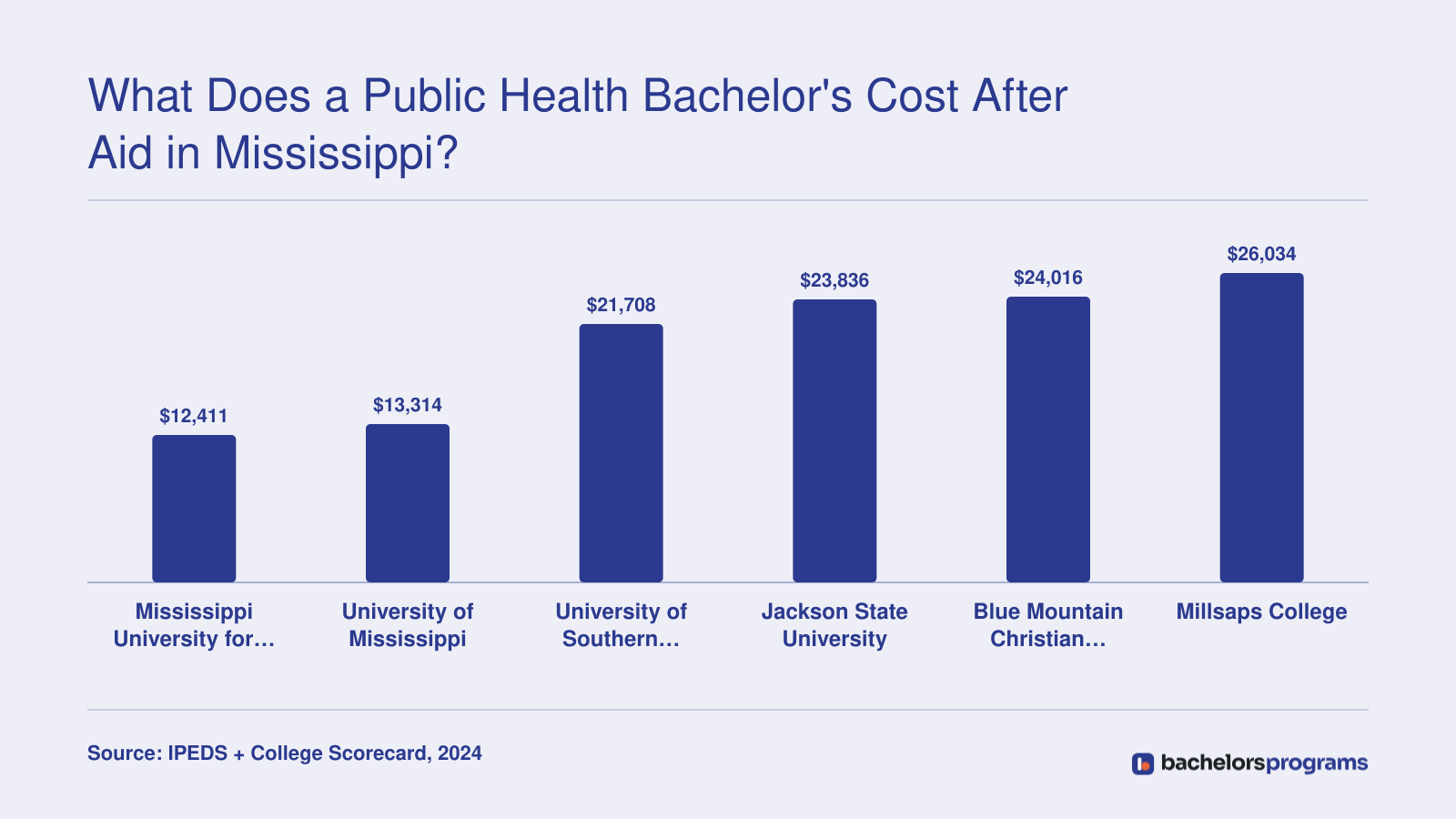
The practical tension is cost against fit. Average net price after aid runs from $12,411 at Mississippi University for Women to $26,034 at Millsaps College. CEPH accreditation, online access, and admissions rules also differ by school.
For careers in Mississippi, a program's accreditation status and its built-in field experience often say more about a graduate's readiness than the campus name does.
Key Points
- Mississippi University for Women has the lowest net price here: $12,411.
- Most programs require 120 to 124 credits, about four years full-time.
- Verify CEPH accreditation; a well-known campus name doesn't guarantee it.
Best Bachelor's in Public Health Schools in Mississippi, Ranked
Seven Mississippi schools currently offer a bachelor's-level path into public health, and they differ sharply in size, setting, and delivery. This list runs from the state's largest public programs to small private colleges and one fully online option. Each entry notes what the school does well and which students it tends to fit.
University of Mississippi
#1University, MS · $10,000 – $15,000/yr (est.)
Best for: Students eyeing an accelerated bachelor's-to-MPH route
Ole Miss houses a newly established public health department and awards a 120-credit Bachelor of Science in Public Health with Community Health and Health Science tracks. Health Science students build a foundation for medical, dental, nursing, or graduate study, while Community Health students train as health educators and patient advocates. Qualified undergraduates can begin master's coursework early through a five-year bachelor's-to-MPH route. As the state's flagship campus in Oxford, it pairs a large university setting with one of the more flexible public health degree plans in Mississippi.
- Two emphasis areas: Community Health and Health Science
- 120-credit, four-year degree
- Five-year bachelor's-to-MPH route for qualified students
- Health Science track feeds medical, dental, nursing, and MPH study
- Community Health track prepares patient advocates and health educators
- Coursework in research methods and public health policy
- Department of Public Health is newly established at the university
Mississippi University for Women
#2Columbus, MS · ~$12,000/yr (est.)
Best for: Working adults needing a fully online program
Mississippi University for Women in Columbus offers a public health education major that students can complete online, with a required internship built into the degree. The core covers biostatistics, epidemiology, and social determinants of health alongside program planning, implementation, and evaluation. A Healthcare Navigator concentration adds healthcare ethics, medical terminology, health insurance, and health information technology, plus electives in patient education or wellness counseling. Small classes and a distance-friendly format make it a practical choice for working adults.
- 120 semester hours, available online
- Required internship in public health education
- Healthcare Navigator concentration adds medical terminology and health insurance
- Electives in patient education, wellness counseling, and chronic disease
- Core includes biostatistics, epidemiology, and social determinants of health
University of Southern Mississippi
#3Hattiesburg, MS · ~$22,000/yr (est.)
Best for: Hattiesburg-area students seeking internship placements
Southern Miss awards a Bachelor of Science in Public Health accredited by the Council on Education for Public Health, taught in Hattiesburg and online. The curriculum blends social, behavioral, and policy sciences with community health, epidemiology, communicable disease, and health administration coursework. Students gain field experience through internships at more than 100 partner sites. Graduates move into health administration, health education, and medical services management, and the program is among the larger public health undergraduate cohorts in the state.
- Accredited by the Council on Education for Public Health
- Offered in Hattiesburg and online
- Internships at more than 100 partner sites
- Coursework in epidemiology, communicable disease, and health administration
- Prepares health administrators, health educators, and health managers
Jackson State University
#4Jackson, MS · $24,000/yr (est. net price)
Jackson State University's Bachelor of Science in Public Health is a newer program in the College of Health Sciences, based at the Jackson Medical Mall. Students examine the social, environmental, and behavioral factors that shape community health and build skills in communication, critical thinking, and health advocacy. The college also awards graduate public health degrees, and the undergraduate program has a CEPH accreditation review scheduled. As a historically Black university in the capital city, Jackson State gives students direct access to state agencies and clinical partners.
- New undergraduate program in the College of Health Sciences
- CEPH accreditation review scheduled
- Located at the Jackson Medical Mall
- Focus on social, environmental, and behavioral factors in health
- Graduate public health degrees also offered in the college
Blue Mountain Christian University
#5Blue Mountain, MS · ~$24,000/yr (est.)
Blue Mountain Christian University delivers its Bachelor of Science in Public Health online, framing the field as the science and art of preventing disease and promoting health. Students take coursework in health education, environmental health, and healthcare administration, then aim at roles in hospitals, government agencies, nonprofits, and private industry. The university is a small private Christian institution in Blue Mountain, accredited by SACSCOC. It suits readers who want a faith-based setting without relocating.
- Offered online
- Coursework in health education, environmental health, and healthcare administration
- University accredited by SACSCOC
- Graduates target hospitals, government agencies, nonprofits, and private industry
- Program emphasizes the ethical dimensions of public health practice
Millsaps College
#6Jackson, MS · ~$26,000/yr (est.)
Millsaps College, a private liberal arts college in Jackson, offers both a Bachelor of Arts and a Bachelor of Science in Public Health with concentrations in policy or research. A required four-credit internship places students with partners such as the University of Mississippi Medical Center or the State Health Department, and students can add online coursework through a Rize partnership. Study-abroad courses and volunteer work at the Evers Care Clinic round out the experience. It is a good fit for students who want small-college attention in a capital city with strong health-system connections.
- Concentrations in policy or research
- Required 4-credit-hour internship
- Placements include UMMC and the State Health Department
- Online coursework through a Rize partnership
- Study-abroad courses and volunteer work at Evers Care Clinic
- Pathway to graduate study in public health and epidemiology
Strayer University-Mississippi
#7Jackson, MS · ~$14,000/yr (est.)
Strayer University's Mississippi location in Jackson serves students through a fully online Bachelor of Science in Health Services Administration with a public health concentration. The 40-course curriculum covers biostatistics, epidemiology, disease prevention, and emergency management, with courses running in 11-week terms. Academic coaches and faculty with industry experience support working adults, and transfer credit can cover a substantial share of the degree. Strayer is a for-profit institution accredited by the Middle States Commission on Higher Education.
- 100% online, 40 courses total
- Concentration coursework in biostatistics, epidemiology, and emergency management
- Courses run in 11-week terms
- Transfer credit for up to 28 classes
- No-cost general education options through Sophia
- Accredited by the Middle States Commission on Higher Education
Cost & outcomes by school
Federal data for the highest-earning Public Health programs, independent of the ranking above. Earnings are this field's bachelor's graduates four years after completing where the Scorecard reports them, else the school's undergraduate median.
| School | Net price / yr | Grad rate | Earnings | Debt | Grads/yr | Format |
|---|---|---|---|---|---|---|
| Millsaps College MS | $26,034 | 57% | $53,848 | $27,000 | — | Campus |
| University of Mississippi MS | $13,314 | 72% | $50,994 | $20,000 | 35 | Campus |
| University of Southern Mississippi MS | $21,708 | 49% | $47,419 | $25,575 | 28 | Hybrid |
| Blue Mountain Christian University MS | $24,016 | 55% | $40,421 | $18,534 | — | Online |
| Strayer University-Mississippi MS | — | — | $40,092 | $40,621 | — | Online |
| Jackson State University MS | $23,836 | 51% | $39,060 | $30,470 | 2 | Campus |
| Mississippi University for Women MS | $12,411 | 47% | $38,325 | $22,500 | 30 | Online |
Sources: U.S. Department of Education. Net price, graduation rate, earnings and debt: College Scorecard (earnings and debt for this field's bachelor's graduates where reported, else school-wide); graduates: IPEDS. A dash means no figure is reported.
Cost, debt & payoff
Median earnings of this field's bachelor's graduates (4 yrs after completing, else the school's undergraduate median) vs. their median federal loan debt · U.S. College Scorecard
Across these programs the median graduate earns about $40,421 and finishes with roughly $25,575 in debt — a ratio that clears a common rule of thumb (keep debt below first-year salary). Net price and debt vary widely school to school, so check the per-school figures in the table above before you shortlist.
How We Ranked Mississippi Public Health Schools
Four factors separate one Mississippi public health school from another: student outcomes, cost, accreditation, and whether you can study on campus or online.
What Drives the Ranking
- Outcomes: Graduation rate shows how many students at a school go on to finish their degree.
- Cost: Net price estimates what students typically pay after grant aid is subtracted from the full cost of attendance.
- Accreditation: Accreditation signals that a program meets recognized standards. For public health, the specialized accrediting body is the Council on Education for Public Health (CEPH).
- Format: Some programs are taught on campus, some online, and some mix the two. Format affects schedule, commuting, and cost.
What the Numbers Do and Don't Show
Both figures are school-wide, not program-specific. They describe the whole school, not the public health program alone, so public health majors may see different results than the school-wide number suggests.
Net price is also a sector-based average. Your own bill will depend on your family income, the aid you qualify for, where you live, and how many credits you take. Treat these figures as a way to compare schools side by side, then run each school's own net price calculator for a personal estimate.
Scope of This Page
The ranking covers bachelor's programs only, at Mississippi schools, in both campus and online formats. Graduate study is not part of the comparison. If you want to study in Mississippi, or online through a school based in the state, these are the programs to weigh.
Is a Bachelor's Degree in Public Health Worth It in Mississippi? CEPH Accreditation Explained
A familiar campus name and a program's accreditation status are two different things, and in Mississippi they do not always point to the same school. The Council on Education for Public Health (CEPH) is the national accreditor for public health education. Its review checks curriculum standards, faculty and student outcomes. For an undergraduate, that can mean easier recognition from employers and a cleaner path into later credentials or further study.
Accredited at the Bachelor's Level
- University of Southern Mississippi: The Public Health Program is listed by CEPH as accredited through December 31, 2029.1 It is the clearest accreditation record among the schools here.
- Jackson State University: CEPH lists the university as accredited, but the status is probationary.1 That means the accreditor has flagged areas the program must address to keep its standing. Ask the school for its current progress before you commit.
Applicants, Not Yet Accredited
- University of Mississippi: The B.S. in Public Health, with concentrations in community health and health science, appears in CEPH's list of applicants.2 A decision is anticipated in summer 2027. Until then, the program is not CEPH-accredited, and a student who enrolls now would be betting on a favorable outcome.
- Mississippi University for Women: The CEPH applicant listing for this school covers a graduate-level health education program, not the bachelor's major.2 It does not establish CEPH accreditation for the Public Health Education major.
Schools Without a CEPH Listing
Blue Mountain Christian University, Millsaps College and Strayer University-Mississippi do not appear in the CEPH accredited or applicant directories for a bachelor's program. Strayer's offering is a Bachelor of Science in Health Services Administration, a related field rather than a public health major. The research for this page identifies no alternative program-level review at these schools. Ask each admissions office what accreditation covers the degree and whether any outside body reviews the program itself.
What This Means for Your Choice
CEPH status is one factor, not the whole answer. A non-accredited program can still prepare you for entry-level health education, community outreach or health services work. If graduate study or a public health employer that screens for accreditation is part of your plan, favor the school whose status is firmest. Check the CEPH directories directly before you apply, because statuses and decision dates change.
How Long Does a Bachelor's Degree in Public Health Take in Mississippi?
A bachelor's degree in public health takes about four years and prepares you to protect and improve community health; most Mississippi programs require 120 to 124 credit hours. Full-time students typically finish in four years. Mississippi University for Women lists its B.S. in Public Health Education at 124 hours over four years.2
What the Coursework Covers
Expect a public-health core built around epidemiology, biostatistics, health policy, and health education, plus electives or an emphasis. At the University of Mississippi, the degree totals 120 hours: a 33-hour core plus a Community Health or Health Science emphasis of 43 to 44 hours.1 The University of Southern Mississippi also lists 120 hours for its general B.S. in Public Health, while its Health Promotion emphasis runs 124 hours, with 57 in the major.
Practicum and Internship Requirements
Experiential learning varies by school, and no single statewide hour requirement applies. Ole Miss requires PH 470, a 3-credit practicum.1 Southern Miss public-health students complete a 140-hour practicum at an approved health-related facility, and its Health Promotion emphasis includes a 6-credit practicum (DPH 493). The Mississippi University for Women program page does not detail practicum requirements, so confirm them with an advisor.2
What Can Change Your Timeline
Part-time enrollment stretches the calendar well past four years. Transfer credit can shorten it, but residency rules limit how much. Southern Miss requires at least 21 of your last 30 hours and 12 major hours to be earned there, plus 30 hours at the 300 level or above. Its Health Promotion emphasis requires 45 upper-level hours and at least half of degree credits from a senior college. Ask each school for a transfer evaluation before you enroll.
Online and Hybrid Bachelor's in Public Health Options at Mississippi Schools
Online and hybrid formats in Mississippi come down to one trade-off: the flexibility of finishing coursework from home versus the supervised field time many programs still require in person. Mississippi schools sit on both sides of that line, and a few blend the two.
Fully Online Programs
- Mississippi University for Women: A public health education major totaling 124 credit hours, including an internship in public health education. Program listings describe it as fully online1, though the university's own catalog page does not spell out the delivery format, so confirm with an advisor before you enroll.
- Blue Mountain Christian University: A B.S. in Public Health offered online, built around disease prevention, health education, and healthcare administration coursework.
- Strayer University-Mississippi: A Bachelor of Science in Health Services Administration with a public health focus, delivered as a 100% online program. The school notes that students can transfer up to 28 classes.
Campus and Hybrid Programs
- University of Mississippi: The B.S. in Public Health is campus-based in Oxford3, with Community Health and Health Science emphases and 120 required credits. Its PH 470 practical applications course carries 3 credits2, but the program pages do not confirm whether that practicum meets in person, off campus, or remotely.
- University of Southern Mississippi: The B.S. in Public Health is campus-only in Hattiesburg; the university's online public health offering is a Master of Public Health.
- Jackson State University: A campus-based B.S. in Public Health taught at the Jackson Medical Mall.
- Millsaps College: A campus program in Jackson with policy and research concentrations, a required 4-credit internship, and some online courses available through a partnership.
What Stays In Person
Field work is where online flexibility usually stops. Southern Mississippi requires 140 hours at an approved health-related facility under a facility preceptor, an in-person, site-based commitment. Millsaps requires its internship as well. For Ole Miss and the University for Women, the published pages list a practicum or internship but do not state the format, so ask the department directly before you count on remote delivery.
What Does a Public Health Bachelor's Cost After Aid in Mississippi?
Average net price after grants and scholarships runs from $12,411 at Mississippi University for Women to $26,034 at Millsaps College. Public universities report this average for in-state students receiving federal aid, while private colleges report one figure for all aided students. These are institution-wide averages for each school's sector, not costs specific to the public health program, so check your own price with each school's net price calculator.
Related Articles
Common Questions About Public Health Degrees in Mississippi
Which Mississippi schools offer a bachelor's degree in public health?
Are there online public health degrees in Mississippi?
What can you do with a public health degree in Mississippi?
Do I need the CHES credential to get hired in public health?
Compare Public Health programs on the data that matters
Explore more Healthcare majors or browse every field of study.
All Healthcare programs Browse every field of study