Best Computer Science Schools in Montana
Compare 8 accredited Computer Science programs in Montana at 4 colleges, with net price after aid, graduation rates, earnings and debt from IPEDS and the U.S. College Scorecard.

A bachelor's degree in computer science in Montana is not a single product. Schools award it as a Bachelor of Science (B.S.) or a Bachelor of Arts (B.A.) in Computer Science, and that distinction shifts your math load, your tuition bill, and the jobs you qualify for.
Montana Technological University holds the top spot in our 2027 ranking, with Carroll College and Montana State University next. The ranked list below compares them on cost after aid, completion, and graduate earnings.
Software work in Montana pays roughly two and a half times the state average wage, so the gap between programs is financial, not just academic.
Key Points
- Montana Technological University ranks first among Montana computer science schools in 2027.
- Montana State CS grads: $22,500 median debt, $66,918 first-year earnings.
- Every program ranked here is campus-based, so fully online routes are rare.
Best Computer Science Schools in Montana: Our Ranked List
Montana Technological University is the best computer science school in Montana in our 2026 ranking, with Montana State University and Carroll College close behind. All four ranked programs are campus-based, and each takes a different angle on the bachelor's degree in computer science: a technology-focused public university in Butte, a liberal arts college in the capital, a large land-grant university in Bozeman, and a data science concentration in Missoula.
Montana Technological University
#1Butte, MT · ~$16,000/yr (est.)
Best for: Engineering-minded students who want small classes
Montana Technological University in Butte is the state's most technology-focused public campus, and computer science sits alongside software engineering, cybersecurity and network administration programs. That concentration of computing majors means CS students share labs, faculty and recruiting contacts with peers in adjacent fields, and the department maintains its own high-performance computing cluster. Montana Tech publishes the lowest in-state tuition in this ranking and posts the second-highest school-wide graduation rate of the four schools here.
- Tracks: Business Application Option
- Internships reported with Google, Dish Networks and Micron
- Internship options also in Butte, Bozeman and Missoula
- Mathematics minor built into the degree requirements
- Coursework covers algorithms, operating systems, AI and computer architecture
- Department maintains a high-performance computing cluster for student research
- Statistics Applications option inside the Computer Science B.S.
- 120 credits required, including internship credit
- Core CSCI courses plus science and writing electives
- Concentration pairs computing with statistical modeling coursework
Carroll College
#2Helena, MT · ~$24,000/yr (est.)
Best for: Liberal arts learners who want government internships
Carroll College is a private liberal arts college in Helena, and its computer science major stays small and project-driven, with coursework tied to application development, systems engineering, database design and data mining. The location in Montana's capital puts students within reach of state and federal agency internships, and the program's close link to mathematics and data sciences makes double majors and minors easy to add. Carroll posts the highest school-wide graduation rate of the four schools here, paired with the highest published tuition in the group, though institutional aid brings the typical net price down substantially.
- Five concentration options, from application development to data mining
- Internships placed with Montana state and federal agencies in Helena
- Double majors and minors in mathematics or data science fit easily
- Project work built on real-life applications rather than theory alone
- Liberal arts core integrated with technical coursework
Montana State University
#3Bozeman, MT · ~$22,000/yr (est.)
Best for: Interdisciplinary students drawn to AI and entrepreneurship
Montana State University in Bozeman is the largest university in this ranking and graduates by far the most computer science majors of the four schools. Students pick between a Professional Option for deeper technical study and an Interdisciplinary Option that pairs computing with fields such as entrepreneurship or Japanese studies, and the department runs regular industry trips and conference travel. Montana State also reports the strongest post-graduation earnings of the group, and it is the only one of the four whose computer science minor is explicitly open to students in other majors.
- Tracks: Interdisciplinary Option
- Interdisciplinary track pairs computing with entrepreneurship or Japanese studies
- Coursework explores artificial intelligence, multimedia and computational biology
- Computer science minor open to students in other majors
- Industry trips to tech companies plus Grace Hopper and oSTEM conference travel
- Career coaching, resume critiques and interview practice
- 120 total credits, including 42 at the 300 level or above
- Core CSCI sequence plus upper-division computer science electives
- Math and science elective requirements alongside major coursework
- Semester-by-semester four-year plan published in the course catalog
The University of Montana
#4Missoula, MT · ~$17,000/yr (est.)
The University of Montana in Missoula awards its computer science degree with a Data Science concentration, threading calculus, linear algebra, machine learning and data visualization through the standard CS core. Because the program sits in the sciences rather than engineering, students add public speaking, discrete mathematics and an approved upper-division math elective to their computing courses. The result is a degree aimed at students who want statistics and modeling depth, and it carries the lowest school-wide graduation rate of the four schools listed here.
- Data Science concentration adds calculus II, linear algebra and machine learning
- Data visualization and simulation courses round out the concentration
- At least 21 upper-division CSCI elective credits required
- Electives include Big Data Project and Data Science Applications
- Research, independent study and internship credit capped at 6 total
- 2.0 GPA and C- or better in major courses required to graduate
Cost & outcomes by school
Federal data for the highest-earning Computer Science programs, independent of the ranking above. Earnings are this field's bachelor's graduates four years after completing where the Scorecard reports them, else the school's undergraduate median.
| School | Net price / yr | Grad rate | Earnings | Debt | Grads/yr | Format |
|---|---|---|---|---|---|---|
| Montana State University MT | $22,499 | 57% | $111,728 | $21,750 | 112 | Campus |
| Carroll College MT | $23,960 | 69% | $61,772 | $25,757 | 5 | Campus |
| Montana Technological University MT | $16,481 | 58% | $54,329 | $18,750 | 8 | Campus |
| The University of Montana MT | $16,784 | 48% | $44,511 | $22,400 | 18 | Campus |
Sources: U.S. Department of Education. Net price, graduation rate, earnings and debt: College Scorecard (earnings and debt for this field's bachelor's graduates where reported, else school-wide); graduates: IPEDS. A dash means no figure is reported.
Cost, debt & payoff
Median earnings of this field's bachelor's graduates (4 yrs after completing, else the school's undergraduate median) vs. their median federal loan debt · U.S. College Scorecard
Across these programs the median graduate earns about $58,051 and finishes with roughly $21,750 in debt — a ratio that clears a common rule of thumb (keep debt below first-year salary). Net price and debt vary widely school to school, so check the per-school figures in the table above before you shortlist.
How We Ranked Montana Bachelor's Degree in Computer Science Programs
We rank Montana computer science bachelor's programs on the measures that shape your four years and your first job: what you pay, whether students finish, what graduates earn, how selective admission is, and how many degrees the program awards.
The Measures We Use
- Net price: average yearly cost after federal, state, and institutional grant aid, not sticker tuition.
- Graduation rate: the share of first-time students who finish within 150% of normal time.
- Program earnings: median pay for graduates measured at a set point after completion, using the window the federal College Scorecard publishes.
- Selectivity: admission rate and the test scores a school reports.
- Completions: bachelor's degrees conferred in the field, a rough signal of program size and stability.
What These Numbers Cannot Tell You
Graduation rate and net price are institution-wide averages. They describe the whole college, not the computer science department, so a strong program can sit inside a school with an ordinary overall rate. Earnings are tied to that stated post-completion window, not to your first offer or your major alone.
The list covers Montana-based campus and online bachelor's programs only. Graduate study sits outside its scope.
ABET Accreditation and Concentrations at Montana Computer Science Programs
A printed list of accredited programs and a live search of ABET's database look equally authoritative, but only one tells you what is true this year. Treat accreditation as something you verify, not something you inherit from a ranking page.
Start With ABET's Own Search
Go to ABET's Find Accredited Programs tool and search computing programs at the bachelor's level in Montana. Filter by commission: the Computing Accreditation Commission covers computer science and closely related computing programs, while software engineering and cybersecurity can fall under different commissions depending on the literal program name. ABET accredits programs, not institutions, so confirm the specific degree title, the commission, and the current status. Montana State University appears in ABET's U.S. bachelor's-level results, but that listing alone does not identify which program it covers, so open the record and match it to the degree you would actually enroll in.1 For the University of Montana, Montana Technological University, and Carroll College, confirm status directly rather than assuming either way.
Confirm Degree Type and Concentrations on the School's Page
Next, open each school's official program page or catalog. Check whether the award is a Bachelor of Science or a Bachelor of Arts, which concentrations or options are open to undergraduates, and what graduation requires: math and science prerequisites, upper-division electives, a capstone, and any internship or portfolio component. At Montana State, the University of Montana, and Montana Tech, ask admissions or a department advisor for the current catalog year, since concentrations and course sequences change.
Cross-Check Fit and Career Relevance
Use the BLS Occupational Outlook Handbook for plain-language descriptions of computing roles and the skills they require. Professional bodies such as ACM and IEEE Computer Society publish curriculum guidance, and cybersecurity associations describe the specializations employers screen for. Finish with the school's career-services page: which employers recruit, what internships are posted, and where recent graduates land. If a page is vague or out of date, email advising and keep the reply.
Your Verification Checklist
- Accreditation: the program's own ABET record, not the university's name.
- Degree type: B.S. or B.A., confirmed in the catalog.
- Concentrations: listed options and how you declare one.
- Graduation requirements: prerequisites, capstone, internship.
- Advising contact: a named person and a current catalog year.
Questions to Ask Yourself
Do the roles you want require an ABET-accredited computer science degree?
Do you want a B.S. with heavier math and science, or a B.A. with room for a second field?
Would you rather specialize in something like cybersecurity or AI, or build broad software skills?
Do you need to stay in Montana or work remotely while you study?
Online and Hybrid Computer Science Bachelor's Options at Montana Schools
An online computer science bachelor's degree can fit around a full-time job, but in Montana it is rarely the default route. The computer science programs at the schools ranked here are listed as campus-based, and none of these schools publishes a fully online or hybrid bachelor's degree in the field.
What the schools actually list
- Montana State University: Its B.S. in Computer Science appears among programs associated with online study, but the department's own pages describe a Bozeman campus program and do not establish that the entire degree can be completed online or in a hybrid format.
- Montana Technological University, Carroll College, The University of Montana: Each lists its computer science bachelor's as an on-campus program. UM's Data Science concentration is a campus degree as well.
Transfer and completion paths
Montana State's program is built to serve first-time students, transfer students with some college credit, and second-degree seekers, which makes it the most flexible entry point of the group even though the coursework happens in Bozeman. Students at any of these schools can usually fold in online general-education or elective credits, but the upper-division computer science sequence is designed to be taken in person, with labs, project teams, and faculty access close at hand.
What to expect
MSU publishes a separate tuition schedule for programs formally designated as online, and it states that online tuition varies by program. No published rate ties an undergraduate computer science degree to that schedule, so confirm the per-credit cost with the department before you budget on it. In-state campus tuition is the safer assumption while you compare.
Related Articles
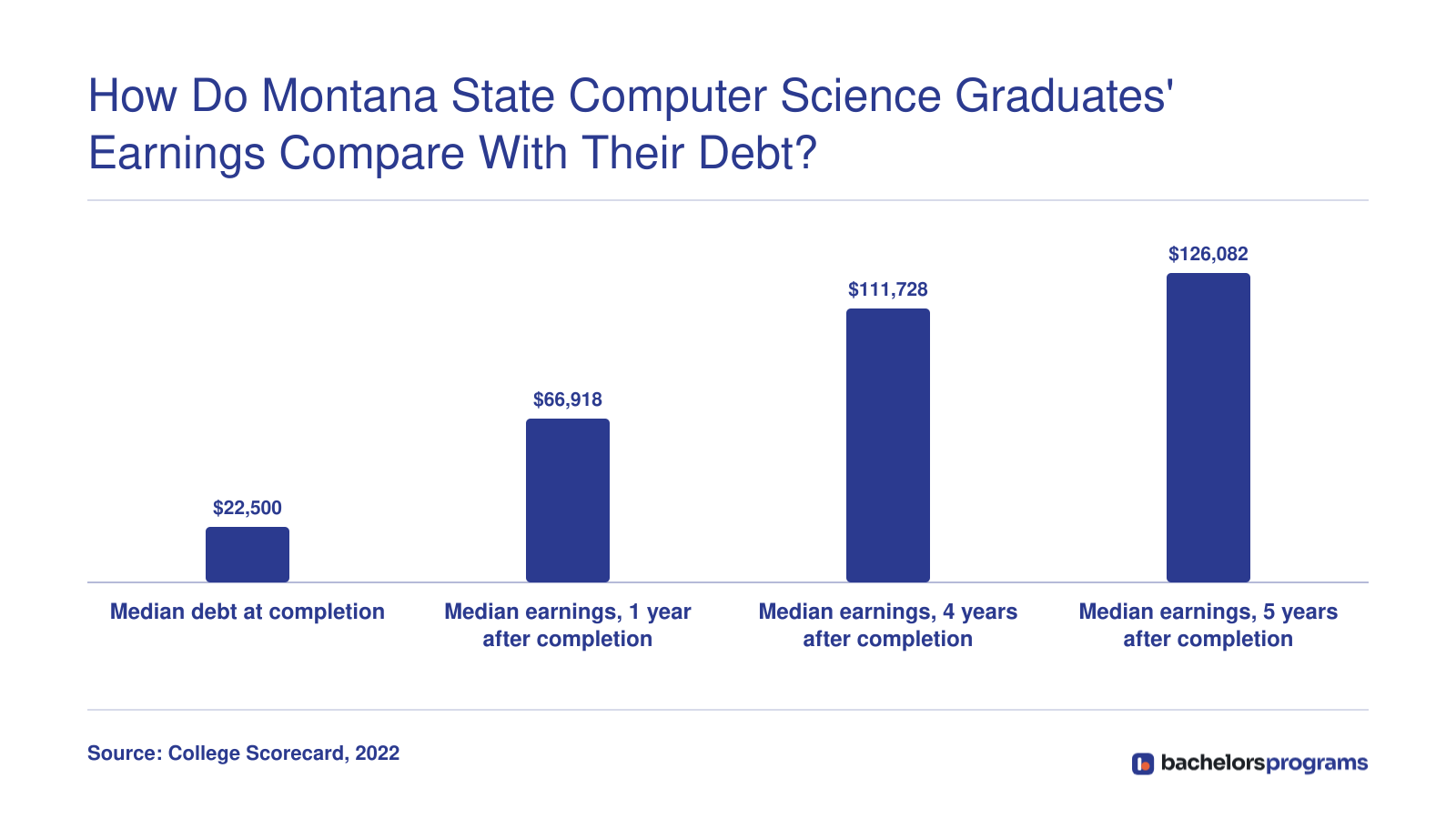
How Do Montana State Computer Science Graduates' Earnings Compare With Their Debt?
Montana State University's Bachelor of Science in Computer Science graduates have a median debt of $22,500. That same group earns a median $66,918 one year after completing the program, $111,728 four years after, and $126,082 five years after. Federal program-level earnings are not yet reported for the computer science programs at Montana Technological University, Carroll College or The University of Montana, so the chart shows Montana State alone. At the median debt, a standard 10-year repayment plan runs about $231 a month.
Computer Science Careers and Salaries in Montana
Software work in Montana now pays roughly two and a half times the state's average wage, and much of it happens away from a Montana office entirely.3 The numbers behind that shift are worth reading carefully before you pick a program.
What the Wage Data Shows
Montana's information sector employed about 5,400 people statewide as of September 2026.1 In the Missoula metro, computer and mathematical occupations accounted for 3.4 percent of jobs in May 2025, with a location quotient of 2.1, meaning that work is concentrated there at roughly twice the national rate.2 Mean hourly pay in the group was $57.73 and median hourly pay $45.66.2 Statewide, the technology sector's average annual wage reached $146,000 in 2025, against $62,000 for Montana workers overall.3 Treat that as a sector average rather than a software developer median, and as a sign of where the ceiling sits rather than a promised starting salary.
Remote Work, Employers, and Hiring
Montana's tech employment clusters in Bozeman and Missoula, and Bozeman's cluster traces back to RightNow Technologies, now part of Oracle. Remote work is not a temporary arrangement here: at surveyed Montana tech firms, more than half of employees work from home at least part time and 30 percent work fully remote.3 A Montana degree does not tie you to a Montana employer. Artificial intelligence has also moved into hiring: 87 percent of surveyed firms use it at least occasionally, and AI skills now count as a hiring consideration.3
No License Required
Software and computing roles are not licensed in Montana. There is no state board, exam, or continuing-education requirement standing between you and a developer job, so employers screen on portfolio, internships, and coursework instead. Federal outcome data for these programs show graduates employed within a year of finishing at very high rates, which fits a field that hires on demonstrated skill.
Early-Career Earnings at the Top-Paying Montana Program
Montana State University in Bozeman posts the highest one-year median earnings among the computer science programs ranked here.
Internships, Co-Ops, and Employer Pipelines for Montana CS Students
What the Schools Publish
Montana State University lists internships year-round rather than summer-only; postings commonly open in September for fall, January for spring, and May or June for summer. Students search Hire-A-Bobcat, LinkedIn, career fairs, and employer information sessions, and can build a search strategy with a career coach at the Student Success Center. MSU also runs a faculty-and-staff partnership program that brings employers into classrooms, workshops, and campus events.
Montana Tech's computer science bachelor's page says students gain real-world experience through internships in their upper-level years, and that past interns have worked at Google, Dish Networks, Micron Technologies, and the City of Butte. Opportunities cluster in Butte and nearby Bozeman and Missoula. Career Services supports co-ops, job shadows, and fellowships, and internships are supervised, degree-related, usually paid, and may carry academic credit. Tech's Employer Partnership Program runs one academic year, with enrollment in July and August.
What to Ask Admissions
- When do employers typically post internships, and are they fall, spring, or summer?
- Is academic credit available, and does it count toward the major?
- Can I join a capstone or industry-sponsored project, and who sponsors them?
- Which employers recruited on campus last year?
How to Choose the Right Montana Computer Science School
Start with the curriculum, not the brochure. The right Montana program is the one whose required courses and electives match the work you want to do after graduation.
Compare the Actual Course Sequence
Ask each school for a four-year plan, not just the catalog description. At Montana State University, The University of Montana, Montana Technological University, and Carroll College, confirm that core courses such as data structures, algorithms, operating systems, and databases are required rather than optional, and ask how often upper-level electives actually run. The University of Montana's data science option suits students aiming at analytics work, while a broader computer science track keeps software engineering and systems courses in view. Keep each school's answers on one page so you can compare them side by side.
Verify Accreditation and Outcomes
Check ABET's online database for computing accreditation where a program holds it. Confirm institutional accreditation through the U.S. Department of Education's database. College Scorecard compares graduation rates, median earnings and typical student debt across campuses. Follow up by asking admissions where recent graduates found work and which employers recruit on campus.
Ask Specific Questions
- Admissions: How do transfer credits apply, what math placement is required, and what is the typical time to graduation?
- Faculty: How large are upper-level classes, and do undergraduates join research or project teams?
- Current students: Can you get the courses you need in four years, and are labs open outside class hours?
- Local employers: Which skills show up as gaps in new hires, and which schools do they recruit from?
Use Field-Level Sources
BLS.gov's Occupational Outlook Handbook covers the national outlook and pay ranges for computer and information technology occupations. ACM and IEEE Computer Society publish curriculum guidance you can hold up against a school's requirements, which helps you judge depth rather than just course titles.
Compare Computer Science programs on the data that matters
Explore more Computers & IT majors or browse every field of study.
All Computers & IT programs Browse every field of study