Best Early Childhood Education Schools in Montana
Compare 5 accredited Early Childhood Education programs in Montana at 4 colleges, with net price after aid, graduation rates, earnings and debt from IPEDS and the U.S. College Scorecard.
In-state tuition for a Montana bachelor's in early childhood education runs from $4,311 a year at Salish Kootenai College to $8,552 at The University of Montana. Most of these programs award the Bachelor of Science (B.S.).
The programs ranked below sit in Dillon, Pablo, Bozeman and Missoula, with one fully online option. Price is only half the decision: a Montana P-3 teaching license requires a state-approved program, a Teacher Education Program review partway through, and in-person placements in licensed early childhood settings.
Early childhood pay in Montana trails elementary teaching, which makes low tuition and modest graduate debt the practical advantage these schools offer.
Key Points
- The University of Montana-Western posts the lowest median graduate debt: $20,829.
- Montana's P-3 endorsement sits on a Class 2 Standard Teacher's License.
- Admission takes two steps: university entry, then Teacher Education Program review.
Best Early Childhood Education Schools in Montana: Our Ranked List of Bachelor's Programs
Montana offers a small but purposeful set of bachelor's degree in early childhood education programs, and each one points toward the same goal: a Montana P-3 teaching license or a leadership role in early learning. The four schools below span a block-scheduled public university in Dillon, a tribal college on the Flathead Reservation, the state's largest land-grant campus, and a research university in Missoula. Every program listed is a bachelor's degree open to campus students, and several can be completed largely online.
The University of Montana-Western
#1Dillon, MT · $17,000/yr (est. net price)
Best for: Place-bound practitioners working in early learning
Montana Western in Dillon built its early childhood degree for working adults as much as for traditional students. Courses run one at a time in 18-day blocks, and students either attend on campus or finish coursework online while completing about 45 lab hours per class in licensed early childhood settings around the state. Full-time study takes four years, stacked certificates and an AAS count toward the degree, and the program closes with a full-semester student teaching placement in a kindergarten through grade 3 classroom.
- B.S. in Early Childhood Education: Pre-Kindergarten through Grade 3
- Leads to Montana teacher licensure in the P-3 endorsement area
- One course at a time in 18-day blocks, on campus or online
- About 45 lab hours per class in licensed early childhood settings
- Full-semester student teaching in a K-3 classroom with a mentor teacher
- AAS and stacked certificates count toward the bachelor's degree
- Background check required in the first semester
- Full-time and part-time scheduling available
Salish Kootenai College
#2Pablo, MT · ~$8,000/yr (est.)
Best for: Students seeking a tribal-college early learning pathway
Salish Kootenai College sits on the Flathead Indian Reservation in Pablo and runs two early childhood tracks through its Division of Education, each available as an A.A. or a B.S. The Early Childhood Education track prepares graduates for Head Start centers and child care settings, while the ECE: P-3 track leads to a Montana teaching license with a preschool through third grade endorsement. Curriculum follows NAEYC standards, integrates Salish and Kootenai culture and language, and connects to a licensed on-campus lab school serving children from 6 weeks to age 6.
- B.S. in Early Childhood Education, offered alongside an A.A.
- Two tracks: Early Childhood Education and ECE: P-3 licensure
- Covers development from birth through age eight
- ECE: P-3 track leads to a Montana preschool through grade 3 license
- Curriculum aligned with NAEYC standards; P-3 aligns with InTASC
- Federal background check required for candidates
- B average in upper-level education courses and 2.75 overall GPA to graduate
- Culture and language integrated into the coursework
Montana State University
#3Bozeman, MT · ~$22,000/yr (est.)
Best for: Future preschool teachers wanting a campus lab school
Montana State University in Bozeman grants a B.S. in Early Childhood Education for the Preschool through Grade 3 license and a separate Child Development option for students headed into care and program leadership rather than a classroom license. Both use the Child Development Center, the campus laboratory preschool, for hands-on work with young children. Coursework covers child growth, family and community relationships, observation and assessment, and developmentally appropriate practice, and a special education option is available for interested students.
- B.S. in Early Childhood Education: Preschool through Grade 3
- Prepares students for P-3 licensure in public school settings
- Special Education option can be added to the degree
- Four-year sample course plan; field experiences throughout
- Hands-on work at the Child Development Center lab preschool
- Child Development option serves children from birth to age eight, no license required
- Child Development concentrations lead to preschool teaching and child care administration
- Program reports more than 96 percent of graduates employed or continuing study within a year
The University of Montana
#4Missoula, MT · ~$17,000/yr (est.)
The University of Montana in Missoula awards a Bachelor of Arts in Early Childhood Education P-3, a 102-credit degree that blends liberal arts coursework in language arts, math, science, social studies, health and the arts with four levels of professional licensure courses. Level 2 runs only in spring and Level 3 only in autumn, so sequencing matters, and admission to the Teacher Education Program is required before EDU and EDEC courses. The final level is student teaching plus a seminar, with additional early childhood fieldwork in an integrated curriculum.
- B.A. in Early Childhood Education P-3, 102 total credit hours
- Includes language arts, math, science, social studies, health and the arts
- Four levels of professional licensure courses plus student teaching
- Level 2 courses run spring only; Level 3 courses run autumn only
- Teacher Education Program admission required for EDU and EDEC courses
- Minimum 2.75 GPA for the major; C- or better in major courses
- EDEC 495 adds early childhood fieldwork in an integrated curriculum
Cost & outcomes by school
Federal data for the highest-earning Early Childhood Education programs, independent of the ranking above. Earnings are this field's bachelor's graduates four years after completing where the Scorecard reports them, else the school's undergraduate median.
| School | Net price / yr | Grad rate | Earnings | Debt | Grads/yr | Format |
|---|---|---|---|---|---|---|
| Montana State University MT | $22,499 | 57% | $45,523 | $24,250 | 51 | Campus |
| The University of Montana MT | $16,784 | 48% | $43,347 | $22,024 | 42 | Campus |
| The University of Montana-Western MT | $16,558 | 51% | $41,988 | $20,829 | 66 | Online or campus |
| Salish Kootenai College MT | $7,945 | 28% | $39,583 | $12,923 | 11 | Campus |
Sources: U.S. Department of Education. Net price, graduation rate, earnings and debt: College Scorecard (earnings and debt for this field's bachelor's graduates where reported, else school-wide); graduates: IPEDS. A dash means no figure is reported.
Cost, debt & payoff
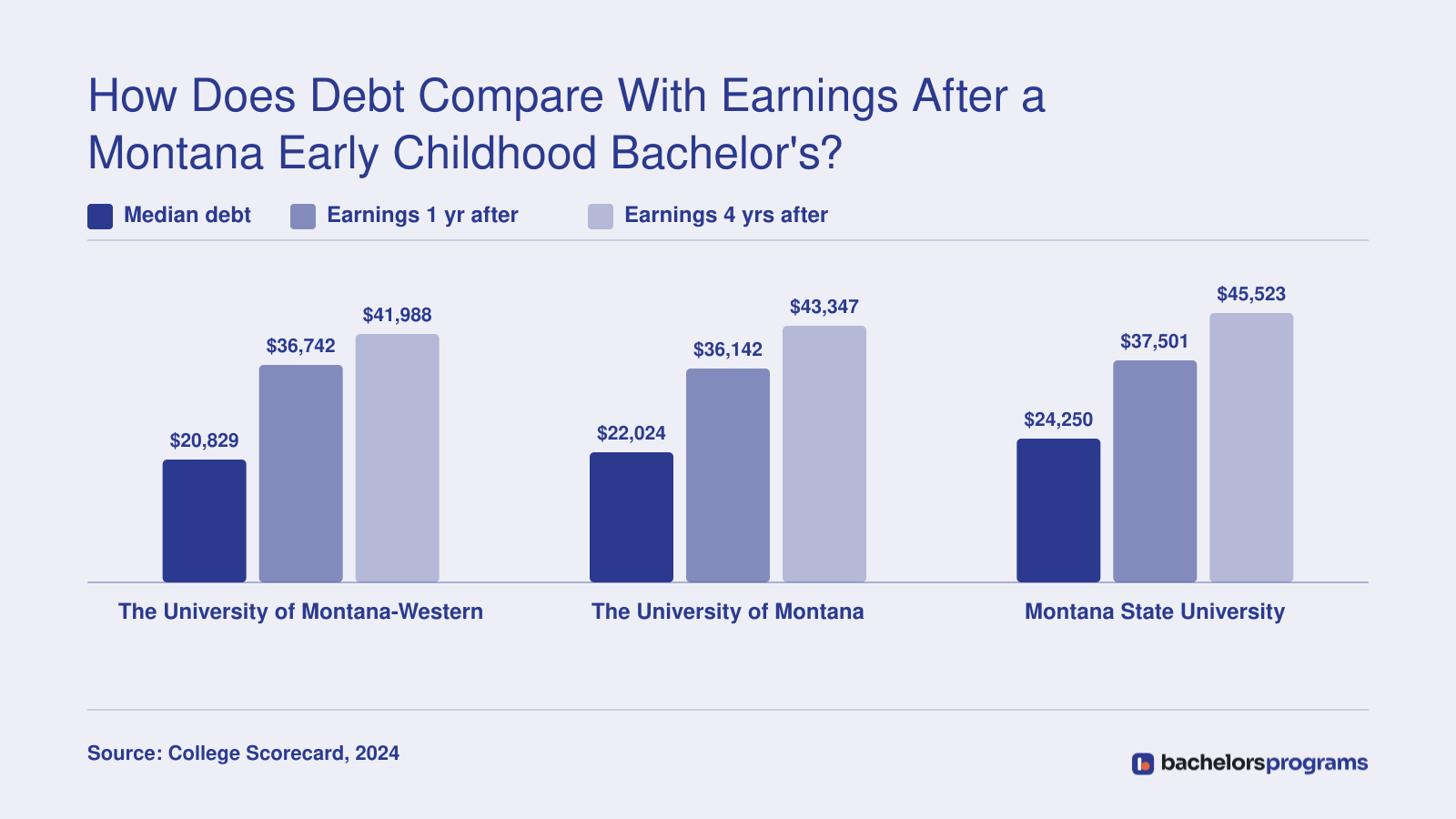
Median earnings of this field's bachelor's graduates (4 yrs after completing, else the school's undergraduate median) vs. their median federal loan debt · U.S. College Scorecard
Across these programs the median graduate earns about $43,347 and finishes with roughly $22,024 in debt — a ratio that clears a common rule of thumb (keep debt below first-year salary). Net price and debt vary widely school to school, so check the per-school figures in the table above before you shortlist.
How We Ranked Montana's Bachelor's in Early Childhood Education Programs
What actually separates one Montana early childhood education bachelor's program from another?
Four things shaped the ranking:
- Cost and value: net price after federal, state and institutional aid, alongside typical annual tuition.
- Outcomes: median earnings and typical student debt in the years after graduates leave.
- Completions: how many students actually finish the early childhood education program.
- Accreditation: institutional accreditation plus state approval for a P-3 licensure track.
Program-Level vs. School-Wide Numbers
Completions, earnings and debt are tied to the early childhood education program itself. Completions reflect the most recent academic year reported, while earnings and debt are measured for graduates in the years after they finish.
Net price and graduation rate work differently. They are published as institution-wide averages covering every undergraduate at the school, not just early childhood majors, so treat them as context rather than a precise forecast for your own situation.
A Short List, On Purpose
Montana is small, and only a handful of its early childhood bachelor's programs pair a P-3 licensure track with reporting detailed enough to compare. The programs below are the ones that clear that bar. A short list is easier to work through than a padded one.
Which Montana Programs Lead to P-3 Licensure, and Are They Accredited?
A degree with "early childhood" in its name does not always lead to a teaching license, and that gap is the first thing to check. The Montana P-3 license covers preschool through grade 3, and only a program approved by the state's Board of Public Education can recommend you for it.
Licensure Programs vs. Non-Licensure Credentials
Four programs here are built around P-3 licensure: Montana State University's Early Childhood Education and Child Services: P-3 Option, The University of Montana's Early Childhood Education P-3, The University of Montana-Western's Pre-Kindergarten through Grade 3 B.S., and the P-3 track at Salish Kootenai College. Salish Kootenai's materials describe a Montana preschool-grade 3 license, but no public source independently confirms that pathway's state approval, so ask the college directly. Montana State also offers a Child Development program, which is a studies-style credential and should not be assumed to carry licensure. Salish Kootenai's A.A. and its Head Start and child care preparation likewise serve roles outside the classroom license.
Accreditation Status
- Montana State University: Its P-3 program is state-accredited by the Board of Public Education, and the university reports CAEP accreditation for its initial-licensure programs. No NAEYC accreditation covers the degree itself.
- The University of Montana: Educator-preparation programs are fully state-accredited through December 31, 2027, and its accountability page gives CAEP the same date. A separate university page lists 2032 for other education programs, so confirm which date applies. NAEYC accreditation (2026) belongs to its Learning and Belonging Preschool, not the degree. The College of Education is described as NWCCU-accredited.
- UM-Western and Salish Kootenai: CAEP, NAEYC and NWCCU status could not be confirmed from the research, so treat those as open questions.
How to Verify It Yourself
Check the Office of Public Instruction's approved educator-preparation list, then the CAEP and NAEYC directories, then NWCCU's institution directory for regional accreditation.1 NAEYC accreditation of a campus preschool does not apply to the degree.
Which School Is Best for Licensure?
Montana State and The University of Montana have the best-documented P-3 pathways. Montana State's record is the cleaner of the two, since Missoula's CAEP dates conflict and expire in 2027. The other two may be strong, but ask them for written proof of approval before you apply.
Online and Hybrid Bachelor's Options at Montana Schools
An online or hybrid bachelor's in early childhood education lets you do most coursework away from campus, but the classroom hours that lead to a Montana P-3 license still happen in person. Only one school here offers a fully online route, so format choice narrows quickly.
How the Formats Compare
- The University of Montana-Western (Dillon): Online or on campus. The campus version uses a block model, one course at a time in 18-day blocks. The online version delivers coursework fully online and leads to the same licensure.
- The University of Montana (Missoula): Campus-based, with courses taken in sequenced levels. Some levels run only in spring or only in autumn, so plan your start date.
- Montana State University (Bozeman): Campus-based, with coursework and field experiences in the P-3 option and a Child Development Center lab preschool.
- Salish Kootenai College (Pablo): Campus-based, with a preschool-grade 3 license track.
What In-Person Really Means
At Montana Western, every student, online or not, completes lab work in licensed or accredited early-childhood settings or schools near them. Expect about 45 hours per early-childhood course. Some courses require specific age groups. Students who already work in a childcare setting may be able to use their workplace if it meets course requirements. Student teaching is a full semester in a K-3 classroom with a licensed mentor and university supervision.
The University of Montana reports more than 200 hours of field experience before student teaching. Student teaching itself is 640 hours, one full semester following the district calendar, with no other courses alongside it.
Treat "online" as meaning flexible coursework, not a degree you can finish without setting foot in a school. You will need placements near home and an employer willing to work around your schedule.
Who Each Format Suits
Montana Western's online option fits rural, place-bound students and working paraeducators or childcare staff who can use local sites. Its block model suits people who prefer to focus on one course at a time. The campus programs at the University of Montana, Montana State and Salish Kootenai College suit students who want a steady cohort pace and campus-arranged placements.
Admissions for a Bachelor's Degree in Early Childhood Education in Montana
Admission to a Montana early childhood bachelor's program means clearing two gates, not one: general university admission first, then a separate Teacher Education Program entry review later in your studies.
The first gate: getting into the university
At the University of Montana in Missoula, the early childhood P-3 bachelor's program publishes a 2.75 minimum GPA for admission and firm deadlines: September 15 for a spring start and February 15 for a fall start. UM's published admissions materials do not list an SAT or ACT requirement, so confirm with the admissions office whether a test score is expected with your application.
Montana State University's P-3 option and the University of Montana Western program did not publish a general admission GPA in the materials reviewed. Western also publishes no application deadline, and neither Western nor Montana State published a standardized test policy. Rather than assume a test score is optional, ask admissions directly.
The second gate: Teacher Education Program entry
Admission to the university is not admission to the teacher preparation program, and it is the gate students most often overlook.
- University of Montana: entry requires a 2.75 cumulative GPA, counting all transfer credits, plus a 2.75 GPA that is achieved or in progress across core courses.
- University of Montana Western: students must hold a 3.00 GPA in the early childhood core, with no grade below C-, and earn B- or better in WRIT 101 and the early childhood specialty courses.
- Montana State University: the education department publishes Teacher Education Program admission requirements, but the available materials do not spell out the GPA, Praxis Core, or background check thresholds.
What to confirm before you apply
Ask each school three things in writing: whether a Praxis Core score is required before program entry, what background check is needed for field placements, and whether a test score belongs with your application. Where a published policy is silent, the answer still exists; you just have to ask for it.
Transfer Credit and Associate-to-Bachelor's Pathways in Montana
The cheapest route into a Montana early childhood bachelor's often starts at a two-year college, but transfer credit only pays off when the courses land inside both the degree and the licensure sequence, not merely on a transcript.
How the Montana University System Handles Transfer
Montana's public system leans on three tools: common course numbering, the General Education Transfer Core, and individual articulation agreements.1 Courses with the same title, number and prefix are generally accepted at participating campuses, and a completed general education core can carry "Core Complete" status. Beyond that, equivalency depends on the receiving school, the major and the program. No single statewide agreement guarantees junior standing for every early childhood course or associate degree.
Tribal and Community College Partnerships
Salish Kootenai College in Pablo offers an Associate of Arts, a Bachelor of Science and a BS Transfer Curriculum in early childhood education, framed around birth to age 8.3 Transferred work must come from a regionally accredited institution, generally with a C or better, and it does not count toward your SKC institutional GPA.2 Bachelor's transfer students complete 60 credits at SKC2, and education courses finished more than five years earlier may be reviewed. On the community college side, an Associate of Science in early childhood education carries a published articulation into the University of Montana-Western in Dillon, the clearest documented associate-to-bachelor route in the state.4 Acceptance details still vary by institution.
Three Practical Checks
- Plan before you enroll: get an advising plan in writing that maps each two-year course to a bachelor's requirement.
- Confirm Praxis timing: check test dates and required subtests against your licensure advisor, not the calendar alone.
- Verify licensure value: ask whether each transferred course counts toward P-3 licensure, not just toward graduation.
Related Articles
How Does Debt Compare With Earnings After a Montana Early Childhood Bachelor's?
At each of these early childhood bachelor's programs, graduates' median debt is well below their median earnings one year after finishing. The University of Montana-Western has the lowest median debt ($20,829), and Montana State University has the highest earnings four years out ($45,523). Salish Kootenai College is not charted because its program does not report a median debt figure.
What Montana Preschool Teachers Earn
Here is a realistic starting benchmark for Montana's early childhood workforce.
How to Become an Early Childhood Teacher in Montana: Licensure Steps
Montana's preschool-through-grade-3 authorization is a P-3 endorsement on a Class 2 Standard Teacher's License, issued by the Office of Public Instruction (OPI). Montana has no licensure reciprocity with other states, so every applicant files a Montana application.
- Complete an approved bachelor's programEarn a bachelor's degree from an institutionally accredited college through an approved educator preparation program. Montana State University's Early Childhood Education PK-3 program is identified as meeting state licensure requirements.
- Pass Praxis 5025 or use another approved pathwayPraxis Early Childhood Education (5025) is the P-3 subject test, and the University of Montana advises that OPI requires it for P-3 endorsement applicants. Class 2 rules also allow alternatives: a passing student-teaching portfolio or a coursework GPA of at least 3.00, either verified by your program. Montana accepts only Praxis scores, which must be under 10 years old. Out-of-state testers should list OPI code 8653.
- Complete student teachingSupervised student teaching is built into every approved program. Your program sets the length.
- Take the Indian Education for All courseAll applicants must verify completion of the free Teacher Learning Hub course An Introduction to Indian Education for All in Montana.
- Apply to OPI through TeachMTSubmit official transcripts, your program's P-3 recommendation, proof of your competency pathway, a fingerprint background check and the licensure fee. OPI begins its review only after it receives all materials and fees. Confirm the current fee amount on OPI's licensure pages.
- Renew every five yearsRenewal requires 60 professional development units. One semester credit counts as 15 units, and one quarter credit counts as 10.
Questions to Ask Yourself
Do you need the P-3 license for a public school classroom, or does a Head Start or childcare role meet your goals?
Can you complete a full-time student-teaching semester, or do you need a program built around a job?
Will your associate credits transfer into the school you are considering, and has an advisor confirmed that in writing?
Are you planning to stay in a rural Montana community where in-person placements are hard to find?
Compare Early Childhood Education programs on the data that matters
Explore more Education & Teaching majors or browse every field of study.
All Education & Teaching programs Browse every field of study