Best Criminology Schools in Montana
Compare 3 accredited Criminology programs in Montana, with net price after aid, graduation rates, earnings and debt from IPEDS and the U.S. College Scorecard.

Which Montana schools actually award a bachelor's degree in criminology? The University of Montana is the only one with a dedicated major, a Bachelor of Arts (B.A.) in Criminology taught in Missoula and fully online. Elsewhere the subject sits inside sociology, and at Montana State University it carries a Bachelor of Science (B.S.) instead.
Montana State University offers a criminology option within its sociology B.S., and Carroll College runs a Sociology-Criminology program in Helena. The field is small, and students often weigh criminal justice coursework alongside these programs.
Residency decides the price. In-state tuition at Montana's public campuses runs a fraction of the non-resident rate, which makes geography as consequential as curriculum.
Key Points
- The University of Montana's B.A. in Criminology is also offered fully online.
- University of Montana residents pay $8,552 yearly; non-residents pay $33,671.
- UM and Montana State admit first-years with a 2.5 GPA or ACT 22.
Best Criminology Schools in Montana Ranked
The University of Montana is the best school for criminology in Montana: it is the only Montana university that awards a dedicated Bachelor of Arts in Criminology, and it offers the degree both on campus in Missoula and fully online. The three ranked programs below take different shapes, from a full criminology major to a sociology degree with a criminology concentration, so read the card notes on which credential each school actually grants. The earnings and debt ranges in these cards are institution-wide figures for graduates of each school, not results for the criminology major alone.
The University of Montana
#1Missoula, MT · ~$17,000/yr (est.)
Best for: Montana students wanting a dedicated criminology major
The University of Montana in Missoula is the flagship option on this list because it grants a Bachelor of Arts in Criminology outright, the only dedicated criminology bachelor's in the state. The degree is housed in the Sociology and Criminology department, every criminology course is taught by a Ph.D. holder, and students can complete the whole program on campus or fully online. Internships run with more than 20 Missoula agencies, including the Missoula Police Department, U.S. Probation and Pretrial Services and the FBI, and a memorial scholarship supports majors.
- Only dedicated criminology bachelor's degree in Montana
- Available on campus in Missoula or fully online
- Every criminology course taught by a Ph.D. instructor
- Upper-level SOCI 438 covers homicide, victimology and theory
- Internships with 20+ agencies including FBI and Missoula Police
- Dusten Hollist Memorial Scholarship funds criminology majors
- Double major option in Criminology and Sociology
- Prepares for law school, graduate study and data analysis roles
Carroll College
#2Helena, MT · ~$24,000/yr (est.)
Best for: Capital-city access to state agencies
Carroll College in Helena grants a Bachelor of Arts in Sociology with a Criminology concentration, so the credential reads sociology rather than criminology, but the coursework centers on crime and criminal behavior. Students pick one of three pathways: Criminology, Medical and Human Services, or Broadfield. The Helena location, in the state capital, puts students near state agencies for internships, and courses use Montana itself as a laboratory, from crime at Montana State Prison to sex trafficking during the oil boom. About half of sociology graduates continue to graduate school.
- Sociology major with a criminology concentration
- Three pathways: Criminology, Medical and Human Services, Broadfield
- Helena location near state agencies for internships
- Coursework uses Montana cases, including Montana State Prison
- About 50% of sociology graduates go on to graduate school
- Prepares for law enforcement, law, policy and corporate security
Montana State University
#3Bozeman, MT · ~$22,000/yr (est.)
Best for: Students wanting a research-heavy sociology base
Montana State University in Bozeman awards a Bachelor of Science in Sociology, Criminology Option, a 120-credit degree built on a sociology foundation with a substantial criminology elective menu. Majors complete Sociological Research Methods, Criminology and a Senior Thesis Capstone, plus 15 credits of criminology-designated courses and 15 more sociology credits, with most electives required at the upper division. Designated options include Criminal Justice System, Principles of Criminal Law and Procedure, Juvenile Justice System, Crime Prevention, Sociology of Corrections and Victims and Society.
- 120-credit sociology degree with a criminology option
- Requires SOCI 311 Criminology and a senior thesis capstone
- 15 criminology elective credits plus 15 sociology credits
- Most of the 30 elective credits must be upper-division
- Electives include Criminal Law, Juvenile Justice and Corrections
- Research methods sequence required before the capstone
Cost & outcomes by school
Federal data for the highest-earning Criminology programs, independent of the ranking above. Earnings are this field's bachelor's graduates four years after completing where the Scorecard reports them, else the school's undergraduate median.
| School | Net price / yr | Grad rate | Earnings | Debt | Grads/yr | Format |
|---|---|---|---|---|---|---|
| Carroll College MT | $23,960 | 69% | $61,772 | $25,757 | — | Campus |
| Montana State University MT | $22,499 | 57% | $53,263 | $22,500 | — | Campus |
| The University of Montana MT | $16,784 | 48% | $44,511 | $22,400 | 21 | Online or campus |
Sources: U.S. Department of Education. Net price, graduation rate, earnings and debt: College Scorecard (earnings and debt for this field's bachelor's graduates where reported, else school-wide); graduates: IPEDS. A dash means no figure is reported.
Cost, debt & payoff
Median earnings of this field's bachelor's graduates (4 yrs after completing, else the school's undergraduate median) vs. their median federal loan debt · U.S. College Scorecard
Across these programs the median graduate earns about $53,263 and finishes with roughly $22,500 in debt — a ratio that clears a common rule of thumb (keep debt below first-year salary). Net price and debt vary widely school to school, so check the per-school figures in the table above before you shortlist.
Choosing a Bachelor's Degree in Criminology in Montana
The University of Montana awards a B.A. in Criminology, which the university describes as the only one in Montana, while Montana State University awards a B.S. in Sociology with a Criminology Option. Carroll College in Helena offers a Sociology-Criminology program, so confirm its exact credential with the college's catalog before you apply.
B.A. vs. B.S. in Plain Terms
Both are four-year bachelor's degrees and both qualify you for entry-level work in the field. A B.A. typically leans toward the liberal arts, with more room for writing, humanities and electives. A B.S. typically puts more weight on research methods, statistics and the social sciences. Neither is better in general. The right choice depends on whether you would rather build a broad base or a more quantitative one.
Criminology, Sociology-Criminology and Criminal Justice
These three labels overlap but point in different directions:
- Criminology: Studies why crime happens, who commits it and how society responds. Expect theory, research and policy analysis.
- Sociology with a criminology emphasis: Grounds crime in the wider study of groups, inequality and institutions. Montana State University and Carroll College follow this model.
- Criminal justice: Focuses on how the system runs day to day, including policing, courts and corrections. It tends to be more applied and procedural.
Matching a Program to Your Goal
- Law enforcement: A criminology degree pairs well with an academy path, and Montana requires separate peace officer certification after hiring.
- Corrections and probation: Look for coursework on punishment, rehabilitation and community supervision, which criminology and sociology programs both cover.
- Victim services: Sociology-based programs suit this work because they emphasize families, communities and social services.
- Law school or other further study: A research-heavy B.A. or B.S. with strong writing and methods coursework prepares you best.
Other Options in the State
Other Montana campuses offer criminal justice bachelor's degrees, including at least one fully online1, and some two-year colleges offer associate degrees that transfer into a bachelor's2. The schools ranked here focus on criminology itself, so compare course lists carefully if a criminal justice title also appeals to you.
Online and Hybrid Criminology Options at Montana Schools
Yes, you can earn a criminology degree online in Montana. The University of Montana in Missoula offers its B.A. in Criminology as a fully online option, open to students in Montana and elsewhere. UM describes it as the only B.A. in Criminology in the state. The same program is also taught on campus.
Format Comparison
- The University of Montana: Campus and fully online. We could not confirm whether every elective or requirement can be finished without any campus attendance, so ask the department before you enroll.
- Montana State University: The B.S. in Sociology with a Criminology Option, based in Bozeman, is listed as campus-based. We could not confirm an online or hybrid version.
- Carroll College: The Sociology-Criminology program in Helena is listed as campus-based. We could not confirm online availability.
None of the three is confirmed as a hybrid bachelor's program, so ask each school directly whether a blended schedule is possible.
Who Each Format Suits
The online UM option fits working adults who cannot relocate to Missoula, and rural students who live hours from any campus. It can also suit transfer students finishing a bachelor's degree in criminology after community college coursework elsewhere, though credit acceptance should be checked with UM first.
Campus formats suit students who want in-person contact with faculty and local agencies. Carroll's Helena location puts students near state government, and UM's campus program points to internship partnerships in Missoula. Those advantages come with showing up in person, so weigh them against your work and family schedule.
Admission Requirements for Montana Criminology Bachelor's Programs: GPA, Test Policy and Transfer Credit
The University of Montana and Montana State University both use the statewide first-year standard for Montana's public four-year campuses: a 2.5 high school GPA, a top-half class rank, or an ACT composite of 22 or SAT total of 1120. Transfer applicants are judged on college GPA and credit totals instead. Carroll College shows "No published policy" wherever we found no figure on its admissions pages, so confirm its requirements with its admissions office. If you plan to start at a two-year college and transfer into a criminology program, build your credits from college-level, non-remedial courses so they count toward the 12-credit transfer threshold. Montana's public university system also has a transfer policy that addresses finishing its general education core for students who arrive with more than 20 credits in that core.
| School | Published GPA Requirement | Test Policy | Transfer Credit Policy |
|---|---|---|---|
| The University of Montana | First-year: meet one statewide standard (2.5 high school GPA, top half of graduating class, or ACT 22 / SAT 1120). Transfer: 2.0 cumulative GPA on a 4.0 scale for all college-level coursework completed after high school | ACT composite of 22 or SAT total of 1120 is one of three alternative first-year standards, not the only path to admission | Transfer applicants need 12 or more university-level, non-remedial semester credits earned after high school at institutions whose accreditation the state university system recognizes |
| Montana State University | First-year: meet one statewide standard (2.5 high school GPA, top half of graduating class, or ACT 22 / SAT 1120). Transfer: 2.0 (C average) cumulative transferable GPA for admission in good academic standing | ACT or SAT not required for admission; submitted scores can replace the MSU supplemental assessment for math and English placement | Students who attempted 12 or more quarter or semester credits of college-level work at a regionally accredited institution after high school are classified as transfer students; remedial, developmental, certificate and continuing-education courses are excluded |
| Carroll College | No published policy | No published policy | No published policy |
Cost of a Criminology Bachelor's Degree in Montana
Sticker price and what students actually pay are drifting further apart in Montana, and the gap is widest for out-of-state enrollees. What it costs depends on your residency and the school.
Tuition and Fees
At the University of Montana, 2026-2027 resident tuition and mandatory fees total $4,259 per semester for 12 or more credits ($3,420 tuition plus $839 in fees). Nonresidents pay $16,535 per semester: $12,276 in nonresident tuition plus the $4,259 in resident tuition and fees. UM says the nonresident add-on reflects the share of costs the state covers for residents. Health insurance is also required unless a student completes a waiver.
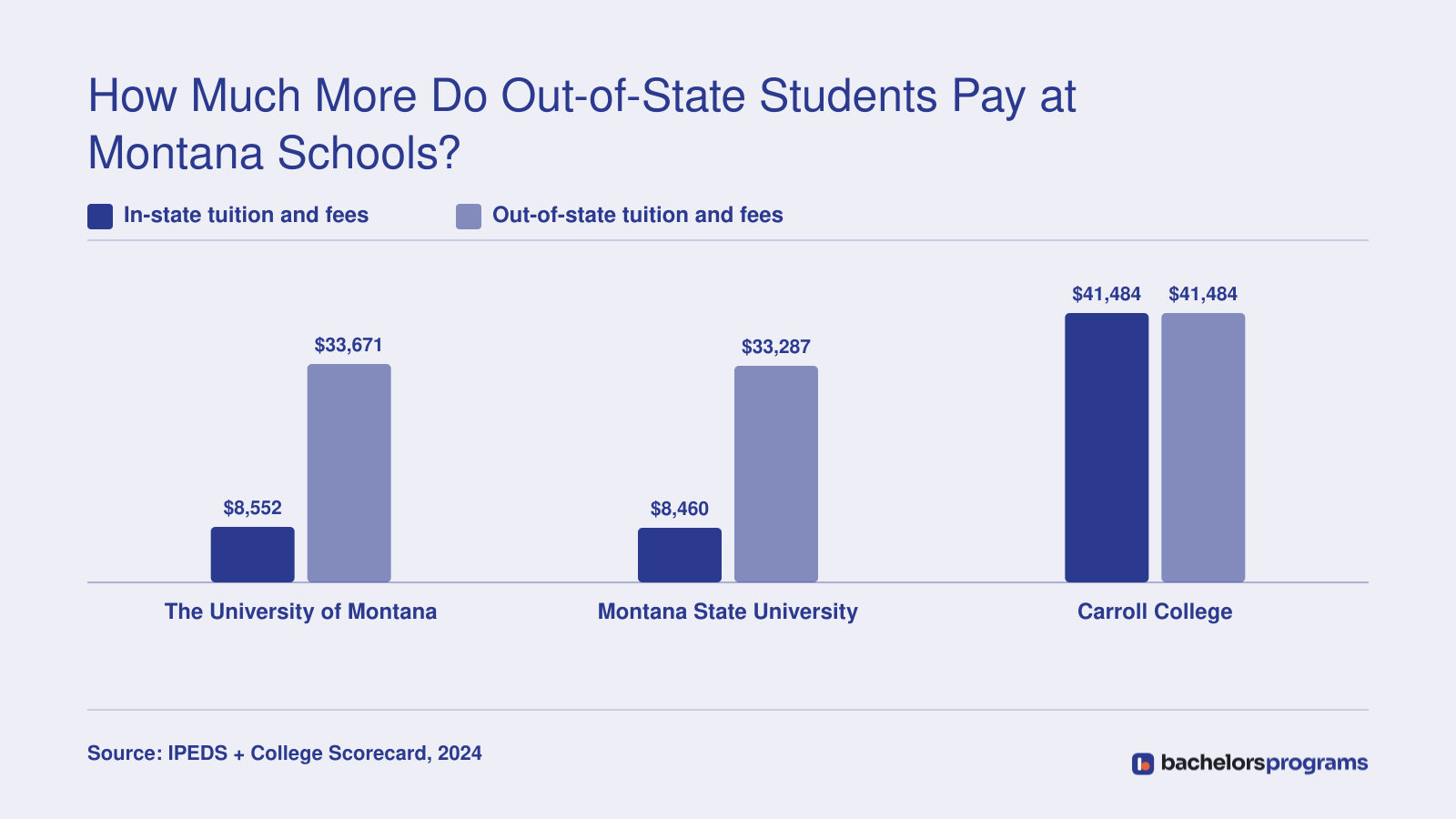
Montana State University's federal Scorecard figures run about $8,460 a year in-state and $33,287 out-of-state. Carroll College, a private school, charges one rate of about $41,484 regardless of residency.
Net Price After Aid
Average net price after grants and scholarships is well below the sticker price at each school:
- University of Montana: about $16,784 a year.
- Montana State University: about $22,499 a year.
- Carroll College: about $23,960 a year.
These are institution-wide averages, not criminology-specific costs. Your own bill will depend on income, scholarships, housing and credit load.
Debt
Program-level debt figures for criminology are not available. Institution-wide median debt for graduates, from federal Scorecard data, is about $22,400 at the University of Montana, $22,500 at Montana State University and $25,757 at Carroll College.
State Aid and Regional Discounts
Montana students may qualify for state aid such as the Montana Higher Education Grant and Montana Promise. Out-of-state students from western states may be able to use the Western Undergraduate Exchange (WUE) discount at participating campuses. Award sizes, eligibility rules and participating schools change, so confirm current terms with each financial aid office and file the FAFSA early. UM and Carroll both advertise scholarships for their criminology students.
How Much More Do Out-of-State Students Pay at Montana Schools?
Non-residents pay nearly four times the in-state rate at Montana's public universities. The University of Montana shows the widest gap: $8,552 in-state versus $33,671 out-of-state, a difference of $25,119 per year. Carroll College, a private school, charges every student the same $41,484, which is about $7,800 more than the public out-of-state rates.
Related Articles
Criminology Internships and Accreditation in Montana
A classroom-only path and a path that includes a field placement can produce the same diploma, but they do not produce the same resume. In Montana, the internship is where coursework on policing, corrections and victim advocacy meets the agencies that do the work.
Where students get placed
The University of Montana's criminology program points students toward internships and research with the Missoula Police Department and local organizations, and it has placed students with U.S. Probation and Pretrial Services, the FBI, Missoula Probation and Parole, CASA, the Parenting Place and the Poverello Center. One documented Missoula placement with U.S. Probation and Pretrial Services ran from September 2023 into spring 2024 at roughly 16 hours per week, with the student shadowing officers, attending court and supporting pre-trial, pre-sentence and post-conviction work. That is one student's experience rather than a guaranteed assignment, so treat it as a picture of what is possible.
UM structures the experience through an internship course open to sociology and criminology majors. It carries 1 to 6 credits, requires a faculty supervisor's approval before you start, and caps internship credit toward graduation at 6. Carroll College and Montana State University do not publish comparable placement partner lists for their criminology offerings, so ask each department directly which agencies they work with and whether field hours count toward the major.
Accreditation and why it matters
The University of Montana has held accreditation from the Northwest Commission on Colleges and Universities since 1932. Institutional accreditation is the gate for federal financial aid and the reason credits transfer cleanly between schools, so confirm it before you enroll anywhere.
Line up a placement early
Because faculty approval comes first, start the conversation a full semester ahead. Email your academic advisor in the fall for a spring placement, ask which agencies took students last year, and have a resume and a short statement of interest ready. Agencies with background checks, including probation offices and police departments, often need weeks of lead time.
What Montana Criminology Graduates Earn After Finishing
Federal earnings data for completers of these Montana criminology bachelor's programs, at one, two or four years after finishing, is not reported.
Montana Peace Officer Certification at a Glance
Common Questions About Criminology Degrees in Montana
What is the best school for criminology in Montana?
Can you get a criminology degree online in Montana?
Do you need a criminology degree to become a police officer in Montana?
Is criminology a good major if I want to work in victim services or probation?
Compare Criminology programs on the data that matters
Explore more Criminal Justice & Law majors or browse every field of study.
All Criminal Justice & Law programs Browse every field of study