Best Accounting Schools in Montana
Compare 4 accredited Accounting programs in Montana, with net price after aid, graduation rates, earnings and debt from IPEDS and the U.S. College Scorecard.

Montana's traditional CPA pathway requires 150 semester credits; a bachelor's degree in accounting typically supplies about 120. The last 30 hours are a planning problem that begins before enrollment, since they must satisfy specific upper-level accounting and business requirements set by the Montana Board of Public Accountants.
The Bachelor of Science (B.S.) in Accounting is the standard credential. Carroll College, Montana State University, The University of Montana and Montana State University Billings offer it on campus, and one delivers the degree fully online, for students who want a Montana school without relocating.
Outcomes diverge: Carroll graduates report a median $79,048 four years out, against $61,408 at the University of Montana.
Key Points
- Carroll College accounting graduates earn a median $79,048 four years out.
- Montana CPA licensure requires 150 credits, and a bachelor's typically covers 120.
- Nationally, accountants and auditors earned a median $83,680 in May 2025.
Best Accounting Schools in Montana: Our Ranked List
Four Montana colleges offer a bachelor's degree in accounting, and they differ sharply in setting, size and delivery. Two are large public universities with deep recruiting pipelines, one is a small private college in Helena, and one delivers the whole accounting option online. The ranked list below starts with the schools whose accounting programs combine strong completion outcomes with the most reasonable net price after aid.
Carroll College
#1Helena, MT · ~$24,000/yr (est.)
Best for: Small-class learners seeking faculty mentorship
Carroll College is a private college in Helena where accounting is taught through a Business: Accounting and Strategic Finance major rather than a stand-alone accounting degree. Classes are small, internships are close to universal (nearly 90% of majors complete one, often with regional firms such as Wipfli and Pinion or agencies like the FBI), and majors receive free memberships in the Montana Society of CPAs. The program also folds in emerging topics such as ESG reporting and forensic fraud analytics, and an optional three-year track lets motivated students finish the bachelor's sooner.
- Accounting core paired with a liberal arts foundation
- Coursework in auditing, taxation and accounting information systems
- Introduces ESG reporting and forensic fraud analytics
- Nearly 90% of majors complete an internship
- Internship partners include Wipfli, Pinion and the FBI
- Optional accelerated three-year completion track
- Free Montana Society of CPAs memberships for majors
- CPA review through Gleim plus ethical leadership certification
Montana State University
#2Bozeman, MT · ~$22,000/yr (est.)
Best for: CPA-track students wanting an accelerated start
Montana State University in Bozeman teaches accounting as an emphasis inside the Bachelor of Science in Business, so students build a full business core before specializing. Hands-on work is built in: students prepare real tax returns through the Volunteer Income Tax Assistance program and consult for nonprofits through Boardroom Bobcats, while the Bracken Business Communications Clinic sharpens writing and presentation skills. An annual Meet the Accounting Recruiters event and faculty-coordinated internships feed a clear pathway into the university's Master of Professional Accountancy for CPA-bound students.
- Accounting emphasis within the B.S. in Business degree
- Real client tax work through the VITA program
- Nonprofit consulting experience via Boardroom Bobcats
- One-on-one coaching at the Bracken Business Communications Clinic
- Annual Meet the Accounting Recruiters event
- Accounting Club and Beta Alpha Psi chapter
- Faculty-coordinated internships
- Accelerated pathway into the Master of Professional Accountancy
The University of Montana
#3Missoula, MT · ~$17,000/yr (est.)
Best for: Students prioritizing national employer recruiting
The University of Montana in Missoula is the only school in the state holding AACSB accreditation in both accounting and business, a distinction fewer than two percent of business schools nationwide earn. The Department of Accounting and Finance pairs that rigor with an active recruiting slate that has placed interns with Microsoft, Deloitte, Goldman Sachs, Wells Fargo and Nike, and roughly 80% of students complete an internship. A one-credit VITA elective helps students accumulate the 150 credit hours Montana CPA licensure requires, and the College of Business awards nearly $500,000 in scholarships each year.
- AACSB accredited in both accounting and business
- One-credit VITA elective builds credits toward CPA licensure
- Internships available in fall, spring and summer
- Internship employers include Microsoft, Deloitte and Goldman Sachs
- About 80% of students complete an internship
- Study abroad options in Italy and Australia
- Accounting Society and Beta Alpha Psi chapters
- College of Business awards nearly $500,000 in scholarships yearly
Montana State University Billings
#4Billings, MT · $17,000/yr (est. net price)
Montana State University Billings offers its accounting option entirely online, making it the most flexible route on this list for working adults and students who live far from the Bozeman and Missoula corridors. The 120-credit Bachelor of Science in Business Administration curriculum covers financial accounting, federal income taxation, auditing, cost and managerial accounting, and government and not-for-profit accounting, with restricted electives in areas such as forensic accounting and tax research. A required capstone and a suggested four-year plan keep online students on pace, and the catalog ties the upper-division accounting credits directly to Montana CPA exam eligibility.
- Accounting option delivered fully online
- 120-credit degree with a required capstone course
- Covers financial accounting, federal taxation and auditing
- Includes government and not-for-profit accounting topics
- Restricted electives include forensic accounting and tax research
- Upper-division accounting credits align with Montana CPA rules
- Suggested four-year plan of study keeps students on track
Cost & outcomes by school
Federal data for the highest-earning Accounting programs, independent of the ranking above. Earnings are this field's bachelor's graduates four years after completing where the Scorecard reports them, else the school's undergraduate median.
| School | Net price / yr | Grad rate | Earnings | Debt | Grads/yr | Format |
|---|---|---|---|---|---|---|
| Carroll College MT | $23,960 | 69% | $79,048 | $24,050 | 14 | Campus |
| The University of Montana MT | $16,784 | 48% | $61,408 | $23,181 | 38 | Campus |
| Montana State University MT | $22,499 | 57% | $53,263 | $22,500 | — | Campus |
| Montana State University Billings MT | $16,524 | 30% | $44,296 | $18,209 | — | Online |
Sources: U.S. Department of Education. Net price, graduation rate, earnings and debt: College Scorecard (earnings and debt for this field's bachelor's graduates where reported, else school-wide); graduates: IPEDS. A dash means no figure is reported.
Cost, debt & payoff
Median earnings of this field's bachelor's graduates (4 yrs after completing, else the school's undergraduate median) vs. their median federal loan debt · U.S. College Scorecard
Across these programs the median graduate earns about $57,336 and finishes with roughly $22,841 in debt — a ratio that clears a common rule of thumb (keep debt below first-year salary). Net price and debt vary widely school to school, so check the per-school figures in the table above before you shortlist.
How We Ranked Montana Bachelor's Degree in Accounting Programs
Four federal measures decide where a Montana accounting program lands on a ranked list.
All four come from the College Scorecard: earnings of graduates, median debt, net price and graduation rate. Each answers a different question, and none of them is a stand-in for teaching quality. For accounting, earnings and debt matter most, because the degree is a career credential and borrowing is the cost students can most directly control.
What Each Measure Tells You
- Earnings: what graduates of a program earn after finishing, a rough signal of salary outcomes.
- Debt: the typical amount students borrow, useful for judging how much of a program's cost is financed.
- Net price: the average a student pays after grants and scholarships. It is institution-wide rather than accounting-specific, so treat it as approximate.
- Graduation rate: the proportion of students who complete their degree. This is also institution-wide, and it is a broad sign of how well a school helps students reach completion.
What the List Covers
The list includes only bachelor's programs in Montana, both campus and online, and the order reflects those measures. Admissions selectivity, accreditation and CPA exam pass rates are not inputs, so use the ranking as a starting filter and confirm tuition, transfer credit and CPA eligibility directly with the schools you are considering.
Montana Accounting Schools Compared: Earnings, Debt and Completions
Federal IPEDS and College Scorecard data show Carroll College accounting graduates earning a median $79,048 four years after finishing, compared with $61,408 at The University of Montana, while median accounting debt at those two schools sits near $24,000. Montana State University Billings has the lowest campus-wide median graduate debt among the schools ranked here, at $18,209. Program-level earnings, debt and completion counts are not reported for Montana State University or Montana State University Billings, so their rows show campus-wide debt and graduation rates.
| School | City | Accounting Bachelor's Completions (Year) | Median Earnings, Accounting Grads (4 Years After Graduation) | Median Debt, Accounting Grads | Median Debt, All Graduates (Campus-Wide) | Overall Graduation Rate |
|---|---|---|---|---|---|---|
| Carroll College | Helena | 7 | $79,048 | $24,050 | $25,757 | 69% |
| The University of Montana | Missoula | 23 | $61,408 | $23,181 | $22,400 | 48% |
| Montana State University | Bozeman | N/A | N/A | N/A | $22,500 | 57% |
| Montana State University Billings | Billings | N/A | N/A | N/A | $18,209 | 30% |
Online and Hybrid Accounting Bachelor's Options at Montana Schools
An online accounting bachelor's degree means completing most or all coursework through distance delivery instead of on a campus. Montana does offer such programs, though the online options are narrower than the on-campus list.
Ranked schools
Montana State University Billings is the clearest online route here. Its Business Administration Accounting Option is listed as offered fully online and requires a capstone. Carroll College, Montana State University and The University of Montana list their accounting programs as campus-based, and their program pages do not confirm online or hybrid formats. None of the four program pages states a transfer-credit minimum, so ask admissions directly.
The Bachelor of Applied Science pathway
Montana Tech does offer a bachelor's pathway in accounting, but it is a Bachelor of Applied Science (B.A.S.) in Business with an Accounting Track, not a B.S. It falls outside the schools ranked here. It is built for students who already hold an Associate of Applied Science (A.A.S.), especially place-bound Helena-area students. Delivery is hybrid: a Helena community college partner typically runs at least two required evening classroom courses each semester, and the remaining courses are distance or online.2 The program typically takes about six semesters. The program pages do not establish that every course is fully online.
Transfer rules are specific:
- Credit block: 54 credits apply for a completed A.A.S. and for certain associate degrees in Accounting Technology, Business Technology or Computer Technology.1
- Excluded credits: Remedial courses, including math below College Algebra, do not count.1
- Degree totals: 120 credits, at least 39 upper-division, and at least 30 upper-division credits earned through Montana Tech, including BMGT426.
- CPA note: Licensure requires 150 credits, which means extra coursework beyond the degree.
Related Articles
Cost of a Bachelor's Degree in Accounting in Montana
What matters is the gap between sticker price and what your family actually pays after grants and scholarships, and in Montana that gap can change which school looks affordable.
Tuition and Net Price
The public universities post similar in-state tuition and fees, while Carroll College charges one private rate to everyone:
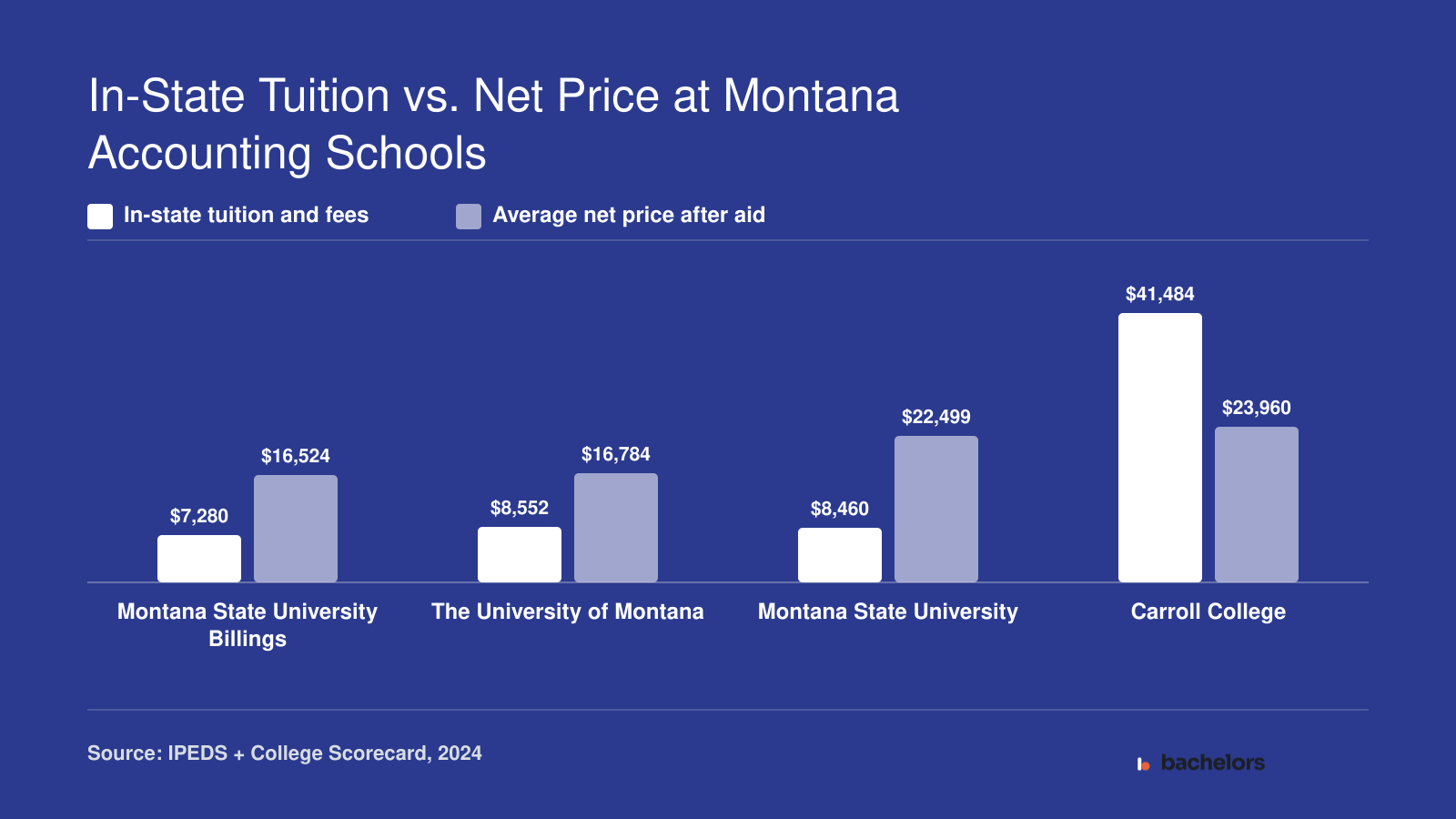
- Montana State University Billings: $7,280 in-state, $22,897 out-of-state, about $16,524 net price
- Montana State University: $8,460 in-state, $33,287 out-of-state, about $22,499 net price
- The University of Montana: $8,552 in-state, $33,671 out-of-state, about $16,784 net price
- Carroll College: $41,484 for all students, about $23,960 net price
MSU Billings is the lowest-cost option on both tuition and net price. Net price is an approximate schoolwide average, tuition, housing and other costs after aid, not a figure specific to accounting majors, so your own number depends on your income. Carroll's net price lands far closer to the public schools than its tuition suggests.
Montana Aid and WUE
The MUS Honor Scholarship is a merit tuition waiver for seniors at Board-accredited Montana high schools. It runs four years and averages about $20,000 in value. Montana also offers state grants such as the Montana Higher Education Grant, but current award amounts and deadlines are not posted, so confirm them with each financial aid office.
The Western Undergraduate Exchange (WUE) is a competitive tuition discount for out-of-state students from participating western states and territories.1 At the University of Montana, apply by December 1, 2026, hold a 3.0 GPA, and take 15 credits per semester. Montana State lists a January 7, 2027 deadline for Fall 2027, a 3.0 high school GPA, and a rate of 1.5 times in-state tuition.
Budgeting Takeaway
Median debt for accounting graduates runs about $23,181 at the University of Montana and $24,050 at Carroll, roughly $246 to $255 a month on a 10-year plan. Compare award letters side by side, not tuition tables.
In-State Tuition vs. Net Price at Montana Accounting Schools
At the public universities, average net price runs higher than published in-state tuition and fees because it adds housing, books and living costs, then subtracts grants and scholarships. At Carroll College, aid brings a $41,484 sticker price down to an average net price of $23,960. Net price is an institution-wide average for all aided undergraduates, not a quote for accounting majors, so run each school's net price calculator for your own estimate.
Accounting Careers in Montana: Where Graduates Work
Nationally, accountants and auditors earned a median of $83,680 in May 2025, according to the Bureau of Labor Statistics (BLS).1 That is occupation-wide pay for everyone in the field, from new hires to senior partners. It is not what a Montana graduate earns after finishing a bachelor's degree in accounting. The BLS also projects 5% national growth from 2025 to 2035, which it classes as faster than average.2 Check Montana-specific wages and growth on the BLS state occupational pages before you plan around them.3
Where Montana Graduates Find Work
Accounting majors from Carroll College, Montana State University, The University of Montana and Montana State University Billings typically move into a few lanes:
- Public accounting: Audit, tax and advisory roles at regional and local firms, a common route toward the CPA.
- State and local government: Agencies, school districts, counties and cities need staff for budgeting, auditing and financial reporting.
- Tax work: Preparation and planning for individuals, small businesses and ranch or farm operations.
- Corporate, agricultural and energy employers: Internal accounting, cost analysis and finance roles at companies tied to the state's agriculture, energy and natural resource economy.
Two Different Pay Measures
The earnings figures cited in the introduction come from federal College Scorecard data. They describe what former students of a specific program earned a set period after leaving school, which reflects early-career pay. The BLS wage covers every working accountant and auditor, so it runs higher because experienced professionals are included. Use the Scorecard numbers to compare programs and the BLS figure to understand where pay can go with experience and credentials such as the CPA. Do not subtract one from the other, since they measure different groups.
Montana CPA Licensure at a Glance
How a Bachelor's Degree in Accounting Fits the CPA Path
Montana licenses CPAs at 150 semester credits, and a bachelor's degree in accounting usually supplies about 120 of them. The last 30 are the student's job to plan for.
What the Bachelor's Degree Covers
Carroll College, Montana State University, The University of Montana and Montana State University Billings all build their accounting majors around the coursework the Montana Board of Public Accountants expects: financial and managerial accounting, auditing, taxation, business law and a supporting business core. That satisfies the accounting-specific requirements of licensure. It does not, by itself, reach the credit total.
Three Ways to Close the Gap
- A fifth year of undergraduate coursework: add upper-division accounting and business electives until the 150-credit threshold is met.
- A stacked degree path: apply graduate accounting credits toward the total, either through a formal combined program or a post-bachelor's sequence of courses.
- Transfer and online credit: outside coursework can fill the non-accounting hours, but confirm each course counts before you enroll in it.
Verify Before You Register
Ask the accounting department for a written credit review against Montana's requirements, then check the same list with the Montana Board of Public Accountants. Treat the review as a planning document, not a formality, because the cost of discovering a missing business-law credit during your application is a delayed exam date.
Pass rates are harder to compare. Montana does not publish a separate statewide pass rate, but NASBA does publish institution-level pass data1: Rocky Mountain College reports the highest first-time pass rate in Montana for 2024, ranking 12th among 291 small programs nationally.2 For scale, national 2025 section pass rates ran from 41.94% to 77.65% depending on the section3, a reminder that difficulty tracks the topic more than the campus.
Questions to Ask Yourself
Will you need a fully online or hybrid format, or can you attend on campus in Montana?
Are you transferring credits or an associate degree, and does the school's published transfer policy accept them?
Do you plan to sit for the CPA exam and need a clear route to 150 credits?
Is in-state tuition, the Western Undergraduate Exchange or state aid the deciding factor in your budget?
Compare Accounting programs on the data that matters
Explore more Business & Management majors or browse every field of study.
All Business & Management programs Browse every field of study