Best Forensic Science Schools in New Hampshire
Compare 3 accredited Forensic Science programs in New Hampshire, with net price after aid, graduation rates, earnings and debt from IPEDS and the U.S. College Scorecard.
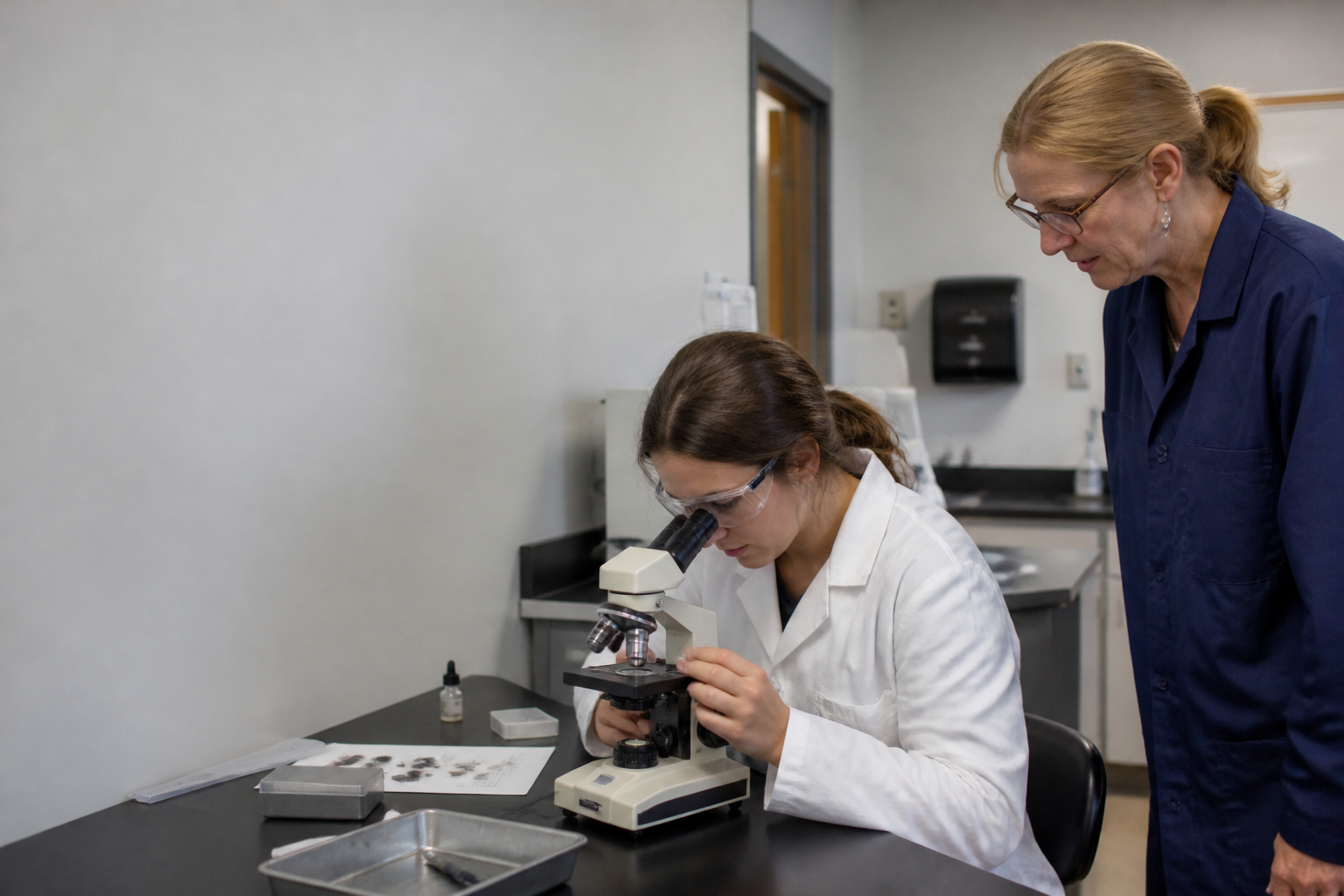
New Hampshire offers two routes into forensic work: a broad chemistry or biology degree supplemented on the job, or a dedicated bachelor's degree in forensic science built around criminalistics and laboratory coursework.
The second is scarcer than it looks. Only a handful of New Hampshire schools award a Bachelor of Science (B.S.) or Bachelor of Arts (B.A.) in Forensic Science, and none holds FEPAC accreditation.
Admissions standards, tuition and transfer credit separate these programs more than reputation does. In a field that hires on documented bench hours, instrument access matters more than the diploma's wording.
Key Points
- Plymouth State, Saint Anselm and Rivier all award forensic science bachelor's degrees.
- None of the schools ranked here holds FEPAC accreditation for forensic science.
- Lab-heavy coursework keeps these forensic science programs on campus, not online.
Best Forensic Science Bachelor's Programs in New Hampshire: Our Ranked List
New Hampshire's roster of forensic science bachelor's programs is short: only three colleges appear in our current review with a program in the field, and each entry was checked against the school's own catalog pages rather than a directory listing. All three award a standalone major, with Saint Anselm offering it as either a B.A. or a B.S. plus a separate forensics minor, and Plymouth State and Rivier offering a B.S. Read each card's program notes to see which credential and concentration you would actually earn.
Plymouth State University
#1Plymouth, NH · $15,000 – $20,000/yr (est.)
Best for: In-state students choosing among three concentrations
Plymouth State University awards a B.S. in Forensic Science with three options, Laboratory Science, Digital Forensics and Forensic Psychology, and describes it as the first baccalaureate forensic science program at a New Hampshire public university. The Laboratory Science option runs 54 credits inside a 120-credit degree and includes a capstone project and an ethics course, with electives drawn from microbiology, biochemistry and instrumental analysis. Schools offering this program have graduation rates of 52%, and Plymouth carries the lowest net price after aid on this list.
- Three options: Laboratory Science, Digital Forensics, Forensic Psychology
- Laboratory Science option totals 54 credits within a 120-credit degree
- Required FS 4100 Forensic Science Capstone Project and an ethics course
- 12 credits of lab electives from microbiology, biochemistry, instrumental analysis
- Called the first baccalaureate forensic science program at a NH public university
- Built on criminal justice and chemistry, plus biology and anthropology coursework
- Students can add a minor in Chemistry or Biology
- Collaborative, project-based Cluster Learning model
Saint Anselm College
#2Manchester, NH · ~$35,000/yr (est.)
Saint Anselm College is the flexible option here: the forensic science major is awarded as either a B.A. or a B.S., and a separate forensics minor runs alongside it. The program sits in the Chemistry Department, with a core of chemistry, computer science and mathematics, options in biology and physics, and supporting coursework in criminal justice, psychology and sociology. Schools offering this program have graduation rates of 80%, the highest on this list, and the college reports median earnings of $73,371 ten years after entry.
- Offered as both a B.A. and a B.S. major
- Separate forensics minor also available
- Core in chemistry, computer science and mathematics
- Options in biology and physics
- Coursework in criminal justice, psychology, sociology and archeology
- Housed in the Chemistry Department
- Focus on applying science to questions at issue in the legal system
Rivier University
#3Nashua, NH · ~$28,000/yr (est.)
Best for: Hands-on learners seeking new lab facilities
Rivier University launched its B.S. in Forensic Science in 2026, with on-campus classes starting in fall 2026, so early students would be among the program's first cohorts. The interdisciplinary degree combines biology, chemistry, genetics, quantitative analysis and criminal law, and students train in a 36,000-square-foot Science and Innovation Center with laboratories for DNA analysis, organic chemistry and digital forensics. Internships with crime laboratories and law enforcement agencies can begin in the sophomore year. Schools offering this program have graduation rates of 52%, and borrowers leave with median federal debt of $26,956.
- 36,000-square-foot Science and Innovation Center opened in 2020
- Labs for DNA analysis, organic chemistry and digital forensics
- Internships with crime labs and law enforcement start sophomore year
- Coursework in criminal justice, law and ethics
- Case-based learning and simulation exercises
- Genomics, AI and chemical analysis tools used in courses
- 100% of full-time undergraduates receive some form of aid
- Financial aid and scholarships available
Cost & outcomes by school
Federal data for the highest-earning Forensic Science programs, independent of the ranking above. Earnings are this field's bachelor's graduates four years after completing where the Scorecard reports them, else the school's undergraduate median.
| School | Net price / yr | Grad rate | Earnings | Debt | Grads/yr | Format |
|---|---|---|---|---|---|---|
| Saint Anselm College NH | $34,779 | 80% | $73,371 | $27,000 | 6 | Campus |
| Plymouth State University NH | $19,216 | 52% | $57,304 | $26,000 | 4 | Campus |
| Rivier University NH | $28,082 | 52% | $52,248 | $26,956 | 5 | Campus |
Sources: U.S. Department of Education. Net price, graduation rate, earnings and debt: College Scorecard (earnings and debt for this field's bachelor's graduates where reported, else school-wide); graduates: IPEDS. A dash means no figure is reported.
Cost, debt & payoff
Median earnings of this field's bachelor's graduates (4 yrs after completing, else the school's undergraduate median) vs. their median federal loan debt · U.S. College Scorecard
Across these programs the median graduate earns about $57,304 and finishes with roughly $26,956 in debt — a ratio that clears a common rule of thumb (keep debt below first-year salary). Net price and debt vary widely school to school, so check the per-school figures in the table above before you shortlist.
How We Ranked New Hampshire Forensic Science Schools
Every school on this list offers a verified bachelor's program in forensic science, confirmed on its own program page. From there, we compared schools on factors that shape a student's education, budget, and career prospects. Where a school does not report a figure, we scored it on the data that is available.
| Ranking Factor | What We Measured | Why It Matters to Students |
|---|---|---|
| Program Availability | A confirmed bachelor's degree in forensic science (B.S. or B.A.) listed on the school's official program page | Ensures you are comparing real, currently offered undergraduate programs, not general criminal justice majors |
| Accreditation | Institutional accreditation and whether the program holds FEPAC accreditation | Accreditation affects credit transfer, financial aid eligibility, and how crime lab employers view your degree |
| Science Curriculum Depth | Required coursework in chemistry, biology, and laboratory methods | Crime lab roles typically expect a strong natural science foundation with hands-on lab experience |
| Cost and Net Price | Published tuition and average net price after grants and scholarships | Net price shows what families actually pay, which can differ sharply from the sticker price |
| Student Outcomes | Graduation rates and reported earnings of graduates where available | Completion and earnings data signal whether students finish the degree and find paying work |
| Format Flexibility | Campus, online, and hybrid delivery options | Flexible formats matter for working adults, transfer students, and those living outside commuting range |
| Admissions and Transfer Policy | Published GPA expectations, test policy, and transfer credit rules | Clear policies help you plan your application and avoid losing credits earned elsewhere |
What a Bachelor's Degree in Forensic Science Covers in New Hampshire (And the FEPAC Question)
No New Hampshire school holds FEPAC accreditation for forensic science, so the coursework itself matters more than any accreditation badge. So judge the coursework: its science core, its lab hours, its practical training.
B.S. vs. B.A.
A Bachelor of Science leans on lab science: chemistry, biology and instrumental analysis. A Bachelor of Arts is more flexible and often pairs forensic coursework with criminal justice or psychology. Saint Anselm College is built around chemistry, computer science and mathematics, with biology and physics options, and it offers both degree types. Plymouth State University and Rivier University each award a B.S.
Three Common Tracks
Plymouth State's forensics degree shows how the tracks divide: Laboratory Science, Digital Forensics and Forensic Psychology. The laboratory option requires General Chemistry I and II, Techniques in Laboratory, Biological Science I, Genetics and a forensic science course with lab work on metals, hairs, fibers and paint (it carries an extra lab fee). Students also choose 12 credits of lab electives, such as Instrumental Analysis or Organic Chemistry. Digital forensics and forensic psychology shift the weight toward computing and behavioral science. Ask each school how internships and capstone projects attach to your chosen track.
Are There FEPAC-Accredited Programs in New Hampshire?
No. The FEPAC accredited-program list showed no New Hampshire institution as of September 2026. FEPAC covers forensic science programs at the bachelor's and master's level, and programs can apply each cycle, so check the list again before you enroll. For crime lab hiring, the missing badge is not disqualifying. Laboratories look closely at your transcript, so a heavy chemistry and biology core carries real weight.
What to Check Instead
Plymouth State and Saint Anselm are accredited by the New England Commission of Higher Education (NECHE). Confirm the same for any school on your list, Rivier included, in NECHE's directory. Then compare programs on these points:
- Chemistry core: Look for a full general chemistry sequence, plus organic or instrumental analysis.
- Lab hours: Count hands-on laboratory courses, not just lecture credits.
- Practical experience: Ask about internships, research and a capstone.
Online and Hybrid Forensic Science Bachelor's Options at New Hampshire Schools
Can you get a forensic science degree online in New Hampshire? Not a lab-based B.S. in forensic science, at least not one offered by a New Hampshire school. Plymouth State University, Saint Anselm College and Rivier University deliver their forensic science bachelor's programs on campus in Plymouth, Manchester and Nashua. Online listings often include out-of-state providers, so check where a school is actually based before you apply.
What Is Available Online or Hybrid
The closest online route is a different degree: a New Hampshire-based online university offers a B.A. in Psychology with a forensic psychology concentration. It runs in 8-week terms with no set class times, and the concentration is four courses (12 credits). The university states it does not lead directly to licensure, and no required campus lab has been identified.
Plymouth State's B.S. in Forensic Science offers Laboratory Science, Digital Forensics and Forensic Psychology options, and is delivered in person. Saint Anselm and Rivier do not publish hybrid or evening details that we can confirm, so ask their admissions offices directly.
Why Labs Stay on Campus
Lab-heavy B.S. tracks depend on hands-on work with evidence, instruments and procedures, so they are usually campus-based. Digital forensics and forensic psychology rely more on software, case analysis and coursework, which is why they adapt more easily to online formats.
Quick Checklist for Vetting Online Options
- Location: Confirm the school is based in New Hampshire, not just advertising to state residents.
- Accreditation: Look for regional accreditation of the institution.
- In-person requirements: Ask whether any lab sessions, residencies or internships must be completed on site.
- Degree title: Check whether the diploma reads forensic science or psychology with a concentration, since employers may read them differently.
Admission Requirements for New Hampshire Forensic Science Bachelor's Programs
Every school ranked here admits a clear majority of applicants. A transcript strong in science and math will matter more than a top test score. We could not confirm published GPA minimums or 2026 testing policies, so check those details with each admissions office before you apply.
- Saint Anselm CollegeSaint Anselm admitted about 78% of applicants in recent federal data, the lowest rate among the schools here, and about 20% of its students receive Pell Grants. The forensic science major sits in the Chemistry Department, with a core in chemistry, computer science and math. Strong high school chemistry and math are the best preparation.
- Rivier UniversityRivier admitted about 83% of applicants, and about 46% of its students receive Pell Grants. Its B.S. uses labs for DNA analysis and chemical analysis, so applicants benefit from solid biology and chemistry backgrounds.
- Plymouth State UniversityPlymouth State admitted about 88% of applicants, and about 41% of its students receive Pell Grants. Its 120-credit B.S. builds on criminal justice and chemistry. Our review did not establish a minimum GPA, test policy or transfer-credit rules, so ask admissions directly.
- High school courseworkPlan on chemistry, biology and math through at least algebra II. This is general guidance, not a published requirement at any of these schools.
- Transfer applicantsRequest official transcripts from every college you attended. Ask each school how it will apply your lab science credits to the major.
Starting at a Community College: Forensic Science Transfer Pathways in New Hampshire
A community college start can work for forensic science in New Hampshire, but the path is less automatic than it looks. The state's community college system lists a transfer-oriented Associate degree in Forensic Science. Published material does not show which of its seven colleges currently offer it, so confirm the campus before you apply. If your nearest campus lacks it, a criminal justice or lab science associate degree may be a fallback, but check how those courses would transfer.
What Transfers, and Where
Plymouth State University takes part in the New Hampshire Transfer Guarantee. It requires an associate degree from a New Hampshire community college and a GPA between 2.0 and 3.0, depending on the receiving school. Admission also depends on open capacity in your intended major. Plymouth State accepts a completed general education block and requires a minimum grade of C in transferred courses.
Saint Anselm College is not listed in the guarantee program. The sources reviewed establish no formal articulation agreement with the community college system for either Saint Anselm or Rivier University. The system does report numerous agreements with four-year institutions, but none is identified as specific to forensic science. Typical credit totals are not published, so do not assume a number.
Two Practical Tips
- Match the lab sequence: Compare the associate degree's chemistry and biology courses with the bachelor's major's requirements. Mismatched lab sequences are a common reason students repeat courses.
- Get it in writing: Ask the four-year school for a written transfer credit evaluation before you enroll, not after.
Forensic Science Careers and Licensure in New Hampshire
Forensic work has split into three fairly distinct hiring tracks over the past decade, and your undergraduate choices shape which one you enter.
Where each track leads
The laboratory science route, the chemistry and biology heavy path you would follow at Plymouth State University, Saint Anselm College or Rivier University, points toward bench roles in drug chemistry, DNA, toxicology and trace evidence. In-state, the New Hampshire State Police Forensic Laboratory is the principal employer for that work, and the Attorney General's Office houses related criminal justice and investigative functions. County and municipal agencies hire crime scene and evidence personnel, and private testing laboratories take a smaller slice. Nationally in 2025, local government employed about 64 percent of forensic science technicians and state government about 27 percent, with other industries at roughly 2 percent, so public agencies dominate the field.
A digital forensics emphasis widens the options: incident response, e-discovery, insurance and corporate security teams hire the same skills that police computer crime units do. Forensic psychology coursework more often leads to victim services, corrections, probation and court support roles at the bachelor's level.
Pay and the licensure question
BLS reported a national median of $34.65 per hour for forensic science technicians in May 2025, with employment projected to grow 13 percent from 2025 to 2035 and roughly 2,800 openings a year. A separate New Hampshire median was not published as of 2026, so treat the national figure as a reference point rather than a local promise.
New Hampshire does not license forensic scientists. What matters instead is the hiring agency's own standards, laboratory accreditation requirements, and voluntary certification through boards accredited by the Forensic Specialties Accreditation Board, including the American Board of Forensic Toxicology and the American Board of Medicolegal Death Investigators. Certification typically asks for a relevant bachelor's degree, documented experience, references and an exam.
A small market
One state laboratory means few annual bench openings. Internships, agency volunteer work and a willingness to apply across New England materially improve your odds.
Related Articles
Choosing the Right New Hampshire Forensic Science School for Your Goals
The right program depends less on prestige than on which part of forensic work you actually want to do. Match the school to the job, then verify the major is live before you apply.
Match the program to your interest
- Lab-science-minded: If you picture yourself at a bench running instrumentation, prioritize hands-on lab hours, chemistry and biology course depth, and access to analytical equipment. Saint Anselm College and Plymouth State University both build forensic science around a science core, so ask how many lab credits you log and who supervises them.
- Digital forensics: Cybersecurity, networking and computer forensics coursework matter more than wet-lab time here. Ask admissions which computing courses count toward the forensic science major and whether electives or a minor can carry the digital side.
- Psychology-minded: If interviewing, criminal behavior or court testimony draws you, look for psychology prerequisites you can stack alongside the science requirements, and confirm those courses fit without pushing you past four years.
- Budget-focused: Compare net price after aid rather than sticker tuition, and ask each school what its average award looks like for in-state students. Rivier University in Nashua and Plymouth State are both worth a direct financial aid conversation.
- Transfer student: Request a written credit evaluation before you commit. Science sequences and labs transfer unevenly, and a general education credit that applies is not the same as a chemistry lab that does.
Confirm the major before you apply
Small programs change. Email the department chair and confirm the forensic science bachelor's is a standalone major, not a concentration being phased out, and that it is accepting new students for your entry term. Then take one concrete step: schedule a campus visit that includes the teaching lab, or send your transcript in for a transfer review.
Forensic Science Bachelor's Degree FAQs for New Hampshire Students
Quick answers to the questions New Hampshire students ask most about earning a bachelor's degree in forensic science. Details on each school appear in the sections above.
Which colleges in New Hampshire offer a bachelor's degree in forensic science?
Are there FEPAC-accredited forensic science programs in New Hampshire?
Can you get a forensic science degree online in New Hampshire?
Do you need a license to work in forensic science in New Hampshire?
Is a forensics minor enough to get a crime lab job?
Is a chemistry degree a good alternative to a forensic science degree?
Compare Forensic Science programs on the data that matters
Explore more Criminal Justice & Law majors or browse every field of study.
All Criminal Justice & Law programs Browse every field of study