Best Criminal Justice Schools in New Hampshire
Compare 9 accredited Criminal Justice programs in New Hampshire, with net price after aid, graduation rates, earnings and debt from IPEDS and the U.S. College Scorecard.

A bachelor's degree in criminal justice, most often a Bachelor of Science (B.S.) in Criminal Justice, is not required to become a police officer in New Hampshire, which is exactly why the choice of program matters. Many employers weigh a degree for promotion, federal agency work and probation or victim-services roles, so the real question is what the degree costs against what it adds.
Every school ranked here is based in New Hampshire, and each serves students who plan to study on campus or online. Tuition, online flexibility and in-state career paths pull in different directions, so the comparison that follows weighs cost, format, admissions and the state's police certification route.
State certification still runs through the Police Standards and Training Council, not the classroom, so a degree supplements the academy rather than replacing it.
Key Points
- UNH Durham tuition and fees: $19,202 in-state versus $39,852 out-of-state.
- Southern New Hampshire University's online B.S. in Criminal Justice offers eight concentrations.
- The Police Standards and Training Council sets New Hampshire's minimum officer standards.
Best Bachelor's Degree in Criminal Justice Schools in New Hampshire
New Hampshire's bachelor's degree in criminal justice options run from small campus programs with internship pipelines into state agencies to a large online degree with eight concentrations. What separates these schools most is how much of the major is hands-on, whether you can transfer academy or prior-learning credit, and what students actually pay after aid. Graduation rates below are for the whole institution, so read them as a sign of how well a school carries students to the finish rather than a program score.
Keene State College
#1Keene, NH · $18,000/yr (est. net price)
Best for: Law and social work graduate study prep
Keene State College is a public liberal arts college in Keene where Criminal Justice Studies is a 44-credit major built on 28 core credits and at least 16 elective credits. Students must earn a C or higher in every core course and take two of their four electives at the 300 level or above, and the 120-credit degree includes 40 credits at the upper level. The catalog describes the program as preparation for local, state and federal criminal justice agencies or for graduate work in law, social work or public administration. The college's institution-wide graduation rate is 60%.
- 44 credits in the major: 28 core plus at least 16 elective credits
- 120 total credits, with 40 at the 300 or 400 level
- Must earn a C or higher in every core course
- Two of the four electives must be at the 300 level or above
- Core includes criminology, research methods and introductory statistics
- Prepares for agency work or graduate study in law, social work, public administration
Franklin Pierce University
#2Rindge, NH · ~$27,000/yr (est.)
Best for: Three-year degree planners
Franklin Pierce University in Rindge awards a Bachelor of Arts in Criminal Justice through its College of Liberal Arts, Business, Social Sciences, and Education, with 25 credits of major requirements plus four electives and at least 12 credits at the 300 or 400 level. The catalog publishes both a four-year plan and a three-year plan that uses summer terms, and summer courses can be swapped for an internship, training academy coursework or prior learning credit. Students need a 2.00 GPA overall and in the major, and 30 semester credits must be completed in residence. The university's institution-wide graduation rate is 54%.
- 25 credits of major requirements plus four criminal justice electives
- At least 12 credits at the 300 or 400 level within the major
- 2.00 GPA required overall and in the major
- 30 semester credits must be completed in residence
- Four-year plan and a three-year plan using summer terms
- Summer courses can be replaced by an internship or academy training
- Alternate electives in anthropology, political science or psychology by permission
Rivier University
#3Nashua, NH · ~$28,000/yr (est.)
Best for: Hands-on internship seekers in legal settings
Rivier University in Nashua offers a B.S. in Criminal Justice that draws on law, behavioral, natural and social sciences alongside training in criminal investigations and electronic database analysis. A sequence of foundational courses ends in a required internship or practicum placed with a police department, prosecutor or public defender office, probation and parole, victim assistance or a correctional facility, and students can start internships after their first year. Students also join police ride-alongs, prison tours and courtroom visits with guest lecturers practicing in the field. The university's institution-wide graduation rate is 52%.
- Required internship or practicum in a legal setting
- Placements span police, prosecution, public defense, probation and corrections
- Students can begin internships after the first year
- Coursework draws on law, behavioral, natural and social sciences
- Training in criminal investigations and electronic database analysis
- Police ride-alongs, prison tours and courtroom visits
- Guest lecturers practicing in the field
- 4+1 pathway to an MBA in Management with a public administration focus
Plymouth State University
#4Plymouth, NH · $15,000 – $20,000/yr (est.)
Plymouth State University awards a Bachelor of Science in Criminal Justice built on a core of criminal procedure, corrections, criminal law, police and society, and research methods and data analysis. Electives reach into forensic anthropology, cybercrime, forensic science, homeland security, juvenile delinquency and constitutional law, and students finish with either a four-credit internship or the criminal justice seminar. The 120-credit degree is planned at about 15 credits a semester, and general education runs through the Pathways HoME program. The university's institution-wide graduation rate is 52%.
- 120 credits, planned at about 15 credits a semester over four years
- Core covers criminal procedure, corrections, criminal law and research methods
- Electives include forensic anthropology, cybercrime and homeland security
- Capstone is a four-credit internship or the criminal justice seminar
- Pathways HoME general education, 24 credits including a certificate
- Data analysis and technical writing skills built into the major
Southern New Hampshire University
#5Manchester, NH · $37,000/yr (est. net price)
Southern New Hampshire University in Manchester runs a Bachelor of Science in Criminal Justice that enrolls students in 8-week terms with six start dates a year, two courses at a time. Students take a general track or add one of eight concentrations, including corrections, criminology and crime analysis, cybercrime, homeland security and counterterrorism, human services and advocacy, police administration and operations, security management, and substance abuse. Admission requires no application fee, no test scores and no essay, and the program accepts up to 90 transfer credits plus up to 12 credits for police academy training. An embedded criminal justice communication certificate comes with the degree. The university's institution-wide graduation rate is 43%.
- Eight concentrations, including cybercrime and police administration
- 120 credits and 40 courses, two courses per 8-week term
- Six start dates a year
- No application fee, no test scores and no college essay
- Up to 90 transfer credits, plus up to 12 for police academy training
- Embedded criminal justice communication certificate
- Faculty drawn from the FBI and Homeland Security
- $250 per credit for active-duty military
New England College
#6Henniker, NH · $27,000/yr (est. net price)
New England College in Henniker structures its Bachelor of Arts in Criminal Justice around 40 credits of core coursework, 8 credits of electives, a 42-credit liberal arts core and 30 general electives, with classes taught by attorneys and law enforcement professionals. Internships run through local police departments, prosecutor offices, the New Hampshire State Prison and victim assistance programs, and a two-day hiring seminar walks students through the entry exam, background check, polygraph and oral boards. A spring break trip to Washington, D.C. has included visits to the FBI, DEA, Secret Service and Supreme Court. The college's institution-wide graduation rate is 35%.
- 120 credits: 40 criminal justice core, 8 electives, 42 liberal arts, 30 free
- Taught by attorneys and law enforcement professionals
- Two-day hiring seminar covers entry exam, background check, polygraph, oral boards
- Spring break trip to Washington, D.C., with past FBI, DEA and Supreme Court visits
- Internships with police departments, prosecutors and the New Hampshire State Prison
- No application fee and no test scores required
- Law enforcement simulations plus a Criminal Justice Club and honor society
University of New Hampshire
#7Durham, NH · $24,000/yr (est. net price)
The University of New Hampshire in Durham awards a Bachelor of Science in Criminal Justice through its College of Professional Studies, with 52 of the 120 credits in the major. Coursework moves from criminology and the criminal justice system through crime prevention and crime victim rights to advanced work in corrections, constitutional law and ethical decision making, closing with a capstone internship or project. Four writing-intensive courses are required, students need a C- minimum in major coursework and at least 30 credits must be taken at UNH. The university's institution-wide graduation rate is 76%.
- 120 credits, 52 of them in the major
- At least 30 credits must be taken at UNH
- Four writing-intensive courses required
- C- minimum grade in major coursework and a 2.0 GPA to graduate
- Advanced courses in corrections, constitutional law and ethical decision making
- Capstone internship or criminal justice project
- 16 upper-level credits within the major
Saint Anselm College
#8Manchester, NH · ~$35,000/yr (est.)
Saint Anselm College in Manchester awards a Bachelor of Arts in Criminal Justice made up of ten courses, also offered as a minor, through a dedicated criminal justice department. Coursework covers law enforcement, prosecution, the courts and corrections including probation and parole, and examines crime in America, its effect on victims and the systems that identify, process and treat offenders. Degree requirements and course details sit in the college's Academic Catalogue under Programs by Area: Majors and Minors. The college's institution-wide graduation rate is 80%.
- Ten courses make up the major
- Also offered as a minor
- Covers law enforcement, prosecution, the courts and corrections
- Includes probation and parole
- Examines crime's impact on victims and offender treatment systems
- Housed in its own criminal justice department
University of New Hampshire at Manchester
#9Manchester, NH · ~$10,000/yr (est.)
The University of New Hampshire at Manchester lists a Bachelor of Science in Criminal Justice that runs 120 credits across 23 courses, with a 52-credit major and a 40-credit general education core. Students take criminology, corrections, probation and parole, constitutional law, crime victim rights and remedies, statistics and ethical decision making, ending in a capstone project or internship. Admission requires a free application and a high school diploma or GED, HiSET or TASC equivalency, enrollment is rolling, and students can transfer up to 90 credits, with credit for prior learning available. The institution's graduation rate is 50%.
- 120 credits across 23 courses, with a 52-credit major
- Free application and rolling admissions
- High school diploma or GED, HiSET or TASC equivalency accepted
- Transfer up to 90 credits; credit for prior learning available
- 8-week course terms with full-time or part-time enrollment
- Capstone project or internship option
- 2.0 GPA required to graduate
Cost & outcomes by school
Federal data for the highest-earning Criminal Justice programs, independent of the ranking above. Earnings are this field's bachelor's graduates four years after completing where the Scorecard reports them, else the school's undergraduate median.
| School | Net price / yr | Grad rate | Earnings | Debt | Grads/yr | Format |
|---|---|---|---|---|---|---|
| University of New Hampshire NH | $23,805 | 76% | $81,768 | $26,814 | — | Online |
| Saint Anselm College NH | $34,779 | 80% | $73,371 | $27,000 | — | Campus |
| Franklin Pierce University NH | $27,154 | 54% | $70,125 | $27,000 | 23 | Online or campus |
| University of New Hampshire at Manchester NH | $9,992 | 50% | $66,479 | $26,814 | — | Online |
| Southern New Hampshire University NH | $36,708 | 43% | $61,027 | $22,000 | 1,160 | Online |
| New England College NH | $26,972 | 35% | $59,998 | $27,000 | 15 | Campus |
| Plymouth State University NH | $19,216 | 52% | $59,937 | $27,000 | 65 | Campus |
| Keene State College NH | $17,887 | 60% | $53,291 | $23,594 | 27 | Campus |
| Rivier University NH | $28,082 | 52% | $52,248 | $26,956 | 10 | Campus |
Sources: U.S. Department of Education. Net price, graduation rate, earnings and debt: College Scorecard (earnings and debt for this field's bachelor's graduates where reported, else school-wide); graduates: IPEDS. A dash means no figure is reported.
Cost, debt & payoff
Median earnings of this field's bachelor's graduates (4 yrs after completing, else the school's undergraduate median) vs. their median federal loan debt · U.S. College Scorecard
Across these programs the median graduate earns about $61,027 and finishes with roughly $26,956 in debt — a ratio that clears a common rule of thumb (keep debt below first-year salary). Net price and debt vary widely school to school, so check the per-school figures in the table above before you shortlist.
Most Affordable Criminal Justice Bachelor's Programs in New Hampshire
These are the lowest-cost criminal justice bachelor's programs at New Hampshire schools, sorted by average net price after grants and scholarships, based on 2024 IPEDS and College Scorecard data from the U.S. Department of Education. Net price is an average for aided students in each school's sector, not a quote. Your own cost depends on your aid package, residency and living arrangements. At New England College, net price sits about $15,000 below published tuition and fees. At Keene State and Plymouth State, net price runs higher than tuition because it also counts housing, books and other attendance costs.
| School | Program | Format | Average Net Price After Aid | In-State Tuition and Fees |
|---|---|---|---|---|
| University of New Hampshire at Manchester | Criminal Justice, B.S. | Online option | $9,992 | $15,838 |
| Keene State College | Criminal Justice Studies (B.A.) | Campus | $17,887 | $14,784 |
| Plymouth State University | Criminal Justice | Campus | $19,216 | $14,626 |
| University of New Hampshire | Criminal Justice Major | Online option | $23,805 | $19,202 |
| New England College | Criminal Justice, BA | Campus | $26,972 | $41,938 |
Online and Hybrid Criminal Justice Bachelor's Options at New Hampshire Schools
A fully online bachelor's and a campus program with a few online courses are different commitments. The first lets you finish the whole degree without relocating. The second still expects you in a classroom most weeks.
Fully Online Programs
You can earn a bachelor's degree in criminal justice entirely online from a New Hampshire school. Southern New Hampshire University offers its B.S. in Criminal Justice fully online, with asynchronous classes and six start dates a year. SNHU also runs a campus version. The University of New Hampshire lists an online Criminal Justice Major through its professional studies division. UNH Manchester lists a B.S. in Criminal Justice with a fully online option and both full-time and part-time enrollment.
Franklin Pierce University lists its criminal justice program in both campus and online formats. Confirm which courses actually run online before assuming the whole degree can be finished remotely.
Credits, Terms and Timeline
- SNHU: 120 credits (40 courses) in 8-week terms, six terms a year. The standard load is two courses per term, which puts a student with no transfer credit on a roughly four-year path. Transfer credit or a heavier load changes that timeline.
- UNH Manchester: 120 credits, 8-week course terms, rolling admissions, and a capstone project or internship.
- University of New Hampshire: 120 credits, a capstone, four writing-intensive courses, and at least 30 credits taken at UNH.
Campus Programs
Keene State College, Rivier University, Plymouth State University, New England College and Saint Anselm College deliver their criminal justice bachelor's programs on campus. These programs suit students who want internships with local agencies, ride-alongs or regular in-person contact with faculty. Franklin Pierce also publishes a three-year completion plan for students who want to finish sooner.
Which Format Fits You
Working adults usually get the most from SNHU's online model. Asynchronous classes, six start dates and a two-course term let you study around shift work. SNHU also awards up to 12 credits for police academy training, which helps officers already working in the field.
Transfer students should look first at SNHU and UNH Manchester, since both accept up to 90 transfer credits. SNHU requires at least 30 credits completed at SNHU, so even a maximum transfer leaves about a year of coursework. UNH Manchester also grants credit for prior learning, and the school reports that about 89 percent of its students transfer in.
Students coming straight from high school, especially those who want hands-on field experience, tend to do better in a campus program.
Admissions for New Hampshire Criminal Justice Bachelor's Programs
GPA floors and test policies vary across New Hampshire's criminal justice programs. For most programs here, less than you might expect. Admission is broadly accessible, though some schools are more selective than others.
Selectivity and GPA
Institution-wide admission rates run from about 78% at Saint Anselm College to above 99% at Southern New Hampshire University (SNHU). Franklin Pierce University (93%), New England College (92%), Keene State College (90%), Plymouth State University (88%) and the University of New Hampshire (88%) admit most applicants. Rivier University (83%) and the University of New Hampshire at Manchester (81%) sit a little lower. These rates cover the whole school, not the criminal justice major alone.
Published GPA floors are modest. UNH Manchester and UNH's online criminal justice major list a 2.0 GPA minimum on their program pages. Keene State's transfer route asks for a 2.0 with no grade below C.3
Tests and Applications
The University of New Hampshire has been test-optional for first-year applicants since fall 2020. SNHU and New England College are also test-optional and charge no application fee, and SNHU does not require an essay. UNH Manchester uses rolling admissions, charges no fee and accepts GED, HiSET or TASC credentials. No published testing or GPA policy turned up for Rivier, Plymouth State or Saint Anselm, so confirm these details with those admissions offices.
Transfer Credit and Associate Pathways
The New Hampshire Transfer Guarantee is the main route from a New Hampshire community college associate degree to a bachelor's. UNH, Keene State, Franklin Pierce and New England College take part.2 Minimum GPAs under the program can be 2.0, 2.5 or 3.0, depending on the school and agreement.1 At Keene State, a completed associate degree applies as a block.3 A January 2026 Keene State announcement said this route waives the application fee and personal essay.4
Transfer caps tend to land at 90 credits. SNHU accepts up to 90 transfer credits and up to 12 credits for police academy training.5 UNH Manchester also accepts up to 90 and offers credit for prior learning. Plan for residency rules as well: Franklin Pierce and UNH's online major each require 30 credits earned at the school.
Practical Tips
- Send transcripts early: Credit evaluations take time, and you want to know what counts before you register.
- Ask about prior learning: Police academy, military or workplace training may earn credit, so bring documentation.
- Confirm the GPA threshold: If you plan to use the Transfer Guarantee, ask which minimum applies before your final community college semester.
Related Articles
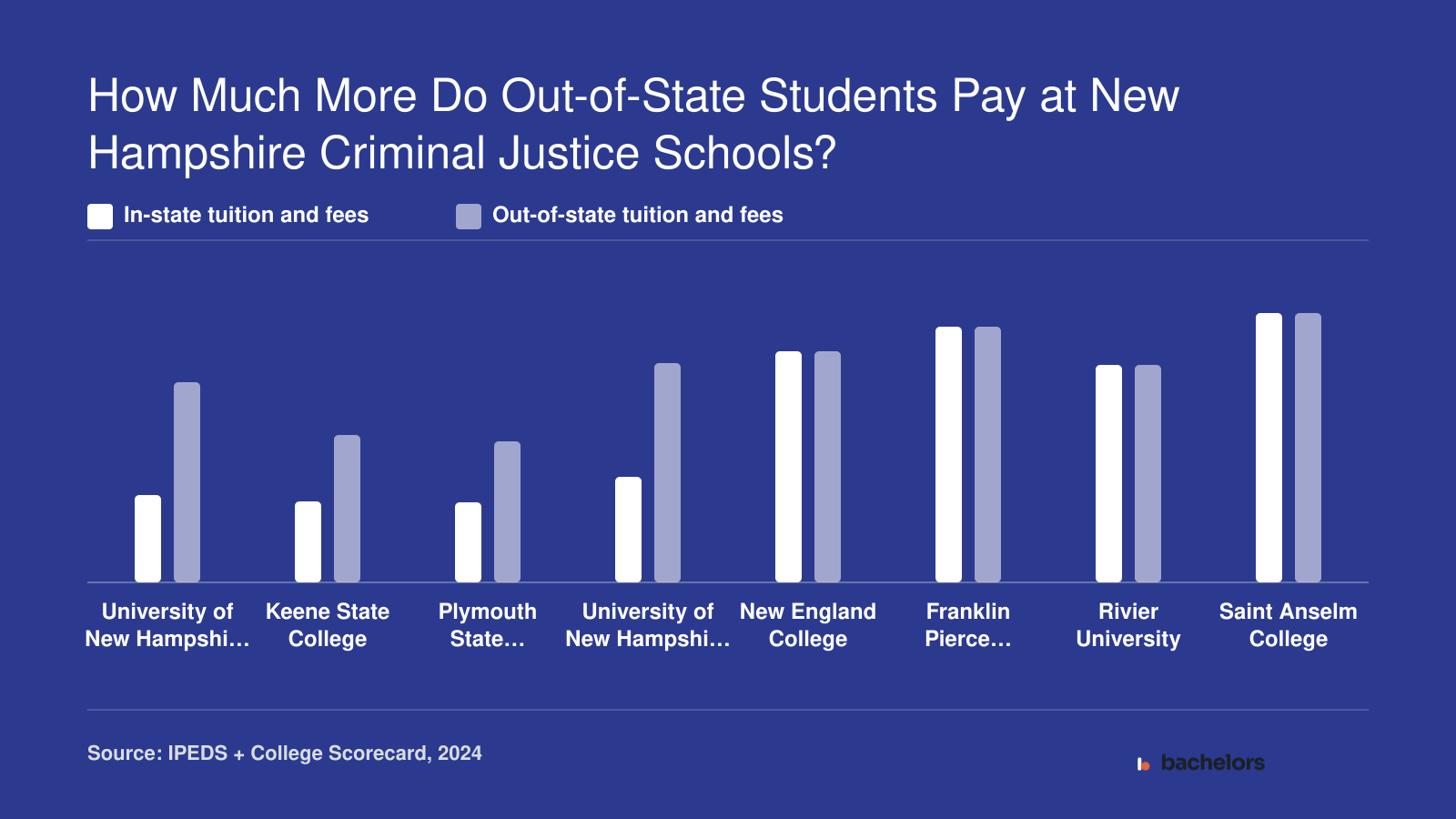
How Much More Do Out-of-State Students Pay at New Hampshire Criminal Justice Schools?
The University of New Hampshire in Durham has the widest residency gap: nonresidents pay $39,852 in tuition and fees versus $19,202 for New Hampshire residents, a $20,650 difference. UNH Manchester follows closely at $20,580. Plymouth State University has the smallest gap among the public campuses at $10,940. Saint Anselm College, Franklin Pierce University, Rivier University and New England College charge every student the same published rate, but that rate is higher than any public school's in-state price.
Criminal Justice Salaries in New Hampshire by Occupation
These are occupational wages from federal labor data (May 2025 where dated). They describe what workers in each job earn in New Hampshire, not what graduates of any one program earn, so read them separately from the College Scorecard graduate-earnings figures elsewhere on this page. Probation work typically requires a bachelor's degree, while police and correctional jobs often start with a high school diploma plus academy training, though a bachelor's degree in criminal justice can strengthen applications and support later promotion into investigative or supervisory roles.
| Occupation | Median Annual Wage (NH) | Wage Range (10th-90th Percentile) | Typical Entry Education |
|---|---|---|---|
| Police and Sheriff's Patrol Officers | $71,640 | $57,930 to $89,940 | High school diploma or equivalent plus police academy training; some agencies prefer college coursework |
| Correctional Officers | $58,850 | N/A | High school diploma or equivalent |
| Probation Officers and Correctional Treatment Specialists | $66,270 | N/A | Bachelor's degree |
| Detectives and Criminal Investigators | $77,310 (broader police and detectives group; no separate NH figure) | N/A | Usually promoted from patrol officer roles; a degree may help with advancement |
Becoming a Police Officer in New Hampshire: Certification Requirements
The New Hampshire Police Standards and Training Council (PSTC) sets the statewide floor for police, corrections and probation/parole officers. Individual agencies may add stricter standards.
- AgeState law lets the PSTC set a minimum age by rule, and each agency applies its own hiring standard. The New Hampshire State Police requires candidates to be 21.
- CitizenshipU.S. citizenship is required for appointment as a police officer.
- EducationYou need a high school diploma or state-recognized equivalent. If neither can be documented, a transcript showing two years of postsecondary study at an accredited institution qualifies.
- Medical and drug screeningUncertified full-time officers must pass a medical exam and drug screen before taking on duties. A licensed physician conducts both using Council protocols, and the hiring agency submits documentation, including proof of education, for certification.
- Academy training and certificationNew full-time officers must finish PSTC police basic training within six months of appointment and pass written and practical tests. The Council may accept training completed elsewhere if it judges it equivalent in content and quality.
- Is a bachelor's degree required?No. A bachelor's degree is not a statewide requirement for any of these roles. Some agencies set higher education standards. For example, the State Police asks applicants without experience for an associate degree or 60 college credits. Otherwise, it asks for a high school diploma plus two years of law enforcement or military experience.
- Corrections officersThe education floor is a high school diploma or equivalent. Officers must complete PSTC corrections basic training within six months. The Commissioner of Corrections certifies line staff after an approved course.
- Probation/parole officersThe education floor is a high school diploma or equivalent. Officers must complete PSTC probation/parole basic training within six months and pass a medical exam.
Compare Criminal Justice programs on the data that matters
Explore more Criminal Justice & Law majors or browse every field of study.
All Criminal Justice & Law programs Browse every field of study