Best Early Childhood Education Schools in New Hampshire
Compare 7 accredited Early Childhood Education programs in New Hampshire at 4 colleges, with net price after aid, graduation rates, earnings and debt from IPEDS and the U.S. College Scorecard.

Early childhood education is not one career path but two, and the degree title often decides which one you get. A bachelor's degree in early childhood education, commonly a Bachelor of Science (B.S.) in Early Childhood Education, can lead to a New Hampshire teaching license or to child care and family services work that requires none.
The programs ranked here include campus and online options, and they differ in cost, admissions and licensure. Titles such as "child development" often signal the non-licensure route. Hands-on hours with children anchor the field, so even online students end up tied to a local classroom or center.
Key Points
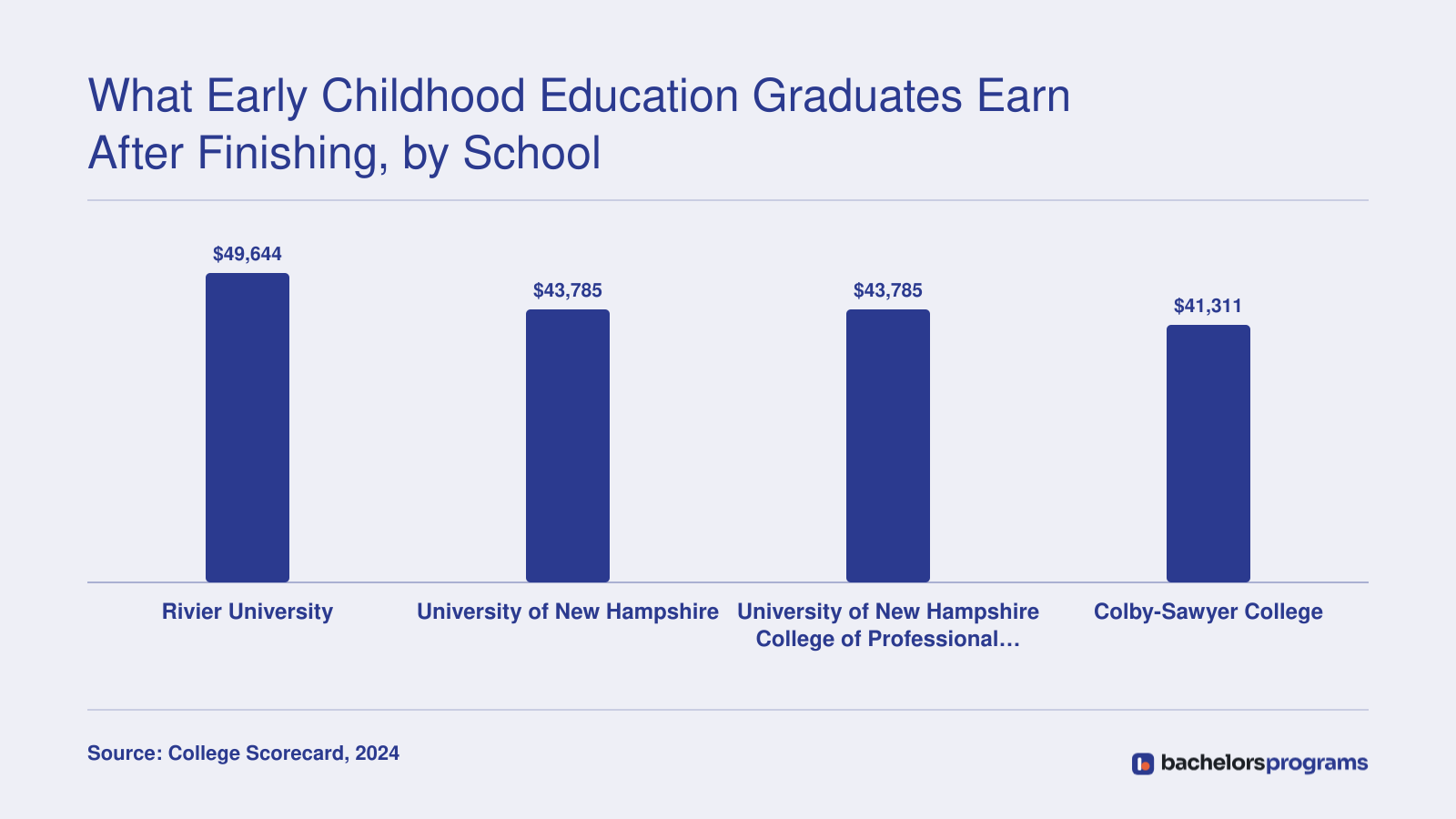
- Rivier University graduates earn a $49,644 median five years after finishing.
- In-state tuition runs from $7,724 online at UNH to $39,488 at Rivier.
- Licensed child care jobs use Child Development Bureau credentials, not teaching licenses.
Best Bachelor's in Early Childhood Education Schools in New Hampshire, Ranked
Four New Hampshire schools appear in this ranking, and all formats are included: campus programs, fully online degrees, and schools that run both. Each entry pairs a note on what students pay on average after aid with how many students the school graduates, so price, completion, and delivery can be weighed side by side.
University of New Hampshire
#1Durham, NH · $24,000/yr (est. net price)
Best for: Future early-childhood policy and research professionals
The University of New Hampshire is the state's flagship entry in this field, offering a campus child development option in Durham alongside a fully online early childhood development degree built for working adults. Campus students complete a practicum at the Child Study and Development Center, while the online route accepts up to 90 transfer credits and runs in eight-week terms. The university also takes part in statewide early childhood research and child-care policy work, which puts students close to New Hampshire's early learning system. Schools offering this program graduate 76% of students, and the average net price after aid is about $23,805.
- 128 total credit hours, 32 of which must be taken at UNH
- Three concentration options within the major
- 2.0 GPA minimum for degree conferral
- Practicum at the Child Study and Development Center
- Optional senior-year internship with Seacoast community organizations
- 16-credit community internship can satisfy supporting coursework
- No foreign language requirement
- Honors in Major available
- Fully online, 120 total credit hours with 30 taken at UNH
- Not for public school teacher licensure
- Meets New Hampshire Early Childhood credential requirements
- Curriculum addresses NAEYC standards
- Transfer up to 90 credits; about 89% of students transfer in
- $0 application fee, no entrance exam, rolling admissions
- 8-week course terms with full-time and part-time options
- Capstone required; minimum C- grade in major courses
Colby-Sawyer College
#2New London, NH · ~$27,000/yr (est.)
Best for: Child development majors preferring small campuses
Colby-Sawyer College is a small private college in New London that awards its child development degree as a Bachelor of Science, listed alongside its other B.S. majors in education, nursing, and business. The program is campus-based, runs 120 credits, and requires a 2.0 cumulative GPA to graduate. It fits students who want a small liberal arts setting rather than a large research university. Schools offering this program graduate 57% of students, and the average net price after aid is about $27,431.
- 120 total credit hours
- 2.0 cumulative GPA minimum
- Awarded as a Bachelor of Science degree
Rivier University
#3Nashua, NH · ~$28,000/yr (est.)
Best for: Future preschool teachers seeking state licensure
Rivier University in Nashua offers a Bachelor of Arts in Early Childhood Education as a day program that leads to licensure to teach children from birth through grade 3. The major pairs a 36-credit education core with early childhood coursework and a 15 to 20 credit concentration in English, math, science, or social studies, then closes with a 12-credit student teaching seminar. An early learning center operates on the Rivier campus, serving infants through preschool-age children in the Greater Nashua area. Schools offering this program graduate 52% of students, and the average net price after aid is about $28,082.
- Leads to licensure for birth through grade 3
- 120 total credit hours
- Education major runs 63 to 68 credits
- 36-credit education core plus 12 credits of early childhood courses
- 15 to 20 credit concentration in English, math, science, or social studies
- 12-credit student teaching and seminar
- Recognized under the NASDTEC Interstate Agreement
- Four concentration options
University of New Hampshire College of Professional Studies Online
#4Manchester, NH · ~$11,000/yr (est.)
The University of New Hampshire College of Professional Studies in Manchester delivers an online Bachelor of Science in Early Childhood Development that can be completed fully online across 120 credit hours. Coursework centers on the early childhood field and the formative years of young learners, and the degree is positioned as a way to move past entry-level roles that hire at the two-year level. It carries the lowest average net price among the schools ranked here. Schools offering this program graduate 30% of students, and the average net price after aid is about $10,864.
- 120 total credit hours
- Can be completed fully online
- Coursework centers on the early childhood education field
- Bachelor's degree opens growth beyond entry-level, two-year roles
Cost & outcomes by school
Federal data for the highest-earning Early Childhood Education programs, independent of the ranking above. Earnings are this field's bachelor's graduates four years after completing where the Scorecard reports them, else the school's undergraduate median.
| School | Net price / yr | Grad rate | Earnings | Debt | Grads/yr | Format |
|---|---|---|---|---|---|---|
| University of New Hampshire NH | $23,805 | 76% | $66,479 | $26,814 | — | Campus |
| University of New Hampshire College of Professional Studies Online NH | $10,864 | 30% | $66,479 | $26,814 | 20 | Online |
| Rivier University NH | $28,082 | 52% | $48,523 | $26,200 | 15 | Campus |
| Colby-Sawyer College NH | $27,431 | 58% | $46,474 | $27,000 | 12 | Campus |
Sources: U.S. Department of Education. Net price, graduation rate, earnings and debt: College Scorecard (earnings and debt for this field's bachelor's graduates where reported, else school-wide); graduates: IPEDS. A dash means no figure is reported.
Cost, debt & payoff
Median earnings of this field's bachelor's graduates (4 yrs after completing, else the school's undergraduate median) vs. their median federal loan debt · U.S. College Scorecard
Across these programs the median graduate earns about $66,479 and finishes with roughly $26,814 in debt — a ratio that clears a common rule of thumb (keep debt below first-year salary). Net price and debt vary widely school to school, so check the per-school figures in the table above before you shortlist.
How We Ranked These New Hampshire Schools
A school's campus-wide numbers and a program's specialty accreditation answer different questions, so this ranking looks at both.
What Went Into the Ranking
The list covers bachelor's-level programs at New Hampshire schools, including the online programs those schools run. Associate degrees and graduate study fall outside its scope. Within that set, we considered four kinds of information:
- Outcomes: College Scorecard data on how students fare, such as graduation and earnings after enrolling.
- Net price: What students actually pay after grants and scholarships.
- Completions: How many students finish an early childhood or child development bachelor's at the school.
- Accreditation: Institutional accreditation plus any program-level early childhood recognition.
One caution: graduation rate and net price are institution-wide averages. They describe the whole school, not the early childhood program on its own.
NAEYC and CAEP at the Bachelor's Level
NAEYC accreditation reviews the early childhood degree program itself, using a self-study and a three-day site visit to check that graduates meet NAEYC's professional standards. It currently covers associate, bachelor's, and master's programs.1 CAEP works differently: it accredits the educator-preparation unit and its programs, and general institutional accreditation does not substitute for it.2 NAEYC's former Recognition process for bachelor's programs also depended on CAEP accreditation.3
NAEYC's directory lists associate-level programs for New Hampshire, and our review did not find a bachelor's program ranked here with current NAEYC accreditation, NAEYC Recognition, or CAEP accreditation.4 The University of New Hampshire says its online B.S. in Early Childhood Development addresses NAEYC standards and prepares graduates for the state Child Development Bureau credential, though not public school licensure. Accreditation status can change, so confirm it on each school's accreditation page before you apply.
Licensure vs. Non-Licensure: Early Childhood Education, Special Education, and Child Development Degrees
A licensure-track degree prepares you to earn a New Hampshire teaching credential for public school classrooms. A non-licensure degree, often titled child development, prepares you for child care, family services and early learning roles that don't require a state teaching license. Early childhood special education adds a second layer: authorization to teach young children with disabilities. Requirements differ by pathway and change periodically, so check with the agency that sets them.
Where to Check Teaching Licensure
The New Hampshire Department of Education's educator licensure pages, handled through its Bureau of Credentialing, cover the Early Childhood and Early Childhood Special Education endorsements for birth through grade 3. These pages answer three core questions: what coursework is required, which tests you must pass, and how much supervised classroom experience counts.
Look for two routes. The approved-program route applies when you complete a state-approved educator preparation program. Alternative 4 is a route for candidates who are already employed in a New Hampshire school and complete requirements while working.
Where to Check Early Childhood Credentials
For roles in licensed child care and preschool settings, the NH Child Development Bureau within the Department of Health and Human Services issues early childhood credentials. A bachelor's degree generally satisfies the education component. Confirm the current credit, coursework and experience rules on the Bureau's requirements page before assuming you qualify.
Other Sources Worth Bookmarking
- College program pages: Confirm whether a specific bachelor's program is state-approved. Titles vary: Rivier University offers a B.A. in Early Childhood Education, while the University of New Hampshire and Colby-Sawyer College frame their degrees around child development, so ask each how its program connects to licensure.
- NAEYC and CEC/DEC: Field standards and credential context for early childhood and early childhood special education.
- BLS Occupational Outlook Handbook: Typical entry requirements and job outlook for preschool, kindergarten and special education teachers.
Your Verification Checklist
Contact the Bureau of Credentialing, your program advisor and the HR office in any district where you hope to work. Ask these questions:
- Program advisor: Does this bachelor's lead to a recommendation for NH licensure, and in which endorsement?
- Bureau of Credentialing: Which tests are required, and does my coursework meet current rules?
- Program advisor: How many practicum or student teaching hours are built in?
- District HR: Do you hire candidates on Alternative 4, and which endorsement do your openings require?
Online and Hybrid Options for a Bachelor's Degree in Early Childhood Education in New Hampshire
The tradeoff in early childhood education is that coursework travels well and children do not. You can take the theory, assessment and curriculum classes from home, but every credential in this field is built on hours spent with real children in a real room, and no program here waives that.
What is actually online
You can earn a bachelor's degree in early childhood education online from a New Hampshire institution. The University of New Hampshire College of Professional Studies Online delivers its Early Childhood Development B.S. in a fully online format, and UNH also offers online versions of its Early Childhood Education and Early Childhood Special Education B.S. and a combined English Language Arts / Early Childhood Education and Early Childhood Special Education B.S. The campus-based routes sit elsewhere: UNH's Human Development and Family Studies teacher licensure track runs in person in Durham, and the early childhood and child development majors at Rivier University and Colby-Sawyer College are campus programs.
How placements work for online students
UNH's online early childhood degrees are clinical-based, which in practice means they are designed for students who are already working or volunteering in an approved early childhood setting. The practicum course, EDC 797, carries four credits and must be completed at a licensed site under a credentialed professional. The combined ELA track uses clinical courses (EDC 710 and EDC 798), with students limited to one clinical course per term, so the sequence stretches across semesters rather than compressing into one. The non-licensure Early Childhood Development B.S. includes a field placement but no separate student-teaching semester. On the campus licensure side, UNH's Durham track requires a full-year internship, a criminal background check and the BASA exam.
Picking the format that fits
- Already in a classroom: Paraprofessionals, lead teachers and center staff get the most from the online clinical model, since the job doubles as the placement site.
- Career changers: Line up an approved site before you enroll online; without one, the clinical sequence stalls.
- Traditional students: A campus program supplies the placement for you and runs the licensure paperwork alongside it.
Admission Requirements: GPA, Test Policy, and Transfer Credit
We read each policy below from the University of New Hampshire's program and transfer admissions pages, and where a page is silent on a point, the table says so rather than filling the gap with a guess. UNH caps transfer credit at 90 credits for its early childhood programs and runs formal transfer pathways that let community college graduates with an associate degree maximize the credits they bring in, which can shorten the path to a bachelor's degree considerably; UNH's application deadlines are Oct. 15 for spring (extended to Dec. 1) and April 1 for fall. Admissions details for Colby-Sawyer College, Rivier University, and UNH College of Professional Studies Online were not part of the pages we reviewed, so contact those admissions offices directly for GPA, testing, and transfer rules.
| School | Minimum GPA / Admit Standard | Test Policy | Transfer Credit Limit | Associate-to-Bachelor's Pathway |
|---|---|---|---|---|
| University of New Hampshire: Early Childhood Development, B.S. | 2.0 cumulative GPA required for degree conferral | High school diploma, homeschool completion, or equivalency (GED, HiSET, or TASC) required; no SAT/ACT policy published on the program page | Up to 90 credits | Formal Transfer Pathways for community college graduates; associate degree holders can have transfer credits maximized |
| University of New Hampshire: Early Childhood Education / Early Childhood Special Education | 2.0 cumulative GPA required for degree conferral | High school diploma, homeschool completion, or equivalency (GED, HiSET, or TASC) required; no SAT/ACT policy published on the program page | Up to 90 credits | Not published on the program page |
| University of New Hampshire: English Language Arts / Early Childhood Education and Early Childhood Special Education | 2.0 cumulative GPA for conferral; 3.0 GPA required for state licensure | High school diploma, homeschool completion, or equivalency (GED, HiSET, or TASC) required; no SAT/ACT policy published on the program page | Up to 90 credits | Associate degree holders can have transfer credits maximized |
| University of New Hampshire: Human Development and Family Studies, Early Childhood Education (Teacher Licensure Option) | 2.0 GPA for conferral; 3.2 overall and major GPA required when applying in spring of junior year | Transfer applicants submit a high school transcript, GED, or HiSET scores unless they already hold an associate or bachelor's degree; no SAT/ACT policy published | Not published on the program page | Not published on the program page |
Related Articles
What a Bachelor's in Early Childhood Education Costs in New Hampshire
Published in-state tuition and fees run from $7,724 at UNH College of Professional Studies Online to $39,488 at Rivier University in federal IPEDS and College Scorecard data, but the average net price after aid is the better guide: UNH College of Professional Studies Online sits lowest at about $10,864, followed by UNH's Durham campus at $23,805, then Colby-Sawyer College at $27,431 and Rivier at $28,082. Treat net price as approximate and institution-wide, not specific to the early childhood major. To lower costs, look at TEACH Early Childhood New Hampshire scholarships for educators working at least 30 hours a week (with a commitment to stay with your employer afterward) and the Preschool Development Grant, which can cover tuition for up to two eligible early childhood courses per term. Also budget for background checks, licensure exam fees and an unpaid student-teaching semester.
| School | Location | Program | Format | In-State Tuition and Fees (Published) | Average Net Price After Aid (Institution-Wide) |
|---|---|---|---|---|---|
| University of New Hampshire College of Professional Studies Online | Manchester, NH | Early Childhood Development B.S. | Online | $7,724 | $10,864 |
| University of New Hampshire | Durham, NH | Human Development and Family Studies: Child Development Option (B.S.) | Campus | $19,202 | $23,805 |
| Colby-Sawyer College | New London, NH | Child Development (B.S.) | Campus | $19,125 | $27,431 |
| Rivier University | Nashua, NH | Bachelor of Arts in Early Childhood Education (Day) | Campus | $39,488 | $28,082 |
What Early Childhood Education Graduates Earn After Finishing, by School
Five years after finishing, early childhood education and child development graduates of Rivier University earn a median of $49,644, the highest among the schools ranked here. Graduates of the University of New Hampshire and its College of Professional Studies Online both show $43,785 five years out, because federal data reports the same median for the two listings, and Colby-Sawyer College graduates earn $41,311 over the same window. These medians count only working graduates who received federal student aid, and small graduating classes can shift them sharply, so treat them as a typical outcome rather than a starting salary or a promise of what any one graduate will earn.
Early Childhood Careers and New Hampshire Licensure
A bachelor's degree in early childhood education leads down one of two paths in New Hampshire: a state teaching license for public school classrooms, or a Child Development Bureau credential for licensed child care and similar early learning programs. Which one you need depends on where you plan to work.
Teaching License vs. Child Development Bureau Credential
The New Hampshire Department of Education certifies teachers in early childhood education, an endorsement that generally covers birth through grade 3. Public school preschool, kindergarten and early elementary jobs typically require it, and it usually means finishing a state-approved educator preparation program that includes student teaching. Licensed child care centers follow a separate system. The Child Development Bureau issues tiered credentials for teachers and directors based on coursework and experience, and a bachelor's degree helps you qualify for higher levels.
So what degree do you need to teach preschool here? A child care classroom does not require a teaching license, although a bachelor's degree raises your credential level. Head Start programs answer to federal rules that push many lead teachers toward a bachelor's in early childhood education or a related field. Public school preschool generally requires state certification. Before you enroll, ask each school whether its program leads to certification. Rivier University's B.A. in Early Childhood Education is the education degree by name. The child development degrees at University of New Hampshire and Colby-Sawyer College may fit child care and family services work better.
Main Roles
- Public preschool teacher: Teaches in a district program and typically needs state certification.
- Head Start teacher: Works with income-eligible families in a federally funded program where a bachelor's is often expected.
- Child care director: Runs a center's staff, budget and compliance, usually after years in the classroom.
- Kindergarten or early elementary teacher: Leads a public school classroom through grade 3 with a state license.
New Hampshire Wages and Outlook
New Hampshire Employment Security's 2025 wage data puts the state median for preschool teachers at $17.42 an hour, with about 780 jobs statewide and entry pay near $15.43.1 Pay rises sharply once you hold a license. Kindergarten teachers in New Hampshire earned roughly $47,150 to $83,570 a year in May 2025, from the 10th to the 90th percentile.1 Elementary teachers reported a median of $71,308, above the national median of $63,820 for kindergarten and elementary teachers combined.
The state data does not break out child care directors, so national figures are the best guide. The Bureau of Labor Statistics reports a $59,300 median and projects a 3 percent decline from 2025 to 2035, though about 5,200 openings a year should still come from replacement needs.2 For preschool teachers, the BLS projects 4 percent national growth over the same period.2
How to Choose the Right New Hampshire Early Childhood Education School
A degree built around a classroom license and one built around broader work with children can look alike on paper, and the gap between them is the first trade-off to weigh. Four other factors sharpen the choice.
Licensure Goal
If your aim is to teach in a public school, start with Rivier University, whose program carries the Early Childhood Education title. The child development degrees at Colby-Sawyer College and the University of New Hampshire in Durham lean toward child and family settings. A program title alone does not settle whether it leads to New Hampshire certification, so ask each advising office directly.
Format and Budget
The University of New Hampshire College of Professional Studies Online offers an Early Childhood Development B.S. with the flexibility working adults need. The trade-off is usually less hands-on placement support than a campus program provides. On price, compare net price after aid rather than sticker price. UNH is public, while Colby-Sawyer and Rivier are private, and aid can narrow gaps that tuition alone suggests.
Location and Accreditation
Durham, New London, Nashua, and Manchester offer different campus settings and commutes, and the closer you are to local schools and child care centers, the easier it is to build placement connections. Whatever you choose, confirm the school's institutional accreditation and ask whether the program holds NAEYC recognition, since some employers look for it.
Your Next Step
Write down your answers on licensure, format, budget, location, and accreditation. Then use program matching on bachelorsprograms.com to compare schools that match those answers.
Questions About Early Childhood Education Degrees in New Hampshire
These answers cover the credential, licensing and transfer questions students ask most often before enrolling. Requirements vary by setting, so confirm details with the employer or state agency before you commit.
What degree do you need to teach preschool in New Hampshire?
Do I need a teaching license to work in early childhood education in New Hampshire?
Is NAEYC accreditation required for an early childhood education program in New Hampshire?
Can I transfer an associate degree into a bachelor's in early childhood education in New Hampshire?
Compare Early Childhood Education programs on the data that matters
Explore more Education & Teaching majors or browse every field of study.
All Education & Teaching programs Browse every field of study