Best Elementary Education Degree Programs in New Hampshire
Compare 8 accredited Elementary Education programs in New Hampshire, with net price after aid, graduation rates, earnings and debt from IPEDS and the U.S. College Scorecard.

A bachelor's degree in elementary education remains the standard route into a New Hampshire classroom, and the degree most schools award is the Bachelor of Science (B.S.) in Elementary Education. Some schools award a B.A. instead, and the University of New Hampshire College of Professional Studies Online pairs a math studies major with licensure.
Each school is based in New Hampshire and offers campus or online study. Each is compared on cost, graduate earnings, admissions, and state licensure, with career outlook alongside.
The central tension is value. Tuition gaps between these schools are far wider than the gaps in what their graduates earn five years out, so the priciest program rarely pays back its premium.
Key Points
- Saint Anselm College graduates report the highest five-year median earnings: $53,401.
- Annual tuition and fees start at $7,724 through UNH's online college.
- New Hampshire's first teaching credential is the Beginning Educator License (BEL).
Best Elementary Education Schools in New Hampshire: Ranked
New Hampshire's elementary education landscape is small: a handful of public and private colleges, and most of them lead to the same New Hampshire K-6 teaching license. What separates them is how early you get into a real classroom, how much the degree costs after aid, and whether an online route fits your life. Here are the eight bachelor's programs we would point a future elementary teacher toward first.
University of New Hampshire
#1Durham, NH · $24,000/yr (est. net price)
Best for: Online learners seeking dual licensure
The University of New Hampshire is the state's flagship public research university in Durham, and about 76% of its students graduate. Its elementary education route is a dual-licensure online B.S. that pairs elementary certification (K-5 or K-8) with general special education for ages 5-22. Students take 120 credits, including 30 in residence at UNH and 16 upper-level credits through the online college, then finish with a culminating teaching experience and seminar. The combination of a research university name with a fully online pathway is why it leads this list.
- Dual licensure: elementary (K-5 or K-8) and special education (ages 5-22)
- Fully online, 120 credits, with 30 credits taken in residence at UNH
- 16 upper-level credits must come from the online college
- 2.0 GPA to graduate; 3.0 GPA required for state licensure
- Basic Academic Skills Assessment required before EDC 700
- Licensure exams include Foundations of Reading and General Curriculum subtests
- Prepares for licensure in New Hampshire, Maine, Massachusetts and Vermont
- Median earnings five years after graduation: $43,785
Saint Anselm College
#2Manchester, NH · ~$35,000/yr (est.)
Best for: Future teachers wanting early fieldwork
Saint Anselm College is a private Catholic liberal arts college in Manchester where roughly 80% of students graduate. Elementary education majors start classroom work as early as sophomore year, log more than 550 hours in schools, and finish with full-time student teaching. The major leads to New Hampshire K-6 licensure, and an ESOL minor is built to pair with it.
- Leads to New Hampshire K-6 teaching licensure
- More than 550 clinical hours in schools before student teaching
- Classroom work begins as early as sophomore year
- Full-time student teaching capstone, including the NH-TCAP
- ESOL minor built to pair with the major
- New Hampshire licensure carries reciprocity with about 40 states
- 34 elementary education completions reported for 2022
- Median earnings five years after graduation: $53,401
Keene State College
#3Keene, NH · $18,000/yr (est. net price)
Best for: Cost-conscious future teachers
Keene State College is a public liberal arts college in Keene that graduates about 60% of its students. Its elementary education major is deliberately broad: 54 education credits plus a required second liberal arts major, for at least 120 credits total. Students finish with a 12-credit student teaching placement, and the program fulfills New Hampshire K-6 certification requirements.
- 54-credit education major plus a required second liberal arts major
- 120 credits minimum, fulfilling New Hampshire K-6 certification
- K-8 recommendation with a content concentration and middle school Praxis II
- 12-credit student teaching placement
- Field experiences integrated throughout the program
- Admission to educator preparation is separate from college admission
- 57 elementary education completions reported for 2022
- Median earnings four years after graduation: $48,940
Colby-Sawyer College
#4New London, NH · ~$27,000/yr (est.)
Colby-Sawyer College is a small private college in New London, and about 57% of its students graduate. Elementary education candidates enter the Professional Education Preparation Program track, which adds 30 credits of education coursework and a full year of clinical experience, including a 16-credit classroom internship in senior fall. Completing every program gateway earns New Hampshire K-6 certification.
- Elementary Education concentration within the B.S. in Education
- Professional Education Preparation Program (PEPP) track leads to K-6 certification
- 30 credits of education coursework plus a full-year clinical experience
- 16-credit classroom internship in senior fall
- Praxis I recommended in the sophomore spring
- Capstone in child development
- Coursework in exceptional students, assessment and classroom management
- Median earnings five years after graduation: $41,311
Plymouth State University
#5Plymouth, NH · $15,000 – $20,000/yr (est.)
Plymouth State University is a public university in Plymouth that graduates about 52% of its students. Its B.S. in Elementary Education and Youth Development offers a Teacher Certification option that leads to K-6 licensure and lays the groundwork for K-8 certification. Field work accompanies every semester of major coursework, ending in a 12-credit teaching internship and a 2-credit seminar.
- Teacher Certification option leads to New Hampshire K-6 licensure
- 120 credits total, with 43 in the certification option
- Field work every semester, starting in the first term
- 12-credit Elementary Internship in Teaching plus a 2-credit seminar
- 45 credits, 3.0 GPA and Praxis Core required to enter the option
- K-8 certification needs a content concentration and middle school Praxis II
- Approved by the New Hampshire Department of Education
- 72 elementary education completions reported for 2022
Rivier University
#6Nashua, NH · ~$28,000/yr (est.)
Rivier University is a private Catholic university in Nashua where about 52% of students graduate. Its B.A. in Elementary Education puts students in classrooms in the freshman year and includes a semester-long student teaching assignment. Faculty-led teaching trips add an international option, and the degree prepares graduates for elementary and middle school certification.
- B.A. in Elementary Education, on campus in Nashua
- Field experience begins in the freshman year
- Semester-long student teaching assignment
- Coursework in curriculum development, instructional strategy and technology
- Faculty-led teaching trips abroad
- Certification eligible in all 50 states under the NASDTEC Interstate Agreement
- State-approved educator preparation program through December 30, 2026
- 17 elementary education completions reported for 2022
University of New Hampshire College of Professional Studies Online
#7Manchester, NH · ~$11,000/yr (est.)
The UNH College of Professional Studies is the University of New Hampshire's online division, based in Manchester and built for adults and transfer students who want a UNH credential without relocating. Its elementary education route is a B.S. in Math Studies with dual licensure in elementary education and general special education. The curriculum aligns with New Hampshire Department of Education standards, and the division reports an institution-wide graduation rate near 30%.
- B.S. in Math Studies with licensure in elementary and special education
- Online delivery through the Manchester-based College of Professional Studies
- Leads to New Hampshire licensure in elementary education (K-6)
- Also leads to general special education licensure, ages 5-22
- Curriculum aligned with New Hampshire Department of Education standards
- Two concentration options
- 23 elementary education completions reported for 2022
New England College
#8Henniker, NH · $27,000/yr (est. net price)
New England College is a private college in Henniker where about 35% of students graduate. Its B.A. in Elementary Education K-8 Licensure is a 130-credit degree with a required 16-credit concentration in English, social studies, mathematics or science. Students complete fieldwork plus a culminating clinical placement, including a 14-week student teaching stint in a New Hampshire public school district. Admission is rolling, with no application fee and no standardized test requirement.
- 130-credit B.A. leading to K-8 licensure
- Education core 40 credits, elementary core 30 credits
- 16-credit concentration in English, social studies, math or science
- 14-week student teaching placement in a New Hampshire district
- 1,260 clinical hours across fieldwork and clinical placement
- Rolling admissions, no application fee, no test scores required
- Four-year completion for full-time students
Cost & outcomes by school
Federal data for the highest-earning Elementary Education programs, independent of the ranking above. Earnings are this field's bachelor's graduates four years after completing where the Scorecard reports them, else the school's undergraduate median.
| School | Net price / yr | Grad rate | Earnings | Debt | Grads/yr | Format |
|---|---|---|---|---|---|---|
| University of New Hampshire NH | $23,805 | 76% | $66,479 | $26,814 | — | Online |
| University of New Hampshire College of Professional Studies Online NH | $10,864 | 30% | $66,479 | $26,814 | 20 | Online |
| Saint Anselm College NH | $34,779 | 80% | $56,049 | $27,000 | 19 | Campus |
| Keene State College NH | $17,887 | 60% | $48,940 | $26,236 | 60 | Campus |
| Rivier University NH | $28,082 | 52% | $48,523 | $26,200 | 15 | Campus |
| Colby-Sawyer College NH | $27,431 | 58% | $46,474 | $27,000 | 12 | Campus |
| Plymouth State University NH | $19,216 | 52% | $44,048 | $27,000 | 53 | Campus |
| New England College NH | $26,972 | 35% | $42,092 | $26,000 | 5 | Campus |
Sources: U.S. Department of Education. Net price, graduation rate, earnings and debt: College Scorecard (earnings and debt for this field's bachelor's graduates where reported, else school-wide); graduates: IPEDS. A dash means no figure is reported.
Cost, debt & payoff
Median earnings of this field's bachelor's graduates (4 yrs after completing, else the school's undergraduate median) vs. their median federal loan debt · U.S. College Scorecard
Across these programs the median graduate earns about $48,732 and finishes with roughly $26,814 in debt — a ratio that clears a common rule of thumb (keep debt below first-year salary). Net price and debt vary widely school to school, so check the per-school figures in the table above before you shortlist.
How We Ranked New Hampshire Bachelor's Degree in Elementary Education Programs
Low sticker prices and strong graduate outcomes rarely describe the same program, so this ranking weighs both together rather than letting either decide alone.
What Carries the Most Weight
Cost comes first: tuition and net price after aid determine what a student actually pays for a bachelor's degree in elementary education. Program outcomes follow: earnings a few years after graduation, and how many students finish what they start. Format counts too, so campus, hybrid, and fully online routes at New Hampshire schools are judged side by side rather than in separate lists. Federal program and institution data, tuition figures, and each school's published program pages supply the underlying numbers; where a college describes its field placements and licensure preparation in detail, that detail is weighed alongside the statistics.
What the Ranking Cannot Tell You
Net price is an institution-wide average, and graduation rates describe the whole college rather than the elementary education major. A small college with a careful, well-run teacher preparation program can post a modest overall completion rate for reasons unrelated to its education major. The order here is a starting point for comparison, not an endorsement of any one school. The right fit comes down to your budget, your schedule, and the age group you want to teach. Use the list to narrow the field, then confirm costs with each financial aid office before you apply.
What an Elementary Education Bachelor's Degree Costs in New Hampshire
Among the lowest-cost programs here, in-state tuition and fees run from $7,724 a year at University of New Hampshire College of Professional Studies Online to $41,938 at New England College, and average net price after grants ranges from $10,864 to $26,972. Net price is an institution-wide average for first-time, full-time undergraduates who receive aid, not a figure for the elementary education major alone, and it counts housing, books and other costs, which is why it can exceed the tuition sticker at a low-tuition online school. New Hampshire residents can cut that cost with the Governor's Scholarship Program, which pays $1,000 to $2,000 a year for up to four years to eligible full-time students at participating New Hampshire schools, and the UNIQUE Annual Allocation Program, which pays $3,500 in 2026-27 to full-time, Pell-eligible students with financial need, though neither award is reserved for future teachers. File the FAFSA early, since it opens the door to Pell Grants and these state awards, and ask each school's education department about its own scholarships for teacher candidates.
| School | City | In-State Tuition and Fees (per year) | Out-of-State Tuition and Fees (per year) | Average Net Price After Aid (per year) |
|---|---|---|---|---|
| University of New Hampshire College of Professional Studies Online | Manchester | $7,724 | $9,284 | $10,864 |
| Keene State College | Keene | $14,784 | $26,840 | $17,887 |
| Plymouth State University | Plymouth | $14,626 | $25,566 | $19,216 |
| University of New Hampshire | Durham | $19,202 | $39,852 | $23,805 |
| New England College | Henniker | $41,938 | $41,938 | $26,972 |
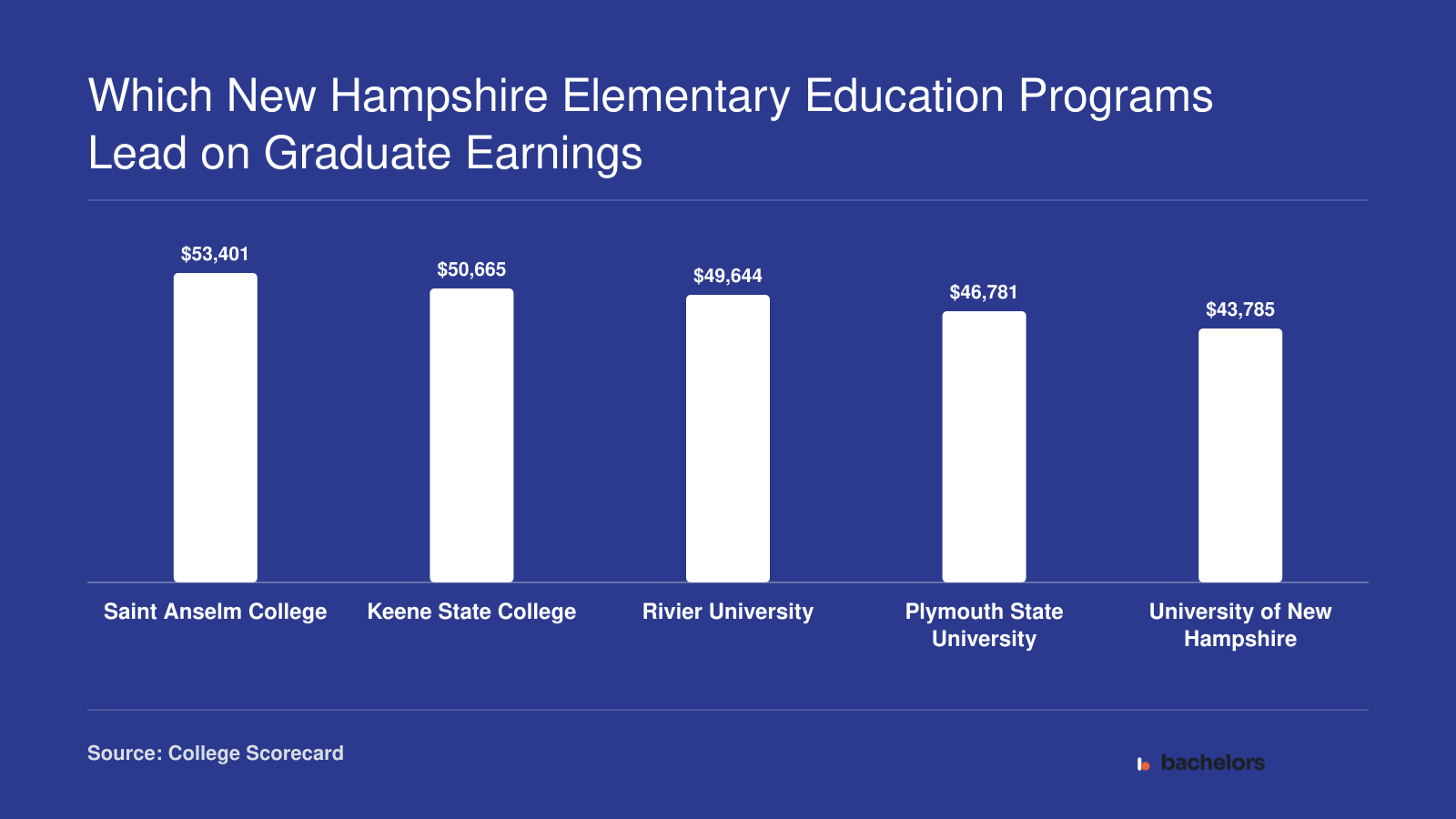
Which New Hampshire Elementary Education Programs Lead on Graduate Earnings
Five years after finishing, elementary education graduates of Saint Anselm College report median earnings of $53,401, followed by Keene State College ($50,665), Rivier University ($49,644), Plymouth State University ($46,781) and the University of New Hampshire ($43,785). One year after finishing, the spread is narrower, from $38,552 at Rivier to $41,564 at Keene State. Median debt runs from $26,200 at Rivier to $27,000 at Saint Anselm and Plymouth State. Elementary teacher pay in New Hampshire follows district salary schedules, so the earnings gaps between these programs stay modest.
Online and Hybrid Elementary Education Bachelor's Options at New Hampshire Schools
You can complete an elementary education degree online in New Hampshire. The University of New Hampshire College of Professional Studies Online offers a fully online bachelor's program leading to licensure in Elementary Education (K-6) and General Special Education, and the UNH Durham program also lists a fully online option, with elementary licensure for K-5 or K-8.
Online versus campus-based formats
The programs here fall into two groups. Online: the UNH College of Professional Studies program in Manchester and the UNH Durham program, both built around New Hampshire Department of Education standards. Campus-based: Saint Anselm College, Keene State College, Colby-Sawyer College, Plymouth State University, Rivier University, and New England College. None of them publishes a hybrid elementary education bachelor's, so the practical choice is fully online or fully on campus. Campus study tends to mean fieldwork early and often: Plymouth State, for instance, requires field work every semester of major coursework and expects students to have their own transportation by sophomore year.
Three-year and 2+2 pathways
Rivier University's Applied Bachelor of Arts in Elementary Education fits the major into 90 credits over three years, six fall and spring semesters, not a year-round accelerated schedule, and ends in site-based New Hampshire elementary licensure. It carries Lab School requirements, including Student Teaching: Lab School, and students can move to the 120-credit four-year version before graduating. Transfer students should also ask about 2+2 arrangements: an associate degree in education or early childhood education can sometimes transfer as a 60-credit block, leaving two years of coursework capped by a year-long student-teaching residency.
Field placement and licensure
Placement rules matter more than the delivery format. Published program pages confirm that student teaching and practicum hours are required, but not whether you can complete them in your home community, whether they must be inside New Hampshire, or whether online students need occasional campus attendance. Ask each school how placements are assigned before you apply.
An online degree from a New Hampshire-based school does not automatically produce a New Hampshire license. Confirm the program is a state-approved educator preparation program, that it names the grade range you want (K-6 or K-8), and that it is authorized to place and license students in your state. UNH notes licensure eligibility extending to Maine, Massachusetts, New Hampshire, and Vermont.
Related Articles
New Hampshire Elementary Teacher Licensure at a Glance
What New Hampshire Elementary Teachers Earn
Federal wage data offers a useful benchmark for what a bachelor's degree in elementary education can lead to in the classroom.
Compare Elementary Education programs on the data that matters
Explore more Education & Teaching majors or browse every field of study.
All Education & Teaching programs Browse every field of study