Best Information Technology Schools in New Hampshire
Compare 4 accredited Information Technology programs in New Hampshire, with net price after aid, graduation rates, earnings and debt from IPEDS and the U.S. College Scorecard.

Cost and flexibility pull against each other in New Hampshire IT education: a flagship campus with labs and in-state tuition sits alongside online programs built for adults who need asynchronous terms more than a dorm.
The credential is the same either way. Hiring managers in Manchester and Nashua screen for the Bachelor of Science (B.S.) in Information Technology.
No New Hampshire license governs IT work, so employers weigh the degree, the transcript and industry certifications together, and one-year earnings for graduates already spread from $61,322 to $75,156.
Key Points
- The University of New Hampshire offers an ABET-accredited B.S. in Information Technology.
- Southern New Hampshire University's online IT degree runs six 8-week terms yearly.
- Graduates' median earnings one year out: $61,322 at SNHU, $75,156 at UNH.
Best Bachelor's Degree in Information Technology Programs in New Hampshire
The University of New Hampshire is the best school for information technology in New Hampshire, pairing an ABET-accredited Bachelor of Science in Information Technology at its Durham campus with the strongest completion rate in the state. Beneath it, Plymouth State offers a lab-heavy 120-credit major, Southern New Hampshire University delivers a fully online degree built for working adults, and UNH's College of Professional Studies runs a 90-credit accelerated online option. Tuition and net price figures throughout this list are institution-wide averages, approximate, and not specific to the IT program.
University of New Hampshire
#1Durham, NH · $24,000/yr (est. net price)
Best for: Students wanting the traditional four-year campus path
New Hampshire's flagship public research university, UNH teaches information technology at its Durham campus in an ABET-accredited Bachelor of Science that pairs a technical core in programming, networking and cybersecurity with a required minor or second major. Students take three IT electives and a two-semester senior project, with options to join a cybersecurity student organization or work in a specialized networking test facility. Schools offering this program have graduation rates of 76%. It is the highest-completing option on this list.
- 128-credit, four-year program with a part-time option
- ABET Computing Accreditation Commission accredited
- Core covers programming, cybersecurity, databases and networking
- Three IT electives plus a two-semester senior project
- Five courses in an approved minor or a second major required
- 2.0 GPA for conferral, C- or better in five core courses
Plymouth State University
#2Plymouth, NH · $15,000 – $20,000/yr (est.)
Best for: Hands-on learners wanting lab-based networking work
Plymouth State University is a public university in Plymouth, New Hampshire, where the 120-credit B.S. in Information Technology is built around how hardware and software systems work inside an organization. Required coursework covers digital forensics, systems administration, network protocols and database management, backed by extensive laboratory time and team-based projects. Students add 11 credits of major electives from areas such as ethical hacking, cloud security and robotics. Schools offering this program have graduation rates of 52%.
- 120-credit, four-year program
- Extensive laboratory experience and team-based projects
- Required courses in digital forensics and network protocols
- 11 credits of major electives, including ethical hacking
- Senior project and cyberethics coursework required
- Sample roles include database administrator and software engineer
Southern New Hampshire University
#3Manchester, NH · $37,000/yr (est. net price)
Best for: Working adults who need a fully online degree
Southern New Hampshire University is a private nonprofit university in Manchester with a very large online enrollment. Its B.S. in Information Technologies runs entirely online in 8-week terms, prices tuition per credit, and accepts up to 90 transfer credits so adults with prior coursework can finish faster. Admission asks for no application fee, no test scores and no essay. Schools offering this program have graduation rates of 43%.
- 120 credits at $354 per credit, $42,480 total tuition
- Fully online, 8-week terms in the Brightspace platform
- Transfer up to 90 credits; 30 must be completed at SNHU
- No application fee, no test scores, no college essay
- Credit accepted for CLEP, Sophia Learning and Google certificates
- Active-duty military rate of $250 per credit
University of New Hampshire College of Professional Studies Online
#4Manchester, NH · ~$11,000/yr (est.)
UNH College of Professional Studies is the online division of the University of New Hampshire, based in Manchester and oriented toward adults who arrive with prior college credit. Its 90-credit applied bachelor's in computer information technology trims the credit total by cutting elective space, so students can finish in as little as three years, and the college maintains transfer pathways with community colleges, including New Hampshire's. Enrolled students can shift into the 120-credit four-year degree for the fuller curriculum. Schools offering this program have graduation rates of 30%.
- 90-credit accelerated format, finishable in three years
- Up to 60 credits transfer, including prior learning assessment
- 30 credits must be completed at UNH
- Coursework in cloud computing, digital forensics and cybersecurity
- No minor available in the 90-credit format
Cost & outcomes by school
Federal data for the highest-earning Information Technology programs, independent of the ranking above. Earnings are this field's bachelor's graduates four years after completing where the Scorecard reports them, else the school's undergraduate median.
| School | Net price / yr | Grad rate | Earnings | Debt | Grads/yr | Format |
|---|---|---|---|---|---|---|
| University of New Hampshire NH | $23,805 | 76% | $105,078 | $27,000 | 77 | Campus |
| University of New Hampshire College of Professional Studies Online NH | $10,864 | 30% | $105,078 | $27,000 | 8 | Online |
| Southern New Hampshire University NH | $36,708 | 43% | $81,533 | $28,689 | 810 | Online |
| Plymouth State University NH | $19,216 | 52% | $57,304 | $26,000 | 6 | Campus |
Sources: U.S. Department of Education. Net price, graduation rate, earnings and debt: College Scorecard (earnings and debt for this field's bachelor's graduates where reported, else school-wide); graduates: IPEDS. A dash means no figure is reported.
Cost, debt & payoff
Median earnings of this field's bachelor's graduates (4 yrs after completing, else the school's undergraduate median) vs. their median federal loan debt · U.S. College Scorecard
Across these programs the median graduate earns about $93,306 and finishes with roughly $27,000 in debt — a ratio that clears a common rule of thumb (keep debt below first-year salary). Net price and debt vary widely school to school, so check the per-school figures in the table above before you shortlist.
How We Ranked New Hampshire IT Schools
What makes a strong IT program in New Hampshire comes down to a few practical questions: what it costs, what graduates earn, how much they borrow, and whether students finish. That is what this ranking is built around, not reputation or marketing copy.
The Factors We Weighed
- Cost: Published tuition plus the average net price after grant and scholarship aid, with in-state rates treated separately at the public universities.
- Earnings: Median pay for graduates a few years out, using program-level figures where schools report them.
- Debt: Typical federal borrowing among graduates of each program.
- Completions and graduation: How many students finish the IT program, alongside the institution-wide graduation rate.
Those figures come from the federal College Scorecard and IPEDS, the same data set counselors and researchers rely on. Only bachelor's programs in New Hampshire were considered, whether campus based or online, so associate degrees and graduate certificates never entered the comparison.
Where the Numbers Stop
The net price shown is an average across the students who receive aid, not a promise for your family's situation. Graduation rates are reported for the whole institution, not the IT department alone. Some programs do not publish earnings for their own graduates, and where a figure is missing we say so instead of estimating.
Online and Hybrid Bachelor's Degree in Information Technology Options at New Hampshire Schools
Southern New Hampshire University's online Bachelor of Science in Information Technology is a 120-credit degree taught asynchronously, with no set class times, six 8-week terms per year, and rolling admissions.1 That one program answers the question most readers start with: yes, a New Hampshire school offers a bachelor's degree in information technology online, and you can finish it without ever setting foot on a campus.
Fully Online, Hybrid and On-Campus Formats
- Fully online: SNHU's B.S. runs in 8-week terms, and students may take one or two courses per term. The University of New Hampshire College of Professional Studies Online offers Computer Information Technology for students who want an online path tied to the UNH system.
- On campus: the University of New Hampshire in Durham and Plymouth State University both offer IT study in a traditional campus setting, and SNHU runs its Manchester campus on a three-term academic year.2
- Hybrid: mixing usually happens course by course, when an online program includes sections with a scheduled campus meeting. Confirm on each program page which courses require a visit to campus before you commit.
Which Format Suits You
Working adults with full-time jobs fit best in the asynchronous online option, where one course per term keeps the load manageable. Transfer students should look closely at transfer limits: SNHU accepts up to 90 credits but requires at least 30 completed in residence. Traditional-age students who want labs, internships and campus recruiting are better served on campus.
Is an Applied Bachelor's Degree the Same as a B.S.?
No. An applied bachelor's is a distinct degree designation, usually built around hands-on coursework and sometimes fewer general education credits. The standard credential at the New Hampshire schools here is the B.S. in Information Technology, a 120-credit degree. Employers generally treat either as a bachelor's degree, but graduate programs may expect the math and theory background a B.S. carries. SNHU also offers a B.A. version of its IT major with the same 14 IT courses plus 21 free elective credits, useful if you want a second area of study.
Admissions for New Hampshire IT Bachelor's Programs: GPA, Test Policy and Transfer Credit
Test-optional admissions has moved from pandemic exception to standing policy at New Hampshire's four-year IT programs, which shifts the weight of an application onto the transcript and the transfer record. At the University of New Hampshire, the admissions office publishes no minimum high school GPA for first-year applicants to the bachelor's degree in information technology. UNH Manchester describes its entering class instead: most admitted first-year students present B and B+ grades in core courses, with an average weighted GPA near 3.4. Treat that as a portrait of who enrolls, not a cutoff.
Test Policy and Transfer Credit
UNH is test-optional. First-year applicants may submit SAT or ACT scores for consideration, and the choice is made inside the Common App or Coalition App and is final once submitted. One exception applies: applicants from schools that issue written evaluations instead of numeric or letter grades must submit standardized test scores.
For transfer credit, no maximum is published. Eligible coursework must come from a regionally accredited institution, match a UNH course in content and level, carry at least 3 semester credits, and earn a C- or better. A third-party summary lists a 2.8 college GPA for consideration, while the official catalog frames transfer review around course selection, academic achievement, and how prior work meets general-education requirements rather than a stated floor.
Deadlines
- First-year, Durham: Early Action November 15; Regular Decision February 1.
- First-year, UNH Manchester: fall Regular Decision April 1; spring entry November 15.
- Transfer: April 1 for fall; October 15 for spring.
How to Read These Standards
Where a policy is not published, the school has not stated a public rule, which is not the same as having none. Admissions standards also vary by campus and by program within a campus, and an IT program can set requirements that differ from general undergraduate policy. Plymouth State University, Southern New Hampshire University and UNH College of Professional Studies Online each publish their own terms, so confirm the current year's requirements with an admissions counselor before you apply.
Community College to Bachelor's Degree: Transfer Pathways for NH IT Students
An associate degree from a New Hampshire community college is a workable first half of a bachelor's degree in information technology, provided you pick the receiving school early. The state's seven community colleges maintain more than 100 pre-approved pathways into public four-year programs1, including the University of New Hampshire (Durham and Manchester), UNH College of Professional Studies Online and Plymouth State University.
Agreements That Exist
- NH Transfer Guarantee: Eligible community college graduates with an associate degree receive guaranteed admission, a waived application fee and guaranteed credit transfer at participating campuses, including UNH and UNH CPS Online.2 Minimum GPA runs from 2.0 to 3.0 depending on the receiving college, and major capacity applies.3
- UNH CPS Online: The B.S. in Computer Information Technology accepts up to 44 credits from an associate program. Concentrations include cybersecurity, cloud computing, data analytics, software development, and artificial intelligence and machine learning.
- SNHU dual admission: Students who finish an associate degree with a cumulative GPA of at least 2.0 can move into their chosen major at Southern New Hampshire University.4
Three Practical Tips
- Get it in writing: Ask the receiving school which credits it will accept.
- Match courses to the major: Check which IT courses count toward the major rather than as general electives.
- Respect the caps: Stay within the transfer-credit limit, such as the 44 credits at UNH CPS Online, so you do not pay for credits that will not count.
No source shows that every IT associate degree maps to every IT bachelor's program, so the details depend on your associate program, your target school and your GPA. Agreements change over time. Before you enroll in a single course, confirm the current terms with an advisor at both schools.
Related Articles
Accreditation and What to Look for in a New Hampshire IT Program
Institutional and Programmatic Accreditation
Regional accreditation in New Hampshire comes from the New England Commission of Higher Education (NECHE), which accredits whole institutions, not individual majors.5 NECHE does not rank schools,1 so treat it as a quality floor. The University of New Hampshire is a NECHE member, first accredited in 19292, and its most recent comprehensive evaluation in 2024 ended with a Continued in Accreditation action.3 Its next comprehensive review is set for Fall 2033.2
Programmatic accreditation is separate. UNH's B.S. in Information Technology is accredited by the ABET Computing Accreditation Commission.4 For Plymouth State University, Southern New Hampshire University and UNH College of Professional Studies Online, confirm both the NECHE listing and any ABET status yourself rather than assuming it.
Why It Matters
- Financial aid: Federal aid generally requires attendance at an accredited institution.
- Credit transfer: Regionally accredited schools are more likely to accept each other's credits.
- Employer recognition: Hiring managers and graduate programs often screen for accredited degrees.
IT, CIS and Computer Science
- Information technology: Applying and managing technology, including networks, systems administration, security and user support.
- Computer information systems: A blend of computing and business, focused on how organizations use information systems.
- Computer science: Theory, algorithms, mathematics and software development.
ABET lists IT as its own category, so an accredited computer science program does not by itself mean an accredited IT bachelor's degree.4
Three-Step Verification Checklist
- Search the school's name in the NECHE directory and confirm its status and next evaluation date.
- Search ABET's accredited program list by school and select the computing category, then check that the exact degree title appears under Information Technology.
- Ask admissions in writing whether the specific program, including any online version, is covered, and note the accreditation date range.
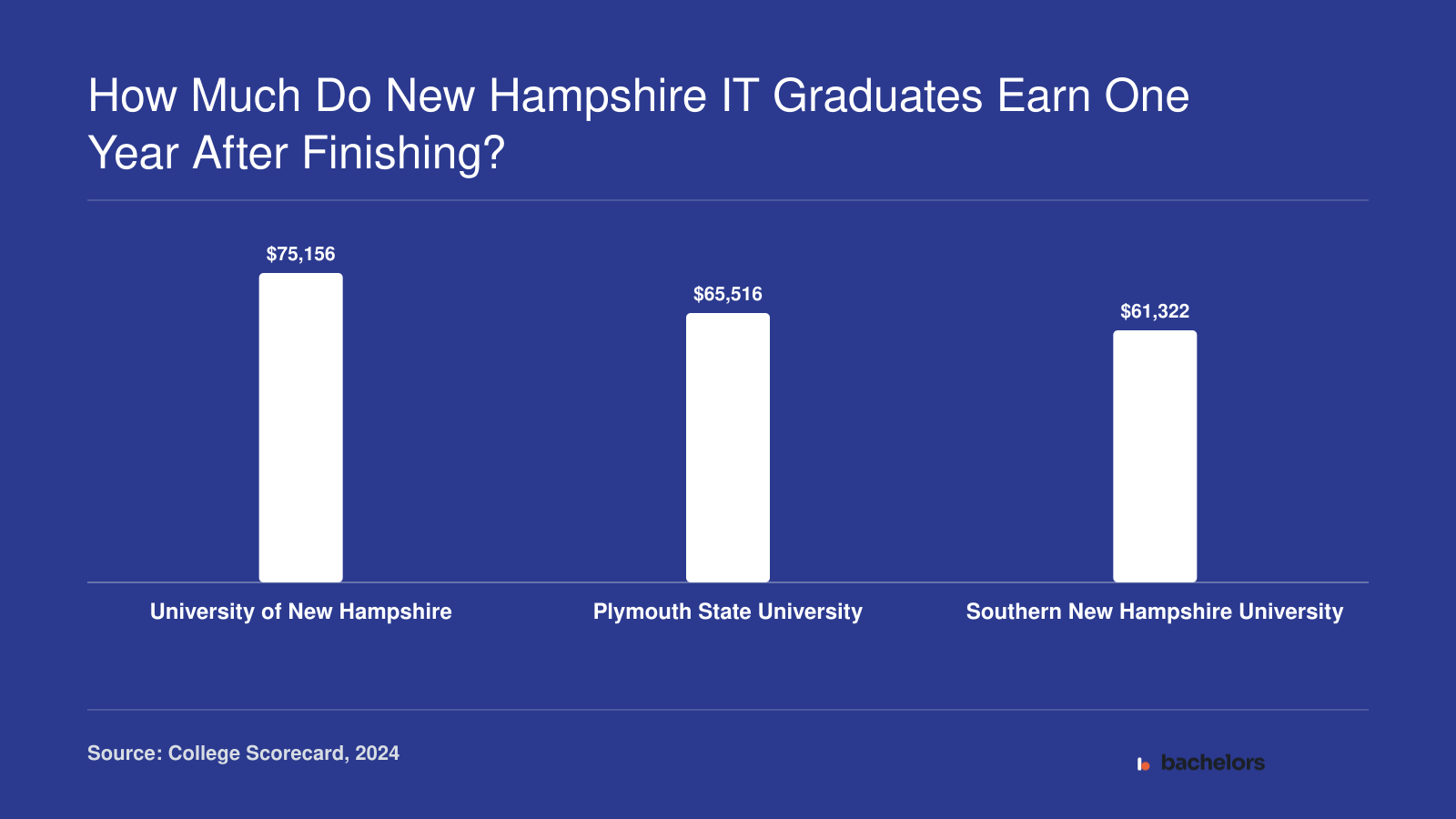
How Much Do New Hampshire IT Graduates Earn One Year After Finishing?
One year after finishing a bachelor's degree in information technology, median earnings for completers run from $61,322 at Southern New Hampshire University to $75,156 at the University of New Hampshire, with Plymouth State University at $65,516. Earnings keep climbing after that: five years out, UNH completers report a median of $110,370 and SNHU completers $78,230. Median program debt is $27,000 at UNH and $28,689 at SNHU, which puts each school's first-year earnings well above what graduates typically borrow.
Information Technology Salaries and Job Outlook in New Hampshire
In the Manchester-Nashua metro area, home to Southern New Hampshire University and the University of New Hampshire College of Professional Studies Online, the U.S. Bureau of Labor Statistics counted 9,210 computer and mathematical jobs in May 2025, with a mean annual wage of $125,260. Information security analysts ($123,630) and computer systems analysts ($112,880) earned the most among the roles below. These figures average workers at every career stage, so treat them as a long-term benchmark rather than a starting salary, and keep them separate from the earnings of recent program graduates shown in the previous section. Wage figures below are means because the May 2025 metro release did not include medians for these roles, and the research gave no 2025-2035 growth figure, so the growth column is marked N/A.
| Occupation | NH Median Annual Wage | NH Employment | Projected Growth |
|---|---|---|---|
| Computer and mathematical occupations (Manchester-Nashua, all roles) | $125,260 (mean) | 9,210 | N/A |
| Information security analysts (Manchester-Nashua) | $123,630 (mean) | 320 | N/A |
| Computer systems analysts (Manchester-Nashua) | $112,880 (mean) | 710 | N/A |
| Computer programmers (Manchester-Nashua) | $73,550 (mean) | 210 | N/A |
| Computer network support specialists (Manchester-Nashua) | $69,780 (mean) | 310 | N/A |
No License Required: Certifications and Employers That Matter in New Hampshire IT
New Hampshire issues no state license for information technology work. A bachelor's degree clears the first screen, and industry certifications show employers you can handle specific systems on day one.
Certifications Employers Ask For
Recent New Hampshire job postings point to a familiar set of credentials. Requirements vary by employer and role, so treat these as strong signals rather than fixed rules:
- CompTIA A+: The foundational credential for help desk and desktop support roles.
- CompTIA Network+ and Security+: Both appear among the industry certifications listed in a 2026 Manchester IT technician posting, alongside Fortinet NSE and Microsoft credentials such as AZ-900 and MS-900.1
- Cisco CCNA: Listed as preferred, not required, in a 2026 Laconia IT manager posting, along with Microsoft certifications.2
- AWS credentials: Relevant to cloud, DevOps and security work. Recent New Hampshire postings that call for AWS skills include SOC analyst and AWS DevOps engineer roles.3
Where the Jobs Are
IT demand clusters in defense, healthcare, advanced manufacturing, financial services and cybersecurity, concentrated along the Manchester-Nashua-Portsmouth corridor.4 Major employers include BAE Systems Electronic Systems (Nashua, Merrimack and Hudson), Dartmouth Health in Lebanon (cited as the state's largest employer)5, and Oracle Dyn, Autodesk and DEKA Research and Development in Manchester. Bottomline Technologies in Portsmouth, Extreme Networks in Salem, Fidelity Investments in Merrimack and Bank of America/Merrill Lynch in Hudson round out the list. Computer, communication and electronics manufacturing alone accounted for 14,260 jobs in 2022, or 34 percent of the state's advanced manufacturing employment.6
Certify Before You Graduate
Aim to pass A+ or Security+ by your junior year. A certification on your resume makes internship applications to these employers more competitive and gives you a head start on entry-level hiring after graduation.
Frequently Asked Questions About IT Degrees in New Hampshire
These answers cover the questions prospective students ask most often about bachelor's degree in information technology options at New Hampshire schools. Details come from each school's own program pages.
What is the best school for information technology in New Hampshire?
Can you get a bachelor's degree in information technology online from a New Hampshire school?
Is an applied bachelor's degree in information technology the same as a B.S.?
Do you need a license to work in information technology in New Hampshire?
Compare Information Technology programs on the data that matters
Explore more Computers & IT majors or browse every field of study.
All Computers & IT programs Browse every field of study