Best Public Health Schools in New Hampshire
Compare 6 accredited Public Health programs in New Hampshire, with net price after aid, graduation rates, earnings and debt from IPEDS and the U.S. College Scorecard.
A bachelor's degree in public health is easy to find in New Hampshire and surprisingly easy to misjudge, because the state's options are few and the titles overlap. The common credential is the Bachelor of Science (B.S.) in Public Health, but some schools here use related names such as community health or health science, and those degrees can differ in curriculum and accreditation status.
The University of New Hampshire, Saint Anselm College, Keene State College, Colby-Sawyer College, Rivier University, and Southern New Hampshire University each take a different route, from a campus major in Durham to a fully online program.
The tension is practical: a degree's name and CEPH status can matter more than its location when employers and graduate programs read a transcript.
Key Points
- Southern New Hampshire University offers a fully online public health B.S.
- Rivier University public health graduates earn a $72,965 median four years out.
- The University of New Hampshire accepts up to 96 transfer credits.
Best Schools for a Bachelor's Degree in Public Health in New Hampshire
Six New Hampshire schools made this list of bachelor's programs in public health, a mix of public universities, private colleges, and one fully online option based in Manchester. Two of the six hold CEPH accreditation for the public health major, and the rest build the degree around pre-professional tracks, internships, or capstone work. Every card below lists the program, city, format, tuition, average net price after aid, and school-wide graduation rate so you can compare them side by side.
University of New Hampshire
#1Durham, NH · $24,000/yr (est. net price)
Best for: New Hampshire residents wanting a research university
The state's flagship public research university, UNH anchors public health study in New Hampshire with a CEPH-accredited B.S. in Public Health on its Durham campus. The program blends epidemiology, biostatistics, environmental health, and health policy with a required capstone, and students can join professional groups such as the American Public Health Association and the New Hampshire Public Health Association. It is the most comprehensive public health option in the state for students who want a large university setting and a curriculum that runs from data analysis to policy and intervention design.
- CEPH accredited public health major
- 128 total credit hours with a required capstone
- 2.0 GPA minimum for the major
- Coursework in epidemiology, biostatistics, and environmental health
- Health policy and health communication coursework
- Focus on health equity and social determinants
- Student membership in APHA and NHPHA
- Prepares for government, nonprofit, and health system roles
Saint Anselm College
#2Manchester, NH · ~$35,000/yr (est.)
Best for: Hands-on learners drawn to community placements
Saint Anselm College is a private Catholic liberal arts college in Manchester whose Community and Public Health B.S. runs on 16 courses, volunteer placements with local organizations, and a senior capstone that pairs a research project with an internship at a hospital, nonprofit, or policy center. The college has been expanding its health sciences footprint, including a new dean for the Jean School of Nursing & Health Sciences and a gift commitment supporting nursing and health sciences students. Students who want to keep going can use a fast-track pathway into a Tufts MPH.
- 16 total courses plus a required capstone
- Offered as a B.S. and as a minor
- Volunteer work with Girls, Inc. and Easter Seals
- Senior capstone pairs research with an internship
- Internships at non-profits, hospitals, and policy centers
- Perspectives include infectious disease, health equity, and pandemics
- Fast-track MPH pathway with Tufts in as few as one year
- Prepares for health policy, law, social work, and medicine
Keene State College
#3Keene, NH · $18,000/yr (est. net price)
Best for: Pre-health students planning professional school
Keene State College is a public liberal arts institution in the Monadnock region that organizes its health sciences and public health degree around three pre-professional tracks: Population Health, Addiction and Pre-Professional Mental Health, and Nutrition. The structure lets students aim at nursing, physician assistant, medical school, occupational therapy, or a Registered Dietitian credential while completing public health coursework. Advisors help students line up prerequisites, which makes it a practical choice for students who already know which health profession they want.
- Three concentration tracks to choose from
- Population Health track supports nursing and medical school paths
- Addiction and Pre-Professional Mental Health track for counseling careers
- Accredited nutrition pathway toward Registered Dietitian
- Advisors help plan coursework and prerequisites
- Prepares students for graduate health professions study
Colby-Sawyer College
#4New London, NH · ~$27,000/yr (est.)
Colby-Sawyer College, a small private college in New London, approaches public health through a liberal arts lens, pairing epidemiology and research methods with policy, law, and the social and ecological drivers of health. A required internship and a two-part capstone put students inside community organizations, health corporations, and government agencies before graduation. A 10-to-1 student-faculty ratio and a rural campus suit students who want close mentorship and a broad education rather than a narrow pre-professional track.
- Required public health internship
- Two-part capstone project
- Epidemiology and health research methods coursework
- Public health policy and law coursework
- Health promotion, disease prevention, and disparities focus
- Prepares for entry-level roles in agencies, nonprofits, and health care
- Solid foundation for students planning a master's in public health
- Small classes with close faculty mentorship
Rivier University
#5Nashua, NH · ~$28,000/yr (est.)
Rivier University is a private Catholic institution in Nashua whose campus-based day program in public health pairs a liberal arts core with 45 credits of public health coursework inside a 120-credit degree. The curriculum covers epidemiology, environmental health, health policy, program planning, global health, and emergency preparedness, finishing with a 6-credit internship and capstone. Rivier has been adding health-related undergraduate programs to serve the regional health care workforce, and the public health major sits alongside them in Nashua.
- 120 total credit hours
- 45 credits of public health coursework
- 72 credits of major requirements
- 6-credit internship and capstone
- Covers epidemiology, environmental health, and emergency preparedness
- Program planning and global health coursework
- Career paths in epidemiology, health promotion, and community health
- Offered as a campus-based day program
Southern New Hampshire University
#6Manchester, NH · $37,000/yr (est. net price)
Southern New Hampshire University, based in Manchester, delivers its CEPH-accredited public health bachelor's entirely online in 8-week terms with six start dates a year. The 120-credit, 40-course curriculum covers epidemiology, biostatistics, health communication, program planning, and health policy, and ends in a capstone project. It is built for working adults and transfer students: the university accepts up to 90 transfer credits, charges no application fee, and accepts military benefits and employer tuition reimbursement.
- CEPH accredited public health major
- 120 credit hours across 40 courses
- 8-week terms with six start dates per year
- Transfer up to 90 credits
- No application fee and no entrance exam
- Military benefits and employer reimbursement accepted
- Capstone required; faculty with public health practice experience
- Program does not lead directly to licensure
Cost & outcomes by school
Federal data for the highest-earning Public Health programs, independent of the ranking above. Earnings are this field's bachelor's graduates four years after completing where the Scorecard reports them, else the school's undergraduate median.
| School | Net price / yr | Grad rate | Earnings | Debt | Grads/yr | Format |
|---|---|---|---|---|---|---|
| Saint Anselm College NH | $34,779 | 80% | $73,371 | $27,000 | 8 | Campus |
| Rivier University NH | $28,082 | 52% | $72,965 | $27,000 | 2 | Campus |
| University of New Hampshire NH | $23,805 | 76% | $66,479 | $26,814 | — | Campus |
| Southern New Hampshire University NH | $36,708 | 43% | $58,520 | $18,750 | 230 | Online |
| Keene State College NH | $17,887 | 60% | $54,368 | $25,749 | 10 | Campus |
| Colby-Sawyer College NH | $27,431 | 58% | $46,474 | $27,000 | 1 | Campus |
Sources: U.S. Department of Education. Net price, graduation rate, earnings and debt: College Scorecard (earnings and debt for this field's bachelor's graduates where reported, else school-wide); graduates: IPEDS. A dash means no figure is reported.
Cost, debt & payoff
Median earnings of this field's bachelor's graduates (4 yrs after completing, else the school's undergraduate median) vs. their median federal loan debt · U.S. College Scorecard
Across these programs the median graduate earns about $62,500 and finishes with roughly $26,907 in debt — a ratio that clears a common rule of thumb (keep debt below first-year salary). Net price and debt vary widely school to school, so check the per-school figures in the table above before you shortlist.
How We Ranked New Hampshire Public Health Schools
Our ranking rests on federal College Scorecard data, pulled at both the school level and the individual program level, for every New Hampshire institution that awards a bachelor's degree in public health.
What we measured
Four kinds of outcomes do most of the work in the order you see above:
- Net price: what students actually pay once grants and scholarships are applied, not the published sticker tuition.
- Graduation rate: the share of entering undergraduates who finish their degree.
- Earnings and debt: reported median pay for public health graduates alongside the typical loan balance they leave with, so cost is judged against what the degree returns.
- Selectivity: admissions data, which tells you how competitive a seat is and who the program is realistically open to.
Why this is not a research ranking
Many published college rankings lean on research funding, faculty citations and grant dollars. Those figures describe a university's scholarly output. They say almost nothing about whether an undergraduate finishes, what that undergraduate paid, or what they earned afterward. For a student choosing where to spend four years and a lot of tuition money, outcomes beat prestige signals.
The honest limits
Two caveats deserve emphasis. First, the graduation rate and net price are measured across the whole institution rather than the public health department, so a strong university number does not guarantee a strong department experience. Second, earnings are captured at fixed windows after students complete their programs, which means they catch early-career pay rather than where a public health career eventually lands.
Use the order below as a starting shortlist, then compare the programs themselves.
Which New Hampshire Colleges Offer a Bachelor's Degree in Public Health?
A standalone Bachelor of Science in Public Health and a related community health or health science degree can look alike in a course catalog, but they differ in focus and sometimes in accreditation. The schools ranked here span both ends of that range.
Who Offers a Public Health Bachelor's
The University of New Hampshire lists a Public Health major (B.S.) at its Durham campus. Rivier University in Nashua offers a Bachelor of Science in Public Health, and Southern New Hampshire University offers a Public Health bachelor's program from Manchester. Keene State College and Colby-Sawyer College each list a program called Public Health, while Saint Anselm College offers Community and Public Health. Program pages differ on whether an offering is a full major, a concentration or a minor, so confirm the exact credential on each school's page before you apply.
CEPH Accreditation: What It Covers
Southern New Hampshire University is the one school here that the Council on Education for Public Health (CEPH) clearly names for a standalone baccalaureate: its B.S. in Public Health, accredited through July 1, 2030. For the other schools, the CEPH listings do not show an accredited undergraduate program, so do not assume one. A related degree such as health science or community health should not be called CEPH-accredited unless CEPH's list names that specific program.
CEPH accreditation is voluntary. It is not a legal requirement for working in public health, and graduates of non-accredited programs do find jobs in the field. What it offers is outside confirmation that a curriculum meets a national standard, which some employers and graduate programs may value. The list is short: CEPH accredits 31 standalone baccalaureate programs nationwide.
Program Length and Major vs. Minor
A bachelor's degree typically takes four years of full-time study, though transfer credits or year-round online terms can shorten that. The difference between a major and a minor matters for your career plans:
- Major: The core of your degree, with the deepest coursework in epidemiology, health policy, health education and community programs.
- Minor: A shorter set of public health courses added to a different major, such as biology, psychology or nursing. It supplements the degree and does not replace a public health major.
If CEPH Accreditation Is a Priority
Students who want a CEPH-accredited bachelor's and prefer a campus setting may need to look at nearby states. Check CEPH's accredited-programs list directly and confirm the program name matches what the school advertises, rather than relying on a school's own description.
Online and Hybrid Public Health Bachelor's Options at New Hampshire Schools
Is there an online public health bachelor's degree from a New Hampshire-based school?
Yes, at Southern New Hampshire University. Its Bachelor of Science in Public Health is fully online, built from 40 courses and 120 credits across 8-week terms, with six start dates a year and room to transfer up to 90 credits (at least 30 must be taken at SNHU). The program does not lead directly to licensure.
Where the Online Options Sit
The split is simple: online or on campus, with no hybrid public health bachelor's listed. SNHU carries the online side and also offers related bachelor's degrees in the same format:
- Health Sciences (B.S.): designed around healthcare management and allied health preparation.2
- Community Health Education (B.S.): coursework aligned with the CHES exam.3
- Sociology, Community Health (B.A.): an online social-science route into community health work.4
University of New Hampshire, Saint Anselm College, Keene State College, Colby-Sawyer College and Rivier University list their public health bachelor's programs as campus-based.
Accreditation and What to Confirm
SNHU is institutionally accredited by the New England Commission of Higher Education.1 That bachelor's program is itself CEPH-accredited, through July 1, 2030. If you plan to pursue an MPH later, ask admissions in writing whether the specific degree you are applying to is CEPH-accredited.
Three other questions deserve answers before you enroll:
- How the capstone is completed, and whether you can finish it from your home state.
- Whether any internship or practicum placement is arranged by the school or found by you.
- What your transfer credits evaluate to, since SNHU caps transfer credit at 90.
Online suits students who need to keep working, live far from Durham or Manchester, or want accelerated terms. Campus programs suit students who want in-person internships and New Hampshire public health networks.
Admissions for Public Health Bachelor's Programs: GPA, Test Policy and Transfer Credit
For transfer students, the University of New Hampshire counts up to 96 credits toward its Public Health B.S. and several related health majors, while Southern New Hampshire University accepts up to 90 credits and requires at least 30 to be completed at SNHU. Neither school requires SAT or ACT scores, so the real differences are GPA and timing: UNH sets a 3.0 GPA for public health transfer applicants and uses fixed Early Action (November 15) and Regular Decision (February 1) deadlines, while SNHU's online program lists no GPA cutoff and accepts applications until two days before each term starts. Applicants to Saint Anselm College, Keene State College, Colby-Sawyer College and Rivier University should confirm GPA, testing and transfer rules directly with each school's admissions office.
| School | Published GPA Expectation | Test Policy | Application Deadline | Transfer-Credit Policy |
|---|---|---|---|---|
| University of New Hampshire (Public Health, B.S.) | 3.0 GPA for public health transfer admission | Test-optional; SAT or ACT scores not required | Early Action: November 15; Regular Decision: February 1 | Up to 96 credits toward a bachelor's degree |
| University of New Hampshire (Health Management and Policy) | Not published | Test-optional; SAT or ACT scores not required | Early Action: November 15; Regular Decision: February 1 | Up to 96 credits toward a bachelor's degree |
| University of New Hampshire (Health and Wellness, B.S.) | 2.0 minimum cumulative GPA required to graduate | Test-optional; SAT or ACT scores not required | Early Action: November 15; Regular Decision: February 1 | Up to 90 credits for B.A. and B.S. programs |
| University of New Hampshire (Health Sciences, B.S.) | 3.2 minimum cumulative GPA to apply; 2.85 minimum by end of second year | Test-optional; SAT or ACT scores not required | February 15 | Up to 96 credits toward a bachelor's degree |
| Southern New Hampshire University (Online B.S. in Public Health) | Not published | No test scores required | Rolling; apply up to 2 days before the term starts | Up to 90 credits; at least 30 credits must be completed at SNHU |
Related Articles
Cost of a Public Health Bachelor's Degree in New Hampshire
The table compares annual undergraduate tuition and fees with average net price after aid. Net price is the full cost of attendance (tuition, housing, food and books) minus grants and scholarships. It is a federal average for each school's sector, so treat it as a benchmark rather than a quote for any one student. At Saint Anselm and Rivier, the private schools with the highest listed tuition, aid pulls the average net price well below the sticker price, while the lower public in-state rates at UNH and Keene State apply only to New Hampshire residents. For help paying, New Hampshire residents should track the Granite Guarantee and the New Hampshire Charitable Foundation, which offers grants and loans to state residents. Federal Pell Grants and Supplemental Educational Opportunity Grants are also available.
| School | Sector | In-State Tuition and Fees | Out-of-State Tuition and Fees | Average Net Price After Aid | What to Know |
|---|---|---|---|---|---|
| Keene State College | Public | $14,784 | $26,840 | $17,887 | The in-state rate is for New Hampshire residents only. Out-of-state students pay $26,840. Starting in fall 2027, incoming first-year residents with family income up to $100,000 can pay no tuition under the Granite Guarantee. Coverage of fees, room and board has not been stated. |
| University of New Hampshire | Public | $19,202 | $39,852 | $23,805 | Out-of-state tuition is more than double the in-state rate. The Granite Guarantee covers full tuition for eligible incoming first-year residents beginning in fall 2027, not in 2026. UNH caps federal Supplemental Educational Opportunity Grants at $200 per semester, up to $600 total. |
| Colby-Sawyer College | Private | $19,125 | $19,125 | $27,431 | Residents and nonresidents pay the same tuition. Net price is higher than tuition because it includes housing, food and books. |
| Rivier University | Private | $39,488 | $39,488 | $28,082 | Even after living costs are counted, the average net price runs about $11,400 below listed tuition and fees, a sign of substantial grant aid. |
| Saint Anselm College | Private | $48,920 | $48,920 | $34,779 | This school has the highest sticker price here. Aid brings the average net price about $14,100 below tuition and fees alone. |
| Southern New Hampshire University | Private | $17,200 | $17,200 | $36,708 | The public health bachelor's is offered online at $354 per credit, which SNHU lists as $42,480 in total program tuition. The net price figure reflects SNHU's overall federal reporting and may not match costs for online students. |
Public Health Careers in New Hampshire: Jobs, Employers and Pay
Two graduates can hold the same public health bachelor's degree and spend their weeks very differently. One works face to face with families in a clinic or community center. The other sits inside a hospital system or state office tracking grants, budgets and program outcomes. New Hampshire needs both, and the entry-level job titles reflect that split.
Entry-Level Roles to Target
- Health education specialist: Designs and delivers prevention programs, often for hospitals, nonprofits or local health departments. Nationally, the Bureau of Labor Statistics reports a median annual wage of $64,070, with about 65,690 people employed as of May 2025.1
- Community health worker: Acts as the bridge between residents and the health care system, helping with navigation, screening follow-up and outreach. The national median is $56,180, across roughly 61,660 workers.1
- Program coordinator: Handles scheduling, reporting and partner communication for grants and initiatives, a common first job at nonprofits and health systems.
- Outreach or patient navigator: Connects people to insurance, transportation and preventive services, frequently through hospital community-benefit programs.
Where the Jobs Are
Hospital systems anchor the field in New Hampshire. Dartmouth Health and Elliot Health System both run community health, population health and patient education functions that hire bachelor's-level staff. The New Hampshire Department of Health and Human Services is the other major employer, hiring across prevention, family health and community programs.4 Local health departments and nonprofits account for much of the rest.
Pay, Outlook and Next Steps
Both occupations are projected to grow nationally between 2025 and 2035: health education specialists by 6 percent, with about 6,900 openings a year, and community health workers by 13 percent, with about 7,000 openings a year.2 New Hampshire's occupational wage release covers roughly 600 occupations but does not yield a clean state median for these two roles, so plan around the national range and confirm local offers directly.3
A Master of Public Health is the usual route into management, epidemiology and policy work, but it is not required to start. Many graduates work for a few years before returning to school.
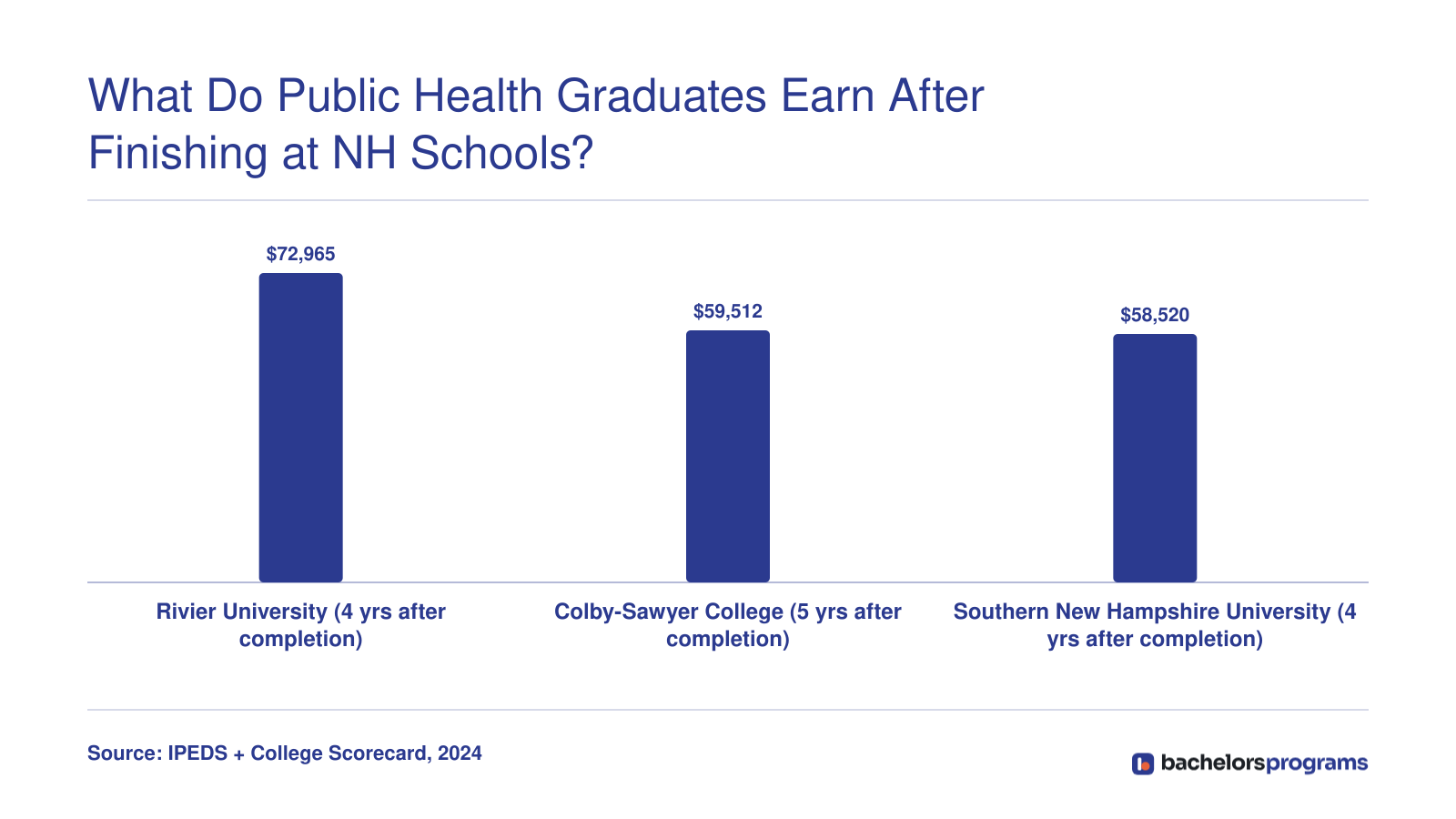
What Do Public Health Graduates Earn After Finishing at NH Schools?
Federal program-level data shows Rivier University public health graduates earning a median of $72,965 four years after completing, the highest figure among these schools. Southern New Hampshire University graduates follow at $58,520 four years out, and Colby-Sawyer College graduates report $59,512 five years out. One year after finishing, the medians are $45,910 at Southern New Hampshire University and $36,710 at Rivier University. The University of New Hampshire, Saint Anselm College and Keene State College do not have earnings reported for their public health programs, so they are left off the chart. Because graduating classes are small, read these figures as a rough guide rather than a guarantee.
Do You Need a License to Work in Public Health in New Hampshire?
No General State License for Most Roles
The decision that matters is whether to plan an optional credential into your bachelor's coursework now. A state license is generally not the hurdle. New Hampshire does not appear to require a general license for most public health work, including health educator and program roles at agencies, hospitals and nonprofits. Community health workers fall under voluntary certification. Under RSA 326-N:3, the state sets criteria for education, training, experience and other qualifications, but certification is not mandatory licensure.1
The main exception is classroom teaching. Under the state's Education Rules (Ed 500), school health education teachers need a license.2 That requires at least a bachelor's degree plus coursework in areas such as anatomy and physiology, nutrition, substance abuse education, mental and emotional health, sexuality education, first aid and CPR, and public or environmental health.2 These rules do not establish a requirement for agency or community health jobs.
The Optional CHES Credential
The Certified Health Education Specialist (CHES) credential is issued by the National Commission for Health Education Credentialing (NCHEC).3 It is voluntary. Bachelor's graduates qualify in one of two ways:
- Major: a transcript showing a major in health education, community health education, public health education or school health education.4
- Coursework: at least 25 semester credits (37 quarter hours), each with a C or better, addressing the Nine Areas of Responsibility and Competency for Health Education Specialists.4 At least 12 of those semester credits must be process courses.
Eligibility rests on your transcript, not on job duties you have performed. NCHEC also awards an advanced credential, the MCHES.
Your Next Step
Before you apply, confirm three things for each school: the exact public health program, its CEPH accreditation status and its cost after aid. Ask an advisor how the curriculum maps to the CHES coursework rule.
Compare Public Health programs on the data that matters
Explore more Healthcare majors or browse every field of study.
All Healthcare programs Browse every field of study