Best Criminology Schools in New Jersey
Compare 9 accredited Criminology programs in New Jersey, with net price after aid, graduation rates, earnings and debt from IPEDS and the U.S. College Scorecard.
New Jersey colleges award criminology bachelor's degrees on campus and online, usually titled B.A. or B.S., and the title alone rarely reveals whether the department leans toward sociology or toward police practice. Programs ranked here are measured on published figures for net price, completion, graduation rate, and graduate earnings.
In-state tuition at the public universities runs from roughly $15,700 to $19,600 a year; median earnings within a few years of graduation span about $40,000 to $73,000.
That spread is the practical question: same credential, very different price and payoff.
Key Points
- Fairleigh Dickinson University's Madison campus tops the list with a 36-credit major.
- Aid drops net price below sticker at Seton Hall and Fairleigh Dickinson.
- Montclair State University pairs criminology with social justice in one bachelor's degree.
Best Criminology Schools in New Jersey: Our Top Bachelor's Programs
Fairleigh Dickinson University's Florham campus in Madison leads this list, pairing a 36-credit criminology and criminal justice major with the university's largest cohort in the field and a clear path toward law school. The better fit for you still comes down to cost versus format: FDU's Teaneck campus runs the same major at a lower net price, The College of New Jersey offers a selective public alternative with a strong completion record, and William Paterson and Strayer let you finish the degree online.
Fairleigh Dickinson University
#1Madison, NJ · ~$23,000/yr (est.)
Best for: Future law students wanting justice-system depth
Fairleigh Dickinson's Florham campus in Madison carries the university's largest criminology cohort, with 29 bachelor's completions in the most recent federal count. The 36-credit major pairs an 18-credit core (theory, research methods, an internship and a capstone) with 18 elective credits split across two concentrations, Justice Systems or Crime, Law and Society. Coursework reaches into cybercrime, terrorism and transnational crime, and learning outcomes follow Academy of Criminal Justice Sciences criteria. Institution-wide, about 67% of students finish their degree, and the average net price after aid is roughly $22,800.
- 36-credit major: 18 core credits plus 18 elective credits
- Two concentrations: Justice Systems, or Crime, Law and Society
- Core includes a criminal justice internship and a capstone
- Learning outcomes follow Academy of Criminal Justice Sciences criteria
- Coursework covers cybercrime, terrorism and transnational crime
- Prepares students for law school and graduate study
- Program coordinators sit at the Florham and Metropolitan campuses
Fairleigh Dickinson University-Metropolitan Campus
#2Teaneck, NJ · $15,000/yr (est. net price)
Best for: Budget-conscious commuters in North Jersey
The Metropolitan Campus in Teaneck runs the same 36-credit Criminology & Criminal Justice B.A. with a smaller cohort and a notably lower average net price after aid, about $15,400. Students complete the 18-credit core with an internship and capstone, then take six major electives or a full 18-credit concentration in Justice Systems or Crime, Law and Society. The program studies law enforcement and control at the local, state, federal and international levels. About 53% of students graduate institution-wide.
- 36 credits: an 18-credit core plus 18 elective credits
- Take six electives or a full 18-credit concentration
- Concentrations in Justice Systems and Crime, Law and Society
- Includes a Criminal Justice Internship and a capstone
- Covers law enforcement at local, state, federal and international levels
- Outcomes mapped to Academy of Criminal Justice Sciences criteria
- Graduates continue to law school and graduate study
The College of New Jersey
#3Ewing, NJ · $20,000 – $26,000/yr (est.)
Best for: Research-minded criminology students
The College of New Jersey offers a B.A. in Criminology built around a compact four-course core: Introduction to Criminology, Criminology, Research Methods and a senior capstone in policy analysis. Students add institution electives in policing, judicature or penology, a methods option such as crime mapping or data analysis, and at least four electives at the 300 level or higher. It is a selective public college with an institution-wide graduation rate near 86%, and several core courses cannot be transferred in, so transfers should plan early. The average net price after aid is about $27,600.
- Four-course core ends in a senior capstone in policy analysis
- Institution electives: policing, judicature or penology
- Methods option includes crime mapping and data analysis
- At least four major electives must be at the 300 level or higher
- One elective must meet the Diversity, Equity and Inclusion requirement
- CRI 205, CRI 306 and CRI 499 cannot be transferred in
- Declare the major after CRI 100 and a Change of Major form
Ramapo College of New Jersey
#4Mahwah, NJ · $15,000 – $20,000/yr (est.)
Ramapo College of New Jersey offers a bachelor's degree in sociology with a criminology concentration rather than a stand-alone criminology major, so students pair crime-focused coursework with a sociology foundation. The criminology track covers law enforcement fields and questions of class, race, gender and religious difference, with courses such as Criminology, Crime and Media, and Sociology of Deviance. Majors have interned with the New Jersey Courts Intensive Supervision Program and with government and nonprofit agencies across northern New Jersey. About 70% of students graduate institution-wide, and the average net price after aid is roughly $18,200.
- Sociology major with a criminology concentration
- Two tracks: public sociology and criminology
- Courses include Criminology, Crime and Media, Sociology of Deviance
- Criminology track covers law enforcement fields
- Internships with the New Jersey Courts Intensive Supervision Program
- Prepares students for teacher education and social studies certification
- Graduates work in courts, the FBI, schools and human services
Montclair State University
#5Montclair, NJ · ~$16,000/yr (est.)
Montclair State University awards a B.A. in Criminology and Social Justice through Bloomfield College of Montclair State University, delivered on campus with an explicit focus on race, gender, economic inequality and environmental harm. Every Bloomfield College degree includes the SCHOLAR certificate, which pairs students with community partners on projects, and internships run through organizations such as Asun Star, NJCDC and S.O.F.I.A. In-state tuition is $8,294 per semester. About 65% of students graduate institution-wide, and the average net price after aid is roughly $15,600.
- Awarded through Bloomfield College of Montclair State University
- SCHOLAR certificate built into every Bloomfield College degree
- Internships with groups such as Asun Star, NJCDC and S.O.F.I.A.
- Examines race, gender, economic inequality and environmental harm
- In-state tuition of $8,294 per semester
- Graduates pursue social work, public administration and policy work
- Leads to law enforcement, policy and advocacy roles
Stockton University
#6Galloway, NJ · $21,000/yr (est. net price)
Stockton University offers a B.S. in Criminal Justice with 169 bachelor's completions in the most recent federal count, the largest criminology-related cohort in this ranking. The 48-credit core runs from Introduction to the Criminal Justice System to a senior capstone, with five concentration choices: General, Forensic Investigation, Forensic Psychology, Homeland Security, and a dual B.S./M.A. track finished in five years. Junior standing, a 2.5 GPA and one prerequisite course are required before the 140-hour internship. About 69% of students graduate institution-wide, and the average net price after aid is roughly $20,700.
- 48-credit core across 12 courses, ending in a senior capstone
- Five concentrations, including Forensic Investigation and Homeland Security
- Dual B.S./M.A. track finished in five years instead of six
- Internship: 140 hours for up to 4 credits, junior standing required
- Internship requires a 2.5 GPA and CRIM 2141 with a C or better
- 16 cognate credits include Introduction to Psychology and Sociology
- Seven CRIM courses accepted from A.A./A.S. transfers
- Graduation with Distinction needs a 3.85 program GPA
Seton Hall University
#7South Orange, NJ · $31,000/yr (est. net price)
Seton Hall University blends criminology and criminal justice in a 36-credit B.A. that splits evenly between required courses and electives drawn from two specialization areas. The internship network reaches the New Jersey Division of Criminal Justice, the New Jersey State Police and the Superior Court of New Jersey alongside federal and municipal agencies, an unusually direct path into New Jersey public-sector work. Required coursework covers criminological theory, criminal procedure and evidence, and research methods. This private Catholic university reports an institution-wide graduation rate of about 69% and an average net price after aid of roughly $31,400 against tuition and fees near $53,200.
- 36 credits: 18 required plus 18 elective
- Two elective areas: Criminology Courses and Criminal Justice Courses
- Required courses include criminological theory, criminal procedure and research methods
- Internship or senior seminar in criminology fills 3 credits
- Internships with federal, state and municipal agencies
- Students take two courses from each specialization area
- Minimum overall GPA of 2.0 required for majors
William Paterson University of New Jersey
#8Wayne, NJ · $16,000 – $25,000/yr (est.)
William Paterson University awards a B.A. in Criminology & Criminal Justice both at its Wayne campus and through WP Online, the one New Jersey option in this ranking that runs the same degree in both formats. The 120-credit degree puts 39 credits in the major, built on a 21-credit core covering research methods, criminal law and a 3- to 6-credit internship, then 12 credits of systems and advanced electives. Students need junior status for some core courses and senior status for others, so sequencing matters when planning a transfer. About 44% of students graduate institution-wide, and the average net price after aid is roughly $18,700.
- 120 total credits, with 39 required in the major
- Offered on campus and through WP Online
- 21-credit core includes research methods, criminal law and internship
- Internship is worth 3 to 6 credits
- Systems electives include Policing, Penology and Victimology
- Advanced electives range from Cybercrime to Criminal Investigation
- Junior status (60 credits) needed for some core courses
- Two zero-credit Will. Power. courses required
Strayer University-New Jersey
#9Piscataway, NJ · ~$14,000/yr (est.)
Strayer University's Piscataway location serves New Jersey students through a fully online B.S. in Criminal Justice with a concentration in Crime and Criminal Behavior. The concentration adds five courses, including The Criminal Mind, Forensic Psychology and Drugs, Gangs and Organized Crime, and each course runs 11 weeks at $1,555 plus a $65 technology fee each term. Up to 28 classes can transfer in, and the university supports employer tuition reimbursement and more than 500 employer partnerships. Graduates earn a median of about $40,100 a decade after enrolling.
- 40 courses total; five in the Crime and Criminal Behavior concentration
- Fully online, with 11-week course terms
- $1,555 per course plus a $65 technology fee each term
- Concentration courses include The Criminal Mind and Forensic Psychology
- Also covers Crime Prevention Strategies and Drugs, Gangs and Organized Crime
- Transfer up to 28 classes
- Middle States Commission on Higher Education accreditation
- Employer tuition reimbursement supported
Cost & outcomes by school
Federal data for the highest-earning Criminology programs, independent of the ranking above. Earnings are this field's bachelor's graduates four years after completing where the Scorecard reports them, else the school's undergraduate median.
| School | Net price / yr | Grad rate | Earnings | Debt | Grads/yr | Format |
|---|---|---|---|---|---|---|
| The College of New Jersey NJ | $27,646 | 86% | $73,323 | $23,250 | — | Campus |
| Seton Hall University NJ | $31,446 | 70% | $70,196 | $22,750 | — | Campus |
| Ramapo College of New Jersey NJ | $18,173 | 70% | $67,541 | $21,000 | — | Campus |
| Montclair State University NJ | $15,566 | 65% | $61,415 | $22,000 | — | Campus |
| William Paterson University of New Jersey NJ | $18,745 | 44% | $57,780 | $22,334 | — | Online or campus |
| Stockton University NJ | $20,670 | 69% | $55,408 | $20,636 | 169 | Campus |
| Fairleigh Dickinson University NJ | $22,829 | 67% | $53,055 | $25,000 | 20 | Campus |
| Fairleigh Dickinson University-Metropolitan Campus NJ | $15,404 | 53% | $53,055 | $25,000 | 3 | Campus |
| Strayer University-New Jersey NJ | — | — | $40,092 | $40,621 | — | Online |
Sources: U.S. Department of Education. Net price, graduation rate, earnings and debt: College Scorecard (earnings and debt for this field's bachelor's graduates where reported, else school-wide); graduates: IPEDS. A dash means no figure is reported.
Cost, debt & payoff
Median earnings of this field's bachelor's graduates (4 yrs after completing, else the school's undergraduate median) vs. their median federal loan debt · U.S. College Scorecard
Across these programs the median graduate earns about $57,780 and finishes with roughly $22,750 in debt — a ratio that clears a common rule of thumb (keep debt below first-year salary). Net price and debt vary widely school to school, so check the per-school figures in the table above before you shortlist.
How We Ranked New Jersey's Bachelor's in Criminology Programs
Every program here earned its spot on published federal data, not on reputation or marketing copy.
What We Looked At
Four public measures do most of the work:
- Net price: What students actually pay after grant and scholarship aid is applied, rather than the sticker tuition a school advertises.
- Program completions: How many criminology and criminal justice degrees a school actually awards, which signals whether the program is a real department or a thin elective cluster.
- Graduation rate: The share of first-time, full-time students who finish.
- Earnings: Reported pay for graduates, always labeled by the window it measures, because pay one year after graduation and pay several years out are not the same measure.
The Caveats That Matter
Two of those numbers describe the whole institution, not the criminology major specifically. Graduation rate covers every undergraduate on campus, and net price averages across the whole sector and every program, so a criminology student's actual bill can land above or below it. Treat both as context, not as a promise about your own outcome.
What Qualified
We included bachelor's degree programs at New Jersey institutions in any format: on campus, online, or a mix of the two. Graduate study sits outside the scope of this page entirely. If a school's criminology or criminal justice degree is awarded below the bachelor's level, it is not ranked here.
Most Affordable Bachelor's in Criminology Programs in New Jersey
These schools are ordered by average net price, the amount students actually pay after grants and scholarships, using U.S. Department of Education data from IPEDS and the College Scorecard (2024). Fairleigh Dickinson University-Metropolitan Campus carries the highest sticker price at $38,004 but the lowest net price at $15,404. The public universities charge in-state tuition and fees between $15,704 and $16,777.
| School | Program | City | Format | In-State Tuition & Fees | Out-of-State Tuition & Fees | Average Net Price | Graduation Rate |
|---|---|---|---|---|---|---|---|
| Fairleigh Dickinson University-Metropolitan Campus | Criminology & Criminal Justice BA | Teaneck | Campus | $38,004 | $38,004 | $15,404 | 53% |
| Montclair State University | Criminology and Social Justice | Montclair | Campus | $15,912 | $26,022 | $15,566 | 65% |
| Ramapo College of New Jersey | Sociology (Criminology track) | Mahwah | Campus | $16,777 | $27,708 | $18,173 | 70% |
| William Paterson University of New Jersey | Criminology & Criminal Justice, BA | Wayne | Campus and online | $15,704 | $25,344 | $18,745 | 44% |
| Stockton University | Criminal Justice | Galloway | Campus | $16,266 | $24,524 | $20,670 | 69% |
Criminology vs. Criminal Justice: Choosing the Right Bachelor's Program
Look at the degree titles on this page and the blur is obvious: Fairleigh Dickinson University and William Paterson University both award a Criminology & Criminal Justice BA, The College of New Jersey awards a Criminology BA, Montclair State University calls its degree Criminology and Social Justice, while Stockton University, Seton Hall University, and Strayer University-New Jersey use Criminal Justice. The titles overlap because the subjects do.
What each field actually studies
Criminology asks why crime happens. Coursework leans on theory, research methods, statistics, and the social conditions tied to offending, victimization, and punishment. Criminal justice asks how the system responds: policing, courts, sentencing, corrections, and the agencies that run them. Most programs teach some of both, which is why a hybrid title like Criminology & Criminal Justice is so common in New Jersey.
B.A. or B.S. in criminology
The B.A. version usually sits inside a liberal arts core, with foreign language or humanities requirements and a social science emphasis. A Bachelor of Science typically pushes further into quantitative work: research design, data analysis, and applied methods. Requirements vary by school, so read the actual course list in the catalog rather than assuming the letters tell you everything.
Compare courses, not titles
Pull up the required courses, internship options, and available concentrations side by side. An internship with a county prosecutor's office or a juvenile services agency shapes your resume more than the word on your diploma.
Then match that to your goal. Field-facing work in policing, probation, or corrections rewards hands-on placements and systems coursework. Analysis, policy research, advocacy, or a path toward graduate school or law school rewards heavy methods and theory training.
Questions to Ask Yourself
Do you want to study crime as a social science, or train for a job in the justice system?
Would a B.A. or a B.S. serve your next step better?
Can you realistically commute to a New Jersey campus, or do you need an online or hybrid schedule?
Related Articles
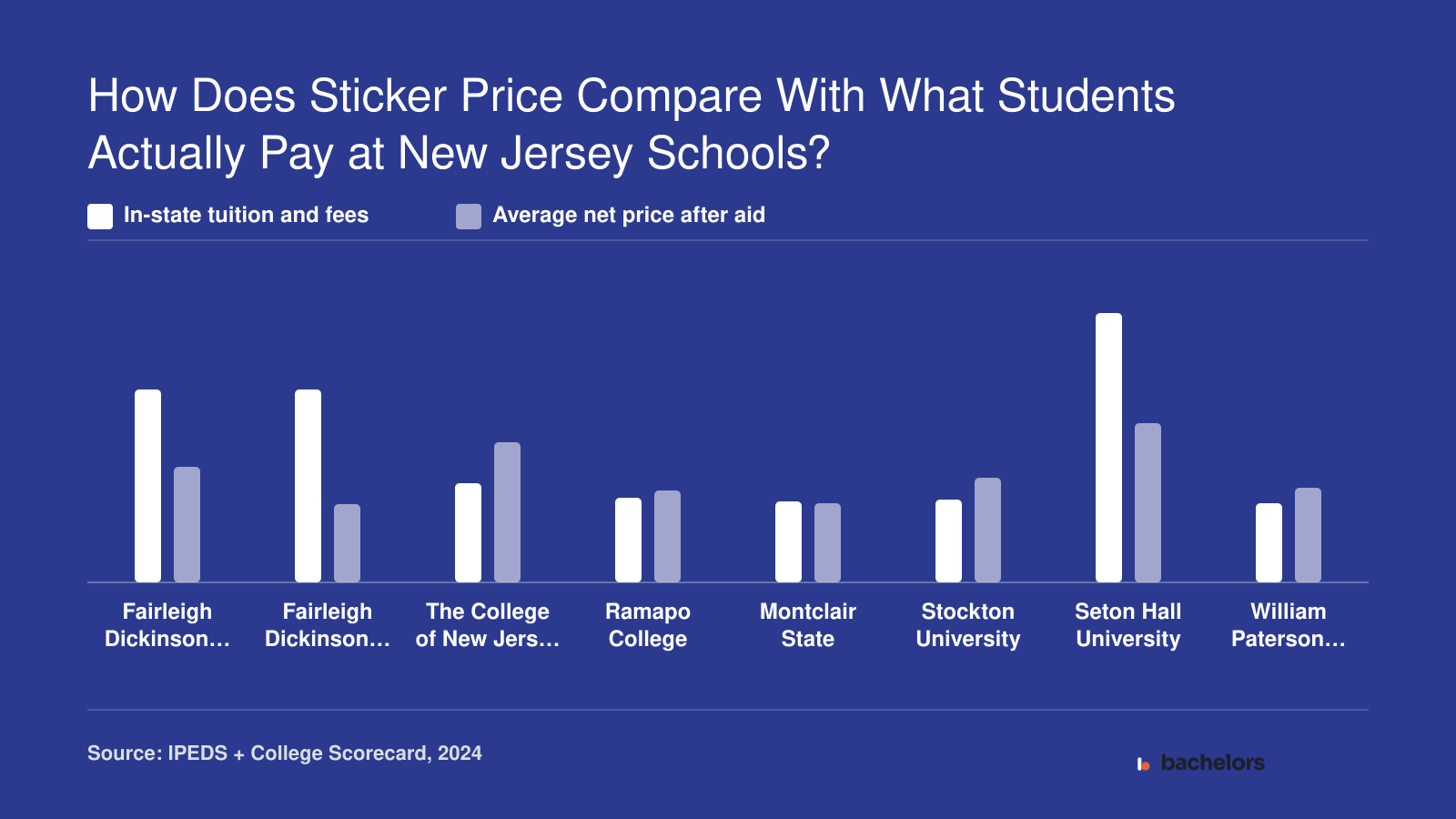
How Does Sticker Price Compare With What Students Actually Pay at New Jersey Schools?
Published tuition is the sticker price. Net price is what students pay on average after grants and scholarships, and it also counts housing, food and books. At Seton Hall and both Fairleigh Dickinson campuses, aid pulls the average net price well below tuition. At The College of New Jersey, Stockton, Ramapo and William Paterson, net price runs above in-state tuition because living costs are added in. Net price is an institution-wide average for aided first-time, full-time students, not a criminology-specific figure, so your own cost depends on your aid package.
Questions to Ask Yourself
Are you aiming for sworn law enforcement, or for a role where the degree is the main credential?
Does your target employer require civil service testing or other steps beyond the degree?
Do you plan to go on to law school or graduate study?
Common Questions About Criminology Degrees in New Jersey
Which New Jersey school has the best criminology program?
Can you get a bachelor's degree in criminology online in New Jersey?
Can I transfer community college credits toward a criminology bachelor's in New Jersey?
Do I need a bachelor's degree to become a police officer in New Jersey?
Compare Criminology programs on the data that matters
Explore more Criminal Justice & Law majors or browse every field of study.
All Criminal Justice & Law programs Browse every field of study