Best Criminal Justice Schools in New Jersey
Compare 22 accredited Criminal Justice programs in New Jersey at 20 colleges, with net price after aid, graduation rates, earnings and debt from IPEDS and the U.S. College Scorecard.

What does a bachelor's degree in criminal justice actually lead to in New Jersey? Often the job it points to does not require a Bachelor of Science (B.S.) in Criminal Justice. Municipal police departments can hire without one, yet the degree can strengthen an application, support promotion, and open federal, probation, and corrections paths.
The real decision comes down to cost, format, and fit. Sticker prices at New Jersey's public and private schools differ sharply, and online completion programs sit beside traditional campus majors.
Strong programs here tie coursework to internships, and the state's employers tend to value that experience.
Key Points
- Saint Peter's University lists $42,552 tuition but nets $12,199 after aid.
- Monmouth University requires a one-semester internship during the senior year.
- New Jersey police hiring doesn't require a criminal justice bachelor's degree.
Best Criminal Justice Schools in New Jersey: Our Top 10 Ranked
New Jersey's criminal justice bachelor's programs range from a dedicated school of criminal justice in Newark to fully online completion degrees built for working adults. The ten schools below span public flagships, regional universities and private colleges, and each entry shows where the program is taught, what the coursework covers and which New Jersey agencies students can reach through internships.
Rutgers University
#1New Brunswick, NJ · $24,000/yr (est. net price)
Best for: Traditional students wanting a full campus life
Rutgers University's New Brunswick campus runs its criminal justice major through the Department of Sociology, giving students a multidisciplinary take on crime, criminalization and the agencies that respond to both. The major sits inside a large public research university, so students get broad elective choice plus advising, course and internship resources behind the degree. Rutgers Statewide also offers hybrid degree-completion pathways for students arriving from partner New Jersey county colleges, with up to 60 credits from a county college generally transferable.
- Housed in the Department of Sociology
- Multidisciplinary study of crime and criminalization
- Covers justice system policies, practices and functions
- Prepares for careers inside and beyond criminal justice
- Advising, course and internship resources on the program site
Rutgers University-Camden
#2Camden, NJ · $15,000 – $20,000/yr (est.)
Best for: Commuter students in South Jersey
Criminal justice at Rutgers University–Camden draws on sociology, criminology and public policy, with small classes and faculty research on gun violence, policing and incarceration. The Camden campus pairs the major with internship and research opportunities and a clear route toward federal agencies or law school. Rutgers Statewide connects the Camden program to partner community colleges, including Camden County College and Atlantic Cape Community College, for hybrid degree completion.
- Draws on sociology, criminology and public policy
- Emphasis on critical thinking and research methods
- Accelerated BA/MA in Criminal Justice available
- Small class sizes and faculty research on policing
- Internships and undergraduate research projects
- Prepares for law school, public policy or justice careers
- Paths into FBI, DEA and Homeland Security work
Rutgers University-Newark
#3Newark, NJ · $20,000/yr (est. net price)
Best for: Research-focused students eyeing justice policy
Rutgers University–Newark houses its criminal justice program in a dedicated School of Criminal Justice and awards the Bachelor of Science in Criminal Justice. Majors complete 42 credits in the field, including research methods and data analysis, alongside a second concentration and a writing-intensive course. The school's New Jersey footprint runs deep: the Newark Public Safety Collaborative works with the mayor's office on violence reduction, NJ-STEP delivers college courses inside state prisons, and a 2026 CLEAR Institute focuses on corrections and sentencing reform.
- 120 total credits, 42 of them in the major
- Required courses include criminology and research methods
- Data analysis course in criminal justice research
- 27 credits of criminal justice or justice studies electives
- Second concentration and writing-intensive course required
- Accelerated BS/MA option and undergraduate internships
- Alpha Phi Sigma honor society chapter
- 2.0 cumulative GPA minimum for graduation
Kean University
#4Union, NJ · $14,000 – $22,000/yr (est.)
Kean University offers both a Bachelor of Arts and a technically oriented Bachelor of Science in Criminal Justice, and classes run in Union, at Kean Jersey City, at Kean Ocean and online. The B.S. leans applied, with crime scene methods, investigation and data skills, plus a tie-in to the university's Center for Cybersecurity. A Spring Break Travelearn trip to London or Amsterdam and guest lectures from FBI and Secret Service personnel give the program an unusually hands-on flavor for a public university.
- B.S. track emphasizes investigation, data and operations
- Courses in crime scene methods, policing and corrections
- Ties to Kean's Center for Cybersecurity
- Classes at Union, Jersey City, Kean Ocean and online
- 2.5 minimum GPA to enter the program
- Spring Break Travelearn to London or Amsterdam
- Guest lectures from FBI and Secret Service personnel
- Minor in cybersecurity and cybercrime available
Stockton University
#5Galloway, NJ · $21,000/yr (est. net price)
Stockton University's Bachelor of Science in Criminal Justice requires 48 credits in the major plus a senior capstone, and it is one of the few programs in the state offering five distinct concentration tracks. Students choose from general criminal justice, forensic investigation, forensic psychology, homeland security, or a dual bachelor's-to-master's route finished in five years. Internships award up to four credits for 140 hours with an agency, and transfer-friendly policies recognize up to seven criminal justice courses.
- 48 credits in criminal justice plus 16 cognate credits
- Five concentrations, including forensic investigation
- Homeland security and forensic psychology tracks
- Senior capstone course required
- Internship of 140 hours for up to four credits
- Dual BS/MA completed in five years
- Open to any Stockton student declaring before junior year
- Internship eligibility: 2.5 GPA and CRIM 2141 with C or better
Rowan University
#6Glassboro, NJ · $22,000/yr (est. net price)
Rowan University delivers its criminal justice curriculum as a Bachelor of Arts in Law and Justice, and the entire degree can be completed online. The 120-credit program includes 51 credits in the major across 17 courses, covering criminal law, corrections, theories of crime, and law and human rights, with a required internship. Admission is built for transfer students: an associate degree or 24 transferable credits and a 2.0 GPA, with no application fee.
- Fully online, 120 semester hours
- 51 credits in the major across 17 courses
- Required internship plus a criminal justice research course
- Coursework in criminal law, corrections and human rights
- Admission with an associate degree or 24 transfer credits
- 2.0 minimum GPA and no application fee
- Full-time or part-time enrollment
- Fall and spring entry; July 1 and November 1 deadlines
Saint Peter's University
#7Jersey City, NJ · ~$12,000/yr (est.)
Saint Peter's University offers a criminal justice bachelor's degree on its Jersey City campus with six specializations, from police administration and corrections to investigative sciences and cyber security and computer forensics. The Jesuit university blends theory with practice and strongly encourages a second major plus an internship, drawing on its placement network in Jersey City and New York City. Students have traveled to the FBI Academy, and graduates move into law enforcement, crime scene investigation, research analysis and court roles.
- Six specializations, including police administration
- Investigative sciences and cyber forensics tracks
- Courses such as Forensic Science and Victimology
- Double major and internship strongly encouraged
- Placement network across Jersey City and New York City
- Student trips to the FBI Academy and abroad
- Jesuit curriculum rooted in justice and equality
Seton Hall University
#8South Orange, NJ · $31,000/yr (est. net price)
Seton Hall University's criminal justice major is a 36-credit Bachelor of Arts split evenly between required courses and electives, with electives clustered in criminology or criminal justice according to career goals. Required coursework runs from criminology and criminal procedure to research methods and scientific and technical writing, capped by an internship or senior seminar. Placements sit in federal, state and municipal agencies, and the South Orange campus feeds graduates into law enforcement, courts, corrections and victim services as well as law school.
- 36 credits: 18 required and 18 elective
- Electives clustered in criminology or criminal justice
- Required criminology, criminal procedure and research methods
- Scientific and technical writing course required
- Internship or senior seminar caps the major
- Placements in federal, state and municipal agencies
- 2.0 overall GPA required for the major
Monmouth University
#9West Long Branch, NJ · $30,000 – $35,000/yr (est.)
Monmouth University awards a Bachelor of Arts in Criminal Justice with core courses in criminology, criminal law and law enforcement, plus attention to criminal behavior, technology and community policing. A one-semester internship is required in the senior year, with placements at local police agencies, prosecutors' offices, law offices, the U.S. Coast Guard and the U.S. Department of Justice. The West Long Branch campus prepares students for law enforcement and corrections work as well as law school and graduate study.
- One-semester internship required in senior year
- Core courses in criminology, criminal law and law enforcement
- Focus on criminal behavior, technology and prevention
- Community policing covered in the curriculum
- Placements with prosecutors' offices and the U.S. Coast Guard
- Internship options with the U.S. Department of Justice
- Prepares students for law school and graduate study
Fairleigh Dickinson University-Metropolitan Campus
#10Teaneck, NJ · $15,000/yr (est. net price)
Fairleigh Dickinson University's Metropolitan Campus in Teaneck runs a criminal justice Bachelor of Arts built on 33 credits of core courses plus 12 credits of major electives, with program outcomes mapped to Academy of Criminal Justice Sciences standards. Required work spans police and society, courts, corrections, juvenile justice, victimology and criminal justice ethics, closed by a capstone seminar.
- 33 credits of core courses plus 12 elective credits
- Outcomes aligned with Academy of Criminal Justice Sciences standards
- Required criminal justice ethics course
- Capstone seminar required
- Coursework in forensic psychology and the forensic sciences
- Covers cyber-crime, terrorism and transnational crime
- Merged into Criminology and Criminal Justice in fall 2025
Cost & outcomes by school
Federal data for the highest-earning Criminal Justice programs, independent of the ranking above. Earnings are this field's bachelor's graduates four years after completing where the Scorecard reports them, else the school's undergraduate median.
| School | Net price / yr | Grad rate | Earnings | Debt | Grads/yr | Format |
|---|---|---|---|---|---|---|
| Thomas Edison State University NJ | — | — | $69,331 | $12,500 | 21 | Online |
| Monmouth University NJ | $30,988 | 72% | $67,842 | $27,000 | 47 | Campus |
| Centenary University NJ | $20,503 | 56% | $67,181 | $20,000 | 19 | Campus |
| Felician University NJ | $40,045 | 47% | $66,879 | $26,000 | 19 | Campus |
| Rutgers University NJ | $24,406 | 84% | $61,817 | $19,750 | 176 | Campus |
| Rutgers University-Newark NJ | $19,703 | 64% | $61,817 | $19,750 | 137 | Campus |
| Rutgers University-Camden NJ | $18,745 | 67% | $61,817 | $19,750 | 54 | Campus |
| Kean University NJ | $12,447 | 47% | $58,644 | $24,213 | 149 | Online or campus |
| William Paterson University of New Jersey NJ | $18,745 | 44% | $58,108 | $23,000 | 148 | Online or campus |
| Stockton University NJ | $20,670 | 69% | $57,602 | $20,500 | 135 | Campus |
| Georgian Court University NJ | $19,285 | 54% | $56,472 | $26,000 | 9 | Hybrid |
| Saint Peter's University NJ | $12,199 | 58% | $56,438 | $23,250 | 29 | Campus |
Sources: U.S. Department of Education. Net price, graduation rate, earnings and debt: College Scorecard (earnings and debt for this field's bachelor's graduates where reported, else school-wide); graduates: IPEDS. A dash means no figure is reported.
Cost, debt & payoff
Median earnings of this field's bachelor's graduates (4 yrs after completing, else the school's undergraduate median) vs. their median federal loan debt · U.S. College Scorecard
Across these programs the median graduate earns about $56,472 and finishes with roughly $24,574 in debt — a ratio that clears a common rule of thumb (keep debt below first-year salary). Net price and debt vary widely school to school, so check the per-school figures in the table above before you shortlist.
Most Affordable Bachelor's in Criminal Justice Programs in New Jersey
Sticker price and actual cost can be far apart in New Jersey. Saint Peter's University lists $42,552 in tuition and fees but has the lowest average net price below, $12,199 after grants and scholarships, while Kean University offers both a low in-state rate and a net price near the top of this group. Net price figures include living costs as well as tuition, so compare the net price column first and use the tuition column to understand the starting point. Figures come from the U.S. Department of Education's IPEDS and College Scorecard data (2024).
| School | City | Program | Format | Tuition and Fees (In-State) | Average Net Price After Aid | Graduation Rate | Median Debt at Graduation |
|---|---|---|---|---|---|---|---|
| Saint Peter's University | Jersey City | Criminal Justice | Campus | $42,552 | $12,199 | 58% | $20,500 |
| Kean University | Union | Criminal Justice | Campus and online | $14,299 | $12,447 | 47% | $23,250 |
| Fairleigh Dickinson University-Metropolitan Campus | Teaneck | Criminal Justice BA | Campus | $38,004 | $15,404 | 53% | $25,000 |
| Rutgers University-Camden | Camden | Criminal Justice, BA | Campus | $17,764 | $18,745 | 67% | $21,500 |
| William Paterson University of New Jersey | Wayne | Criminology & Criminal Justice | Campus and online | $15,704 | $18,745 | 44% | $22,334 |
Online and Hybrid Criminal Justice Bachelor's Options at New Jersey Schools
New Jersey schools offer online coursework toward a Bachelor of Science (B.S.) or a related bachelor's in criminal justice. Formats differ by school, so check each program page before you apply.
What the Formats Look Like
- Fully online: Kean University lists an online option, and Rowan University lists one for its B.A. in Law & Justice. Rowan's program also has full-time and part-time pacing. William Paterson University lists 100% online coursework, accessible 24/7.1
- Accelerated: William Paterson offers an Accelerated Professional Track alongside its standard online degree.
- Hybrid: Rutgers University runs Criminal Justice through statewide partnerships, and at least one partner campus delivers it as a mix of in-person and online. Rutgers says format varies by partner.
- Campus-based: Rutgers University-Camden, Rutgers University-Newark, Stockton University, Saint Peter's University, Seton Hall University, Monmouth University, and Fairleigh Dickinson University-Metropolitan Campus are listed primarily as on-campus programs.
Tuition and Gaps to Watch
William Paterson shows $381 per credit for its online options.1 Kean and Rowan do not clearly state whether online students pay in-state or a different rate, so confirm that with the bursar before budgeting.
Some schools do not publish delivery details at all. Caldwell University confirms a 120-credit Bachelor of Arts in Criminal Justice but lists no online, hybrid, evening, or accelerated format. Kean lists "Online" without saying whether it is fully online or blended. A missing format on a web page does not prove a school has no flexible option, so ask admissions directly.
Ask whether required courses are offered online every term, and whether internships must be completed in person.
Admissions: GPA, Test Policy, and Transfer Credit
New Jersey's criminal justice programs are, for the most part, accessible: published GPA thresholds are modest, standardized tests have largely stopped being a barrier, and community college transfer routes are unusually well mapped.
Test policy and GPA
Rutgers is test-optional and test-blind through 2026, and transfer applicants are not asked for SAT or ACT scores at all1; the one exception is recent high school graduates who will not have 12 graded college credits by the deadline, who may still submit scores. Rutgers does not publish a separate minimum high school GPA for direct entry into the Newark criminal justice B.S.
Where Rutgers does set a number, it is for students moving between Rutgers schools: at least 12 Rutgers-system credits at the time of application, a 2.10 cumulative Rutgers GPA, a C or better in English Composition I and II or equivalents, and demonstrated math proficiency. The Rutgers partnership with Atlantic Cape asks for a 2.0 combined GPA plus 42 credits in criminal justice, sociology, anthropology or related coursework.
Stockton's one published GPA figure is tied to a selective dual-degree criminal justice pathway rather than the standard B.S.: early conditional admission there calls for a 3.7 high school GPA, Accuplacer scores of 255 math and 250 in writing and reading (or SAT/ACT equivalents of 570/24 math and 520/20 reading and writing), CRIM 1100, and a 3.3 GPA to stay in the track.3
Several other schools here publish no GPA or test requirement specific to the criminal justice major, so check the general undergraduate admissions page and treat selectivity as a cue instead: Rutgers-New Brunswick admits roughly 58 percent of applicants, while Saint Peter's, Fairleigh Dickinson's Metropolitan Campus, Monmouth and Stockton all admit close to nine in ten.
County college transfer
Rutgers reports articulation agreements with every New Jersey county and community college, and routes students to NJ Transfer to check course equivalencies.2 Associate degree holders can bring in up to 60 credits; students with 12 or more community college credits and no degree remain eligible.2 Rutgers-Newark caps total transfer credit at 65 against a 121-credit degree, allows up to 20 transferred credits toward the major, and excludes police academy and corrections training credit.
Related Articles
Cost of a Bachelor's Degree in Criminal Justice in New Jersey
Sticker price is a poor guide to what a New Jersey criminal justice bachelor's degree really costs. State and institutional aid close much of the gap.
Public vs. Private: Sticker Price and Net Price
At the public universities ranked here, in-state tuition and fees run from roughly $14,300 to $17,800 a year, and out-of-state charges reach about $24,500 to $37,300. Private universities on the list publish tuition near $38,000 to $42,600. Average net price, the approximate sector average for first-time, full-time students who receive aid, narrows the difference: roughly $12,400 to $22,400 at the publics and $12,200 to $15,400 at the privates. Need-based aid reaches most students, with the Pell share at these schools running from about half to nearly 80 percent.
New Jersey Aid That Changes the Math
File the FAFSA or the NJ Alternative Financial Aid Application by the state deadline. Every program below depends on it.
- TAG: Full-time undergraduates in approved programs at eligible New Jersey schools. HESAA's 2026-27 figures list $3,098, plus $774 for the part-time grant, which is limited to county colleges.1 Requires 12 consecutive months of New Jersey residency, and the grant funds up to nine State-aid payments toward a bachelor's degree.2
- NJ STARS: Tuition-only award for the top 15.0 percent of a high school class, used at the county college within five semesters of graduation, at 12 to 18 credits per semester for up to five semesters, with a 3.0 GPA by the third semester.3
- Garden State Guarantee: At in-state public four-year colleges, families with adjusted gross income of $65,000 or less pay $0 in tuition and mandatory fees in the third and fourth years, up to four semesters or 128 credits, after other aid.4
- OSRP: HESAA's current published material does not spell out 2026 undergraduate award terms for the Outstanding Scholars Recruitment Program; ask the financial aid office.5
How to Cut Your Bill
For many students, the lowest-cost path is two years at a county college, ideally funded through NJ STARS, then a transfer into a four-year program where the Garden State Guarantee can cover the final two years. Confirm how your criminal justice credits will transfer before you enroll.
Internships, Accreditation, and Specializations to Compare
Monmouth University requires a one-semester internship in the senior year, one of the clearest field-placement requirements among the New Jersey programs here. Most other schools make the internship optional but credit-bearing, so the practical question is how many credits you can earn and what the hour load looks like.
How placements work
Stockton University students may earn up to 4 credits, with 140 hours at a criminal justice agency or professional private-security organization for 4 credits and 70 hours for 2 credits, plus a daily-activity journal and research papers.1 Applicants need junior or senior standing, a 2.5 GPA, and CRIM 2141 completed with a C or better. New Jersey City University's Cooperative Education Program offers internships of up to 12 credits, capped at 6 credits in any single experience. Caldwell University arranges off-campus field work individually: 120 hours plus related assignments, with sites that have included the New Jersey State Police, the DEA, and the Department of Homeland Security.
Accreditation and concentrations
Criminal justice has no single mandatory programmatic accreditor, so check regional accreditation first. Middle States Commission on Higher Education is the regional body for New Jersey institutions, and it is the baseline every program on this list should meet.
Concentrations vary widely. Stockton offers General, Forensic Investigation, Forensic Psychology, and Homeland Security. Georgian Court offers Cyber Crime, Global Justice & Society, and Law Enforcement & Corrections, and awards up to 21 credits for New Jersey police academy training.2
Ask before you enroll
- Is the internship required, optional, or arranged case by case?
- How many credits and hours, and who approves the site?
- Which concentrations appear on the transcript?
- Is the institution regionally accredited?
- Will academy or transfer credit count toward the major?
Criminal Justice Careers and Licensure in New Jersey
New Jersey does not license criminal justice graduates the way it licenses nurses. No state board issues a "criminal justice" credential, and there is no license to renew. Regulation attaches to the job instead: municipal police officers are certified through the Police Training Commission, correctional police officers must meet Department of Corrections standards, and probation officers are hired under the Judiciary's own rules. A bachelor's degree in criminal justice gets you into the applicant pool; the badge-specific credential comes after you are hired.
What you can do with the degree in New Jersey
- Municipal police officer: the largest single destination for graduates, hired through the Civil Service Commission's Law Enforcement Examination in most departments.
- Correctional police officer: state prison positions with the Department of Corrections, a separate hiring path from municipal policing.
- State probation officer: supervision roles within the New Jersey Judiciary.
- Detective and investigative work: nearly always a promotion after several years of service, not an entry-level title.
- Federal and private-sector roles: FBI, DEA, Homeland Security Investigations, plus fraud investigation, corporate security, and compliance.
Police hiring: exam, age, residency
Most municipal departments hire from the Law Enforcement Examination run by the New Jersey Civil Service Commission.1 Applicants must be under 35 when the announcement closes, and prior specified law enforcement service can lift that ceiling for some candidates under 45.1 Residency in the hiring jurisdiction is required at the closing date. Appointment triggers Police Training Commission training before enrollment in the pension system, and PTC academy standards list a minimum age of 18 and a maximum of 35.2 College credit expectations vary by department, and no single statewide standard applies, so read the announcement you are applying under. A 2026 proposal, A2498, would exempt some full academy graduates from the exam, but it is not law.
Corrections and probation
Department of Corrections Correctional Police Officer applicants do not take the Civil Service exam. The title requires a high school diploma or equivalent, a valid New Jersey driver's license, English proficiency, a background check, medical and psychological screening, and the PTC physical assessment.3 A degree is not required at entry, though it helps at promotion. Probation officer requirements come from the Judiciary's postings rather than the municipal police process, so check the current announcement before you assume the police standard carries over.
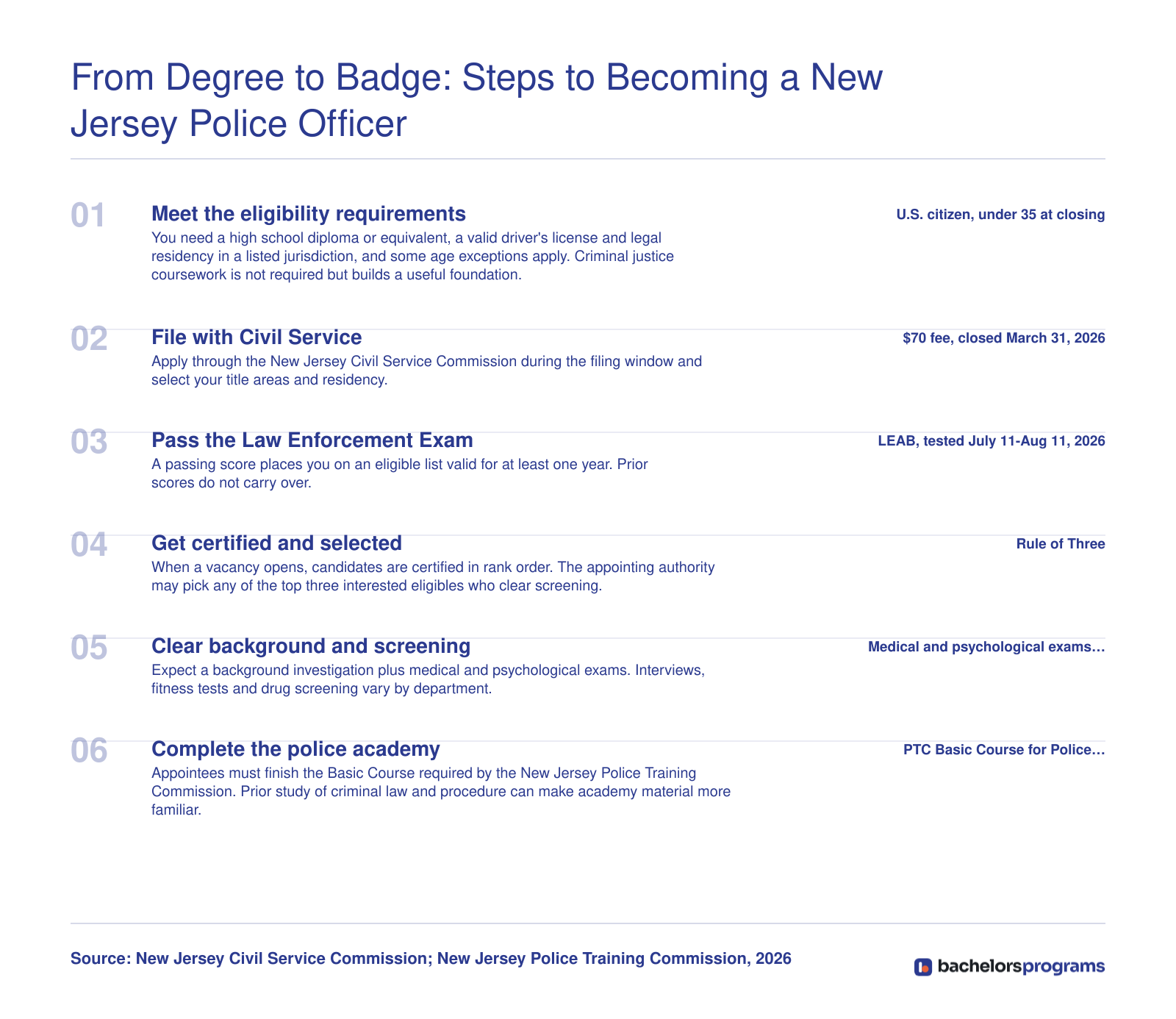
From Degree to Badge: Steps to Becoming a New Jersey Police Officer
In Civil Service jurisdictions, New Jersey hires municipal police officers through a fixed sequence, and the order matters. A bachelor's degree in criminal justice is not required to apply, but it can prepare you for several stages.
What Criminal Justice Professionals Earn in New Jersey
What does a criminal justice career actually pay in New Jersey? New Jersey's occupational wage data answers that directly, and the range is wider than many students expect.
The figures below come from the 2025 Occupational Employment and Wage Estimates, based on the May 2025 Occupational Employment and Wage Statistics survey and published by the New Jersey Department of Labor and Workforce Development, the most recent data year available in 2026.1
Median Wages and Employment by Role
- Police and sheriff's patrol officers: $92,613 median annual wage, 21,780 jobs statewide.1
- Detectives and criminal investigators: $116,303 median annual wage, 3,080 jobs.1
- Correctional officers and jailers: $94,773 median annual wage, 7,570 jobs.1
- Probation officers and correctional treatment specialists: $80,280 median annual wage, 2,890 jobs.1
Reading the Numbers
Detectives and criminal investigators earn the most of the four groups, and often they are promoted from patrol ranks rather than hired directly, which is why the entry path usually runs through a police officer role first. Patrol officer pay in New Jersey is strong relative to national figures, and corrections pay sits close behind it. Probation and correctional treatment work carries the lowest median of the group, though caseload and court-adjacent roles can vary.
One caution: these are occupational wages for everyone working in the job, including officers with decades of service and advanced training. They are not the earnings of recent bachelor's degree graduates, and no one should read a starting salary into them. Expect entry-level pay well below the median, rising with seniority, specialty assignments and promotion through the ranks.
Patrol officers are the largest of these four groups, which matters when you weigh where the jobs are.
Compare Criminal Justice programs on the data that matters
Explore more Criminal Justice & Law majors or browse every field of study.
All Criminal Justice & Law programs Browse every field of study