Best Information Technology Schools in New Jersey
Compare 14 accredited Information Technology programs in New Jersey, with net price after aid, graduation rates, earnings and debt from IPEDS and the U.S. College Scorecard.
Rutgers University's information technology and informatics major runs 120 credits, a common length for IT bachelor's programs in New Jersey. Price is where they diverge: public in-state tuition sits far below private sticker rates, and median earnings a year after graduation vary by program.
The credential itself is standard, a Bachelor of Science (B.S.) in Information Technology, delivered on campus, online, or hybrid at New Jersey-based schools. What separates programs is admission requirements, transfer credit policy, and how much certified, resume-ready training sits inside the coursework.
New Jersey employers screen on skills first. The degree moves an application past the filter; the debt behind it decides how fast the job pays off.
Key Points
- Rutgers ranks first with a 120-credit information technology and informatics major.
- Kean, Montclair State, NJIT and Ramapo undercut private tuition for in-state students.
- NJIT's co-op courses, IT 311 and IT 411, open after sophomore year.
Best Information Technology Schools in New Jersey: Our Top 10
Rutgers University takes the top spot for its information technology and informatics major, a 120-credit program that pairs technical coursework with humanities and social science theory at one of the state's largest research universities. Schools offering this program have institution-wide graduation rates of 47% to 84%, and all ten entries below are bachelor's degrees a New Jersey student can enroll in now. Each card covers format, tuition and average net price after aid so the comparison stays apples to apples.
Rutgers University
#1New Brunswick, NJ · $24,000/yr (est. net price)
Best for: Students seeking IT within a large research university
Rutgers is New Jersey's flagship public research university, and its IT and informatics major sits in the School of Communication and Information rather than a computing college, so students pair technical coursework with humanities and social science theory. The degree takes 120 credits, admits students by application to the school after prerequisite courses, and lets students swap a formal concentration for a senior thesis capstone, a certification practicum, an internship or independent study. Instruction is on campus in New Brunswick. In-state tuition and fees run about $17,929, and the average net price after aid is about $24,406.
- 120 total credits, with about 15 credits per semester advised
- Major declaration requires an application to the School of Communication and Information
- Two prerequisite courses with a C or better and a 2.0 cumulative GPA
- Optional senior thesis capstone project
- Certification practicum in IT available
- Internship and independent study options
- Coursework on evaluating, implementing and managing information technologies
- School cites careers such as IT manager and web analyst
Ramapo College of New Jersey
#2Mahwah, NJ · $15,000 – $20,000/yr (est.)
Best for: Community college transfer students
Ramapo College of New Jersey is a public liberal arts college in Mahwah, and its Bachelor of Science in Information Technology Management is taught inside the Anisfield School of Business, so students complete a business core alongside the IT major. The major combines required courses with three electives and a Career Pathways component, and the catalog publishes a sample four-year graduation plan. Instruction is on campus. In-state tuition and fees run about $16,777, and the average net price after aid is about $18,173, among the lower figures on this list.
- Bachelor of Science taught in the Anisfield School of Business
- Three major electives plus a Career Pathways component
- Business core includes an international category and an ethics category course
- One Quantitative Reasoning course required
- Sample four-year graduation plan published in the catalog
New Jersey Institute of Technology
#3Newark, NJ · $20,000 – $38,000/yr (est.)
Best for: Students wanting multiple IT concentration tracks
NJIT is a public research university in Newark devoted to technology, and its 120-credit Bachelor of Science in Information Technology comes from the Ying Wu College of Computing's informatics department. The degree pairs a 36-credit IT core with eight major electives, seven advisor-approved general electives and a 3-credit capstone that students are encouraged to build with the university's industry partners. Six 24-credit concentrations are offered, including Criminal Justice and Law, Management Information Systems, Game Development, Immersive Media Systems, Cybersecurity, and Web Applications. Instruction is on campus; in-state tuition and fees run about $19,974 and the average net price after aid is about $16,504.
- 120 credits built on a 36-credit information technology core
- Six 24-credit concentrations, from cybersecurity to game development
- 3-credit capstone often developed with NJIT industry partners
- Co-op Work Experience I and II count as IT major electives
- One independent study can count toward the major
- Up to two special topics courses may be applied
Fairleigh Dickinson University
#4Madison, NJ · ~$23,000/yr (est.)
Fairleigh Dickinson University is a private university with campuses in Madison and Teaneck, and its Bachelor of Science in Information Technology is accredited by the Computing Accreditation Commission of ABET. Three concentration areas are offered, including Web Development Technology, Network and System Administration, and Security and Forensics, and a concentration or minor requires at least 15 credits. Students follow an eight-semester plan that includes a required capstone, and cooperative education can earn up to six credits. Tuition is about $38,004 a year regardless of residency, and the average net price after aid is about $22,829.
- ABET accredited by the Computing Accreditation Commission
- Three concentrations, including Web Development Technology
- A concentration or minor requires at least 15 credits
- Eight-semester plan with a required capstone project
- Cooperative education can earn up to six credits
- Campus labs hold more than 250 internet-connected machines
- Practice labs support CompTIA certification preparation
Montclair State University
#5Montclair, NJ · ~$16,000/yr (est.)
Montclair State University is a public university in Montclair whose Bachelor of Science in Information Technology is delivered on campus through the School of Computing in the College of Science and Mathematics. Coursework covers computing systems, networks, cybersecurity, databases, and web and mobile development, with an emphasis on labs, software development and emerging technologies, and the program holds ABET computing accreditation. Accelerated 4+1 pathways pair the bachelor's with a master's in cybersecurity or data science in five years, using graduate swing courses in the senior year. In-state tuition and fees run about $15,912, and the average net price after aid is about $15,566.
- ABET-accredited BS delivered through the School of Computing
- Coursework in networks, cybersecurity, databases, web and mobile development
- Lab and software development emphasis
- 4+1 pathway to an MS in Cybersecurity in five years
- 4+1 pathway to an MS in Data Science in five years
- Graduate swing courses taken in the senior year
- Up to 12 credits of graduate work in analytics and machine learning
Kean University
#6Union, NJ · $14,000 – $22,000/yr (est.)
Kean University in Union awards a Bachelor of Science in Information Technology through its Department of Computer Science and Technology, with a general track or a cybersecurity option. Coursework spans networking, cybersecurity, health IT, computer forensics, game design and web client programming, and the program is accredited by the Computing Accreditation Commission of ABET. The university hosts a 24-hour HackKean event and offers study abroad at its China campus. In-state tuition and fees run about $14,299 and the average net price after aid is about $12,447, the lowest net price among the ten schools here.
- General track or cybersecurity option
- ABET accredited by the Computing Accreditation Commission
- Coursework in network design, computer security and cyber defense
- Health IT and health informatics courses available
- Hosts a 24-hour HackKean event
- Study abroad available at the university's China campus
- Employers cited include IBM, the NSA and Verizon
Rider University
#7Lawrenceville, NJ · ~$25,000/yr (est.)
Rider University in Lawrenceville offers a 120-credit, STEM-designated Bachelor of Science in Business Administration in Information Technology Management that blends computer technology courses with a business core in an AACSB-accredited school. Coursework covers network administration, system analysis, application development, security auditing and database management, and includes HTML and Python. Students can take paid internships or co-ops in the summer of junior or senior year, with recent placements at Bloomberg, Dow Jones, the FDA and Fidelity Investments. Tuition is about $41,120 regardless of residency, and the average net price after aid is about $24,792.
- 120-credit STEM-designated degree
- AACSB-accredited business school
- Combines IT coursework with a business core
- Covers network administration, security auditing and database management
- Paid internships or co-ops in the junior or senior summer
- Recent placements include Bloomberg, Dow Jones and the FDA
- Includes HTML and Python alongside e-commerce and game design topics
Thomas Edison State University
#8Trenton, NJ · $5,000 – $10,000/yr (est.)
Thomas Edison State University in Trenton runs its Bachelor of Science in Information Technology entirely online and designs it for people already working in the field. The 120-credit degree requires at least 18 area-of-study credits at the upper level, and professional IT certifications, credit by exam and prior learning assessment can satisfy some or all of the elective requirements, so transfer students often finish faster than a traditional four-year plan suggests. New Jersey residents pay about $6,838 in tuition and fees and out-of-state students about $8,856, the lowest published tuition on this list. Coursework includes network technology, Windows servers, Linux and cloud computing.
- 120 credits, delivered fully online
- At least 18 upper-level area-of-study credits required
- IT certifications can satisfy some or all elective requirements
- Credit accepted from testing, prior learning assessment and transfer work
- Required courses include Statistics and College Algebra
- Courses in cloud computing, Linux and Windows servers
- Built for working IT professionals
Seton Hall University
#9South Orange, NJ · $31,000/yr (est. net price)
Seton Hall University in South Orange delivers its Bachelor of Science in Business Administration in Information Technology Management through the Stillman School of Business, pairing technology courses with management, marketing, communications and finance. IT-side coursework covers business information modeling, data analytics, advanced business software tools and IT project management, and the curriculum spans database design and the analytics modern organizations rely on. The university reports that 95% of graduates are employed in career-related work and that 76% of students complete at least one internship. Tuition is about $53,170 regardless of residency, and the average net price after aid is about $31,446, the highest on this list.
- BSBA awarded through the Stillman School of Business
- Coursework in business information modeling and data analytics
- IT project management and advanced business software tools
- Electives in information systems technology
- 76% of students complete at least one internship
- School reports 95% career-related employment
- Careers cited include business analyst, consultant and network administrator
Fairleigh Dickinson University-Metropolitan Campus
#10Teaneck, NJ · $15,000/yr (est. net price)
The Metropolitan Campus in Teaneck is the second Fairleigh Dickinson location offering the Bachelor of Science in Information Technology, and this one holds ABET computing accreditation plus a National Center of Academic Excellence in Cyber Defense designation through the 2026 academic year. Students choose from the same three concentrations, including Security and Forensics, and Security and Forensics students can apply for the Department of Defense Cyber Scholarship Program. Campus labs include Netlab+ servers for CompTIA practice and Cisco Academy networking equipment. Tuition is about $38,004 regardless of residency, and the average net price after aid is about $15,404.
- ABET computing accreditation at the Metropolitan Campus
- NSA/DHS CAE-CDE cyber defense designation through 2026
- Concentrations include Security and Forensics
- DoD Cyber Scholarship Program open to Security and Forensics students
- Netlab+ servers for CompTIA certification practice
- Cisco Academy networking equipment on campus
- One full-year laboratory science sequence of eight credits required
Cost & outcomes by school
Federal data for the highest-earning Information Technology programs, independent of the ranking above. Earnings are this field's bachelor's graduates four years after completing where the Scorecard reports them, else the school's undergraduate median.
| School | Net price / yr | Grad rate | Earnings | Debt | Grads/yr | Format |
|---|---|---|---|---|---|---|
| Rutgers University NJ | $24,406 | 84% | $125,303 | $20,904 | 924 | Campus |
| Ramapo College of New Jersey NJ | $18,173 | 70% | $115,174 | $21,500 | 42 | Campus |
| New Jersey Institute of Technology NJ | $16,504 | 73% | $97,926 | $19,500 | 536 | Campus |
| Kean University NJ | $12,447 | 47% | $91,546 | $23,651 | 78 | Campus |
| Strayer University-New Jersey NJ | — | — | $82,304 | $37,500 | 5 | Online |
| Montclair State University NJ | $15,566 | 65% | $79,692 | $21,500 | 171 | Campus |
| Fairleigh Dickinson University NJ | $22,829 | 67% | $76,778 | $25,000 | 27 | Campus |
| Fairleigh Dickinson University-Metropolitan Campus NJ | $15,404 | 53% | $76,778 | $25,000 | 6 | Campus |
| William Paterson University of New Jersey NJ | $18,745 | 44% | $76,282 | $25,500 | 92 | Online or campus |
| Rider University NJ | $24,792 | 61% | $72,734 | $23,942 | 13 | Campus |
| Seton Hall University NJ | $31,446 | 70% | $70,196 | $22,750 | 65 | Campus |
| Thomas Edison State University NJ | — | — | $69,331 | $12,500 | — | Online |
Sources: U.S. Department of Education. Net price, graduation rate, earnings and debt: College Scorecard (earnings and debt for this field's bachelor's graduates where reported, else school-wide); graduates: IPEDS. A dash means no figure is reported.
Cost, debt & payoff
Median earnings of this field's bachelor's graduates (4 yrs after completing, else the school's undergraduate median) vs. their median federal loan debt · U.S. College Scorecard
Across these programs the median graduate earns about $76,778 and finishes with roughly $23,797 in debt — a ratio that clears a common rule of thumb (keep debt below first-year salary). Net price and debt vary widely school to school, so check the per-school figures in the table above before you shortlist.
How We Ranked New Jersey Bachelor's in Information Technology Programs
What actually separates one New Jersey IT program from another: the school's name, or what its graduates earn and owe?
What the Numbers Behind the List Show
Reputation rankings and Niche-style review pages lean heavily on campus amenities, overall prestige, and a single graduation rate for the whole institution. They rarely tell you what an IT major specifically earns after graduating, or how much student debt that major carries. This ranking weighs program-level earnings and debt against cost, then adds graduation rate and net price as context. Both of those are institution-wide averages, so read them as approximate: a school with a strong engineering and computing core may post averages that do not describe its IT cohort at all.
IT Is Not Computer Science
Before comparing schools, know which degree you are actually shopping for.
- Information technology: applied infrastructure and systems. You run, secure, and support the networks, servers, and devices an organization depends on.
- Computer science: theory and software engineering, with algorithms and programming treated as the foundation.
- Information systems: business-focused systems work that bridges technical operations with management. Rider University's B.S.B.A. in IT management sits closest to this model.
- Cybersecurity: usually a specialization inside an IT degree rather than a separate major.
Check the Concentration
Two IT degrees with the same name can prepare you for different jobs. Ask whether the program offers tracks in cybersecurity, networking, cloud, or data, since the concentration shapes which internships and entry-level roles are open to you. Saint Elizabeth University, for example, pairs IT with machine learning and AI, which points toward a different first job than a networking-heavy curriculum would.
Most Affordable Bachelor's Programs in Information Technology in New Jersey
Cost differences among New Jersey IT programs come down mostly to sector and financial aid. Public universities such as Kean, Montclair State, NJIT and Ramapo charge in-state tuition well below private rates. Fairleigh Dickinson University-Metropolitan Campus, a private school, posts the highest sticker price here, yet aid brings its average net price close to the public schools. Figures below are approximate annual averages from U.S. Department of Education IPEDS and College Scorecard data (2024), and median debt reflects graduates of each school's IT bachelor's program.
| School | City | Sector | In-State Tuition and Fees (approx. annual avg.) | Net Price After Aid (approx. annual avg.) | Median Debt, IT Bachelor's Graduates |
|---|---|---|---|---|---|
| Kean University | Union | Public | $14,299 | $12,447 | $23,651 |
| Fairleigh Dickinson University-Metropolitan Campus | Teaneck | Private nonprofit | $38,004 | $15,404 | $25,000 |
| Montclair State University | Montclair | Public | $15,912 | $15,566 | $21,500 |
| New Jersey Institute of Technology | Newark | Public | $19,974 | $16,504 | $19,500 |
| Ramapo College of New Jersey | Mahwah | Public | $16,777 | $18,173 | $21,500 |
Online and Hybrid Bachelor's in Information Technology Options at New Jersey Schools
An online or hybrid IT bachelor's lets you complete some or all of the degree without weekly trips to a New Jersey campus. Coursework, labs and exams run through a learning management system, and any required in-person sessions are scheduled in blocks.
Which New Jersey IT programs are online?
- William Paterson University: a 100% online, asynchronous B.S. in Information Technology with seven-week classes and multiple start dates. Accelerated students can finish in as few as 36 months.
- Thomas Edison State University: a B.S. in Information Technology with a fully online option built for working IT professionals, including 18 upper-level credits in the area of study.
- Campus delivery: Rutgers, Ramapo, NJIT, Fairleigh Dickinson on both the Madison and Teaneck campuses, Montclair State, Kean, Rider and Seton Hall list their IT programs as campus-based.
Credits, accreditation and pacing
Plan on about 120 credits and roughly four years of full-time study; transfer credit and prior-learning assessment shorten that. William Paterson requires 120 credits, 59 of them in the major, with at least 30 completed at the university. NJIT's overview lists 129 required credits while its catalog sets a 120-credit minimum. Fairleigh Dickinson's Teaneck program maps 90 semester credits across six semesters plus at least 15 for a concentration, without stating a full degree total.1 ABET's Computing Accreditation Commission accredits that Teaneck B.S. in IT.1 William Paterson and NJIT do not publish a separately named part-time track.
Who each format suits
Working adults juggling a job should look first at the asynchronous, seven-week structure at William Paterson or the online route at Thomas Edison, where certifications and prior learning can count toward the degree. Transfer students benefit most from generous credit evaluation and residency rules. Students who want hands-on labs, networking equipment and campus recruiting should choose a campus program; Fairleigh Dickinson's Teaneck site, for instance, maintains more than 250 lab computers.
Admission Requirements for New Jersey Bachelor's Programs in Information Technology
New Jersey IT programs apply different admission rules to first-year applicants and to transfer students. One group is judged on high school preparation; the other on completed college coursework and course-by-course equivalency. The distinction matters most for students arriving with an associate degree.
First-Year Standards and Test Policy
NJIT is test-optional for Fall 2026, Spring 2027 and Fall 2027, except for applicants to its honors college and accelerated programs. Its published transfer standard requires a 2.0 cumulative GPA. Rutgers publishes general undergraduate admission standards for Information Technology and Informatics, and the major itself requires prerequisite coursework plus a separate application to declare. Rutgers does not publish a separate IT-specific admission policy on the program page. Where a school publishes general first-year requirements rather than IT-only rules, confirm the current GPA and test policy on each admissions page.
Transfer Credit Rules
NJIT asks transfer applicants for at least 15 semester hours, including English composition and pre-calculus; remedial courses may not satisfy those prerequisites. Applicants with fewer than 30 semester hours also submit a high school transcript. NJIT sets no maximum transfer credits but requires at least 33 upper-division major credits in residence. Credit is granted only for completed courses equivalent to NJIT coursework with a C or better, evaluated course by course.
Kean University's published articulation agreement for its B.S. in Information Technology caps transferred and awarded credit at 50% of baccalaureate requirements, depending on course equivalency. Kean lists articulation partnerships with several New Jersey community colleges, though not every agreement is confirmed for the IT pathway. Thomas Edison State University accepts transfer credit from accredited institutions and awards credit by testing and prior learning for its online B.S. in Information Technology.
Associate-to-Bachelor's Pathways
New Jersey's statewide transfer framework sets broad expectations, but each college applies its own review. Ramapo College publishes a 2+2 pathway with a New Jersey community college for associate-degree completers who earn at least a 2.5 GPA and continue in the same or a closely related field.
Before you apply, ask admissions how many IT credits will transfer. Get the answer in writing, course by course.
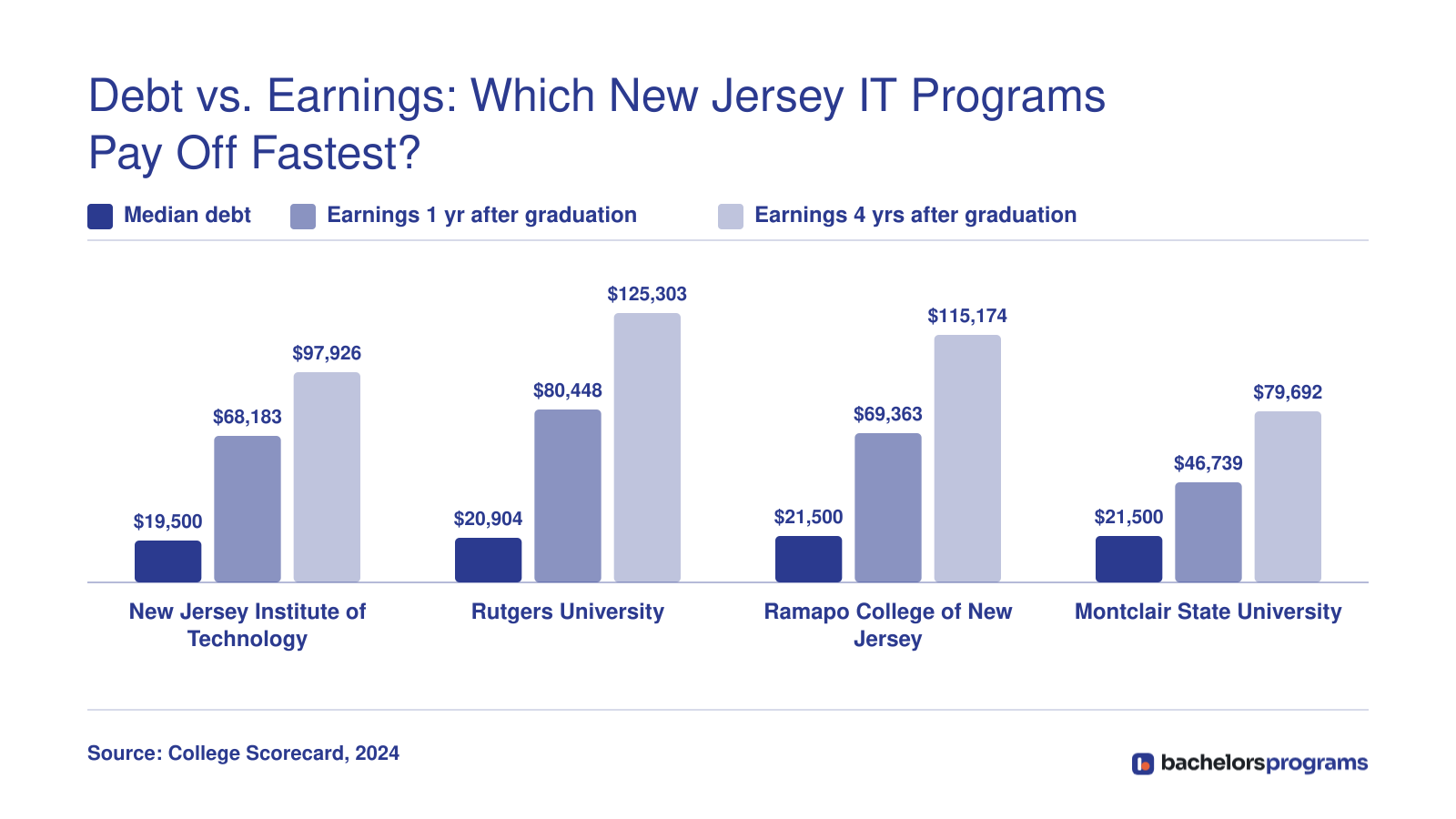
Debt vs. Earnings: Which New Jersey IT Programs Pay Off Fastest?
This chart compares the median federal loan debt of information technology bachelor's graduates with their median earnings one year and four years after graduation, at the program level rather than across the whole school. Rutgers University has the strongest ratio: graduates earn a median of $80,448 one year out against $20,904 in debt, nearly four times what they borrowed. NJIT and Ramapo follow closely, and Montclair State's earnings climb sharply by year four.
Cost of a Bachelor's Degree in Information Technology in New Jersey
What does an IT bachelor's in New Jersey actually cost after aid? The sticker price splits sharply by sector, and the average net price narrows the gap.
Public vs. Private Prices
Among the public schools here, in-state tuition and fees run from $14,299 at Kean University to $19,974 at New Jersey Institute of Technology. Average net price after aid runs from $12,447 at Kean to $24,406 at Rutgers University. Montclair State University ($15,566) and Ramapo College of New Jersey ($18,173) fall in between.
Fairleigh Dickinson University and Rider University list tuition of $38,004 and $41,120. Their average net prices are far lower: $22,829 at the Madison campus and $24,792 at Rider. The Metropolitan Campus is the outlier at $15,404, which puts it near the public schools. These net figures are school-wide averages, not IT-specific.
State Aid Worth Knowing
- TAG: Need-based for NJ residents pursuing a first bachelor's.2 2026-27 awards range from $1,280 to $14,404 depending on need and tuition, for up to nine payments.1
- NJ STARS: For students in the top 15.0% of their high-school class.3 It covers county college tuition for up to five semesters and 18 credits per term.
- NJ STARS II: The four-year transfer route. For Fall 2026 it requires a 3.25 GPA, family income under $250,000, and 12 or more credits, with awards up to $1,250 per semester.4
- Garden State Guarantee: For residents at in-state public four-year schools with income of $0 to $65,000.6 It brings net tuition and fees to $0 in the third and fourth years, for up to four semesters or 128 credits, at 12 or more credits per term.5
The Governor's Urban Scholarship also exists, though its $250,000 appropriation for 2026 is a program total, not a per-student award.7
Time and Debt
A full-time bachelor's takes four years, and 120 credits is typical (NJIT and Rider both list 120). Transfer credit from a county college can shorten that, and some schools offer accelerated paths.
Program-level median debt among graduates runs from $19,500 at NJIT to $25,000 at Fairleigh Dickinson, with Rutgers at $20,904 and Kean at $23,651. That is a manageable load compared with first-year earnings at most of these programs.
Related Articles
Information Technology Careers and Salaries in New Jersey
New Jersey employers hire for IT roles under a handful of standard occupation titles, and the state publishes wage and outlook data for each one. About fifteen minutes of careful reading gives you a far better picture than a single statewide average. The most recent New Jersey-specific wages and ten-year projections for these roles were not available when this section was prepared. Confirm them at the sources below rather than trusting a remembered number.
Start With Federal Wage Data for New Jersey
Open BLS.gov and go to the Occupational Employment and Wage Statistics pages for New Jersey. Search each title in turn: "network and computer systems administrators," "computer user support specialists," and "information security analysts." Record the median annual wage and the employment estimate for each. Treat them as estimates: New Jersey's latest wage survey draws on six survey panels collected over three years3, so the published number is an average across that window rather than a single-year snapshot. National medians sit alongside the state tables, so keep the two separate. A national figure says little about pay in Newark or Trenton.
Confirm Ten-Year Growth With the State
The New Jersey Department of Labor and Workforce Development publishes occupational projections covering roughly a decade. Match the occupation title and the region carefully before you quote anything. Broad groupings such as "computer occupations" blend roles with very different outlooks, and a statewide growth rate can hide sharp differences between north and south Jersey.
Cross-Check With Schools and Associations
- Program and career pages: the career services or program outcomes pages at schools such as NJIT, Montclair State and Kean often name the employers and job titles recent graduates report.
- Professional associations: CompTIA and ISC2 publish salary surveys and certification outlooks, while New Jersey technology and IT associations add regional hiring context and networking contacts.
- Ask direct questions: when you speak with an advisor, ask which job titles alumni hold in their first role and whether local employers recruit on campus.
Certifications and Internships Built Into New Jersey IT Programs
Among the schools here, NJIT documents the clearest path from classroom to paid work. Its B.S. in Information Technology lists co-op courses (IT 311 and IT 411, three credits each) that students can take after finishing sophomore year, with approval from the program coordinator and the Office of Cooperative Education and Internship. NJIT describes co-op as paid, tied to the major, and open for one or more assignments that need not be consecutive. Students need good academic standing and a GPA of at least 2.2.
NJIT separates co-ops from internships. Internships run during a semester or summer, may be paid or unpaid, may or may not carry credit, and usually involve no faculty oversight.
Program pages for NJIT, William Paterson, Kean and Rutgers do not name a specific CompTIA, Cisco, AWS or Microsoft certification built into the curriculum. The same is true of named co-op programs at William Paterson, Kean and Rutgers. Do not assume either exists.
What to Ask Each Program
- Which industry certifications does the coursework prepare me for, and are exam costs covered?
- Are internships or co-ops for credit, and who supervises them?
- Which employers hired recent IT graduates?
- How does career services support job searches after graduation?
Questions to Ask Yourself
Do you need an online or part-time schedule, or can you attend on campus?
Are you transferring from a New Jersey community college with credits to protect?
Do you want broad IT or a cybersecurity or networking concentration?
Is a lower net price or stronger program-level earnings your priority?
Compare Information Technology programs on the data that matters
Explore more Computers & IT majors or browse every field of study.
All Computers & IT programs Browse every field of study