Best Cinematography Degree Programs
Compare 30+ accredited Cinematography programs, with net price after aid, graduation rates, earnings and debt from IPEDS and the U.S. College Scorecard.
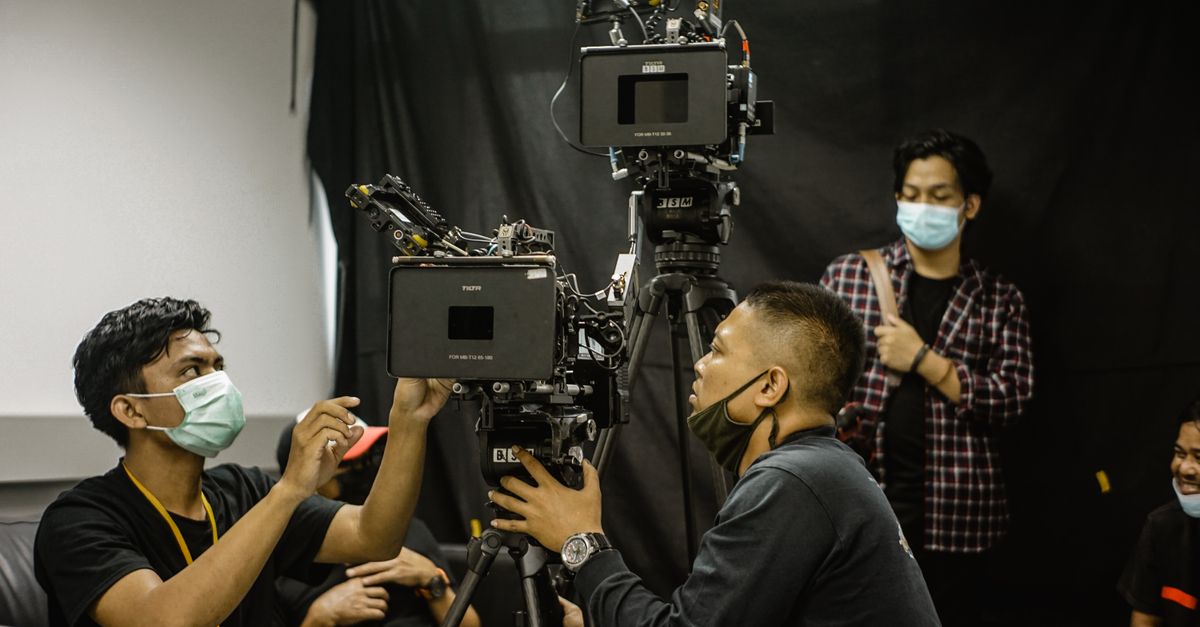
A bachelor's degree in cinematography trains students to light, frame and shoot for film and television, most often through a Bachelor of Arts (B.A.) in Cinematography or a closely related production major. Annual tuition at the schools here runs from $6,507 in-state at Utah Valley University to $72,097 at USC. The payoff therefore depends on cost, hours on professional cameras and graduate outcomes, not on prestige.
Only bachelor's programs are ranked; graduate study is excluded. It draws on net price, graduation rates, and program-level earnings and debt.
Camera work is a freelance-heavy trade. Early pay is modest, and a strong reel usually wins the next job more reliably than the diploma does.
Key Points
- Utah Valley University's Digital Cinema Production B.S. leads first-year earnings at $41,833.
- USC admits about 10 percent of applicants; Arizona State, roughly 90.
- The B.A. is most common; the BFA adds heavier production work.
Best Cinematography Schools Ranked: Top 10 Bachelor's Programs
What separates the strongest cinematography programs is access: dedicated camera and lighting coursework, soundstages and equipment students can actually book, and faculty who have worked on real productions. The schools below also keep their credit requirements structured enough that students finish in four years, and several report the highest early earnings in the field. Each entry notes the school's graduation rate and admission rate, plus median earnings for program graduates one year after finishing where that figure is reported.
University of Southern California
#1Los Angeles, CA · ~$33,000/yr (est.)
Best for: Los Angeles industry-networking hopefuls
USC's School of Cinematic Arts gives undergraduates a large, competitive production cohort in the middle of Los Angeles, with BA and BFA routes into Cinematic Arts, Film and Television Production. Admission is highly selective at roughly 10 percent, and the school's graduation rate is about 92 percent. Program graduates report median earnings of $34,187 one year after finishing and $58,623 four years out, a fit for students who want scale and industry proximity over a small cohort.
- BA and BFA options in Cinematic Arts, Film and Television Production
- CIP 50.0602: Cinematography and Film/Video Production
- Production courses span all aspects of filmmaking
- BFA adds electives from Animation and Interactive Media
- Kevin Feige endowed the Production Division
- Classes meet at University Park in Los Angeles
University of North Carolina School of the Arts
#2Winston Salem, NC · $9,000 – $27,000/yr (est.)
Best for: Students seeking a small conservatory cohort
UNCSA is a public conservatory in Winston-Salem where undergraduates spend 84 of their 120 credits on filmmaking rather than a broad liberal arts load, so it rewards students who want to be on set from the first year. Roughly 30 percent of applicants are admitted and the school's graduation rate is about 78 percent. Median earnings for program graduates are $24,053 one year after finishing and $41,000 four years out.
- 120-credit BFA with 84 credits of filmmaking coursework
- 30 credits of general education, 6 in liberal arts or arts
- Year Two workshops in first and second choice concentrations
- Concentrations: cinematography, directing, editing, producing, screenwriting
- Intermediate and advanced cinematography practica
- At least 10 credits of film or arts electives
Arizona State University
#3Tempe, AZ · ~$15,000/yr (est.)
Best for: Working students needing part-time pacing
Arizona State's Herberger Institute pairs a large research-university setting with the MIX Center, a 118,000-square-foot production complex in Tempe with soundstages, a color-grading room and sound-mixing studios. The school admits about 90 percent of applicants and its graduation rate is about 68 percent, and full-time and part-time enrollment make it workable for students who need to keep a job. Graduates report median earnings of $31,148 one year after finishing and $49,759 four years out.
- 120-credit BFA at the Tempe campus
- Trains students to capture images for film, TV and emerging media
- 118,000-square-foot MIX Center with soundstages and color-grading room
- Changing majors need a 2.25 GPA, then 2.50 within one semester
- Full-time and part-time enrollment options
- Not eligible for STEM-OPT extension
George Mason University
#4Fairfax, VA · $15,000 – $20,000/yr (est.)
George Mason runs its film program inside a broad public university in Fairfax, Virginia, and treats cinematography as one of six pathways in the Film and Video Studies BA rather than a standalone major. The school admits about 87 percent of applicants and its graduation rate is roughly 68 percent. Program graduates report median earnings of $23,989 one year after finishing and $50,086 four years out, which makes the pathway a reasonable fit for students who want a film concentration inside a wider liberal arts degree.
- Cinematography is one of six pathways in the Film and Video Studies BA
- Covers framing, camera movement, angles, lighting, color and composition
- Electives include Advanced Cinematography and Darkroom Photography
- Students work with directors, producers, actors and design crews
- Pathway led by Professor Hans Charles
DePaul University
#5Chicago, IL · ~$31,000/yr (est.)
DePaul is a private university in Chicago whose School of Cinematic Arts runs a production facility at Cinespace, next door to shows including Chicago Fire and The Bear. About 76 percent of applicants are admitted and the school's graduation rate is about 68 percent. Median earnings for program graduates are $26,164 one year after finishing and $46,969 four years out, and the ten-week LA Quarter suits students who want an industry term before graduating.
- BFA in Film and Television with a Cinematography concentration
- Specializes in camera and lighting for film, TV and the web
- Nearly 60,000-square-foot production facility at Cinespace
- Six soundstages, a green screen and editing suites
- Ten-week LA Quarter with classes on a historic studio lot
- Annual Premiere Film Festival showcases student work
Temple University
#6Philadelphia, PA · $23,000 – $39,000/yr (est.)
Temple is a large public research university in North Philadelphia whose film and media arts program sits in the School of Theater, Film and Media Arts and puts professional cameras in student hands. The school admits about 80 percent of applicants and its graduation rate is about 75 percent. Median earnings are $24,345 one year after finishing and $42,526 four years out.
- 121-credit BA in Film and Media Arts
- Four concentrations, including Cinematography
- Covers cinematic and theatrical lighting
- Also covers moving camera, videography and documentary making
- Students shoot with professional cameras
- Faculty hold Oscar, Emmy and Guggenheim honors
- Film program moves to Klein College on July 1, 2027
Chapman University
#7Orange, CA · $47,000/yr (est. net price)
Chapman is a private university in Orange, California, whose Dodge College runs three soundstages, a virtual studio with an LED wall, and up to $15,000 in thesis funding while students keep ownership of their films. About 65 percent of applicants are admitted and the school's graduation rate is about 82 percent. Program graduates post the highest four-year median on this list at $66,494, up from $35,795 one year after finishing.
- BFA in Film and Television Production with a cinematography track
- First two years cover general education and all aspects of filmmaking
- Final two years specialize in one of five tracks
- Up to $15,000 in thesis funding; students keep film ownership
- Three soundstages and a virtual studio with an LED wall
- Creative Supplement required with the Common Application
Southern Methodist University
#8Dallas, TX · ~$41,000/yr (est.)
SMU is a private university in Dallas whose Meadows School of the Arts houses film and media arts inside a broad liberal arts framework, with active Production and Screenwriting subplans. About 63 percent of applicants are admitted and the school's graduation rate is about 84 percent, among the highest on this list. It suits students who want a film degree from a smaller private university with a generalist rather than track-heavy structure.
- Minimum 120 credit hours for the BFA
- Film and Media Arts Division, Meadows School of the Arts
- Active subplans in Production and Screenwriting
- CIP 50.0602: Cinematography and Film/Video Production
Syracuse University
#9Syracuse, NY · $35,000 – $40,000/yr (est.)
Syracuse's Newhouse School is a widely known communications school, and its Television, Radio and Film BS lets students pick cinematography as one of seven tracks. About 46 percent of applicants are admitted and the school's graduation rate is about 84 percent. Graduates report median earnings of $26,331 one year after finishing and $54,115 four years out, and the semester in Los Angeles with an internship suits students aiming at entertainment media rather than pure cinema.
- BS in Television, Radio and Film at the Newhouse School
- Seven tracks, including cinematography and production
- Semester in Los Angeles with an industry internship
- Television and multimedia studios plus Orange Television Network
- Citrus TV, a 350+ member student-run studio, airs shows 24/7
- Coursework spans film, documentary, sports, gaming and podcasting
Utah Valley University
#10Orem, UT · $5,000 – $10,000/yr (est.)
Utah Valley University is a public institution in Orem with a Digital Cinema Production BS built on a 33-credit discipline core and six career tracks, one of them cinematography. The school's graduation rate is about 45 percent. Program graduates report median earnings of $41,833 one year after finishing, the highest first-year figure among these ten schools, which makes it worth a look for students who want a technically focused degree close to home.
- 120-credit BS in Digital Cinema Production
- 33-credit discipline core includes cinematography and production sound
- Six 57-credit tracks, including cinematography
- Cinematography track adds Cinematography III and aerial capture
- 4-credit internship required in the cinematography track
- 2.5 GPA in core courses plus a portfolio review to graduate
- 40 upper-division and 30 residency credits required
Cost & outcomes by school
Federal data for the highest-earning Cinematography programs, independent of the ranking above. Earnings are this field's bachelor's graduates four years after completing where the Scorecard reports them, else the school's undergraduate median.
| School | Net price / yr | Grad rate | Earnings | Debt | Grads/yr | Format |
|---|---|---|---|---|---|---|
| Southern Methodist University TX | $40,892 | 84% | $78,354 | $19,500 | 21 | Campus |
| Chapman University CA | $46,555 | 82% | $66,494 | $18,500 | 160 | Campus |
| University of Southern California CA | $32,740 | 92% | $58,623 | $19,500 | 195 | Campus |
| Biola University CA | $31,495 | 68% | $56,778 | $23,875 | 69 | Campus |
| Utah Valley University UT | $6,376 | 45% | $55,486 | $14,750 | 47 | Campus |
| Marymount Manhattan College NY | $36,861 | 49% | $55,285 | $26,851 | 39 | Campus |
| Syracuse University NY | $38,793 | 84% | $54,115 | $26,875 | 52 | Campus |
| Nevada State University NV | $14,068 | 34% | $53,166 | $19,691 | 23 | Campus |
| Ohio University OH | $21,637 | 66% | $52,581 | $21,056 | 21 | Campus |
| Vermont State University VT | $18,212 | 47% | $50,331 | $15,000 | — | Campus |
| George Mason University VA | $17,915 | 68% | $50,086 | $23,205 | 50 | Campus |
| Art Center College of Design CA | $48,661 | 79% | $49,933 | $28,750 | 32 | Campus |
Sources: U.S. Department of Education. Net price, graduation rate, earnings and debt: College Scorecard (earnings and debt for this field's bachelor's graduates where reported, else school-wide); graduates: IPEDS. A dash means no figure is reported.
Cost, debt & payoff
Median earnings of this field's bachelor's graduates (4 yrs after completing, else the school's undergraduate median) vs. their median federal loan debt · U.S. College Scorecard
Across these programs the median graduate earns about $46,848 and finishes with roughly $23,938 in debt — a ratio that clears a common rule of thumb (keep debt below first-year salary). Net price and debt vary widely school to school, so check the per-school figures in the table above before you shortlist.
How We Ranked Cinematography Degree Programs
The deciding factor in this ranking is what a cinematography degree costs against what it returns, not reputation, equipment inventories or the size of a school's alumni credits list. Every program on the list is measured the same way, using federal data wherever it exists.
The Five Inputs
- Average net price: what undergraduates actually pay after grant and scholarship aid, rather than the published sticker tuition.
- Graduation rate: the share of first-time, full-time students at the institution who finish their degree.
- Admission rate: how selective the institution is overall, which signals the academic bar applicants must clear.
- Program-level earnings: median pay for people who complete that particular cinematography and film program, measured in the first years after graduation.
- Federal debt at completion: the median amount students in that program borrowed before graduating.
Program-Level Data, Not Just School Averages
Most published film school lists rank institutions on reputation alone. This one leans on College Scorecard figures for the cinematography and film production field, which means a strong film program at a mid-tier university can outrank a famous name with weaker outcomes.
Where the Data Stops
Be clear about the limits. Graduation rate is school-wide, not specific to the film department. Net price averages all undergraduates, so treat it as a reference point, not a quote for one major. Some programs report no earnings at all, so those entries are judged on cost and completion alone.
Bachelor's Degrees Only
Every delivery format is in scope, so campus, online and hybrid programs compete side by side. Graduate programs are out of scope.
Is a Bachelor's Degree in Cinematography Worth It? Cost, Debt and Earnings
Families can now judge a film degree by what its own graduates borrow and earn, rather than by a campus-wide average that blends every major together. For cinematography majors, those program-level numbers show a wide gap between debt and early pay from one school to the next.
Debt Versus First-Year Pay
Median federal debt among cinematography completers ranges from $18,500 at Chapman University to $26,875 at Syracuse University. On a standard 10-year plan, that works out to monthly payments between $196 (Chapman) and $285 (Syracuse).
Median earnings one year after finishing range from $23,989 at George Mason University to $41,833 at Utah Valley University. Chapman ($35,795), USC ($34,187) and Arizona State ($31,148) sit in the upper tier. DePaul ($26,164), Syracuse ($26,331) and Mount Saint Mary's ($25,835) land closer to the middle of the range.
Treat any school-wide return figure as a rough proxy only. Institution-level earnings and debt describe all graduates, not film majors, so they should never stand in for what a cinematography graduate will owe or earn.
Who Is Working a Year Out
Employment one year after completion is strong across most of the programs below. It runs from about 81% at Mount Saint Mary's to 96% at George Mason and Chapman, and every tracked Utah Valley completer was working. The share earning more than a poverty-level income ranges from about 65% at George Mason to about 86% at SMU, with Arizona State at 83%.
These are early-career snapshots. Cinematographers often start as camera assistants, grips or freelancers, and pay tends to climb over several years. At USC, for example, median earnings for the same program reach $58,623 four years out.
A Simple Borrowing Rule
Keep your total borrowing below what you expect to earn in your first year. Among the schools here, that test holds for:
- Chapman: $18,500 in debt against $35,795 in first-year earnings.
- Arizona State: $19,250 against $31,148.
- USC: $19,500 against $34,187.
- DePaul: $24,000 against $26,164.
- George Mason: $23,205 against $23,989, a narrow margin.
Syracuse and Mount Saint Mary's fall just short, with median debt slightly above first-year pay. Neither result disqualifies those schools, but it argues for chasing scholarships and limiting loans there. These debt figures cover federal loans only; private or parent loans would raise your real total.
What Camera Operators Earn Nationally
Before comparing program-level outcomes, it helps to know what the occupation pays across the country.
Which Cinematography Programs Post the Highest First-Year Earnings?
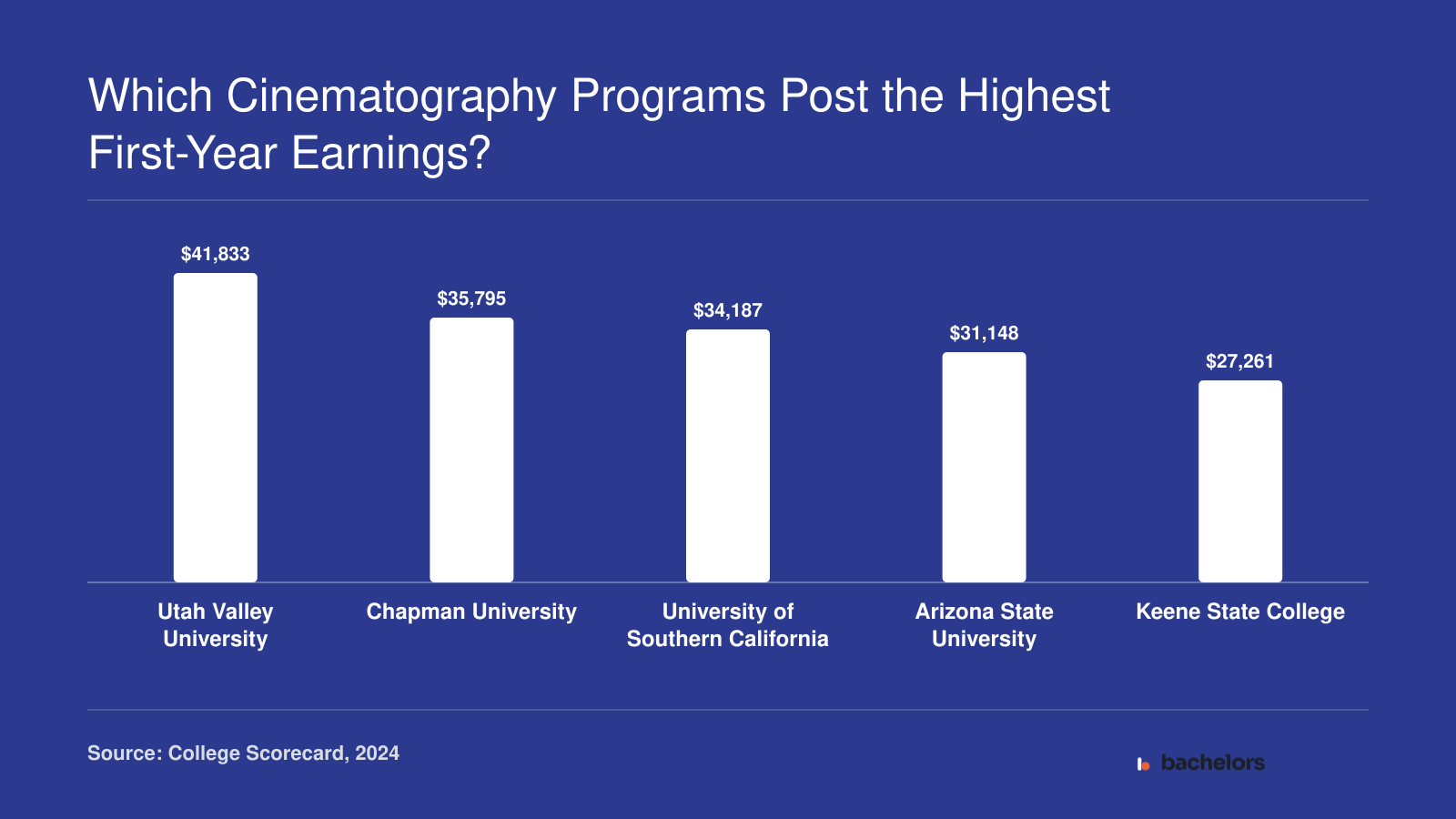
Utah Valley University's Digital Cinema Production B.S. leads at $41,833, ahead of Chapman University, USC, Arizona State University and Keene State College. These are College Scorecard median earnings for graduates of each school's cinematography program one year after finishing, an early-career snapshot rather than lifetime pay. Even the top bar is a starting figure, so compare it with the national camera-operator median in the salary box above to see the gap between new graduates and experienced professionals.
Most Affordable Cinematography Degree Programs by Net Price
These are the lowest-cost cinematography bachelor's programs on this page, ranked by average net price in 2024 U.S. Department of Education data (IPEDS and College Scorecard), with published tuition and fees for context. Net price is a school-wide average of what students pay after grants and scholarships, so your cost can be higher or lower depending on family income and the aid you receive. Tuition is only part of the bill: also budget for camera gear, hard drives and storage, and production costs for student films.
| School | Location | Program | Average Net Price (After Aid) | In-State Tuition and Fees | Out-of-State Tuition and Fees |
|---|---|---|---|---|---|
| Eastern New Mexico University | Portales, NM | Digital Filmmaking | $4,904 | $7,194 | $9,174 |
| Utah Valley University | Orem, UT | Digital Cinema Production, B.S. | $6,376 | $6,507 | $18,489 |
| Western Kentucky University | Bowling Green, KY | Film Production | $10,990 | $11,652 | $27,000 |
Related Articles
Cinematography Degree Portfolio and Admission Requirements
Selectivity varies widely among cinematography programs. USC admits about 10 percent of applicants and UNCSA about 30 percent, while Arizona State admits roughly 90 percent. At the most competitive film schools, your creative materials often carry as much weight as your grades. Expect these core requirements:
- Common Application plus a creative applicationMost top film schools pair the Common App with a separate creative submission. Chapman Dodge College requires a Creative Supplement through its Application Status Page. NYU Tisch uses a SlideRoom Creative Portfolio, and USC requires a separate SlideRoom application for each major.
- Short film or creative portfolioUSC's Film and Television Production BFA asks for a 2-minute film with a critique of 150 words or less and a crew list. UCF's Film BFA requires a portfolio, and Utah Valley reviews portfolios for admission to its Digital Cinema Production degree.
- Written statementsUSC sets a 500-word personal statement, a 400-word writing sample and a 500-word creative-team question. Each Chapman major has its own prompt, and going over the length limits can hurt your application.
- Video introductionUSC requests a 30- to 60-second video introduction. AI is not permitted in any written or media portion.
- Early deadlinesNYU Tisch lists November 1 (Early Decision 1), January 1 (Early Decision 2) and January 5 (Regular Decision), and it advises submitting at least a week early.
- Academic minimums and testingArizona State lists a 2.3 GPA minimum and Utah Valley a 2.5. Confirm each school's current test-score policy before you apply.
BA, BFA or BS in Cinematography: Which Credential Fits You?
The B.A. is the most common credential for a bachelor's degree in cinematography, while the BFA is the conservatory-style option with heavier production work. The federal classification (CIP 50.0602, Cinematography and Film/Video Production) covers all three labels and does not treat them as separate occupational categories, so the label matters less than the curriculum behind it. The splits below are typical patterns that vary by school, so check each program's degree plan.
| Factor | B.A. | BFA | B.S. |
|---|---|---|---|
| Share of studio and production credits | Typically a minority to about half of the degree, with the rest in film studies and electives | Usually the largest share, with most credits in hands-on production and set work | Often about half, weighted toward cameras, lighting and digital imaging |
| General education load | Heaviest, with a broad liberal arts core | Lightest, since the degree is built around studio work | Moderate, often with math, science or technology requirements |
| Typical admission gate | Often standard admission, with a reel or portfolio sometimes required later for upper-level courses | Portfolio, reel or interview commonly required at application | Usually standard admission, with a portfolio at some schools |
| Best-fit student | Wants a creative foundation plus flexibility, such as a minor or double major | Is certain about a camera or lighting career and wants maximum production time | Is drawn to the technical side, including optics, sensors and workflow |
| Common career path | Camera assistant, production assistant, editor, or a route toward camera operator and director of photography | Camera department roles, gaffer or grip work, and a strong reel for freelance crews | Digital imaging technician, camera technology, post-production and broadcast roles |
| Concentration versus dedicated major | A cinematography concentration inside a film major means shared core classes and a few specialty courses | A dedicated cinematography major means more camera and lighting courses plus advanced capstones | Technology-focused programs may be structured either way, so check the concentration listed for each school in the rankings |
Highest Program-Level Earnings Among Ranked Schools
Among the schools ranked here, Chapman University reports the highest program-level earnings for film and television graduates.
Cinematography programs by state
Cinematography Degree FAQs
These answers cover the questions prospective cinematography students ask most often about internships, program length, equipment and career paths. Details vary by school, so confirm specifics with each program before you apply.
Do film schools help cinematography students get internships on professional sets?
How long does a bachelor's degree in cinematography take to finish?
Do I need to buy my own camera for a cinematography degree?
Can you become a cinematographer without a degree?
Compare Cinematography programs on the data that matters
Explore more Arts & Design majors or browse every field of study.
All Arts & Design programs Browse every field of study