Best Audio & Music Degree Programs
Compare 590+ accredited Audio & Music programs at 560+ colleges, with net price after aid, graduation rates, earnings and debt from IPEDS and the U.S. College Scorecard.

What does a bachelor's degree in audio and music actually train you to do? It depends on the letters on the diploma. Peabody at Johns Hopkins runs a 133-credit Bachelor of Music in Recording Arts & Sciences with an internship after the third year. Florida State offers a BA in commercial music with round-the-clock studio access. Stanford folds music technology into a liberal arts BA.
Cost spreads just as wide. Average annual net price runs from $11,297 at Florida State to $23,777 at Yale.
Early pay is modest everywhere. Median earnings one year after graduation range from $15,289 at Georgia to $22,625 at BYU, which is too little to service heavy borrowing comfortably.
Key Points
- Peabody runs a working studio; Florida State has a student-run label.
- Expect auditions for BM programs; some BA and BS tracks skip them.
- Graduate earnings often start low, then climb as credits and clients build.
Best Audio & Music Schools for a Bachelor's Degree at a Glance
Ten schools, ten different centers of gravity: a research lab culture at Stanford and MIT, a working recording studio at Peabody, a student-run label at Florida State, and technology emphases across the University of California campuses. Each card names the concentration audio students should look at first, alongside the program details that separate one bachelor's degree in audio and music from another.
Stanford University
#1Stanford, CA · $10,000 – $15,000/yr (est.)
Best for: Music technology students eyeing research careers
Stanford's Department of Music builds its BA around a 62-unit degree, 42 of which form a shared foundation in theory, performance, history and technology, and then opens eleven subplans. The Music, Science, and Technology track is the natural home for audio-focused students, adding music technology courses plus design and processing work, while the remaining units support an advisor-guided focus area. All majors finish a capstone, and honors requires a 3.6 overall GPA and a 3.7 in the major.
- 62 units total, 42 in a shared theory, history and technology core
- Eleven subplans, including Music, Science, and Technology
- Capstone required, usually MUSIC 198
- Piano proficiency exam during MUSIC 21
- Aural skills exam at the end of junior year
- Honors needs a 3.6 overall and 3.7 major GPA
- Self-designed concentration available with a faculty advisor
Massachusetts Institute of Technology
#2Cambridge, MA · ~$20,000/yr (est.)
Best for: Musicians balancing heavy science coursework
MIT awards a Bachelor of Science in Music through Course 21M, and the degree sits inside a science-heavy general institute requirement that keeps audio students fluent in technical coursework. Majors complete 120 to 126 units in music and 72 restricted elective units, with two terms of performance study and at least one music history and culture subject. Research activity in machine listening, synthesis and AI-assisted music creation gives undergraduates an unusually technical surrounding culture.
- 180 units beyond the general institute requirements
- 72 restricted elective units in the 21M curriculum
- Two terms of performance study required
- Harmony and Counterpoint I required
- Two communication-intensive seminars in the major
- Electives chosen with an advisor
- Swimming plus four physical education courses
Johns Hopkins University
#3Baltimore, MD · $19,000/yr (est. net price)
Best for: Aspiring recording engineers wanting studio hours
The Peabody Institute's recording arts degree is the most studio-centered program on this list, pairing a full applied performance or composition major with recording coursework that runs from fundamentals to rock and pop mixing. Students add musical acoustics, architectural acoustics, psychoacoustics, calculus and physics, taking the engineering courses on the Homewood campus. Recording majors work paid studio shifts engineering Peabody performances and live streams, then complete an internship after the third year. Median earnings were $16,479 one year after finishing and $29,849 four years after finishing.
- 133 credits combining recording technology with performance or composition
- Recording 1a Fundamentals through Recording 4b Rock/Pop Mixing
- Musical Acoustics, Architectural Acoustics and Psychoacoustics
- Calculus, physics and electronics taken on the Homewood campus
- Work-study studio shifts plus an internship after year three
- Engineer Peabody concerts and live streams
- Double major in Composition, Computer Music, Guitar, Jazz or Piano adds 40 credits
Yale University
#4New Haven, CT · ~$24,000/yr (est.)
Florida State's commercial music major is built for students who want to sit on both sides of the studio glass, working as artist and engineer. Two recording studios stay open around the clock, and students can run a student label while taking coursework in sound engineering, producing, composition, mixing and mastering. Median earnings were $19,429 one year after finishing and $44,454 four years after finishing, and alumni work in licensing, label operations, booking and artist management.
- Audition-based admission
- 24/7 access to two recording studios with modern equipment
- Coursework in sound engineering, producing, mixing and mastering
- Student-run record label experience
- Guest speakers from major labels and agencies
- Faculty with decades of industry experience
Florida State University
#5Tallahassee, FL · ~$11,000/yr (est.)
UC San Diego awards the same BA in Music to every graduate, whatever their emphasis, and lets students concentrate in Technology, Composition, Performance, Literature, or Jazz and the Music of the African Diaspora, with courses spread across areas if they choose. The technology emphasis covers computer music, electronic music production, audio and MIDI studio technique, psychoacoustics and music programming. Median earnings were $21,592 one year after finishing and $58,071 four years after finishing, the highest four-year figure reported in this group.
- Five emphasis areas, including Technology
- Technology courses in computer music, audio/MIDI studio technique and psychoacoustics
- Department seminar every declared quarter
- Three performance ensembles required
- C- or better required in major courses
- Honors needs a faculty sponsor and a 3.6 major GPA
- Lesson auditions held each fall quarter
University of California-San Diego
#6La Jolla, CA · $10,000 – $15,000/yr (est.)
UC Irvine's BA in Music runs through the Claire Trevor School of the Arts with a common core in theory, history, musicianship, keyboard skills, performance, composition and improvisation, and technology. The Integrated Composition, Improvisation, and Technology emphasis adds 24 units and pairs composition and improvisation with a four-quarter workshop. Every student completes a faculty-supervised BA project with a proposal due November 1, and median earnings four years after finishing were $43,120.
- Two emphases: History and Theory of Music, or ICIT
- ICIT emphasis adds 24 units plus four workshop quarters
- Faculty-supervised B.A. Project proposal due November 1
- Musicianship Proficiency Exam within six quarters of entering
- Honors track requires a 3.5 GPA
- Pairs well with a second major or study abroad
University of California-Irvine
#7Irvine, CA · $14,000/yr (est. net price)
UVA treats music as a liberal art, and the major needs at least 32 credits: an introductory course, three core courses in theory, Critical Studies in Music and Sound, and Composition and Computer Technology, plus musicianship, performance credits and a 4000-level seminar. A Performance Concentration adds 21 credits for juniors and seniors admitted to it, and the Distinguished Major Project across the final two semesters can lead to a BA with Distinction. Students may apply up to 16 performance credits toward the College's 120-credit graduation requirement.
- At least 32 credits, including one 4000-level seminar
- Core includes Composition and Computer Technology
- Performance Concentration adds 21 credits, needs a 3.0 GPA
- Distinguished Major Project over the final two semesters
- Full recital in the fourth year
- No grade below C- counts toward the major
- Up to 16 performance credits count toward graduation
University of Virginia
#8Charlottesville, VA · $22,000/yr (est. net price)
The Hugh Hodgson School of Music at Georgia awards a 120-credit BA in Music with 22 upper-division music electives and 23 hours of general electives, which makes double majors and outside minors realistic. Students audition on a primary instrument or voice, join a large ensemble every semester and pass a keyboard proficiency test, and scholarships are awarded by audition and renewed for four years. Median earnings were $15,289 one year after finishing, and graduates move into studio teaching, music business, arts administration, performance or graduate study.
- 120 credits, with 22 upper-division music electives
- Audition on a primary instrument or voice for admission
- Large ensemble every semester
- Keyboard proficiency test required
- Scholarships by audition, renewed for four years
- AP Music Theory credit not accepted
- Double Dawgs pathway available
University of Georgia
#9Athens, GA · ~$14,000/yr (est.)
BYU's commercial music degree is a Bachelor of Music with a Production track that runs from songwriting and music technology through studio recording, music business and a closing capstone or juried recital. Business coursework in finance and marketing sits alongside film scoring, sound design and audio applications, and a musicianship core covers aural skills, sight singing, functional piano and four theory courses. Median earnings were $22,625 one year after finishing and $29,483 four years after finishing.
- 75 to 76 credits across two options
- Production track: Songwriting 1, Music Technology 1 and 2, Recording Studio 1
- 2 credit hours of academic internship
- Electives include film scoring, sound design and audio applications
- Musicianship core: theory, aural skills, functional piano
- One ensemble hour per semester for four semesters
- Capstone project or juried recital finish
Brigham Young University
#10Provo, UT · $15,000 – $20,000/yr (est.)
Cost & outcomes by school
Federal data for the highest-earning Audio & Music programs, independent of the ranking above. Earnings are this field's bachelor's graduates four years after completing where the Scorecard reports them, else the school's undergraduate median.
| School | Net price / yr | Grad rate | Earnings | Debt | Grads/yr | Format |
|---|---|---|---|---|---|---|
| Massachusetts Institute of Technology MA | $20,111 | 96% | $143,372 | $14,768 | 7 | Campus |
| Stanford University CA | $13,807 | 92% | $124,080 | $12,000 | 11 | Campus |
| Carnegie Mellon University PA | $31,944 | 94% | $114,862 | $24,431 | 20 | Campus |
| Santa Clara University CA | $50,062 | 88% | $109,183 | $19,162 | 8 | Campus |
| Georgetown University DC | $40,815 | 95% | $103,494 | $15,500 | 2 | Campus |
| Worcester Polytechnic Institute MA | $43,071 | 90% | $103,470 | $27,000 | — | Campus |
| Rensselaer Polytechnic Institute NY | $36,228 | 84% | $102,051 | $23,750 | 2 | Campus |
| Yale University CT | $23,777 | 96% | $100,533 | $12,975 | 13 | Campus |
| Duke University NC | $29,612 | 97% | $97,800 | $13,000 | 4 | Campus |
| Washington and Lee University VA | $23,781 | 94% | $94,810 | $19,500 | 5 | Campus |
| Bucknell University PA | $40,766 | 86% | $93,807 | $27,000 | 3 | Campus |
| California Polytechnic State University-San Luis Obispo CA | $16,665 | 86% | $90,768 | $18,500 | 7 | Campus |
Sources: U.S. Department of Education. Net price, graduation rate, earnings and debt: College Scorecard (earnings and debt for this field's bachelor's graduates where reported, else school-wide); graduates: IPEDS. A dash means no figure is reported.
Cost, debt & payoff
Median earnings of this field's bachelor's graduates (4 yrs after completing, else the school's undergraduate median) vs. their median federal loan debt · U.S. College Scorecard
Across these programs the median graduate earns about $49,587 and finishes with roughly $24,000 in debt — a ratio that clears a common rule of thumb (keep debt below first-year salary). Net price and debt vary widely school to school, so check the per-school figures in the table above before you shortlist.
How We Ranked These Audio & Music Schools
Every figure behind this list traces to two federal sources: the College Scorecard and the Integrated Postsecondary Education Data System, both maintained by the U.S. Department of Education. Both are public datasets, and every school that accepts federal student aid reports into them.
Program Figures vs. School Figures
Some measures describe only graduates of the audio or music program itself, including median earnings after completion and the number of degrees awarded. Others describe the whole institution: average net price, graduation rate, retention rate, and median federal debt at completion. Each figure is labeled, because a strong music program at a school with a weak overall graduation rate tells a different story than the reverse. Read the label before you compare two schools.
Where the Numbers Stop
Not every program reports earnings. The Scorecard withholds figures for small programs, and average net price is blended across every undergraduate at the school, not just arts majors. For a realistic picture of your own cost, enter your family's actual income into the net price calculator at each school on your list before you apply.
Why We Show Our Work
Plenty of "best of" lists name winners and never say what put them there. Publishing the criteria lets you check the reasoning, disagree with it, and weight the factors you care about: debt, completion, or earnings a year out. You can decide for yourself whether a lower net price or a faster finish matters more.
What a Bachelor's Degree in Audio and Music Covers: BM vs. BA vs. BS vs. BFA
A bachelor's degree in audio and music is not one credential but a family of four, and the letters after your name signal how much of your coursework is music and how much is something else. The four ask for different mixes of music, technology, and outside coursework.
The BM: A Professional Music Degree
The Bachelor of Music is the conservatory-style option. Roughly two-thirds of the credit load sits in music: private lessons, ensemble work, ear training, music history, conducting, and theory. Admission usually requires an audition, and many programs expect a theory placement exam before you enroll. Choose this route if you intend to perform, teach music, or compose at a professional level.
The BA: Liberal Arts With Room to Move
A Bachelor of Arts in music trades depth for breadth. Music courses share space with general education and electives, so double majors and minors are common, and students often add business, communications, or film courses. It suits students who want music plus a second marketable skill, or who plan to move into arts administration or journalism.
The BS and BFA: Technical and Studio Tracks
The Bachelor of Science in audio production or audio engineering leans technical: acoustics, signal flow, electronics, digital audio workstations, and studio systems. Expect math and physics more often than recitals. The Bachelor of Fine Arts is the creative-studio counterpart, built around project work, recording sessions, and portfolio development.
Bachelor of Music vs. Bachelor of Science in Audio Production
The difference is intent. A BM prepares you to make music; a BS in audio production prepares you to capture, mix, and engineer it. The BM is audition-first and theory-heavy. The BS is signal-and-systems-first, with more science and less recital time.
Rule of thumb: performer or composer, BM; engineer or technician, BS; creative producer or studio artist, BFA; undecided or pairing music with another field, BA.
Audio Engineering vs. Music Production vs. Music Technology vs. Music Business
The four pathways share a foundation in music theory and studio time, then split along one question: do you want to run the board, write and produce, build the tools, or manage the artists and the rights? Nearly every bachelor's degree in audio and music covers some of each, but the balance differs enough to shape your first job.
How the Four Pathways Compare
- Audio engineering: Usually a BS or BM. Coursework centers on signal flow, acoustics, consoles, microphones, and DAW sessions. Expect a heavy math and physics load, often algebra, physics of sound, and sometimes calculus. You submit mixed multitrack sessions and studio work rather than a performance audition. First jobs: studio assistant, live sound technician, audio and video technician.1
- Music production: Often a BA or BM. Study is songwriting, arranging, beat-making, and production sessions. Math is light, with technology or business courses instead. Your portfolio is finished tracks and production credits. First jobs: assistant producer, staff songwriter, podcast or advertising music work.
- Music technology: Usually a BS. Curriculum covers digital signal processing, synthesis, recording systems, and audio software. It carries the most math of the four, with programming, calculus, and acoustics. Portfolios feature plugins, installations, or research projects. First jobs: audio software support, studio technician, systems installer.
- Music business: A BA or BS. Contracts, licensing, publishing, marketing, artist management, and accounting. Business math and statistics replace physics. Many programs still expect an audition or a musical background. First jobs: label or publishing assistant, booking coordinator, royalties analyst.
What Is the Best Degree for Audio and Music Production?
It depends on the work you want after graduation. If you want to run sessions and solve technical problems, choose audio engineering. If you want to write, arrange, and shape records, choose music production. If you want to build the tools, choose music technology. If you want to manage artists, catalogs, and rights, choose music business.
Online vs. Campus Audio & Music Degrees: Studio Access, Gear, and Laptop Requirements
Audio and music schools increasingly expect students to arrive with their own production rig, even when the campus has professional studios. That shifts part of the cost of training from tuition to your own equipment budget.
Where the Ranked Programs Fall
Every program in this ranking is campus-based, and the facilities show why. Florida State lists 24/7 access to two recording studios. At Johns Hopkins, Peabody recording arts students engineer performance recordings, work in recording studios through work-study, and run audio for live-streamed concerts.
Can You Earn the Degree Online?
Yes, though you will rely on your own home setup instead of tracking rooms and consoles. Berklee Online, for example, supports macOS 12.0 or later and Windows 11 or later.1 It accepts Pro Tools 2025 Studio or Ultimate, Logic Pro 11 or Ableton Live 12.2 One of its production courses calls for an XLR microphone, cable and over-ear studio headphones, with studio monitors recommended.2 Before enrolling in any online program, confirm whether it expects on-campus visits or intensives.
The Gear Bill Most Lists Skip
- Berklee (campus): Music Production and Engineering is Mac-only. You need a MacBook Pro, Pro Tools Studio, Logic Pro, Melodyne Assistant, Auto-Tune Artist, iZotope Music Production Suite 8 and an iLok. Hardware includes a 25-key MIDI keyboard, a two-channel interface, a Shure SM57 and two 1 TB drives. You need the MacBook Pro and interface before your first semester, and vocalists also need an XLR mic.3
- Middle Tennessee State: You need Avid Pro Tools and a computer that meets Avid's specs, with at least a 256 GB internal SSD and 512 GB encouraged.4 If that costs too much, an external drive works instead. The school cites a 1 TB external drive for about $100 as an example.
- Full Sail: Its Project LaunchBox is mandatory. It bundles a laptop with degree-specific hardware and software that you keep after graduation, and Full Sail describes its tuition as all-inclusive.5
None of these schools publishes a total equipment price, so build your own gear budget before comparing tuition.
Related Articles
Admission Requirements: Auditions, Portfolios, and Music Theory Tests
Whether you need an audition depends on the degree type. Bachelor of Music (BM) programs usually require one. Some BA and BS audio or music business tracks admit you through the general university application or ask only for a portfolio or interview. Selectivity also varies widely among the schools ranked here. Stanford admits about 3.6 percent of applicants and BYU about 67.8 percent, so check each program's music-specific steps as well as the overall admission rate.
- Live or recorded auditionBerklee's Bachelor of Music requires an audition in person or online, built around a prepared piece of about three to five minutes. Florida State and Georgia also list auditions for admission. Berklee's BA in Music Industry Leadership and Innovation skips the audition.
- Prescreening videoThe University of Miami Frost School requires a prescreening video with the application before it grants a Media Scoring & Production audition. Early Action closes November 1 and Regular Decision December 1.
- Production portfolioFrost asks for original scores, your own produced tracks, or arrangements. Belmont's DAW-production portfolio calls for two original productions of 1.5 to 2 minutes each, built with MIDI-programmed virtual instruments.
- Music theory and aural skillsBerklee's audition includes notation reading and ear training. Some schools test placement after you enroll, and Yale lists no theory placement test, so ask each program how it handles this.
- InterviewBerklee requires an interview for both its BM and its no-audition BA. The interview covers your goals, background, and what you would contribute.
- Transcript and GPAEvery program still reviews your academic record through the university application, even when the audition or portfolio carries more weight.
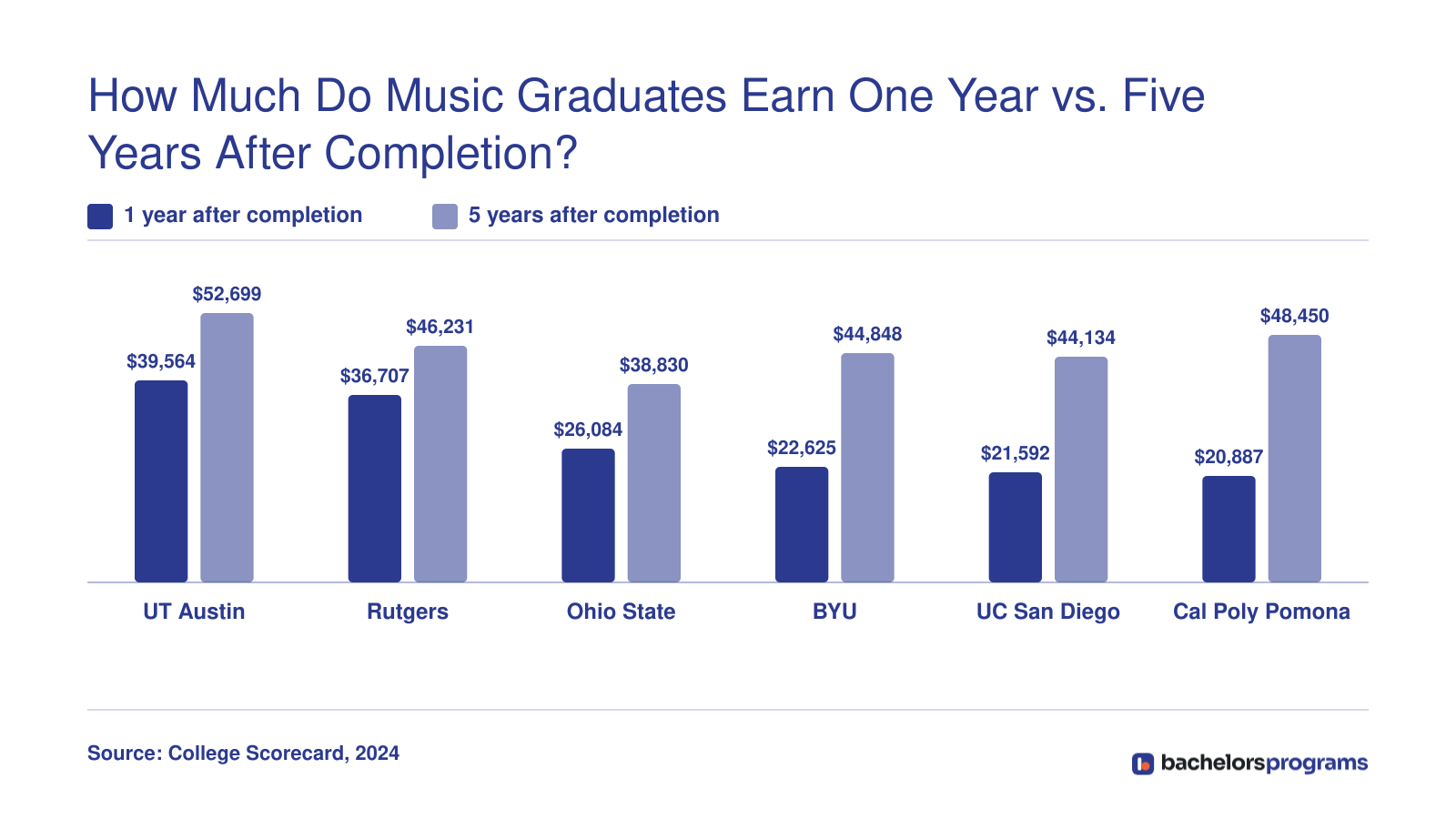
How Much Do Music Graduates Earn One Year vs. Five Years After Completion?
Audio and music careers often start low, with freelance gigs, assistant engineer roles, and part-time teaching, then climb as graduates build credits and clients. That is why you should compare program-level median earnings at both windows. At Cal Poly Pomona, BYU, and UC San Diego, the five-year median is roughly double the one-year figure. UT Austin posts the highest median at both points. Each window reflects a different graduating group, so read the bars as separate snapshots rather than one class tracked over time.
What Sound Engineering Technicians Earn Nationally
Sound engineering is one of the most direct career paths for graduates with a bachelor's degree in audio and music.
Audio & Music programs by state
Audio & Music Degree FAQs
These answers summarize how a bachelor's degree in audio and music compares with shorter training options. Outcomes depend on the program, your portfolio, and your connections, so treat each answer as a starting point for your own research.
Is an audio engineering degree worth it?
What is the best degree for audio and music production?
Should I choose a bachelor's degree or a shorter recording-school certificate?
Compare Audio & Music programs on the data that matters
Explore more Arts & Design majors or browse every field of study.
All Arts & Design programs Browse every field of study