Best Art Degree Programs
Compare 1,400+ accredited Art programs at 1,050+ colleges, with net price after aid, graduation rates, earnings and debt from IPEDS and the U.S. College Scorecard.

Net price for a bachelor's degree in art runs from $6,128 to $19,285 a year among the schools here, and the lowest figure belongs to a private university with a sticker price above $62,000. Only undergraduate programs appear here, no MFA or other graduate study.
The Bachelor of Arts (B.A.) in Art is the most common credential among these programs, with the BFA as the alternative. Every program here is campus-based.
Selectivity complicates the price question. Admission rates run from under 4 percent at the most competitive schools to roughly 27 percent at the most accessible.
Key Points
- Net price swings more than $7,000 across the ranked art schools.
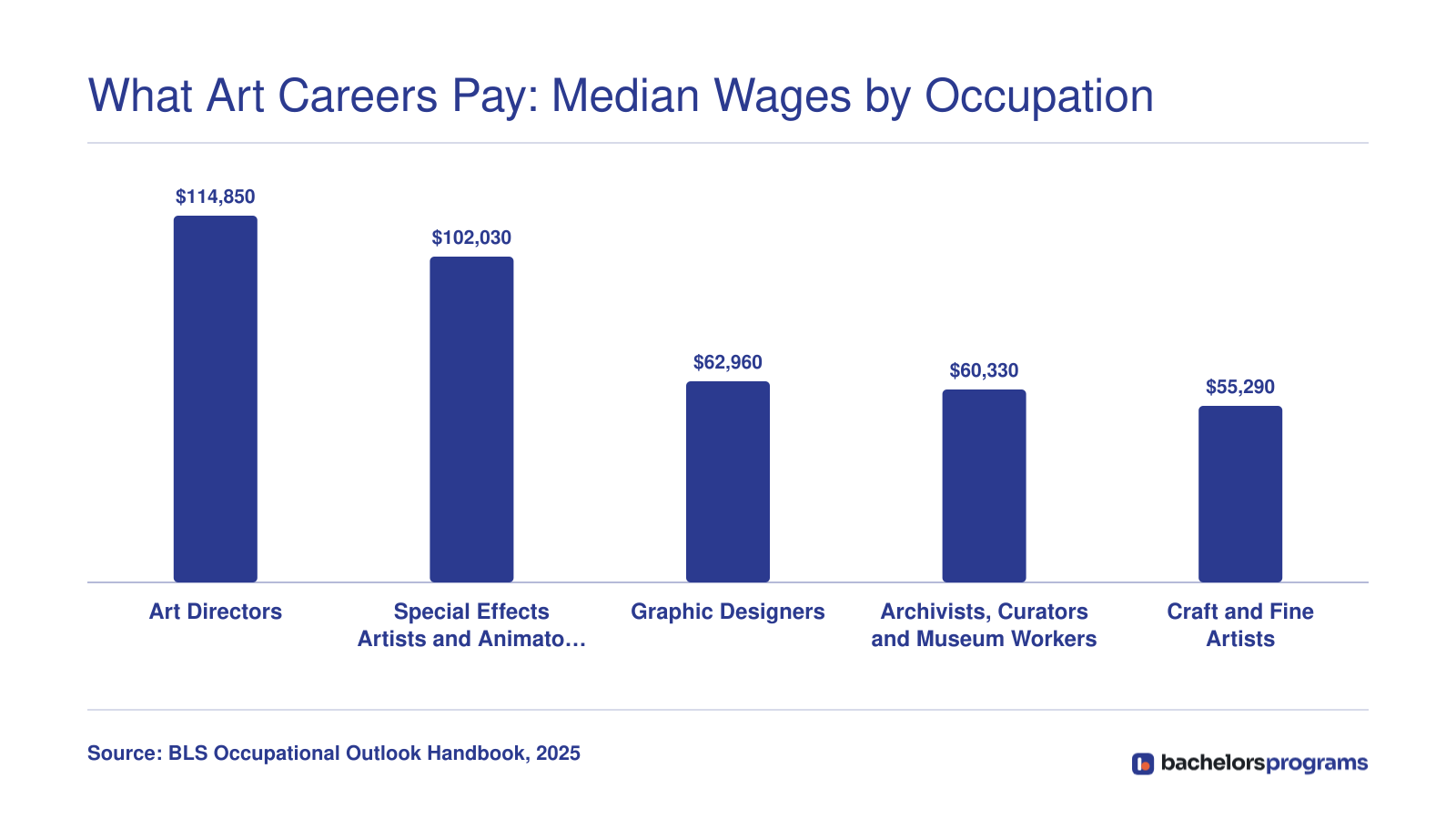
- Art directors' median annual wage was $114,850 in May 2025, per BLS.
- Most BFA programs require portfolios; B.A. and B.S. requirements vary.
Top 10 Schools for a Bachelor's Degree in Art
All ten programs here are campus-based, and the group splits four public universities against six private ones, so what a family actually pays ranges widely from card to card. Studio facilities, capstone exhibitions and portfolio reviews appear almost everywhere; what separates these schools is how much studio time the degree allows, how early students commit to a medium, and how much grant aid closes the gap between sticker price and the bill.
Princeton University
#1Princeton, NJ · ~$6,000/yr (est.)
Best for: Independent studio artists wanting generous aid
Princeton's art major sits in the Department of Art and Archaeology and runs through a dedicated studio building at 185 Nassau Street, with darkrooms, welding and mold-making bays, a letterpress shop and film editing suites. Juniors get round-the-clock studio access and seniors work in semi-private studios, with student work shown in the Lucas and Hurley galleries and the James Stewart Film Theater. The school graduates 98% of students, and it posts the lowest average net price in this group after grant aid.
- Courses in painting, drawing, film and video, sculpture and graphic design
- Darkrooms, welding and mold-making areas, letterpress studio
- Dedicated film track for majors and visual arts minors
- 24/7 studio access as a junior; semi-private studios as a senior
- Student work shown in the Lucas, Hurley and Hagan galleries
- Single concentration in Visual Art, taken through Art and Archaeology
- Film editing bays and a theater for 35 mm and 16 mm projection
University of California-Berkeley
#2Berkeley, CA · ~$13,000/yr (est.)
Best for: Interdisciplinary artists eyeing a large public university
Berkeley's Art Practice major blends ten studio courses with three art history courses and ends in a thesis exhibition at the Worth Ryder Art Gallery. Only nine seniors per semester are admitted to the Advanced Studio and Critique Program, and coursework runs from painting and printmaking to ceramics, installation, performance, video and social practice. The school graduates 93% of students, and California residents pay a fraction of what out-of-state students do.
- 13 courses: five lower-division and eight upper-division
- Ten studio courses plus three art history courses
- Senior capstone and thesis exhibition at Worth Ryder Art Gallery
- Advanced Studio and Critique Program admits nine seniors each semester
- Intended majors who finish prerequisites at a 2.0 GPA are guaranteed a spot
- Studio work spans printmaking, ceramics, video, performance and social practice
- Portfolio review is part of the competitive application
- Final chance to apply is the start of junior year
University of Florida
#3Gainesville, FL · ~$7,000/yr (est.)
Best for: Florida residents wanting an affordable studio BFA
Florida's studio BFA is a 120-credit degree in the School of Art + Art History, built on space, drawing, time and perceptual studio courses plus art theory and two art history courses. Students clear a sophomore portfolio review before upper-division studio work and finish with a faculty-juried senior exhibition. The school graduates 91% of students, and it carries one of the lowest net prices on this list.
- 120 credit hours with a 3.0 GPA required to graduate
- Sophomore portfolio review before upper-division studio work
- Senior capstone includes a faculty-juried exhibition
- Foundation studio courses in space, drawing, time and perceptual studio
- Upper-division electives with ART, GRA or PGY prefixes
- Minimum grade of C in every major course
- Two art history courses plus coursework in art theory
Harvard University
#4Cambridge, MA · $15,000 – $20,000/yr (est.)
Harvard's Art, Film, and Visual Studies concentration lets students choose among studio arts, film and video making, or film and visual studies, each carrying its own requirements. The program pairs conservatory-level studio intensity with the breadth of a liberal arts college, and coursework covers both art-making and critical study of the visual arts. The school graduates 98% of students.
- Bachelor of Arts (A.B.) concentration at Harvard College
- Tracks: studio arts, film and video making, film and visual studies
- Each focus area carries different requirements
- Conservatory-level studio intensity with liberal arts breadth
- Combines visual arts practice with criticism and critical study
University of North Carolina at Chapel Hill
#5Chapel Hill, NC · ~$12,000/yr (est.)
Carolina's BA in Studio Art is the flexible liberal arts route: 36 credit hours, room for a second major, and a for-credit practicum that places students in supervised internships of at least 135 hours. Transfer students can bring up to 20 studio art credit hours, and strong AP or IB art scores earn credit for foundation courses. A new partnership with the UNC School of the Arts is expected to open intercampus exchange and study-abroad pathways, though specific programs were not yet finalized. The school graduates 91% of students.
- 36 credit hours in the major; up to 45 ARTS credits count toward graduation
- ARTS 493 practicum requires at least 135 supervised hours
- Transfer students may apply up to 20 BA credit hours
- AP portfolio score of 4 earns Basic Drawing or Design credit
- IB Art score of 6 or higher earns Basic Drawing credit
- Internship requires a faculty sponsor
- Preferred route for students adding a second major
Rice University
#6Houston, TX · ~$13,000/yr (est.)
Rice's BA in Art fits 13 courses into a 120-credit degree, with at least six courses at the 300 level or above and individual studio spaces for seniors in the Senior Studio capstone. Students choose between Senior Studio and a Senior Seminar route, and both end in public exhibition work, including shows at the Moody Center for the Arts. The school graduates 95% of students.
- 13 courses, 39 to 40 credit hours inside a 120-credit degree
- At least 6 courses must be at the 300 level or above
- No more than 2 courses from study abroad or transfer credit
- Capstone options: Senior Studio or Senior Seminar plus a studio course
- Senior Studio students get individual spaces and a year-end exhibition
- Coursework in drawing, painting, sculpture, printmaking, photography and film
- Exhibitions at the Moody Center for the Arts
University of Chicago
#7Chicago, IL · ~$15,000/yr (est.)
UChicago's Department of Visual Arts awards a BA built from an individually arranged mix of studio, lecture and seminar courses, entered through one of three 100-level foundations in two-dimensional, three-dimensional or time-based media. A Studio Track is available, double majors are common, and the degree pairs hands-on work with art history, intellectual history, criticism and aesthetics. The school graduates 96% of students.
- Individually arranged program of studio, lecture and seminar courses
- Entry through one of three 100-level courses in 2D, 3D or time-based media
- Studio Track major available
- Double majors are common among visual arts majors
- Studio practice paired with art history, criticism and aesthetics
- BA thesis exhibition
University of California-San Diego
#8La Jolla, CA · $10,000 – $15,000/yr (est.)
UC San Diego's Studio Art BA is a contemporary-art program covering painting, drawing, sculpture, performance, installation and cross-disciplinary practice, backed by wood and metal shops, digital and photo labs and 24-hour studio access. Students pair technical and conceptual training with art history, criticism and theory, and the degree is built for gallery, museum and professional studio careers. The school graduates 86% of students.
- Major code VIS-BA-004
- Painting, drawing, sculpture, performance and installation coursework
- Cross-disciplinary art practices alongside art history and theory
- Woodshop and metal shop training
- 24-hour studio access with digital and photo labs
- Exhibition spaces for student work
- Prepares students for gallery, museum and professional studio careers
Pomona College
#9Claremont, CA · ~$19,000/yr (est.)
Pomona's art major is deliberately small and sequential: 13 courses, five foundation studios taken at Pomona, two art history courses and a Junior Senior Seminar that meets in both the junior and senior years. Every major mounts a final exhibition, and seniors complete a thesis exhibition in the spring, with electives available across the five Claremont colleges. The school graduates 93% of students.
- 13 courses plus two required exhibitions
- Five foundation studios at Pomona: drawing, design, painting, photography, sculpture
- Two art history courses and three art electives, possibly across the 5Cs
- Junior Senior Seminar taken twice
- Senior thesis exhibition required in spring of senior year
- All major courses taken for a letter grade
- Study abroad and transfer credit need department chair approval
Vanderbilt University
#10Nashville, TN · ~$16,000/yr (est.)
Vanderbilt's 30-credit art major combines a foundation course, 15 studio credit hours, a related requirement pairing contemporary art sources with art history, and a senior independent research course that leads into the Senior Show. The department runs Space 204, a Nashville-facing exhibition and visiting-artist venue, and mounts the annual Hamblet thesis exhibitions for graduating majors. The school graduates 94% of students.
- 30 credit hours in the major
- Foundation: Intro to Studio, Drawing and Composition I, or Intro to Lens-Based Art
- 15 studio credit hours, including one course at the 2000 level or above
- Related requirement pairs Sources of Contemporary Art with an art history course
- Independent Research (ARTS 3971) in senior year prepares the Senior Show
- Declaration of Major/Minor form required to enter
- Exhibitions through Space 204 and the Hamblet thesis shows
Cost & outcomes by school
Federal data for the highest-earning Art programs, independent of the ranking above. Earnings are this field's bachelor's graduates four years after completing where the Scorecard reports them, else the school's undergraduate median.
| School | Net price / yr | Grad rate | Earnings | Debt | Grads/yr | Format |
|---|---|---|---|---|---|---|
| Massachusetts Institute of Technology MA | $20,111 | 96% | $143,372 | $14,768 | — | Campus |
| Stanford University CA | $13,807 | 92% | $124,080 | $12,000 | 21 | Campus |
| Princeton University NJ | $6,128 | 98% | $110,066 | $10,320 | 11 | Campus |
| Lehigh University PA | $36,931 | 88% | $105,584 | $21,960 | 2 | Campus |
| Boston College MA | $41,704 | 91% | $103,937 | $19,000 | 22 | Campus |
| Georgetown University DC | $40,815 | 95% | $103,494 | $15,500 | 19 | Campus |
| Worcester Polytechnic Institute MA | $43,071 | 90% | $103,470 | $27,000 | — | Campus |
| Columbia University in the City of New York NY | $21,590 | 96% | $102,491 | $27,000 | 42 | Campus |
| Rensselaer Polytechnic Institute NY | $36,228 | 84% | $102,051 | $23,750 | — | Campus |
| Harvard University MA | $19,066 | 98% | $101,817 | $14,000 | 16 | Campus |
| Yale University CT | $23,777 | 96% | $100,533 | $12,975 | 54 | Campus |
| University of Notre Dame IN | $26,780 | 95% | $99,980 | $19,000 | 13 | Campus |
Sources: U.S. Department of Education. Net price, graduation rate, earnings and debt: College Scorecard (earnings and debt for this field's bachelor's graduates where reported, else school-wide); graduates: IPEDS. A dash means no figure is reported.
Cost, debt & payoff
Median earnings of this field's bachelor's graduates (4 yrs after completing, else the school's undergraduate median) vs. their median federal loan debt · U.S. College Scorecard
Across these programs the median graduate earns about $47,485 and finishes with roughly $24,000 in debt — a ratio that clears a common rule of thumb (keep debt below first-year salary). Net price and debt vary widely school to school, so check the per-school figures in the table above before you shortlist.
How We Ranked the Best Art Schools for Undergraduates
Most art school rankings that dominate search results score graduate programs, and they lean on peer-reputation surveys in which academics rate one another's departments. This list works differently. It scores undergraduate outcomes and affordability, because a student choosing a bachelor's program needs to know what it costs, whether classmates finish, and what graduates earn.
What We Scored
- Net price: the average cost after grants and scholarships, not the sticker tuition.
- Graduation rate: the share of students who complete a degree at the institution.
- Earnings and debt: program-level earnings and median debt from the U.S. Department of Education's College Scorecard.
- Admissions rate: how selective the school is, a signal of how competitive entry may be.
- Format: whether the program is offered online, on campus, or both.
Where the Data Has Limits
Two caveats matter. Graduation rates are institution-wide, so they describe the whole school, not the art program specifically. A university with strong overall completion can still have a small, uneven art department, and the reverse is also possible. Net price reflects an average after aid rather than a quote for any one student. Your family income, residency, and merit awards will move the number up or down.
How to Read Earnings Figures
Earnings always come with a time window, such as four years after finishing the degree, so compare them only with figures measured over the same span. Wherever College Scorecard publishes program-level earnings for art, we use those rather than school-wide numbers, since art graduates often earn differently from the campus average.
B.S., B.A. and BFA in Art: Which Bachelor's Degree Fits Your Goals
The B.S. in Art is the common credential among the schools ranked here. It typically adds a technical or digital emphasis, or pairs studio work with art education, and it leans on broader general education and electives. The difference between a BA and a BFA in art is mostly studio time: a BFA is a professional degree that normally puts at least 65% of credits (roughly two-thirds) into art and design, while a BA is a liberal arts degree that puts about 30 to 45% (roughly one-third) there. Rule of thumb: choose the BFA for a studio career or an MFA, the BA to pair art with another field, and the B.S. for digital, technical or teaching-focused paths.
| Comparison Point | B.S. in Art | B.A. in Art | BFA |
|---|---|---|---|
| Total credits | Varies by school; 120 is a common bachelor's baseline | 120 credit hours in one U.S. example | 124 credit hours in one U.S. example |
| Share of credits in studio art | Varies by program; check the degree plan | About 30 to 45% in art and design courses (55 of 120 hours, or 45.8%, in one example) | Normally at least 65% in art and design (79 of 124 hours, or 63.7%, in one example) |
| General education and liberal arts load | Broader liberal arts general education plus a wide range of electives | The remaining 50 to 70% is liberal arts coursework from other departments | No less than 25% of credits outside art, design and art history |
| Art history requirement | Set by each school | 8 to 12 credit hours | 12 to 18 credit hours |
| Typical portfolio requirement | Varies by school; confirm on the program page | Varies by school; often a lighter review | Often a portfolio for admission or entry to the major; confirm with each school |
| Best-fit careers | Digital and technical art roles, or art education when paired with teaching preparation | Applied double major, minor or broader liberal arts goals | Studio-related visual arts careers and professional practice |
| Readiness for an MFA | Depends on studio depth; additional portfolio work may be needed | Balanced study, but some MFA programs require added studio depth or prerequisites | Explicitly prepares students for graduate study and professional practice (78 art credits in one U.S. example) |
Portfolio Requirements: What Art Programs Ask Applicants to Submit
Most BFA programs and art schools require a portfolio. B.A. and B.S. programs vary more: some require one, some make it optional and some don't ask. Check each school's current guidelines, since counts and formats change from year to year.
- Number of piecesRoughly 10 to 20 works is common: RIT asks for 7-10, Cornell at least 10, Tufts 12-20 and Alfred 15-20.
- Observational drawingAlfred requires four direct-observation works, UA Little Rock at least three and UT Austin two, and RIT does not accept photo references for these samples.
- Personal workPair technical studies with self-directed pieces, since reviewers weigh creativity, idea development and composition alongside skill.
- Artist statementFormats differ: FIU caps it at about 500 words, UT Austin asks for 1-3 paragraphs, and Tufts wants 1-3 sentences per work.
- Work detailsExpect to list title, medium, dimensions and date for each piece, as Alfred and Tufts require.
- Submission platformFIU and Alfred use SlideRoom, Tufts uses its own Digital Portfolio, and some schools set file-size limits, such as RIT's 8 MB.
- DeadlinesUT Austin's falls on December 1, Cornell's on January 2, Alfred's on February 1 and FIU's on February 25, 2027.
- Feedback before applyingAlfred participates in National Portfolio Day, where applicants can get reviewer feedback before they submit.
Accreditation and Transfer Credit: What to Verify Before You Apply
Accreditation is an outside review that confirms a school meets quality standards, and art students deal with two layers of it. Institutional (regional) accreditation covers the whole college. It is required for federal financial aid and is the baseline for credit transfer. NASAD accreditation is a voluntary seal from the National Association of Schools of Art and Design, and it covers specialized art and design education at the undergraduate and graduate levels.
How to Verify, Step by Step
- Check NASAD first: Open the NASAD Accredited Institutions directory and search by school name. Open the listing and note the initial accreditation date, the most recent comprehensive-review year, and the next on-site evaluation year.
- Confirm the exact degree: Scroll to the degree and program listing and look for your specific bachelor's degree and art field. A school can be NASAD-accredited without every art program being included.
- Check the federal record: Look up the institution in the U.S. Department of Education's DAPIP database to confirm its institutional accreditor.
- Cross-check with CHEA: The Council for Higher Education Accreditation lists recognized accrediting organizations, so you can confirm the accreditor itself is legitimate.
Why It Matters for Transfer and Graduate Study
Institutional accreditation is usually the first thing a receiving school checks, and graduate programs look for it too. It does not guarantee credit, though. NASAD does not require schools to accept art credits without examination.1 Studio courses are often reviewed for content, level, contact hours, grades, and a portfolio or syllabus.1 The outcome may be a direct equivalent, elective credit, or no credit at all. NASAD-accredited schools publicly disclose their transfer policies2, so get the receiving school's policy in writing.
Online Program Warning
For online art courses, confirm that the school itself grants the credit and lists it on its own transcript. If a third-party provider issues the credit, a receiving school may not recognize it.
Related Articles
Cost, Net Price and Financial Aid at Top Art Schools
Sticker price can be intimidating, but net price after grant aid is the number that matters, and it can swing by more than $7,000 among the programs here. The tradeoff is not simply public versus private. Aid packaging, merit awards, and portfolio scholarships can reorder the list.
Public and Private Net Prices
After grant aid, average net prices among the schools ranked here run from roughly $6,100 to about $13,500 a year. Public options average about $11,600. Private options average about $10,900, though Princeton's roughly $6,100 net price pulls that figure down; Cooper Union and Rice land near $13,300. The practical point: a private art school can beat a public one on net price, and the reverse can be true, depending on the aid package. Compare offers side by side, not sticker prices.
Pell Share at the Lowest-Cost Schools
The least expensive options here also serve many lower-income students. Princeton and Florida report Pell Grant shares above 80% and about two-thirds, respectively, which suggests need-based aid is doing substantial work at the low end of the cost range. Pell eligibility varies with family income and state aid, so the share is not a complete measure of affordability, but it is a useful signal of which campuses are putting need-based dollars to work.
Art-Specific Aid Worth Pursuing
Art departments often add talent and portfolio awards on top of need-based aid. Pratt Institute, for example, awards $3,000 a year to Portfolio Gold recipients in general art or photography, $2,000 a year to Portfolio Silver recipients, and $1,000 a year for individual Gold work. National competitions can be larger. Scholastic Art & Writing Awards portfolio scholarships pay $12,500 to each of 16 Gold portfolio winners, split evenly between art and writing, and $2,000 to Silver portfolio winners, with other Scholastic awards ranging from $500 to $2,500. YoungArts cash prizes run from $250 to $10,000, and named YoungArts awards reach $50,000. The University of Washington's School of Art + Art History + Design awards more than 30 undergraduate scholarships annually, generally $1,000 to $5,000.
Ask One Direct Question
Before revising a portfolio, ask whether the review itself puts you in the running for talent scholarships or whether a separate application is required. At Pratt, for instance, some national Scholastic awards count only for students who apply independently and are admitted. Ask for the answer in writing, and confirm whether the portfolio deadline matches the admissions deadline. The answer can change both your timeline and your net price.
What Art Careers Pay: Median Wages by Occupation
These Bureau of Labor Statistics figures are May 2025 median annual wages for all workers in each occupation. They are not the earnings of new graduates from the programs ranked above. Art directors ($114,850) and special effects artists and animators ($102,030) earn the most, while museum work pays a median of $60,330, and curator roles in that group often call for a master's degree rather than a bachelor's degree in art alone. For 2025-2035, BLS projects 4% growth for art directors and for archivists, curators and museum workers, little or no change for animators, and small declines for graphic designers (-2%) and craft and fine artists (-1%). Craft and fine artists are still expected to average about 4,300 openings a year.
Questions to Ask Yourself
Do you want most of your credits in the studio, or room to double-major?
Is your portfolio ready for a review deadline this year?
Can you learn critique and technique through a screen?
Will the program's median debt be manageable on entry-level art wages?
Art programs by state
Compare Art programs on the data that matters
Explore more Arts & Design majors or browse every field of study.
All Arts & Design programs Browse every field of study