Best Creative Writing Degree Programs
Compare 320+ accredited Creative Writing programs, with net price after aid, graduation rates, earnings and debt from IPEDS and the U.S. College Scorecard.

Can a creative writing major pay rent? Federal data offers a partial answer: graduates of Johns Hopkins' Writing Seminars earned a median of $43,524 a year after finishing, and graduates of other creative writing programs land closer to $30,000.
The credential is usually the Bachelor of Arts (B.A.) in Creative Writing, a workshop-heavy major, and private tuition now tops $70,000 a year before aid. Campus, hybrid, and online formats all exist.
Net price after aid varies far more than sticker numbers suggest, and that spread, not workshop pedigree, is the real constraint.
Key Points
- Johns Hopkins Writing Seminars graduates earned a $43,524 median one year out.
- Brown graduates finish with just $10,500 in median federal loan debt.
- University of South Florida charges residents $6,410 yearly tuition, nonresidents $17,324.
Best Creative Writing Schools for a Bachelor's Degree: Our Top 10
Creative writing bachelor's programs come in many shapes, and the ten below run from a science-focused writing degree at a major research university to a thesis-driven concentration at a small liberal arts college. Each entry pairs the program's structure and workshop requirements with the outcomes the data reports. The methodology section below explains how the ranking was built.
Massachusetts Institute of Technology
#1Cambridge, MA · ~$20,000/yr (est.)
Best for: Aspiring science and technical writers
MIT's writing major, known on campus as Course 21W, lets undergraduates choose among creative writing, science writing and nonfiction, and every subject requires extensive writing and revision with written instructor commentary. A senior thesis is required of full majors, and a joint degree can pair seven writing subjects with six subjects in engineering or science. The school graduates 96% of students.
- Three emphasis areas: creative writing, science writing, nonfiction
- Workshops plus written instructor commentary in every subject
- Senior thesis required of full majors
- Coursework spans contemporary writing, journalism and digital media
- Joint degree pairs seven writing subjects with engineering or science
- Interactive and nonlinear digital forms explored
- Introductory and advanced subject levels available
University of Chicago
#2Chicago, IL · ~$15,000/yr (est.)
Best for: Students who want writing inside a literature department
Chicago's creative writing major lives inside the Department of English Language and Literature, so workshops sit alongside serious literary study and students work with established poets and prose writers. A joint minor in English and creative writing is available, and interdisciplinary work is encouraged. The school graduates 96% of students.
- Undergraduate major in the Department of English Language and Literature
- Joint minor in English and creative writing
- Study with established poets and prose writers
- Interdisciplinary work opportunities
University of Michigan
#3Ann Arbor, MI · $18,000 – $61,000/yr (est.)
Best for: Digital storytellers and fiction writers
At Michigan, creative writing and literature is a major inside the Residential College, with genre tracks in fiction and creative nonfiction, poetry, and digital storytelling. Students complete at least 28 credits, take most writing courses in small seminars with faculty mentors, and can apply for an honors thesis with a 3.4 GPA. Program graduates reported median earnings of $43,689 four years after finishing, with median debt of $13,999.
- Three genre tracks: fiction and creative nonfiction, poetry, digital storytelling
- At least 28 credits, including four writing courses in the fiction or poetry track
- Honors thesis of 75 to 100 pages of prose, 3.4 GPA to apply
- Nelson Award pays two students a $2,500 summer internship stipend
- Introductory Residential College creative writing course required before declaring
- C- or better required in every major course
- Five literature courses at the 300 level or above, one before 1600
- Digital storytelling pairs writing workshops with media theory
Johns Hopkins University
#4Baltimore, MD · $19,000/yr (est. net price)
The Writing Seminars at Johns Hopkins lead to a Bachelor of Arts and combine fiction, nonfiction and poetry workshops with literature courses taught for close reading and craft. Specialized classes cover literary translation, writing for children and narrative nature writing, and screenwriting or playwriting is available through ties with film and theater. Program graduates reported median earnings of $63,503 four years after finishing, and 94% of students graduate.
- Fiction, nonfiction and poetry workshops plus craft-focused literature courses
- Specialized classes in literary translation and writing for children
- Screenwriting and playwriting available through film and theater ties
- Narrative nature writing and community-based learning offered
- Foreign language competency required
- Graduates enter publishing, speechwriting, journalism, law and medicine
University of California-Davis
#5Davis, CA · $10,000 – $15,000/yr (est.)
Creative writing at UC Davis is a specialization inside the English major, entered through a separate department application after a 20-unit introductory sequence. Students then complete 44 upper-division units across historical periods, theory and thematic courses, and double majors with cell biology, computer science or genetics are common. The school graduates 86% of students.
- Creative writing is one of two specializations inside the English major
- Separate department application required for the specialization
- 20 introductory units plus 44 upper-division units
- Double majors with cell biology, computer science or genetics are common
- Coursework ranges from medieval texts to graphic novels and sound poetry
- Department honors program and literary magazines available
University of Washington-Seattle Campus
#6Seattle, WA · ~$14,000/yr (est.)
Washington's creative writing concentration sits inside the English major and traces back to a program Theodore Roethke founded in 1947. Workshops stay small and student-centered, paired with literary models and coursework in literature and critical theory, and faculty include David Shields, Maya Sonenberg, Rae Paris and Andrew Feld. Program graduates reported median earnings of $47,124 four years after finishing, and 85% of students graduate.
- Creative writing program founded in 1947 by Theodore Roethke
- Small, student-oriented workshops paired with literary models
- Concentration runs alongside literature and critical theory study
- Faculty includes David Shields, Maya Sonenberg, Rae Paris and Andrew Feld
- Scholarships and prizes available to undergraduates
- Advising through Humanities Academic Services
Columbia University in the City of New York
#7New York, NY · ~$22,000/yr (est.)
Columbia's creative writing major is a 12-course, 36-point sequence taken over four to five semesters, and students commit to poetry, fiction, nonfiction or a cross-genre plan. Five workshops plus four seminars taught from a writer's perspective are required, and all workshops and seminars must be taken in the department. Program graduates reported median earnings of $47,702 four years after finishing, and 96% of students graduate.
- 12 courses, 36 points, completed over four to five semesters
- Choose poetry, fiction, nonfiction or a cross-genre plan
- Five workshops: four in the focus genre, one in another
- Four seminars plus three approved related courses
- Maximum of one workshop and two seminars per semester
- No minor offered; workshops and seminars taken in the department
- No more than two courses taken elsewhere apply to the major
Brown University
#8Providence, RI · $25,000 – $30,000/yr (est.)
Brown's Literary Arts concentration leads to the A.B. and covers fiction, poetry, playwriting, screenwriting, literary translation, electronic writing and mixed media. The open curriculum lets students sample courses widely before declaring, and interdisciplinary undergraduate certificates can run alongside the concentration. Graduates of the program who borrowed carried median debt of $10,500, and 96% of students graduate.
- Concentration leads to the A.B. degree
- Fiction, poetry, playwriting, screenwriting and literary translation
- Also covers electronic writing and mixed media
- Interdisciplinary undergraduate certificates can accompany the concentration
- Open curriculum lets students sample courses before declaring
Wellesley College
#9Wellesley, MA · $25,000 – $30,000/yr (est.)
Wellesley, a women's college, offers an English and creative writing major covering poetry, creative nonfiction, and writing for children, film, television and video games, alongside critical courses from Shakespeare to speculative fiction. Funded summer internships have placed students at Slate, W.W. Norton and Maven Screen Media, and Special Collections holds early editions and the Browning love letters. The school graduates 92% of students.
- Creative writing courses in poetry and creative nonfiction
- Writing for children, film, television and video games offered
- Funded summer internships at Slate, W.W. Norton and Maven Screen Media
- Sample workshop: Weirdcraft, a speculative fiction workshop ending in a portfolio
- Special Collections holds early editions and Browning love letters
- Alums work at Hachette Book Group, Publicis Sapient and City Year
- Dedicated Creative Writing Major Director
Bates College
#10Lewiston, ME · ~$29,000/yr (est.)
Creative writing at Bates is a concentration within the English major, started in 1992 by poet Robert Farnsworth, and it requires a creative thesis of 15 to 20 poems or 40 to 60 pages of prose. Workshops are taught by published writers, and students take a third workshop outside their chosen genre. The school graduates 90% of students.
- Concentration founded in 1992 by poet Robert Farnsworth
- Introductory workshop in fiction, poetry, nonfiction or playwriting
- Second introductory workshop plus an advanced workshop in the genre
- Third workshop required outside the chosen genre
- Thesis: 15 to 20 poems or 40 to 60 pages of prose
- Two-semester thesis option runs 70 to 100 pages with a preface
- Workshops taught by published writers including Jessica Anthony and Myronn Hardy
Cost & outcomes by school
Federal data for the highest-earning Creative Writing programs, independent of the ranking above. Earnings are this field's bachelor's graduates four years after completing where the Scorecard reports them, else the school's undergraduate median.
| School | Net price / yr | Grad rate | Earnings | Debt | Grads/yr | Format |
|---|---|---|---|---|---|---|
| Massachusetts Institute of Technology MA | $20,111 | 96% | $143,372 | $14,768 | 4 | Campus |
| University of Pennsylvania PA | $28,699 | 97% | $111,371 | $15,715 | — | Campus |
| Dartmouth College NH | $29,519 | 96% | $97,434 | $17,500 | — | Campus |
| Bucknell University PA | $40,766 | 86% | $93,807 | $27,000 | 19 | Campus |
| Brown University RI | $25,184 | 96% | $93,487 | $10,500 | 43 | Campus |
| University of Chicago IL | $14,860 | 96% | $91,885 | $15,000 | 25 | Campus |
| George Washington University DC | $36,586 | 84% | $90,873 | $20,449 | 11 | Campus |
| California Polytechnic State University-San Luis Obispo CA | $16,665 | 86% | $90,768 | $18,500 | — | Campus |
| Northwestern University IL | $29,167 | 95% | $89,363 | $15,000 | 2 | Campus |
| Washington University in St Louis MO | $21,786 | 94% | $86,182 | $17,500 | 31 | Campus |
| Wellesley College MA | $25,496 | 92% | $84,803 | $10,000 | 13 | Campus |
| New York University NY | $37,050 | 88% | $82,509 | $20,500 | — | Campus |
Sources: U.S. Department of Education. Net price, graduation rate, earnings and debt: College Scorecard (earnings and debt for this field's bachelor's graduates where reported, else school-wide); graduates: IPEDS. A dash means no figure is reported.
Cost, debt & payoff
Median earnings of this field's bachelor's graduates (4 yrs after completing, else the school's undergraduate median) vs. their median federal loan debt · U.S. College Scorecard
Across these programs the median graduate earns about $53,668 and finishes with roughly $24,046 in debt — a ratio that clears a common rule of thumb (keep debt below first-year salary). Net price and debt vary widely school to school, so check the per-school figures in the table above before you shortlist.
How We Ranked These Creative Writing Programs
Graduates of the Writing Seminars program at Johns Hopkins University earned a median of $43,524 one year after finishing, according to the U.S. Department of Education's College Scorecard. Figures like that, not prestige alone, shaped the order of the schools below.
What We Measured
Every school on this list offers a bachelor's-level creative writing program. Each was scored on the same measurable factors, drawn from College Scorecard and the federal IPEDS database:
- Net price: the average annual cost after grants and scholarships.
- Graduation rate: the share of students who finish a bachelor's degree at the institution.
- Earnings: median pay for creative writing graduates after completion, where published.
- Debt: median federal loan debt at completion.
- Selectivity: the school's admission rate.
- Completions: how many students finish the creative writing program.
Why Outcomes Come First
A creative writing degree does not lead to a single licensed career path, so the financial side carries more weight. Borrowing heavily for a major with modest early earnings can follow a graduate for years. Ranking on cost, debt, and completion gives you a clearer picture of value than a famous name on its own.
Limits of the Data
Some numbers describe the whole school rather than the writing program. Graduation rates and net price are institution-wide averages, so they reflect every major on campus. Program-level earnings have gaps too: when a program graduates only a handful of students, as at MIT and UC Davis, College Scorecard does not publish earnings. Wellesley College and Bates College also have no published program earnings. Treat a missing figure as a sign of a small graduating class, not a red flag, and ask the department directly where recent graduates have landed.
Cost, Net Price, and Debt: What a Creative Writing Degree Really Costs
Net Price vs. Sticker Price
The ranked group is 13 public universities and 16 private institutions, so at the public schools the published tuition figure swings hard on residency. At the University of South Florida, in-state tuition runs $6,410 a year against $17,324 for out-of-state students; at Purdue, the split is $9,992 versus $28,794. Net price, which subtracts average grant aid from the sticker, lands far lower: $9,812 at South Florida and $14,600 at Purdue. Across the ranking, net price stretches from that $9,812 up to $14,741 at UC Davis, a gap of roughly $4,900. UW Tacoma ($10,163), UCF ($10,411) and Cal State Long Beach ($10,440) cluster near the bottom too. Median debt at graduation runs from $13,000 to $19,500. Net price is an average for students who receive aid, not a bill for your family; your own number depends on income, residency and merit offers.
Where Pell Dollars Go
A campus's Pell share is a quick read on how hard it works at affordability. At Cal State Long Beach, 81 percent of students receive Pell grants; at UC Riverside, 79 percent; at UCF, 70 percent; at South Florida, 69 percent. Michigan (41 percent) and Purdue (42 percent) sit at the other end, which usually means bigger institutional aid budgets paired with higher sticker prices.
Writing-Specific Awards Worth Chasing
- Scholastic Art & Writing Awards: portfolio scholarships up to $12,500, but eligibility stops at grade 12, so this is a high-school move, not a college one.2
- University of Washington departmental prizes: Edith K. Draham Scholarship ($7,000), Stephanie Dassel Barden Scholarship in Creative Writing ($3,000), Joan Grayston Poetry Prize ($2,000), Arthur Oberg Award for Poetry ($1,500 to $3,000) and the Charlotte Paul Reese Fiction Award ($3,000, open by faculty nomination only).1
- Washington eligibility: 3.5 GPA, 3.7 English GPA, 10 English credits and two quarters enrolled by the deadline; awards pay out the following academic year.1
The Move That Pays
File the FAFSA as early as you can, then email the English or creative writing department and ask directly which awards accept a portfolio submission and whether a faculty nomination is required.
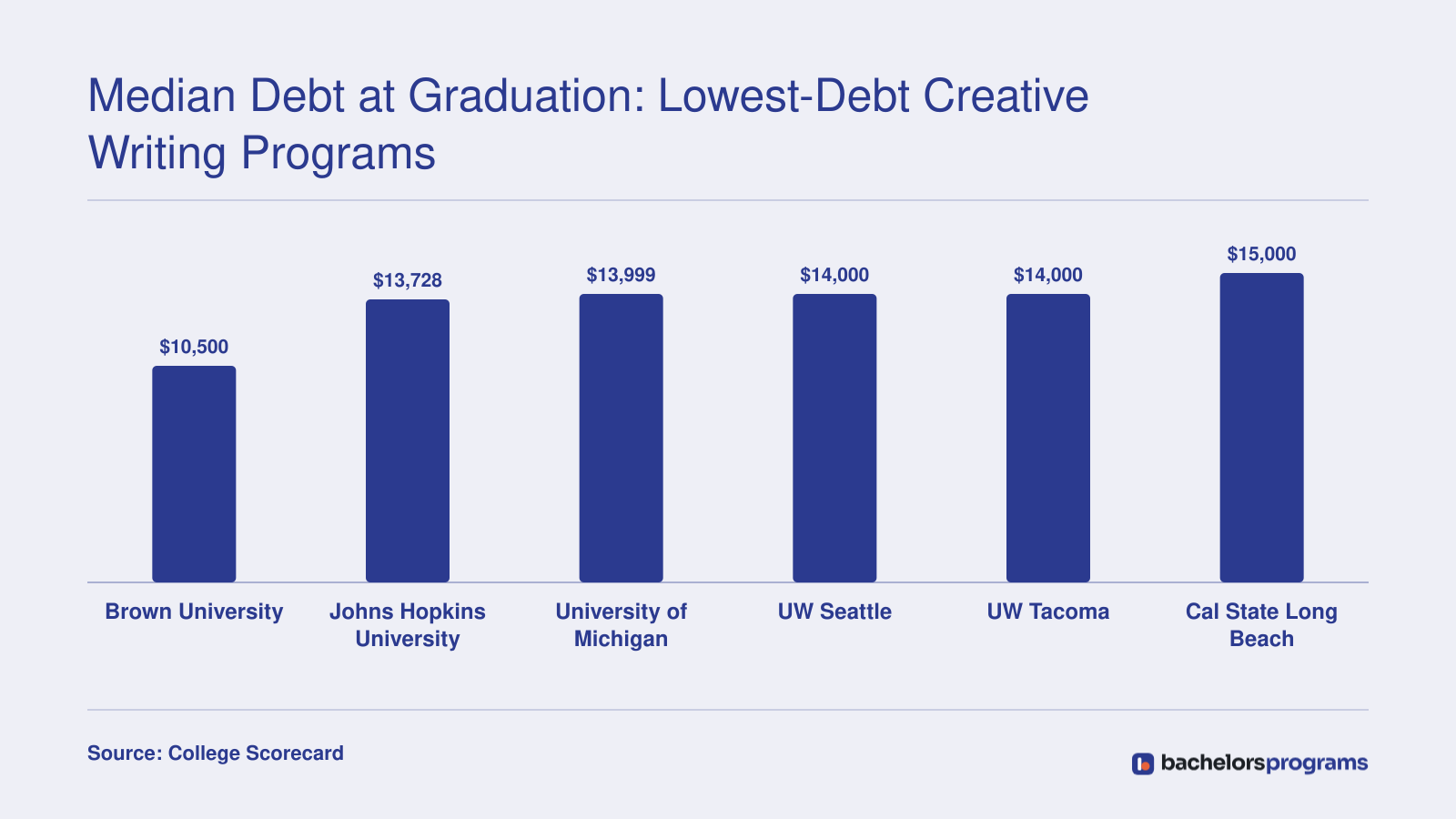
Median Debt at Graduation: Lowest-Debt Creative Writing Programs
Median federal loan debt at completion for creative writing bachelor's graduates at the lowest-debt programs here ranges from $10,500 at Brown University to $15,000 at Cal State Long Beach, according to College Scorecard. On a standard 10-year repayment plan, that works out to a median monthly payment of $111 at Brown, $146 at Johns Hopkins, $148 at Michigan and at both University of Washington campuses, and $159 at Cal State Long Beach. Programs without their own program-level debt figure are left off the chart rather than shown with a school-wide number.
Related Articles
BA vs. BFA vs. English With a Creative Writing Concentration
The three paths share a core: reading widely, writing regularly, and revising under critique. They differ in how much of your schedule goes to writing workshops and how selective the entrance process is. Rather than wait for a single national statistic, compare the programs yourself.
Compare the Curriculum Directly
Open each school's program page and its course catalog. Tally the creative-writing and workshop credits, then set them against general-education and literature credits. A B.A. often leaves room for a second major or minor. A BFA typically concentrates more of the degree in studio-style writing courses. An English major with a concentration usually leans toward literary study with a smaller writing track. Treat these as tendencies, not rules, because the mix varies from school to school.
Verify BFA Admissions Requirements
Check the admissions page for each BFA you are considering, then contact the program director or admissions office to confirm details. Ask specifically whether each of these is required, optional, or recommended:
- Portfolio: A set of your creative work, sometimes tied to a genre.
- Writing sample: A shorter piece submitted with the application.
- Statement: A personal or artistic statement of purpose.
- Interview: A conversation with faculty or staff, if offered.
Requirements can change from one admissions cycle to the next, so rely on current school sources.
Count Standalone BFA Programs
The Association of Writers & Writing Programs publishes a Guide to Writing Programs you can search to count standalone undergraduate BFA programs in creative writing. Filters and program definitions can shift the total, so read the listing criteria before drawing conclusions. Then confirm current details in AWP listings and on each school's website.
Use BLS for Career Context Only
For career outlook, turn to the Occupational Outlook Handbook at BLS.gov and to professional associations in fields such as writing, editing, and publishing. BLS does not publish BFA program counts or credit mixes. Use it for occupation outlook, and use school and program sources for curriculum and admissions specifics.
Questions to Ask Yourself
Do you already have 10 to 20 polished pages of fiction or poetry you would be comfortable submitting?
Would you rather spend most of your credits in workshops, or pair writing with a second field?
Do you want to commit to one genre now, or sample several before you choose?
Do you need an online or part-time schedule around a job, or do you want daily access to a campus literary journal and reading series?
How to Choose a Creative Writing School: Accreditation, Admissions, and Fit
Before you compare workshops or reading lists, confirm the basics. Use this checklist to evaluate any bachelor's degree in creative writing.
- Verify institutional accreditationSearch for the school in the U.S. Department of Education's DAPIP database, which lists about 6,900 institutions and programs, or in the CHEA directory. Confirm that the listing covers the specific campus or online division you plan to attend. Accreditation by a recognized agency is required for federal financial aid, and it makes your credits far more transferable, although no listing guarantees transfer. Creative writing has no separate programmatic accreditor, so institutional accreditation is the check that matters. Membership in a writers' association does not count as accreditation.
- Check writing sample requirementsFind out whether the program asks for a writing sample or portfolio when you apply, or only when you move into upper-level workshops.
- Gauge selectivityUse the school's admission rate to judge how competitive your application will be.
- Look at faculty and literary cultureLook for faculty who publish and also teach undergraduates. A student-run literary journal or a reading series is another good sign.
- Ask about internshipsAsk whether you can earn internship or practicum credit in publishing, media, or communications.
- Compare net price, not sticker tuitionCompare the net price after grants and aid, and ask about scholarships set aside for writing students.
Questions to Ask Yourself
Will you graduate with a portfolio you could send to an editor or employer, not just a transcript?
Can you get in-state tuition at a public school on this list, and how much would that save over four years?
Does the program publish a literary journal or run readings where undergraduates can get published?
If you plan to transfer in credits, will the school accept your existing coursework toward the major?
Creative Writing programs by state
Creative Writing Degree FAQs
These answers cover the questions prospective students ask most about a bachelor's degree in creative writing. Figures come from federal program-level data and the Bureau of Labor Statistics, and they are best read as general guides, not guarantees.
What is the best college for a creative writing degree?
How much do creative writing majors make?
Do you need a creative writing degree to become a published author?
Can you double major or minor in creative writing alongside a career-focused field?
Compare Creative Writing programs on the data that matters
Explore more Arts & Design majors or browse every field of study.
All Arts & Design programs Browse every field of study