Best Graphic Design Degree Programs
Compare 760+ accredited Graphic Design programs, with net price after aid, graduation rates, earnings and debt from IPEDS and the U.S. College Scorecard.

Design software tutorials are free, yet employers hiring for agency and in-house roles still screen for two things: a bachelor's degree in graphic design and a portfolio that proves the skills. Schools award the credential as a Bachelor of Science (B.S.) or Bachelor of Arts (B.A.) in Graphic Design, and the school behind it shapes both cost and pay.
The spread is wide. One year after completion, median earnings for graduates run $33,615 at Washington University in St. Louis and $66,274 at Carnegie Mellon. Average net price runs $6,541 a year at the University of Florida against $31,944 at Carnegie Mellon.
Picking a program is a financial decision as much as a creative one, and at many schools a portfolio review gates entry to the major itself.
Key Points
- Carnegie Mellon graduates lead first-year median earnings at $66,274.
- Public universities offer the lowest net prices, $4,564 to $6,555 yearly.
- Art schools like FIT and CalArts review portfolios before admission.
Best Graphic Design Schools for a Bachelor's Degree: Our Top 10
These are the 10 strongest graphic design bachelor's programs in the country by cost, completion, and outcomes. Each card below gives the school's average net price after aid (an approximate figure), its institution-wide graduation rate, whether the program runs online, on campus, or both, its city and state, and the concentration a graphic design student would actually enroll in.
University of California-Los Angeles
#1Los Angeles, CA · $13,000/yr (est. net price)
Best for: Studio-focused designers wanting small critique cohorts
UCLA runs its design work through the Department of Design Media Arts, one of the few programs where typography and creative coding sit in the same studio sequence. Studios are capped at roughly 20 students, and every major finishes with a two-quarter capstone and a public senior exhibition. The school graduates about 93% of its students. Design majors report median earnings of $57,615 one year after finishing.
- One of three undergraduate majors in the Department of Design Media Arts
- Lower-division work in typography, interaction design, and creative coding
- Upper-division electives include branding, motion graphics, and publishing
- Studios capped at no more than 20 students
- Two-quarter Senior Capstone Project and Senior Exhibition
- Creative supplement submitted through SlideRoom
- Fall-quarter entry only; UC application due November 30, 2026
- Change of major applications carry no cost
University of Georgia
#2Athens, GA · ~$14,000/yr (est.)
Best for: Designers wanting a summer studio abroad
The University of Georgia awards a BFA in Art with an emphasis in graphic design, and the studio sequence runs deeper than most large public universities: typography, type and image, advanced typography, and visual narrative systems. Entry is through a portfolio review rather than a direct admit, so the cohort is screened on craft before upper-division work begins. The school graduates about 90% of its students. Students can spend a summer studying graphic design in Cortona, Italy, and recent graduates have landed at CNN, Instagram, IBM, and Conde Nast.
- 120 credit hours including 39 in the major
- Portfolio review after three foundation courses with a C or better
- Coursework spans typography, type and image, and visual narrative systems
- Graphic Design Senior Capstone required
- Summer graphic design study in Cortona, Italy
- Experiential learning in the Layton Design Studio
- 2.5 overall GPA minimum for transfer applicants
- AIGA student chapter on campus
Florida State University
#3Tallahassee, FL · ~$11,000/yr (est.)
Best for: Applicants who want no portfolio gate
Florida State's design degree sits inside an interdisciplinary framework, so graphic design students take studios alongside spatial, experience, and fabrication coursework. There is no entry portfolio requirement, and the program is accredited by the National Association of Schools of Art and Design. The school graduates about 86% of its students. Design majors report median earnings of $49,144 one year after finishing.
- Accredited by the National Association of Schools of Art and Design
- 120 credit hours total, 68 beyond general education
- No entry portfolio requirement for admission
- Capstone required
- IDDEAS Lab fabrication space and modular wood shop on site
- Summer study abroad in London, Valencia, and Florence
University of Florida
#4Gainesville, FL · ~$7,000/yr (est.)
The University of Florida's BFA in graphic design is a portfolio-gated studio degree built around typography, hierarchy, and symbolic representation. Students clear a sophomore review before upper-division studios and finish with a senior capstone that includes a faculty-evaluated portfolio exhibition. The school graduates about 91% of its students, and the average net price after aid is among the lowest in this group for Florida residents. Design graduates report median earnings of $43,144 one year after finishing.
- 120 credit hours with a 3.0 GPA required at upper division
- Sophomore portfolio review gates upper-division studio courses
- Coursework includes typography, visual methods, and design technologies
- Senior design studio with faculty-evaluated portfolio exhibition
- Grade of C or better required in all major coursework
- Students must obtain a computer system for the first design course
- Design studio and coworking space available to majors
The University of Texas at Austin
#5Austin, TX · ~$20,000/yr (est.)
UT Austin's BFA in Design lets students pick a graphic design or product design studio after shared foundations, and the graphic track leans hard on type with three sequential typography courses plus identity systems and brand storytelling. Every student completes a design internship and a senior portfolio course before graduating. The school graduates about 89% of its students. Design majors report median earnings of $44,506 one year after finishing, with the four-year figure climbing well above that.
- 120 credit hours on a suggested four-year plan
- Two concentration studios: Graphic Design or Product Design, 15 hours each
- Typography I through III, Identity Systems, and Brand Storytelling
- Publication Studio, Information Visualization, and Interaction Design I through III
- Three-hour Design Internship built into the degree
- Capstone Design Project and Senior Portfolio course
- 42 hours of core curriculum and 12 hours of free electives
Washington University in St Louis
#6St. Louis, MO · ~$22,000/yr (est.)
Washington University in St. Louis runs communication design as a studio-intensive BFA, with 65 studio credits and tracks in illustration, graphic design, and interaction design. Seniors spend a full spring semester on a capstone that goes into a public exhibition and is reviewed by outside design professionals, closer to a graduate thesis model than a typical undergraduate show. The school graduates about 94% of its students. Design majors report median earnings of $33,615 one year after finishing.
- 65 studio credits, roughly half of total coursework
- Tracks in illustration, graphic design, or interaction design
- Foundation drawing and design studios in the first year
- Capstone semester plus annual thesis exhibition
- Public exhibition reviewed by external design professionals
- Studio spaces in upper Steinberg Hall for juniors and seniors
- Digital fabrication and printing labs on site
- Second majors and minors supported
University of Notre Dame
#7Notre Dame, IN · ~$27,000/yr (est.)
Notre Dame's design degree is a BA with a visual communication design concentration, and it asks students to pair studio work with a five-course core spanning science, math, history, philosophy, and theology. The facilities are unusually strong for an undergraduate program: a 20-station 2D computer studio, a 16-station 3D studio, and a model shop with rapid prototyping and 3D printing. The school graduates about 95% of its students. Design majors report median earnings of $46,825 one year after finishing.
- 36 credit hours in Art and Design
- 27 to 30 studio and design hours plus 6 to 9 art history hours
- Five-course core curriculum alongside design studios
- 20-station 2D computer studio and 16-station 3D computer studio
- Rapid prototyping and 3D printing in the model shop
- Design Center at West Lake Hall
- Concentration covers color, type, movement, symbols, and images
Yale University
#8New Haven, CT · ~$24,000/yr (est.)
Yale College offers a BA in art with a graphic design concentration, taught in the School of Art's studio facilities in New Haven. The major is small and review-gated: fourteen course credits, five introductory studios, a junior seminar, and a two-credit senior project. The school graduates about 96% of its students, and advanced majors who finish all undergraduate coursework in an area may occasionally take graduate courses when space allows.
- Fourteen course credits required for the major
- Five 1000-level prerequisites, including Visual Thinking and Basic Drawing
- Sophomore review of studio work required for acceptance
- Junior Seminar plus a two-credit Senior Project
- Two courses in art history, film and media studies, or visual culture
- Studio courses taken at the Yale School of Art
- Advanced majors may take graduate courses when space is available
Ohio State University
#9Columbus, OH · $17,000/yr (est. net price)
Ohio State awards a Bachelor of Science in Design in visual communication design, and the curriculum is unusually studio-heavy, with more than 65% of credit sitting in art and design. Students go through a shared Design Foundations year, then apply separately to the major, which ends in a capstone thesis. The school graduates about 88% of its students. Design majors report median earnings of $45,176 one year after finishing.
- Bachelor of Science in Design on the Columbus campus
- Shared first-year Design Foundations program
- Separate application to the major after the first year
- More than 65% of credit in art and design coursework
- Lock-step studio curriculum ending in a capstone thesis
- Student organizations include CSCA@OSU, Design for 90, and D3
- Study abroad opportunities available
Carnegie Mellon University
#10Pittsburgh, PA · ~$32,000/yr (est.)
Carnegie Mellon's B.Des. puts graphic design inside a school that also teaches product and environmental design, so communication students work beside industrial designers and share prototyping facilities. First-year students rotate through all three areas before choosing Communications, and studio courses run all four years. The school graduates about 94% of its students. Design majors report median earnings of $66,274 one year after finishing, the highest one-year figure in this group.
- Minimum of 360 units over four years
- First year covers product, communication, and environments studios
- Tracks in Communications, Products, or Environments; a dual path is allowed
- Studio courses run in all four years
- Design Studies courses in histories, systems, cultures, and persuasion
- Senior fall Design Research Studio and semester-long Capstone
- Analog and digital prototyping facility
Cost & outcomes by school
Federal data for the highest-earning Graphic Design programs, independent of the ranking above. Earnings are this field's bachelor's graduates four years after completing where the Scorecard reports them, else the school's undergraduate median.
| School | Net price / yr | Grad rate | Earnings | Debt | Grads/yr | Format |
|---|---|---|---|---|---|---|
| Carnegie Mellon University PA | $31,944 | 94% | $138,588 | $24,500 | 37 | Campus |
| Stevens Institute of Technology NJ | $41,346 | 87% | $108,772 | $27,000 | — | Campus |
| Lehigh University PA | $36,931 | 88% | $105,584 | $21,960 | 29 | Campus |
| Georgetown University DC | $40,815 | 95% | $103,494 | $15,500 | — | Campus |
| Yale University CT | $23,777 | 96% | $100,533 | $12,975 | — | Campus |
| George Washington University DC | $36,586 | 84% | $90,873 | $20,449 | 33 | Campus |
| California Polytechnic State University-San Luis Obispo CA | $16,665 | 86% | $90,768 | $18,500 | — | Campus |
| University of Washington-Seattle Campus WA | $14,091 | 85% | $89,193 | $12,250 | 41 | Campus |
| Northeastern University MA | $30,915 | 91% | $87,336 | $25,500 | 70 | Campus |
| Saint Joseph's University - Philadelphia PA | $29,689 | 79% | $86,881 | $25,500 | — | Campus |
| The Cooper Union for the Advancement of Science and Art NY | $13,269 | 81% | $83,847 | $15,000 | — | Campus |
| University of Notre Dame IN | $26,780 | 95% | $83,414 | $19,250 | 27 | Campus |
Sources: U.S. Department of Education. Net price, graduation rate, earnings and debt: College Scorecard (earnings and debt for this field's bachelor's graduates where reported, else school-wide); graduates: IPEDS. A dash means no figure is reported.
Cost, debt & payoff
Median earnings of this field's bachelor's graduates (4 yrs after completing, else the school's undergraduate median) vs. their median federal loan debt · U.S. College Scorecard
Across these programs the median graduate earns about $53,215 and finishes with roughly $23,900 in debt — a ratio that clears a common rule of thumb (keep debt below first-year salary). Net price and debt vary widely school to school, so check the per-school figures in the table above before you shortlist.
How We Ranked Graphic Design Bachelor's Programs
Prospective students ask what a design degree pays back, not just how a school is perceived. Our rankings start with federal College Scorecard data: program-level earnings after completion, median federal debt, average net price, completions, retention, and admission rate.
Why Reputation-Only Lists Fall Short
Reputation lists rarely show what graduates earn or owe. Graphic Design USA's 2026 Top Design Schools list is a curated, alphabetical, national roster informed by conversations with creative leaders, educators, hiring managers, and recruiters. It is a useful read on industry standing, but it publishes no numerical weighting and no graduate earnings or debt figures.1 Its companion gallery orders schools by student award wins, which reflects portfolio recognition rather than financial outcomes. Animation Career Review also publishes a 2025 list of 50 public U.S. graphic design schools, but we could not confirm how it is built2, so we do not lean on it.
Industry standing is what those lists measure. Our approach adds the cost and earnings side they leave out.
Limits of the Data
Federal figures have gaps, and you should know them:
- Institution-wide averages: Graduation rate and net price cover the entire school, not the graphic design program alone.
- Missing earnings: Small programs sometimes lack published earnings, which can leave a strong program with a thinner profile than it deserves.
How to Use the Rank
Treat each ranking as a shortlist, not a verdict. Once you have a few schools in mind, confirm accreditation and portfolio requirements directly with each one before you apply. Admission policies and program details change, and the school itself is the only reliable source for them.
What a Bachelor's Degree in Graphic Design Covers: B.S. vs. B.A. vs. BFA
The best degree for graphic design depends on the career you want. The BFA is studio-heavy, the B.A. is a broader liberal arts degree, and the B.S. leans toward technology, UX, and digital production. NASAD, the main accreditor for art and design programs, treats the B.A. and B.S. as liberal arts formats and the BFA as a professional format. Full-time students typically finish any of the three in four years at about 120 credits, and transfer credit can shorten that.
| Factor | B.S. in Graphic Design | B.A. in Graphic Design | BFA in Graphic Design |
|---|---|---|---|
| Degree orientation | Liberal arts format | Liberal arts format | Professional format |
| Total credit hours | About 120 at most schools | About 120 at most schools | 122 in a typical NASAD-aligned curriculum |
| Studio vs. liberal arts balance | General education of at least 42 credits, so studio share is smaller | General education of at least 42 credits, so studio share is smaller | At least 65% of credits in studio studies, with about 30 credits of general education |
| Science and humanities requirements | 7 science hours including a lab, plus 9 humanities and fine arts hours | 3 science hours, plus 12 humanities and fine arts hours | 3 science hours, plus 12 humanities and fine arts hours |
| Typical length | Four years full time; transfer credit can shorten it | Four years full time; transfer credit can shorten it | Four years full time; transfer credit can shorten it |
| Technical emphasis | Highest: technology, UX, and digital production | Moderate: design paired with broader coursework | Craft and concept first, with technical skills built into studio work |
| Portfolio intensity | Moderate, often weighted toward digital and interface projects | Moderate, with room for electives and a second field | Highest: deep studio sequence and a demanding capstone portfolio |
| Best-fit career paths | UX/UI, web design, digital production | Marketing, communications, in-house design, design plus another field | Brand identity, art direction, studio and agency design |
| Core curriculum shared by all three | Typography, branding and identity, motion graphics, UX/UI, print production, capstone portfolio | Typography, branding and identity, motion graphics, UX/UI, print production, capstone portfolio | Typography, branding and identity, motion graphics, UX/UI, print production, capstone portfolio |
Related Articles
Online vs. Campus Graphic Design Programs: Which Format Fits You
UCLA caps its design studios at 20 students, Florida State runs a modular wood shop alongside its IDDEAS Lab fabrication space, and Carnegie Mellon keeps students in studio courses all four years. That is the case for campus study: equipment, square footage, and a critique room full of people looking at your work.
Can you earn the degree online? Yes
Accredited online bachelor's programs in graphic design do exist, and an online student at an accredited, state-authorized school is treated the same as a campus student for federal aid purposes. The schools ranked here, by contrast, deliver their degrees on campus, built around studio sequences, print and prototyping labs, and in-person reviews like the sophomore portfolio check at the University of Florida.
Online study buys flexibility: you keep your job, you work at night, you skip relocation. What it does not hand you is a cohort. You have to build peer feedback yourself through design communities, AIGA chapters, freelance work, and instructor office hours. Ask any online program how critique actually happens and whether it is live or asynchronous before you enroll.
Transfer credit can shorten either path
An associate degree does not automatically clear bachelor's requirements, but articulation agreements can move a lot of credit. Oakland Community College's 65-credit Associate in Graphic Design feeds Oakland University's 124-credit bachelor's1, and Broward College's Associate of Science in Graphic Design transfers toward Florida Atlantic's BFA in Graphic Design, a 60-credit program with a 2.0 minimum GPA, admission requirements still applying.2 For 2026-2027, UNLV dropped the general 60-credit transfer cap for its design pathway while still requiring at least 30 upper-division credits in residence.3 Get a written transcript evaluation, and ask directly whether portfolio work can substitute for any studio course.
Paying for it
File the FAFSA either way. Direct Subsidized and Unsubsidized Loans require at least half-time enrollment; Pell Grants generally do not.4 Then chase design-specific awards: the YoungArts Design Arts Award, for example, covers graphic design applicants ages 15 to 18, with the 2026 cycle closing October 7.5
Cost, Debt, and Return on Investment: The Most Affordable Picks
The most affordable picks here are all public universities, with average net prices of $4,564 to $6,555 a year, so if a private school on the list appeals to you, weigh its net price against these figures first. Net price is the average yearly cost after grants and scholarships, drawn from U.S. Department of Education data, not a personal quote, so use each school's net price calculator to estimate your own number. To judge return on investment, compare what you'll owe with what graduates of the program earn early on: Cal State San Bernardino graphic design graduates carry median federal debt of $15,669 and earn a median $24,604 one year after finishing ($42,348 at five years), while University of Florida graduates owe $19,839 and earn $43,144 at one year ($73,474 at five years).
| School | Location | Average Net Price (per year) | Median Federal Debt at Completion | Estimated 10-Year Monthly Payment | Format |
|---|---|---|---|---|---|
| California State University-San Bernardino | San Bernardino, CA | $4,564 | $15,669 | $166 | On campus |
| University of Florida | Gainesville, FL | $6,541 | $19,839 | $210 | On campus |
| California State University-Fullerton | Fullerton, CA | $6,555 | Not reported | Not reported | On campus |
What Graphic Designers Earn Nationally
Federal wage data gives a useful baseline for what a bachelor's degree in graphic design can lead to once you are working in the field.
Graphic Design Degree Starting Salary and Career Outcomes
Among the programs that report one year after completion, median graduate earnings run from $34,670 (University of Illinois Urbana-Champaign) to $66,274 (Carnegie Mellon University). Five years after completion, the range is $67,824 (Cal State Long Beach) to $93,917 (San Jose State University). Carnegie Mellon's median reaches $138,588 four years out, but it is a clear outlier.
Why New Graduates Start Below the National Median
The BLS median for all graphic designers was $62,960 in May 2025.1 Most of the one-year figures above sit under that line, and nearly every five-year figure sits above it. The national median blends designers at every stage of a career, while new graduates start in junior production and assistant roles. The BLS range runs from under $39,520 for the lowest 10% to over $104,910 for the highest 10%1, and a compilation of the same May 2025 data puts the middle half at $49,040 to $81,830.2 Pay grows as designers take on ownership of projects, clients and teams.
The programs ranked here are selective and well regarded. Your own results will depend on your region, portfolio and employer.
Where Pay Tends to Climb
Industry medians are fairly close together: specialized design services at $63,780, information at $62,970, advertising and related services at $61,200, and manufacturing at $51,670.1 The bigger gains usually come from the role rather than the employer type. Program pages at Florida, Illinois and Cal State Long Beach point toward UX/UI design, art direction and in-house brand roles at tech or advertising firms. Freelancing is also common: about 20% of graphic designers are self-employed.1 Freelance income swings more than salaried pay, so budget for it.
Is a Bachelor's Degree in Graphic Design Worth It?
The degree pays off when two conditions hold. First, your debt stays manageable against those early earnings, which is why public in-state options carry weight. Second, your portfolio is strong enough to land a good first job. A degree without a standout body of work rarely pays off. A degree that produces both studio skills and a professional portfolio usually does, especially if you move toward interaction design or art direction.
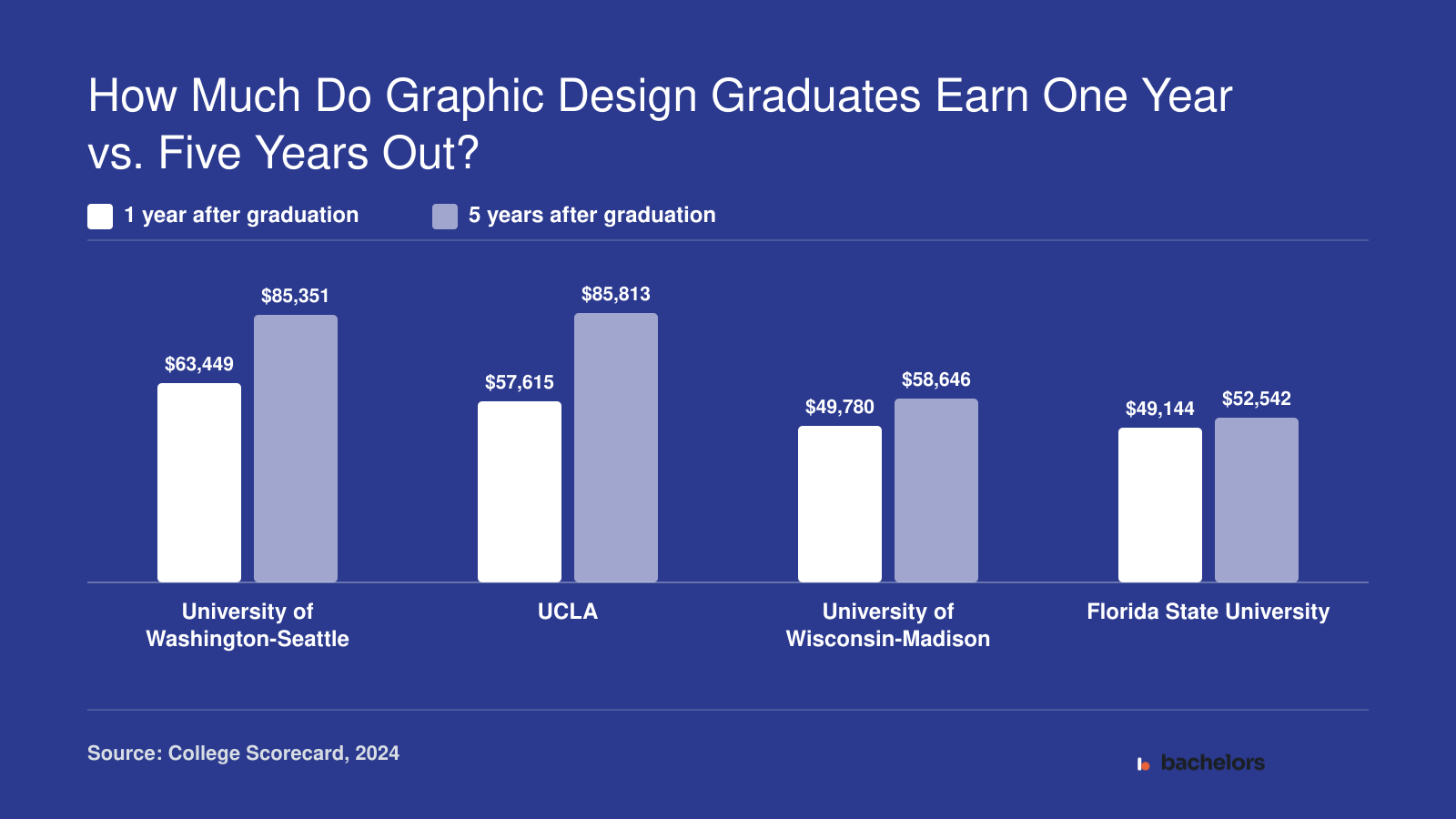
How Much Do Graphic Design Graduates Earn One Year vs. Five Years Out?
The chart compares median program earnings one year and five years after completion for ranked schools that publish both figures for their graphic design bachelor's graduates. The gap between the two bars shows how fast design pay climbs once graduates build experience. UCLA shows the steepest rise, from $57,615 to $85,813, while Florida State grads move from $49,144 to $52,542.
Admissions and Portfolio Requirements Checklist
Requirements for a bachelor's degree in graphic design depend on the school type. Art schools and BFA programs such as FIT and CalArts review a portfolio before admission. Many universities admit students first and hold a portfolio review after foundation courses. Check each school's admission rate in the ranking above to gauge how much your portfolio will matter.
- High school diploma or GEDFirst-year applicants need one. Confirm each school's minimum GPA and testing policy with its admissions office.
- PortfolioPiece counts vary. UCF asks for 5 projects, FIT for 12–15, and CalArts for 20–30 slides. Media can be broad: WVU accepts animation, video, performance, and sound.
- Formats and labelsMontclair State takes PDF, JPG, PNG, website, or slideshow files up to 10 MB. WVU asks for the title, medium, and a description of each piece.
- Artist statement or essayLengths range from 150–250 words at Champlain to one page at UCF and 500–1,000 words at CalArts.
- Recommendation lettersSome programs request them. Confirm the number with each school.
- Transfer transcripts and sophomore reviewUF requires a sophomore review before upper-level studios. Colorado Mesa requires grades of B or higher in its foundation courses. Nicholls State reviews students at 30 credit hours.
Graphic Design programs by state
Compare Graphic Design programs on the data that matters
Explore more Arts & Design majors or browse every field of study.
All Arts & Design programs Browse every field of study