Best Art History Degree Programs
Compare 490+ accredited Art History programs, with net price after aid, graduation rates, earnings and debt from IPEDS and the U.S. College Scorecard.

A bachelor's degree in art history trains students in visual analysis, archival research and argumentative writing, skills that transfer well beyond the museum. The degree is usually a Bachelor of Arts (B.A.) in Art History, offered at everything from public flagships to Ivy League departments.
The tension is practical. Sticker prices at private schools such as Princeton and Columbia exceed $60,000 a year, while UCLA and the University of Florida cost a fraction of that for in-state students. Outcomes and collection access vary just as widely, and many curatorial roles still expect graduate study after the B.A.
Key Points
- UNC Chapel Hill posts the lowest net price here: $11,655.
- Columbia University graduates earn the strongest median pay one year out.
- Most schools award a B.A., while SCAD offers a studio-focused B.F.A.
Best Schools for a Bachelor's Degree in Art History
Each program below awards a bachelor's degree in art history, and every entry balances three things: what the degree costs after aid, how many students actually finish, and how selective the door is. Cards are ordered by that combined picture and carry program-level detail on internships, collections access, and thesis requirements. The section just below the list explains how we weighted those factors.
Princeton University
#1Princeton, NJ · ~$6,000/yr (est.)
Best for: Thesis-focused researchers in art history
Princeton's art history major lives in the Department of Art and Archaeology, where the A.B. in History of Art pairs a broad foundation in periods and regions with unusually heavy independent work: a junior paper of roughly 30 to 40 pages and a senior thesis of 60 to 80 pages, defended in a one-hour oral exam before three faculty. Majors also meet twice a year in colloquia with the Practice of Art cohort, and up to two approved courses may be taken at other institutions. A departmental art library of about 500,000 volumes gives thesis writers a deep research base on campus.
- 13 departmental courses, no more than two cognates from other departments
- Junior paper of roughly 30 to 40 pages
- Senior thesis of 60 to 80 pages
- Year-long senior research project closes with a one-hour oral exam
- Junior seminar ART 390 required
- Two colloquia a year with the Practice of Art cohort
- Declare the major in spring of sophomore year
- Up to two departmental courses may be taken at other institutions
University of California-Los Angeles
#2Los Angeles, CA · $13,000/yr (est. net price)
Best for: Curatorial hopefuls wanting broad global coverage
UCLA's art history bachelor's degree spreads 11 upper-division courses across three historical periods and at least three geographic regions, so graduates leave with working knowledge of African, Asian, European and American, Latin American, Mediterranean, and Middle Eastern traditions rather than a single specialty. Four lower-division preparation courses come first, and one elective may be drawn from another department with advisor approval. Seniors holding a 3.8 UC GPA can enter the honors program, which ends in a roughly 30-page thesis and a presentation at the spring Honors Student Symposium.
- 11 upper-division courses after four lower-division prep courses
- One course each in Ancient/Medieval, Early Modern, Modern/Contemporary
- Three courses spanning at least three geographic regions
- Five art history electives; one may come from another department
- Honors requires a 3.8 UC GPA and a roughly 30-page thesis
- Honors students present at the spring Honors Student Symposium
University of California-Berkeley
#3Berkeley, CA · ~$13,000/yr (est.)
Best for: Visual culture thinkers drawn to seminars
The History of Art major at Berkeley is built as a sequence from lower-division surveys through upper-division lectures, seminars, and an optional honors program. The department frames the field around artistic traditions, practices, and contexts, including historical and contemporary visuality, and asks students to weigh visual, material, and textual evidence from specific cultures and historical circumstances. Requirements deliberately spread majors across periods, regions, and topics while leaving room to pursue a particular interest, and written argument and independent research are treated as core skills rather than side benefits.
- Coursework runs lower division, upper division, seminars, honors
- Distribution across historical periods, regions, and topics
- Trains students in visual, material, and textual evidence
- Seminar and honors program for advanced majors
- Emphasis on independent research and academic writing
Columbia University in the City of New York
#4New York, NY · ~$22,000/yr (est.)
Columbia's Art History major is an 11-course program in the Department of Art History and Archaeology, with distribution across four historical periods and five geographic regions, two seminars, and a required studio art course in the Visual Arts Department. A Majors Colloquium, normally taken in junior year, anchors the cohort, and an optional year-long senior thesis seminar opens the path to departmental honors at a 3.7 GPA in art history courses. The department grants no AP or IB credit and accepts at most three transfer courses toward the major, so most of the sequence happens in residence on the Morningside Heights campus, where museum assignments and New York City site visits supplement classroom work.
- 11 courses, 36 to 43 points
- Three of four historical periods plus two of five geographic regions
- Two seminars, two electives, and the Majors Colloquium in junior year
- Studio art course in the Visual Arts Department required
- Senior thesis seminar, 6 points, qualifies for honors at a 3.7 GPA
- No AP or IB credit; at most three transfer courses count
- Museum assignments and New York City site trips
University of Florida
#5Gainesville, FL · ~$7,000/yr (est.)
Florida's Bachelor of Arts in Art History runs from introductory surveys of African, Asian, ancient through medieval, Renaissance to modern, and Latin American art into advanced electives that reach from the Royal Cemetery of Ur and the Templo Mayor to Rococo France, modern Mozambique, and contemporary Korea. Courses meet in the Harn Museum and University Galleries, and the HESCAH series brings international scholars to campus. A capstone thesis written in a small-group Senior Seminar with core research faculty closes the degree, and the program draws on archaeology, anthropology, religion, and literature alongside art history.
- Global surveys from African and Asian to Latin American art
- Advanced electives from Ancient Rome to contemporary Korea
- Classes visit the Harn Museum and University Galleries
- HESCAH series brings international scholars to campus
- Capstone thesis in a small-group Senior Seminar
- Interdisciplinary work across archaeology, religion, and literature
Harvard University
#6Cambridge, MA · $15,000 – $20,000/yr (est.)
Harvard's History of Art and Architecture concentration is one of roughly 50 undergraduate fields, and its gateway courses run from a visual arts colloquium and Contemporary Art to Notre-Dame of Paris, the Spanish Golden Age, world architecture, and Buddhist arts of space and place; first-year seminars can also count. Students may add a secondary field as a minor. The Alexis Gregory Undergraduate Internship and Travel Fund, open to sophomores, juniors, and seniors concentrating fully or jointly in the field, supports paid research hours, about 10 a week at $16 an hour, with the Harvard Art Museums' European works from 1400 to 1900, plus travel planning alongside a supervising curator.
- One of roughly 50 undergraduate concentrations
- Gateway courses from Contemporary Art to Buddhist arts of space and place
- First-year seminars such as Michelangelo: Terrible Genius count
- Secondary field can be added as a minor
- Alexis Gregory Undergraduate Internship and Travel Fund for concentrators
- Paid spring research with Harvard Art Museums' European works, 1400 to 1900
- Roughly 10 hours a week at $16 an hour, not for course credit
Stanford University
#7Stanford, CA · $10,000 – $15,000/yr (est.)
Stanford awards its art history bachelor's degree through the Department of Art & Art History, and suggested preparation pairs ARTHIST 5, Art and Power, with surveys such as Introduction to Experiencing Early Global Art and Architecture, How to Look at Art and Why, Asian Arts and Cultures, and Introduction to Islamic Art. Declaring the major means meeting the student services specialist, choosing a faculty advisor, and filing on Axess. Majors also complete a required orientation with Art and Architecture Library staff covering research and reference tools in the quarter after declaring.
- Suggested preparation: ARTHIST 5, Art and Power
- Surveys include How to Look at Art and Why
- Declare by meeting the student services specialist and a faculty advisor
- Library research orientation required in the quarter after declaring
Amherst College
#8Amherst, MA · ~$23,000/yr (est.)
Amherst's bachelor's major in Art and the History of Art offers two concentrations, History of Art and Practice of Art, and students work in studio spaces, darkrooms, and galleries as well as seminar rooms. The department publishes explicit learning goals and major requirements, and seniors produce art theses. Study away and summer study options let majors build in time abroad or intensive summer work within the degree.
- Two concentrations: History of Art and Practice of Art
- Studio spaces, darkrooms, and galleries
- Senior art theses
- Study away and summer study options
Yale University
#9New Haven, CT · ~$24,000/yr (est.)
Yale's Department of the History of Art treats looking itself as the core method: classes center on sustained attention to works of art, texts contemporary with their production, and the materials, politics, social institutions, religion, technology, and urban context that shaped them. The undergraduate program publishes its requirements, senior essay expectations, prizes and awards, and a running list of opportunities for majors. A director of undergraduate studies oversees advising for the concentration.
- Classes center on close looking at works of art
- Reads texts contemporary with the works studied
- Senior essay required of majors
- Prizes and awards listed for majors
- Director of undergraduate studies oversees advising
University of Chicago
#10Chicago, IL · ~$15,000/yr (est.)
Chicago's BA in Art History is a tightly structured ten-course major organized as four distribution courses, three in a Special Field, two free electives, and the methods seminar Doing Art History. Majors write two research papers of 10 to 15 pages; honors adds a senior thesis workshop and a 20- to 30-page BA paper, with eligibility set at a 3.5 major GPA and 3.3 cumulative. Up to four courses taken outside the University may count, AP credit cannot, and qualified undergraduates may enroll in graduate seminars with instructor permission.
- 10 courses organized as 4-3-2-1
- Methods seminar: ARTH 29600 Doing Art History
- Two research papers of 10 to 15 pages
- Honors adds ARTH 29800 and a 20- to 30-page BA paper
- Honors eligibility: 3.5 major GPA, 3.3 cumulative GPA
- Up to four outside courses count; AP credit does not
- Qualified undergraduates may take graduate seminars
Cost & outcomes by school
Federal data for the highest-earning Art History programs, independent of the ranking above. Earnings are this field's bachelor's graduates four years after completing where the Scorecard reports them, else the school's undergraduate median.
| School | Net price / yr | Grad rate | Earnings | Debt | Grads/yr | Format |
|---|---|---|---|---|---|---|
| Stanford University CA | $13,807 | 92% | $124,080 | $12,000 | 21 | Campus |
| Princeton University NJ | $6,128 | 98% | $110,066 | $10,320 | 11 | Campus |
| Santa Clara University CA | $50,062 | 88% | $109,183 | $19,162 | 19 | Campus |
| Lehigh University PA | $36,931 | 88% | $105,584 | $21,960 | 2 | Campus |
| Boston College MA | $41,704 | 91% | $103,937 | $19,000 | 22 | Campus |
| Georgetown University DC | $40,815 | 95% | $103,494 | $15,500 | 19 | Campus |
| Columbia University in the City of New York NY | $21,590 | 96% | $102,491 | $27,000 | 42 | Campus |
| Harvard University MA | $19,066 | 98% | $101,817 | $14,000 | 16 | Campus |
| Yale University CT | $23,777 | 96% | $100,533 | $12,975 | 54 | Campus |
| University of Notre Dame IN | $26,780 | 95% | $99,980 | $19,000 | 13 | Campus |
| Duke University NC | $29,612 | 97% | $97,800 | $13,000 | 9 | Campus |
| Washington and Lee University VA | $23,781 | 94% | $94,810 | $19,500 | 16 | Campus |
Sources: U.S. Department of Education. Net price, graduation rate, earnings and debt: College Scorecard (earnings and debt for this field's bachelor's graduates where reported, else school-wide); graduates: IPEDS. A dash means no figure is reported.
Cost, debt & payoff
Median earnings of this field's bachelor's graduates (4 yrs after completing, else the school's undergraduate median) vs. their median federal loan debt · U.S. College Scorecard
Across these programs the median graduate earns about $49,842 and finishes with roughly $22,954 in debt — a ratio that clears a common rule of thumb (keep debt below first-year salary). Net price and debt vary widely school to school, so check the per-school figures in the table above before you shortlist.
How We Ranked These Art History Programs
This ranking compares schools that award a bachelor's degree in art history, using public federal data that any family can look up and verify. Four measures carry the weight:
- Net price: what students pay on average once grants and scholarships are applied, not the sticker tuition.
- Graduation rate: the proportion of students who finish their degree at the institution.
- Selectivity: how competitive admission is, based on acceptance rates.
- Outcomes: College Scorecard figures such as early-career earnings and median debt, used where they are published.
What the Numbers Can and Can't Tell You
Campus-wide completion rates and average prices describe the whole institution, not the art history department. A university with a strong overall completion rate may have a small major with its own advising culture and class sizes. Program-level earnings show up only when the College Scorecard publishes them, so outcome figures appear on some cards and not others.
Campus, Online and Hybrid Options
The list covers all formats. Each card flags whether a program is offered on campus, online or in a hybrid format, but format itself doesn't move a school up or down.
What You Still Need to Check Yourself
No dataset captures the qualities that often define an art history education. Before you apply, look into:
- Faculty fit: whether professors research the periods and regions that interest you.
- Collection access: campus museums, nearby institutions and internship connections.
- Specializations: concentrations such as museum studies, architectural history or non-Western art.
3 Most Affordable Art History Degree Programs
Published tuition is the sticker price, while average net price is what students who received aid actually paid after grants and scholarships, based on 2024 IPEDS and College Scorecard data from the U.S. Department of Education. Treat net price as an average across aided students, not a quote for your own bill. Princeton University, a private school, posts the lowest net price here despite $62,688 in published tuition because of its large aid awards, while the University of Florida and the University of Central Florida are public universities with in-state tuition under $6,400. Out-of-state students at those two Florida schools face published tuition of $28,659 and $22,467, and public net price figures are calculated for in-state students, so nonresidents should expect to pay more.
| School | State | Format | Average Net Price | In-State Tuition | Out-of-State Tuition |
|---|---|---|---|---|---|
| Princeton University | NJ | On campus | $6,128 | $62,688 | $62,688 |
| University of Florida | FL | On campus | $6,541 | $6,381 | $28,659 |
| University of Central Florida | FL | On campus | $10,411 | $6,368 | $22,467 |
Art History Degree Cost: Net Price, Debt, and Who Gets Aid
What does a bachelor's degree in art history actually cost after aid?
Net price, the average price students pay after grant aid, runs from $11,655 at the University of North Carolina at Chapel Hill to $17,716 at Williams College. Most of the public universities here sit between roughly $12,470 and $16,110, while Williams, one of several private liberal arts colleges on the list, lands at the high end. The spread between the lowest and highest net price is about $6,000 a year.
Debt After Graduation
Program-level median federal debt for art history graduates ranges from $9,899 at San Diego State University to $17,635 at UC Irvine. On a standard 10-year repayment plan, that translates to about $109 to $166 a month. Those figures describe federal loans tied to the program, not private loans or parent borrowing. A lower debt figure can reflect lower tuition, faster completion, or more grant aid, so read it alongside net price rather than in isolation.
Pell Share and Aid Access
Pell share shows the percentage of undergraduates receiving federal Pell Grants, a rough marker of lower-income enrollment. The highest shares here belong to UC Irvine (76.5%), UC Santa Barbara (72.8%), UC Davis (72.2%), UC San Diego (72.0%) and San Diego State (70.2%). UNC Chapel Hill is lowest at 51.4%. A high Pell share often signals that a campus has built substantial need-based aid and support services for lower-income students. A lower share does not mean aid is scarce, especially at private colleges with large endowments.
Check the Net Price Calculator
Before applying, run each art history program's net price calculator. Private sticker prices often shrink substantially after institutional aid, and the estimate is the fastest way to compare what your family would actually pay.
Related Articles
B.A. vs. B.F.A. vs. Liberal Arts Art History Degrees
Most schools award a Bachelor of Arts (B.A.) in art history, while some art and design schools, such as SCAD, award a B.F.A. with a stronger studio component. Small liberal arts colleges usually offer a B.A. with close faculty mentoring and a senior thesis. Requirements vary by school, so treat the liberal arts column as typical patterns and confirm details in each catalog. If you are aiming for museum or academic careers, choose a B.A.; if you want to make art alongside studying it, choose a B.F.A.
| Factor | B.A. in Art History | B.F.A. in Art History (SCAD example) | Liberal Arts College B.A. |
|---|---|---|---|
| Credit share in the major | Varies by school. SCAD's four-year B.A. totals 180 quarter hours (120 semester hours) | 65 of 180 quarter hours in the major curriculum, about one third of the degree | Varies; usually a minority of roughly 120 semester credits, leaving room for electives |
| Studio art requirement | Often little or none; some schools ask for an introductory course | 25 quarter hours of foundation studies, including Sketching and Drawing and Color in Context | Typically optional studio electives rather than a requirement |
| General education breadth | SCAD B.A. programs require at least 50 quarter hours (11 or more classes) across humanities, social sciences, and math/science | 65 quarter hours, including writing, communication, business, and math/natural sciences | Usually broad distribution requirements across many disciplines |
| Foreign language | May count toward general education; the sequence depends on the school | Three courses in general education, all in the same language | Often expected, commonly through an intermediate level; confirm by college |
| Capstone and mentoring | Varies; a thesis or seminar paper is common | Art History B.F.A. Thesis plus upper-level electives across four of five concentrations | Senior thesis commonly required, with close one-on-one faculty advising |
| Best-fit student | Students headed toward museums, galleries, or research-focused study | Students who want art-making skills and design foundations alongside art history | Students who value small classes, mentoring, and a wide liberal arts base |
Can You Earn a Bachelor's in Art History Online?
An online bachelor's in art history is the same Bachelor of Arts credential delivered through remote coursework. It carries the same title, and usually the same curriculum, as the on-campus version. The real question is how a program handles the work that normally happens in a gallery: looking closely at objects, comparing paintings and prints in person, and logging internship hours.
Fully Online Options
Every program on the ranked list below is campus-based, so anyone who needs remote study has to look beyond it. Arizona State University is the clearest regionally accredited option: a fully online Bachelor of Arts in Art with an Art History concentration worth 120 credits, though the same concentration also runs in person, so confirm your courses stay online. Lindenwood University's Bachelor of Arts in Art History and Visual Culture is 100% online and finishes in three to four years1; ask about its regional accreditation directly, since the program materials do not name one. Newlane University is fully online and self-paced, but it awards a Bachelor of Arts in Liberal Arts with an Art History specialization and holds national accreditation from the Distance Education Accrediting Commission, which some graduate programs and employers will not accept.2 Utah Valley University's online-plus degree mixes formats and may require campus visits.3
The Limits of Remote Study
A screen cannot replace standing in front of a work and reading its surface, scale and brushwork. Programs compensate in different ways. Lindenwood uses VR headsets to walk through Raphael's Vatican Rooms; others lean on digitized collections and image databases, and some help students line up an internship at a museum or gallery near home. Ask an advisor how object-based assignments work and who finds the internship before you enroll.
Who Online Fits
Online study suits working adults with full-time jobs, transfer students who already hold credits, and career changers who live within commuting distance of a museum, that proximity is what makes a remote internship workable.
Top Early-Career Earnings Among Ranked Art History Programs
One year out, art history graduates from Columbia University post the strongest median pay among the schools ranked here.
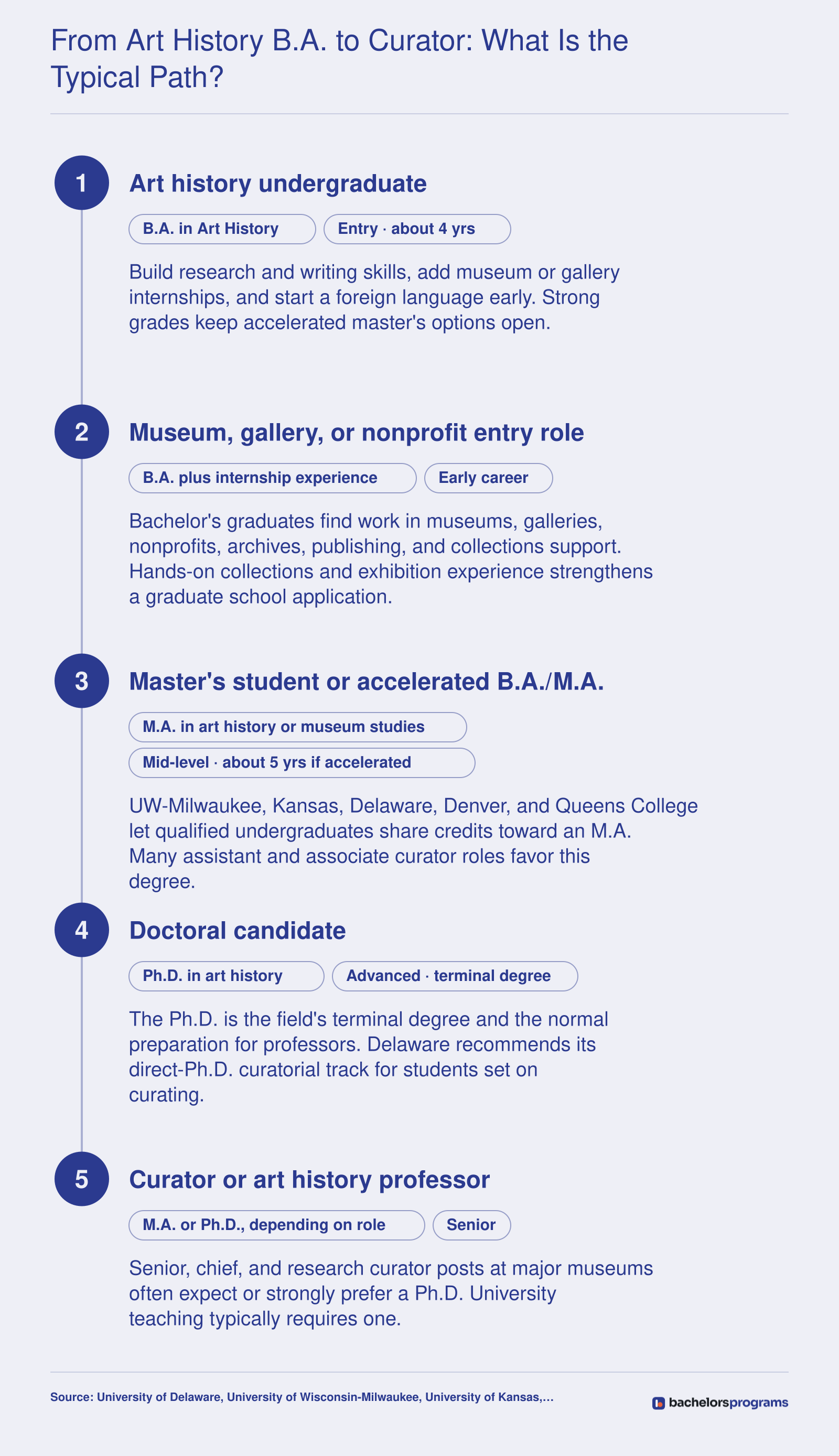
From Art History B.A. to Curator: What Is the Typical Path?
Many museum roles favor or expect graduate study, so undergraduate research, writing, and language skills matter from the first year. There is no single national sequence, and the right path depends on whether you are aiming for collections work, curating, or teaching. Accelerated B.A./M.A. tracks can shorten the climb to about five years, though the requirements differ by school.
Art History programs by state
Art History Degree FAQ
These are the questions prospective art history majors ask most often. The answers reflect guidance from university career offices and law school admissions pages, so check each school's own requirements before you commit.
Is an art history degree worth it if I don't want to work in a museum?
Do I need to speak another language to major in art history?
Can an art history major go to law school?
Should I double major or minor alongside art history (e.g., business, museum studies, computer science)?
Compare Art History programs on the data that matters
Explore more Arts & Design majors or browse every field of study.
All Arts & Design programs Browse every field of study