Best Fine Arts Degree Programs
Compare 1,250+ accredited Fine Arts programs at 980+ colleges, with net price after aid, graduation rates, earnings and debt from IPEDS and the U.S. College Scorecard.

A bachelor's degree in fine arts, most often a Bachelor of Fine Arts (B.F.A.) or a Bachelor of Arts (B.A.), costs $6,381 a year in-state at the University of Florida and $71,845 at Columbia University. The major is the same. The sticker price is more than eleven times higher.
Most online rankings of art schools lean on reputation surveys, which say little about what a studio degree costs or how many students finish it. Admission is also uneven, from portfolio-driven selection to open enrollment into the major.
Studio majors have no licensing exam and no fixed employer pipeline, so debt load tends to matter more than the name on the diploma.
Key Points
- Princeton's $62,688 sticker price falls to a $6,128 average net price.
- Affordability, completion and graduate outcomes drive these rankings more than prestige.
- At some universities, portfolio review comes after general admission, not before.
Best Fine Arts Schools Ranked: Top 10 for Bachelor's Students
These ten programs are ranked on a blend of affordability, completion and outcomes, so a well-priced public studio program can sit beside famous private names. Each card covers what the art department actually offers, plus how selective the school is and how many students finish.
Princeton University
#1Princeton, NJ · ~$6,000/yr (est.)
Best for: Aspiring filmmakers drawn to fine art
Princeton awards a bachelor's degree in The Practice of Art through the Department of Art & Archaeology, with studio work in painting, drawing, graphic design, photography, film/video and sculpture. About 5% of applicants are admitted and the school graduates 98% of students, so the program stays small and highly selective. Juniors get shared studio loft space around the clock, seniors get semi-private studios, and a dedicated film track runs through the major.
- Studio courses in painting, drawing, graphic design, photography, sculpture
- Dedicated film track for majors and visual arts minors
- Juniors get 24/7 shared studio loft space
- Seniors get semi-private studios and show work in three galleries
- Facilities include darkrooms, ceramics, welding and mold-making areas
- Letterpress studio, film editing bays and 35 mm projection theater
- Visual Arts minor can pair with another major
Rice University
#2Houston, TX · ~$13,000/yr (est.)
Best for: Small-cohort learners wanting close critique
Rice's Bachelor of Arts in Art packs 13 courses, 39 to 40 credit hours, into a 120-credit degree, with a two-semester Senior Studio option that ends in an exhibition. The school admits about 8% of applicants and graduates 95% of students. Studio work spans 2-D and 3-D design, sculpture, drawing, painting, printmaking, film and photography, and studio-option seniors receive their own work spaces.
- 13 courses, 39 to 40 credit hours inside a 120-credit degree
- At least 6 courses must be at the 300 level or above
- Capstone is two-semester Senior Studio or Senior Seminar
- Studio work in 2-D and 3-D design, sculpture, drawing, painting, printmaking
- Major GPA of 2.00 or higher required
- Studio-option seniors get individual studio spaces and a year-end show
- No more than 2 courses of transfer or study abroad credit apply
University of Chicago
#3Chicago, IL · ~$15,000/yr (est.)
Best for: Interdisciplinary thinkers pairing art with research
The University of Chicago offers a Visual Arts major inside its liberal arts College, and the campus arts ecosystem includes the Gray Center for Arts and Inquiry, which brings visiting artists and scholars into collaborative projects. The school admits about 5% of applicants and graduates 96% of students. It fits students who want studio practice sitting alongside heavy reading, writing and critique.
- Visual Arts major offered through the undergraduate College
- Gray Center for Arts and Inquiry hosts visiting artists and scholars
University of Florida
#4Gainesville, FL · ~$7,000/yr (est.)
Florida's School of Art + Art History awards both a BFA in Art and a BFA in Graphic Design, plus a BA in Art for students who want fewer studio courses. The school admits about 24% of applicants and graduates 91% of students, making it the most accessible entry point in this group. BFA students spend their first two years in a cross-media foundations program before developing a personal body of work.
- BFA in Art, BFA in Graphic Design, and a BA in Art option
- Foundations program across media spans the first two years
- Upper-level studios across several media build a personal artistic idiom
- Emphasis on contemporary art theories and practices
- BA in Art requires ten fewer studio courses than the BFA
- Prepares students for work as artists, designers or graduate study
University of California-Berkeley
#5Berkeley, CA · ~$13,000/yr (est.)
Art Practice at Berkeley is a BA in studio art that finishes with a senior thesis project shown at the Worth Ryder Art Gallery. The school admits about 11% of applicants and graduates 93% of students. Concentrations run from painting and printmaking to ceramics, performance and new media, and declaring the major requires a 2.0 GPA with C- or better in major courses.
- Five lower-division courses including ART 8 Introduction to Visual Thinking
- At least three Art History courses required
- Concentrations include painting, printmaking, ceramics, new media and video
- Capstone senior thesis project shown at the Worth Ryder Art Gallery
- High-demand major: 2.0 GPA overall and in major courses
- Transfer students typically finish in four semesters
- Individual studios available through the ASCP program
Columbia University in the City of New York
#6New York, NY · ~$22,000/yr (est.)
Columbia College's Visual Arts major runs through the School of the Arts, with studio courses in drawing, painting, photography, printmaking, sculpture and moving image taught in the Dodge Building and Prentis Hall. About 4% of applicants are admitted and the school graduates 96% of students. Seniors complete a two-semester thesis with visiting critics and receive studio space.
- Major requires 35 to 36 points, 32 inside the program
- Seven 3-point studio courses plus two 4-point Senior Project semesters
- Studio areas include drawing, painting, photography, printmaking, sculpture
- Senior Thesis I and II plus Visiting Critic I and II form the capstone
- Portfolio review and two remaining semesters required for Senior Thesis
- No AP credit accepted; transfer credit capped at 12 points
- Senior Thesis students get studio space with a $150 refundable deposit
- Classes meet in the Dodge Building and Prentis Hall
Stanford University
#7Stanford, CA · $10,000 – $15,000/yr (est.)
Stanford's Art Practice BA is a 65-unit major that pairs six lower-level and six upper-level studio courses with art history and critical theory. The school admits about 4% of applicants and graduates 92% of students. Seniors finish with a capstone and the Senior Art Exhibition, and selected students can add a year-long honors thesis with a materials stipend.
- 65-unit major inside a 180-unit bachelor's degree
- Six lower-level and six upper-level studio courses
- Four art history or critical theory courses
- Capstone ends in the Senior Art Exhibition
- Year-long honors program adds 6 units and a written thesis
- Honors students receive studio space and a materials stipend
- Faculty-supervised independent study available
University of California-Los Angeles
#8Los Angeles, CA · $13,000/yr (est. net price)
UCLA's Department of Art offers a BA in Art across six areas: ceramics, interdisciplinary studio, new genres, painting and drawing, photography, and sculpture. The school admits about 9% of applicants and graduates 93% of students. It enrolls the most art majors of any program in this group, and the department pairs studio courses with art history and critical theory taught across the wider campus.
- Six areas: ceramics, new genres, painting and drawing, photography, sculpture
- New Genres covers moving image, sound, performance and installation
- Sculpture covers woodworking, metal working, mold-making and casting
- Studio courses paired with art history and critical theory
- Faculty are internationally recognized artists, plus visiting lecturers
- Study abroad available for current Art majors
Harvard University
#9Cambridge, MA · $15,000 – $20,000/yr (est.)
Harvard's Art, Film, and Visual Studies leads to an A.B. and asks students to choose among studio arts, film/video making, or film and visual studies. About 4% of applicants are admitted and the school graduates 98% of students. The program blends conservatory-level studio intensity with the breadth of a liberal arts college.
- Three areas of focus: studio arts, film/video making, film and visual studies
- Coursework covers studio practice and critical study of the visual arts
- A.B. awarded through Harvard College
- Each area of focus carries slightly different requirements
- Combines conservatory intensity with liberal arts breadth
Duke University
#10Durham, NC · ~$30,000/yr (est.)
Duke's Visual Arts major requires 12 courses and ranges across film/video/digital, graphic design, painting, photography, printmaking, sculpture, digital imaging, interface design and book art. The school admits about 6% of applicants and graduates 97% of students. Advanced Visual Practice and a Senior Capstone anchor the upper years, and graduates move into art, teaching, architecture, advertising and design.
- 12 courses required for the major
- Studio work in film/video/digital, graphic design, painting, photography
- Also covers digital imaging, interface design, book art and figure drawing
- Advanced Visual Practice and Senior Capstone required
- Lower-level drawing, color and form lead into individual conceptual work
- Prepares students for artist, teacher, architect or design careers
- Art history and visual and media studies coursework available
Cost & outcomes by school
Federal data for the highest-earning Fine Arts programs, independent of the ranking above. Earnings are this field's bachelor's graduates four years after completing where the Scorecard reports them, else the school's undergraduate median.
| School | Net price / yr | Grad rate | Earnings | Debt | Grads/yr | Format |
|---|---|---|---|---|---|---|
| Massachusetts Institute of Technology MA | $20,111 | 96% | $143,372 | $14,768 | — | Campus |
| Stanford University CA | $13,807 | 92% | $124,080 | $12,000 | 21 | Campus |
| Princeton University NJ | $6,128 | 98% | $110,066 | $10,320 | 11 | Campus |
| Lehigh University PA | $36,931 | 88% | $105,584 | $21,960 | 2 | Campus |
| Boston College MA | $41,704 | 91% | $103,937 | $19,000 | 22 | Campus |
| Georgetown University DC | $40,815 | 95% | $103,494 | $15,500 | 19 | Campus |
| Columbia University in the City of New York NY | $21,590 | 96% | $102,491 | $27,000 | 42 | Campus |
| Harvard University MA | $19,066 | 98% | $101,817 | $14,000 | 16 | Campus |
| Yale University CT | $23,777 | 96% | $100,533 | $12,975 | 54 | Campus |
| University of Notre Dame IN | $26,780 | 95% | $99,980 | $19,000 | 13 | Campus |
| Duke University NC | $29,612 | 97% | $97,800 | $13,000 | 9 | Campus |
| Washington and Lee University VA | $23,781 | 94% | $94,810 | $19,500 | 16 | Campus |
Sources: U.S. Department of Education. Net price, graduation rate, earnings and debt: College Scorecard (earnings and debt for this field's bachelor's graduates where reported, else school-wide); graduates: IPEDS. A dash means no figure is reported.
Cost, debt & payoff
Median earnings of this field's bachelor's graduates (4 yrs after completing, else the school's undergraduate median) vs. their median federal loan debt · U.S. College Scorecard
Across these programs the median graduate earns about $46,731 and finishes with roughly $23,615 in debt — a ratio that clears a common rule of thumb (keep debt below first-year salary). Net price and debt vary widely school to school, so check the per-school figures in the table above before you shortlist.
How We Ranked These Bachelor's Degree in Fine Arts Programs
Prestige sells brochures, but a fine arts degree is also a financial decision: the schools that look strongest on reputation are not always the ones that leave graduates with manageable debt. Our ranking starts with numbers a prospective student can check rather than with peer surveys that few applicants can see.
The Numbers Behind the Order
We compare average net price after grant aid, completion rate, admission selectivity, and the program-level earnings and debt the College Scorecard reports. Net price matters more than sticker tuition because it reflects what families actually pay. Completion rate signals whether students finish. Earnings and debt show what graduates of a given program tend to earn and owe. Selectivity gives context for portfolio expectations and class size.
Why Federal Data Beats Reputation Surveys
Many competing rankings lean on peer-reputation polls, where a small group of administrators rates other schools. Those surveys reward familiarity and age, not necessarily teaching quality or value. Federal data is imperfect, but it is public, consistent, and directly relevant to a cost-conscious undergraduate choosing where to spend four years and how much to borrow.
What the Data Cannot Tell You
Graduation rates and net price are institution-wide, not specific to the fine arts department. Program earnings appear only when a graduating cohort is large enough for the federal government to publish them. Portfolio requirements and accreditation status were checked separately against school and accreditor sources, including NASAD.
Cost and Debt Compared: Public Universities vs. Private Art Schools
Princeton University's $62,688 sticker price drops to an average net price of $6,128 after aid, below Florida State University's $11,297 and close to the University of Florida's $6,541, because generous aid at private schools offsets much of the posted cost while public averages largely reflect in-state students. That public advantage depends on residency: out-of-state tuition and fees run $28,659 at Florida and $18,786 at Florida State, enough to erase the savings for nonresidents who pay full price. Program-level debt is published for fine arts graduates at both Florida schools, with medians of $16,046 at Florida and $18,750 at Florida State, or about $170 and $199 a month on a 10-year repayment plan.
| School | Sector | Average Net Price After Aid | In-State Tuition and Fees | Out-of-State Tuition and Fees | Median Program Debt (10-Year Monthly Payment) |
|---|---|---|---|---|---|
| Princeton University (Princeton, NJ) | Private nonprofit university | $6,128 | $62,688 | $62,688 | Not reported for this program |
| University of Florida (Gainesville, FL) | Public university | $6,541 | $6,381 | $28,659 | $16,046 ($170/month) |
| Florida State University (Tallahassee, FL) | Public university | $11,297 | $5,656 | $18,786 | $18,750 ($199/month) |
BFA Portfolio Requirements and Admissions Selectivity
Two applicants can submit the same ten drawings and face very different reviews. At one school the portfolio is the deciding document; at another it is a checkpoint you clear after you have already enrolled.
What schools actually ask for
There is no uniform national standard. Boston University asks for three analog direct-observation drawings in charcoal, graphite, or ink1, while UT Austin wants 12 to 15 works including two direct-observation pieces made without photographic references2. Cornell expects at least 10 artworks through SlideRoom plus an artist statement and a 3 to 5 minute interview recording3. Maine College of Art & Design wants 12 to 20 works from the past two years, each labeled with title, dimensions, media, date, time spent, and a concept note4. FIU requires 20 works, JPGs under 8 MB, video or audio capped at 3 minutes, and a statement of about 500 words5. Academy of Art University asks for 8 to 15 original works and accepts at most two sketchbook slots online6. George Mason has lifted its portfolio requirement for incoming freshmen and transfers7.
How the review happens
Most files go through SlideRoom or a school portal. Carnegie Mellon's School of Art SlideRoom opens September 1, with early decision materials due November 2 and regular decision portfolio files due January 118. Some programs add an in-person or virtual review. National Portfolio Day events let you put work in front of representatives from several schools before you apply.
School admission is not program admission
A university's published admission rate describes the whole institution, not the art department. At Cornell and Carnegie Mellon the portfolio travels with the application and helps shape the decision. At MSU Denver the gate comes later: an internal progression review after foundation and one other art course, submitted through SlideRoom by September 25, 2026, with notification by October 9.9
Three habits worth building now
- Draw from life: observational pieces are the most commonly specified requirement, and several schools bar photographs or other reproductions as source material.
- Follow the spec exactly: piece counts, file sizes, video runtimes, and statement limits are screening criteria, not suggestions.
- Document and draft early: keep title, media, size, and date for every work as you finish it, and write the artist statement well before the deadline.
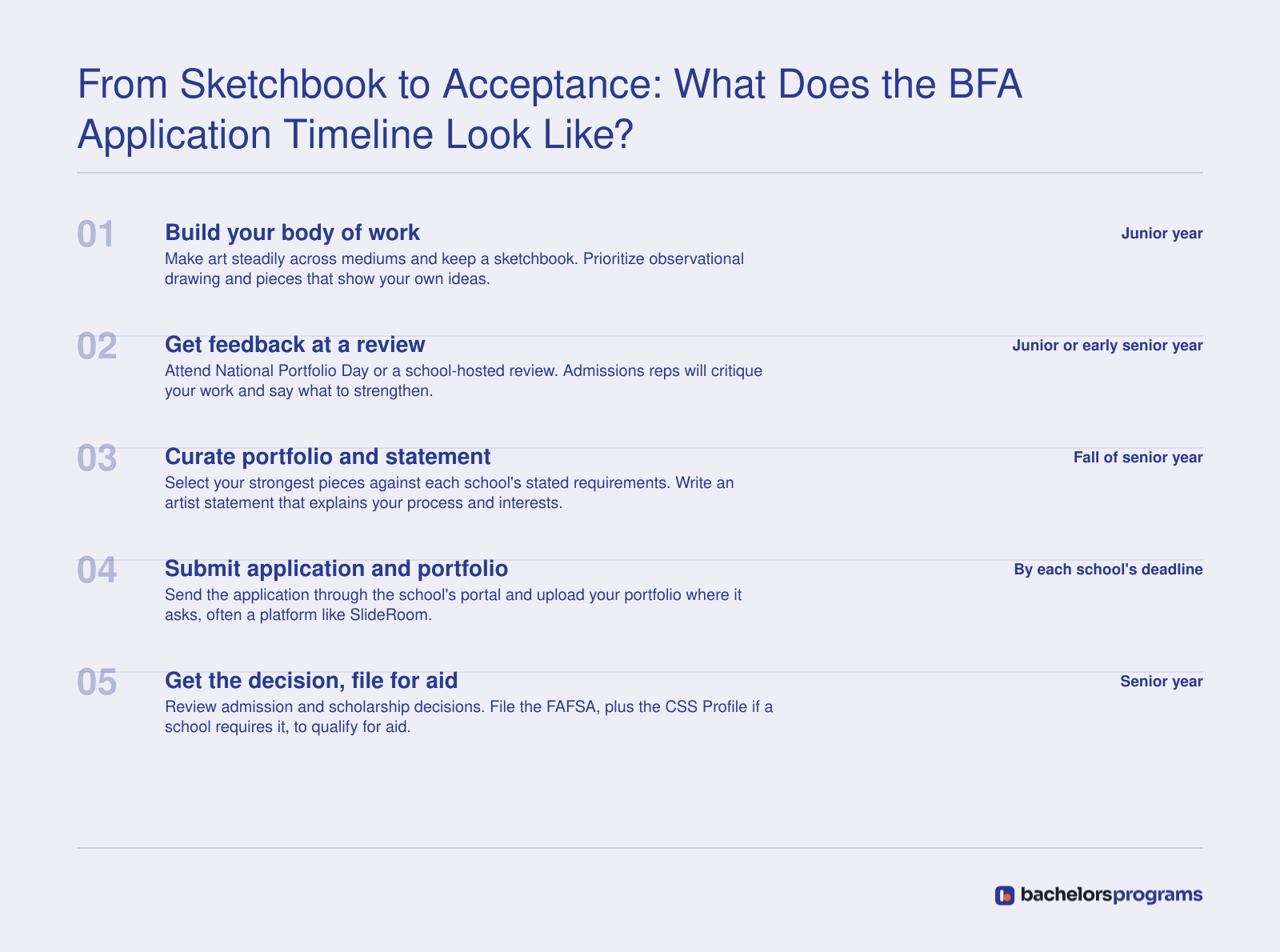
From Sketchbook to Acceptance: What Does the BFA Application Timeline Look Like?
Most fine arts applicants follow the same basic sequence, and starting early leaves room to revise your work. Universities with a separate departmental portfolio review may add a step after general admission, so confirm each school's process before you plan your calendar.
Related Articles
What Working Fine Artists Earn
Federal wage data offers a realistic baseline for what a bachelor's degree in fine arts can lead to after graduation.
How to Choose Between an Art School and a University Fine Arts Program
Both paths are recognized routes into craft and fine artist work, and federal labor data does not separate pay or job outcomes by school type. Employer surveys also rank an arts degree among the top indicators of creativity without distinguishing where it was earned. The decision comes down to fit, so use the patterns below as general tendencies and confirm details with each school.
| Factor | Independent art school | University fine arts program |
|---|---|---|
| Typical credential | Bachelor of Fine Arts (BFA), with certificates and associate degrees also offered | B.S. or B.A. in Fine Arts, or a BFA housed within a college of arts |
| Studio access and hours | Often dedicated studios, with extended or round-the-clock access common for majors | Varies by department. Access is often tied to course enrollment and building hours, and space may be shared with other majors |
| Class size and faculty contact | Studio classes are usually small, with regular critiques from working artists | Studio classes are often small, but lecture courses outside the major can be large |
| General education load | Often weighted heavily toward studio, with a smaller liberal arts share | Usually a larger liberal arts share, especially in B.A. tracks, so studio time is a smaller portion of credits |
| Sticker price vs. aid | Private tuition is often high, so compare net price after scholarships, many of which are portfolio-based | Public in-state tuition is often lower, but material and studio fees add up. Check net price at every school |
| Campus life and resources | Creative peer community and gallery or critique culture, but fewer non-arts options | Broader resources such as athletics, labs, libraries and varied student clubs |
| Flexibility to switch majors | Limited. Most coursework is arts-based, so leaving the field can cost credits | Greater. Credits in general education transfer more easily to other majors |
Questions to Ask Yourself
Do you want roughly two-thirds of your credits in the studio, or a degree that leaves room for a minor in business, education or design?
Would you thrive on a campus made up entirely of artists, or do you want collaborators from engineering, film or computer science?
If you change your mind about art, how easily could you switch majors without transferring schools?
Fine Arts programs by state
Fine Arts Degree FAQs
Requirements for international applicants, portfolios, and open admission vary by school, so confirm every detail on each school's admissions page before you apply.
What are the best fine arts degree programs for international students?
Do international applicants submit a different portfolio than U.S. applicants?
What do Reddit and student forums say matters most when picking an art school?
Can you get a fine arts bachelor's without a portfolio?
Compare Fine Arts programs on the data that matters
Explore more Arts & Design majors or browse every field of study.
All Arts & Design programs Browse every field of study