Best Media Arts Degree Programs
Compare 770+ accredited Media Arts programs at 710+ colleges, with net price after aid, graduation rates, earnings and debt from IPEDS and the U.S. College Scorecard.
A media arts degree can mean a sound stage in Orlando, a game-design lab in Atlanta, or a code-heavy animation studio in La Jolla. Median earnings five years after graduation reach $91,748 at Georgia Institute of Technology, while average net price across the schools here runs from $4,815 to $13,370. Those two numbers rarely share a brochure.
Most programs award the Bachelor of Arts (B.A.) in Media Arts, though transcripts may read computational media, digital media production, or media studies depending on the school. A bachelor's degree in media arts puts students behind the same cameras and software regardless of the label.
What separates programs is not naming convention. Equipment access and the portfolio work students finish differ sharply between schools that charge nearly identical net prices.
Key Points
- Georgia Tech computational media graduates earn a $91,748 median five years out.
- Net price runs $4,815 at University of Florida to $13,370 at Rice.
- A B.F.A. means more studio time; a B.A. leaves room for minors.
Best Media Arts Schools at a Glance: Top 10 Bachelor's Programs
This list covers the range of formats a media arts bachelor's degree actually comes in: traditional on-campus programs with sound stages and equipment rooms, hybrid options that pair coursework with a semester in Los Angeles, and at least one fully online pathway. Each card below also shows the institution-wide graduation rate, meaning the share of all students at that school who finish, and the average net price after grants and scholarships, so you can compare cost and completion on the same footing. Rank order follows those metrics rather than reputation alone.
Rice University
#1Houston, TX · ~$13,000/yr (est.)
Best for: Students pairing media with a second major
A small private research university in Houston, Rice keeps its media studies major deliberately lean: 30 credit hours inside a 120-credit degree, capped by a senior workshop and rounded out with electives split across film history, media theory, and production. That leaves real room for a second major or a term abroad, and up to 12 transfer or study abroad credits can count toward the major. The program leans toward critical analysis of media alongside hands-on audiovisual work, so it suits students who want to think and write about media as carefully as they produce it.
- 10 courses and 30 credit hours inside a 120-credit degree
- At least 6 courses must be at the 300 level or above
- Capstone: MDIA 410 Media Studies Senior Workshop
- 7 electives drawn from film history, media theory, and production
- At least one course required from each of the three elective areas
- Up to 12 credit hours of study abroad or transfer credit may apply
- 2.00 major GPA required to stay in good standing
- Majors may not also declare the Cinema and Media Studies minor
University of California-San Diego
#2La Jolla, CA · $10,000 – $15,000/yr (est.)
Best for: Hands-on filmmakers wanting production-lab access
UC San Diego's visual arts department runs one of the more production-heavy media degrees in the University of California system, with 40 units of film, video, and photo production alongside media studies and interdisciplinary coursework. Undergraduates work in a Media Teaching Lab stocked with analog and digital cinema cameras, Mac Pro editing stations, sound design platforms, and darkrooms. An honors track supports senior thesis projects and up to 12 units of faculty-mentored independent study, and the Kamil Media Awards give student work a cash prize and a public showcase.
- 40 units in film, video, and photo production
- 20 units media studies, 16 interdisciplinary, 4 art history
- Media Teaching Lab with analog and digital cinema cameras
- Mac Pro editing stations, sound design platforms, darkrooms
- Honors track supports senior thesis and up to 12 units independent study
- Kamil Media Awards: $4,000 grand prize and two $2,000 finalist prizes
- Coursework in narrative and documentary filmmaking, sound design, cinematography
- Electives in computing arts and speculative design
University of Central Florida
#3Orlando, FL · ~$10,000/yr (est.)
Best for: Game design and web platform specialists
UCF's Nicholson School of Communication and Media runs a Digital Media BA built for students who want to construct interactive products rather than shoot film. Two specializations, Game Design and Web and Social Platforms, sit on 48 credits of major coursework that ends in a two-course capstone sequence. The degree requires a 2.75 GPA in upper-level Digital Media courses and caps overlap with a minor at 6 hours, so it rewards students who want a focused digital track rather than a broad liberal arts spread.
- 48 major credits inside a 120-hour degree
- Specializations in Game Design or Web and Social Platforms
- 6 basic core credits, 36 advanced core credits, 6-credit capstone
- 24 hours of upper-level Nicholson School residency required
- 2.75 GPA required in upper-level Digital Media courses
- B or better required in DIG 2000 and DIG 4713; C in other required courses
- No more than 6 hours of overlap with a minor
- Capstone courses are cohort-based and sequential
University of California-Berkeley
#4Berkeley, CA · ~$13,000/yr (est.)
Media Studies at Berkeley is a theory-forward major in the College of Letters & Science, drawing on communication, history, anthropology, sociology, and political science rather than a production curriculum. Students choose one of three concentrations: Digital Studies, Global Cultural Studies, or Media Law and Policy. It fits readers who want to analyze media systems, institutions, and policy, and who are ready to clear four prerequisites before declaring and take every major course for a letter grade.
- Three concentrations: Digital Studies, Global Cultural Studies, Media Law and Policy
- Four prerequisites required to declare, with a C or better in each
- 2.0 GPA required in both prerequisites and major courses
- All major coursework is letter-graded
- Coursework draws on communication, history, anthropology, sociology
- Honors requires a 3.5 overall and major GPA
- Two-course honors thesis sequence, MEDIAST H194 and H195
Stanford University
#5Stanford, CA · $10,000 – $15,000/yr (est.)
Stanford's Film & Media Studies BA sits in the School of Humanities and Sciences and covers film aesthetics, national cinematic traditions, and production across narrative, documentary, and experimental forms. The department also examines moving-image work by contemporary artists and newer digital media formats. It is a strong fit for students who want a critical studies foundation with room to make their own work, and the program also offers a minor and an honors track.
- BA in Film & Media Studies in the School of Humanities and Sciences
- Covers film aesthetics and national cinematic traditions
- Production work in narrative, documentary, and experimental film
- Studies moving-image media by contemporary artists
- Explores the proliferation of new digital media forms
- Also offers a minor and an honors track
- Listed under the Arts and Performance interest area
Florida State University
#6Tallahassee, FL · ~$11,000/yr (est.)
Florida State's Digital Media Production major is a limited-access program in the School of Communication, admitting students who already hold 52 credit hours with a 3.0 GPA. Students pick between Documentary and Public Affairs or Sports Media and train on Adobe Premiere Pro, After Effects, Audition, and Photoshop alongside 3D animation, VR, and 360 video. Production courses are capped at 20 to 25 students, and students can build credits through WFSU-TV and Seminole Productions live sports broadcasts.
- Limited-access BA or BS in the School of Communication
- 39 credit hours over two years: foundation, production core, advanced production
- Emphasis options in Documentary and Public Affairs or Sports Media
- Training in Adobe Premiere Pro, After Effects, Audition, and Photoshop
- Coursework in 3D animation, VR, and 360 video production
- 3.0 GPA and 52 credit hours required to apply; December 31, 2026 deadline
- Production courses capped at 20 to 25 students
- Experience through WFSU-TV and Seminole Productions live sports
Georgia Institute of Technology
#7Atlanta, GA · ~$12,000/yr (est.)
Computational Media at Georgia Tech is a joint degree from the College of Computing, the School of Literature, Media, and Communication, and the School of Music. It pairs 36 credit hours of computer science with 30 hours in media technology or liberal arts media study, then lets students specialize in areas such as interactive games design or special effects. It is the most technical option on this list and the natural pick for students who want to build media tools and systems, not only media content.
- Joint degree of Computing, Literature Media Communication, and Music
- 36 credit hours of computer science plus 30 in LMC or Music Technology
- Specialties include interactive games design and special effects
- Covers digital media representation, software design, visual and interactive design
- International Plan adds three international courses and two terms abroad
- Research Option adds nine research credit hours
- Five-year BS/MS in Computational Media and Digital Media requires a 3.5 GPA and fall start
University of Chicago
#8Chicago, IL · ~$15,000/yr (est.)
The University of Chicago's Media Arts and Design major is 12 courses spanning theory, history, and practice, organized into clusters that include creative computing, design, digital sound and music, expanded cinema, games, and media performance. Every graduate compiles a portfolio due in the final quarter, and an optional proposal-based capstone runs across the fourth year. It suits students who want a liberal arts frame around making, with up to four courses double-counting toward another major.
- 12 courses: foundations, 2 theory, 2 history, 3 practice, 4 electives
- Concentration clusters include creative computing, design, digital sound and music
- Also clusters in expanded cinema, games, and media performance
- Optional proposal-based capstone taken in the fourth year
- Portfolio required for completion, due week 5 of the graduating quarter
- Honors require a 3.5+ GPA and a portfolio review
- Up to four courses may double-count toward another major
- Students typically declare by the end of second year
San Diego State University
#9San Diego, CA · $15,000/yr (est. net price)
San Diego State awards a BA in Art with an emphasis in Multimedia, an impacted program that requires prerequisite art courses at a C or better and a 2.20 cumulative GPA to enter. Upper-division work covers digital photography, three-dimensional digital media, typography, book arts, sequential media, and emerging technologies, with an art and design internship available to students. It is a practical choice for readers who want a studio art degree carrying digital production skills, and no minor is required.
- Impacted program: prerequisite art courses with a C or better
- 2.20 cumulative GPA required; petition route for special consideration
- At least 30 upper-division art units, including 6 in art history
- Coursework in digital photography, 3D digital media, and typography
- Also covers book arts, sequential media, and emerging technologies
- Art and design internship available
- Minor not required with this major
- Graduation Writing Assessment Requirement applies
University of Florida
#10Gainesville, FL · ~$4,800/yr (est.)
The University of Florida's Digital Arts and Sciences BA is run by the Digital Worlds Institute and crosses the arts, communications, and engineering. Students complete 11 critical-tracking courses covering game design and development, digital storytelling, 2D and 3D animation, 3D modeling, and interaction and usability, then finish with a senior project. Entry to upper-division work runs through a portfolio of original digital art and programming plus a personal statement, and a fully online pathway is available alongside the campus program.
- 120 credits crossing the arts, communications, and engineering
- 11 critical-tracking courses including game design and 2D and 3D animation
- Portfolio of original digital art and programming due March 15 of sophomore year
- 2.5 critical-tracking GPA and 2.0 UF GPA required
- 12 credits of major electives such as motion design and audio design
- Senior Project Research plus the DIG 4970 Senior Project capstone
- Interaction and usability and project methodologies coursework
- Fully online option available
Cost & outcomes by school
Federal data for the highest-earning Media Arts programs, independent of the ranking above. Earnings are this field's bachelor's graduates four years after completing where the Scorecard reports them, else the school's undergraduate median.
| School | Net price / yr | Grad rate | Earnings | Debt | Grads/yr | Format |
|---|---|---|---|---|---|---|
| Stanford University CA | $13,807 | 92% | $124,080 | $12,000 | — | Campus |
| Gnomon CA | $51,949 | 100% | $114,785 | $28,332 | 73 | Campus |
| Lehigh University PA | $36,931 | 88% | $105,584 | $21,960 | — | Campus |
| Cornell University NY | $28,690 | 95% | $104,043 | $14,000 | — | Campus |
| Georgia Institute of Technology GA | $12,116 | 94% | $102,772 | $21,672 | — | Campus |
| Duke University NC | $29,612 | 97% | $97,800 | $13,000 | 3 | Campus |
| Dartmouth College NH | $29,519 | 96% | $97,434 | $17,500 | — | Campus |
| Brown University RI | $25,184 | 96% | $93,487 | $11,428 | — | Campus |
| University of Southern California CA | $32,740 | 92% | $92,498 | $18,000 | 34 | Campus |
| University of California-Berkeley CA | $13,481 | 93% | $92,446 | $13,000 | — | Campus |
| University of Chicago IL | $14,860 | 96% | $91,885 | $15,000 | — | Campus |
| Vanderbilt University TN | $15,846 | 94% | $91,565 | $14,000 | — | Campus |
Sources: U.S. Department of Education. Net price, graduation rate, earnings and debt: College Scorecard (earnings and debt for this field's bachelor's graduates where reported, else school-wide); graduates: IPEDS. A dash means no figure is reported.
Cost, debt & payoff
Median earnings of this field's bachelor's graduates (4 yrs after completing, else the school's undergraduate median) vs. their median federal loan debt · U.S. College Scorecard
Across these programs the median graduate earns about $53,413 and finishes with roughly $23,236 in debt — a ratio that clears a common rule of thumb (keep debt below first-year salary). Net price and debt vary widely school to school, so check the per-school figures in the table above before you shortlist.
How We Ranked Media Arts Bachelor's Programs
Where do the numbers behind a media arts ranking come from? They come from two federal sources: the U.S. Department of Education's College Scorecard and the Integrated Postsecondary Education Data System (IPEDS). Four measures drive the order: average net price, completion rate, earnings after completion, and median federal debt.
Program-Level vs. Institution-Wide Figures
Not every number describes the same thing, so know which kind you are reading.
- Program-specific: Earnings after completion and median federal debt are reported for the media arts credential itself. They reflect what graduates of that bachelor's program experienced.
- Institution-wide: Graduation rate and 10-year earnings cover the whole school, not only media arts majors. Treat them as a read on the overall environment, not a promise about your major.
What Net Price Does and Does Not Tell You
Net price averages what students paid once grants and scholarships were subtracted from the cost of attendance. It is not a guaranteed quote. Your own figure depends on family income, merit aid, residency, and housing choices. Run each school's net price calculator before you rule a program in or out. Most take about ten minutes and return an estimate built on your own profile.
What Does Not Influence the Order
This ranking uses no reputation surveys, and no school pays for placement. Because the order rests on that federal data, a lesser-known school with strong completion and manageable debt can outrank a famous name. Use the order as a starting point for your shortlist, then check portfolio requirements, faculty, and facilities for the media specialty you actually want to pursue.
B.A. vs. B.F.A. vs. Media Studies: What a Bachelor's Degree in Media Arts Covers
Choosing between a B.A. and a B.F.A. in media arts comes down to time: how much of it you want to spend inside a studio, and how much room you want left for a second major, a minor, or a semester abroad. Both routes lead to media careers. They get there through very different weekly schedules.
Reading the credit math
Most bachelor's degrees land near 120 credits, but catalog totals are not comparable across institutions. Maryville University's online B.F.A. in Digital Media requires 128 credits.1 Northern State University's 2026-2027 plan of study totals 120, with 90 of them inside the major.2 Lindenwood University shows the gap at the major level: 48 credits for its B.A. in Art and Design against 66 for its B.F.A. in Digital Art.3 Catalogs rarely publish a clean studio-versus-liberal-arts percentage, so compare major credit totals, the number of sequential studio and critique courses, and whether a capstone or thesis is required. Slippery Rock University's B.F.A. pairs a 15-credit concentration with a 3-credit senior project.5
Concentrations to compare
- Film and video: production, cinematography, editing, screenwriting.
- Animation: 2D, 3D, motion graphics, character work.
- Sound design: mixing, recording, audio for picture and games.
- Game design: engines, level design, interactive narrative.
- Interactive and UX media: interface design, prototyping, user research.
Who each degree suits
A B.F.A. fits students who want sustained studio practice and a critique-heavy portfolio. A B.A. in media arts fits students who want breadth, a double major, or room for internships, and it usually carries more general education. Media studies takes a different angle, examining media as culture, technology, and institutions. Central Connecticut State University's 38-credit major (20 core, 11 emphasis, 7 directed electives) blends theory and literacy with film history and some production.4
The MFA question
If professional practice or teaching is a long-term goal, degree type matters less than portfolio. Howard University's M.F.A. in Art accepts a BA, BFA, or BS with a 3.0 minimum (admissions are paused for Fall 2026, so confirm status).6 A B.F.A. can strengthen a studio-based application; a B.A. can demonstrate equivalent preparation through electives, a minor, and independent projects.
Concentration choice, more than degree letters, decides what lands in your portfolio and which jobs you can pursue first.
Related Articles
Affordable Media Arts Degree Programs: Net Price and Debt
Public schools advertise low tuition, and private schools advertise high tuition, but neither number is what most students pay. Average net price across the ranked schools runs from $4,815 at the University of Florida to $13,370 at Rice University. The three most affordable options are Florida, California State University-Northridge ($7,021) and Florida International University ($9,288).
Sticker Price vs. Net Price
Public universities publish a base rate that differs sharply by residency. Florida lists $3,876 in tuition and fees for in-state students and $16,579 for out-of-state students. Georgia Tech lists $12,058 in-state and $34,484 out-of-state. Net price is a different measure. It is the cost of attendance minus grant aid, so it includes housing, books, and living costs, which is why it can sit above in-state tuition at a public school.
Private schools show the opposite pattern. Rice publishes $64,144 in tuition and fees, yet its average net price is $13,370 because of institutional aid. For a private school, the sticker price tells you very little.
Debt at Graduation
Where program-level figures exist, median federal debt for media graduates is moderate at most schools here:
- University of Florida: $15,000, or about $159 a month over 10 years.
- Cal State Northridge: $14,244, or about $151 a month.
- Florida International: $14,265, or about $151 a month.
- Florida State: $17,750, or about $188 a month.
- University of Central Florida: $17,992, or about $191 a month.
- Georgia Tech: $27,840, or about $295 a month.
What the Average Leaves Out
Net price is an average for a whole sector of schools. Your own figure depends on family income, residency, and the aid you receive, so use it as a starting estimate and run each school's net price calculator. Production-heavy majors also carry costs that the average does not capture. UCF, for example, charges a $90 per-term equipment fee for full-time students and expects continual computer access. Budget for software subscriptions, storage, cameras, and lab fees at any school you consider.
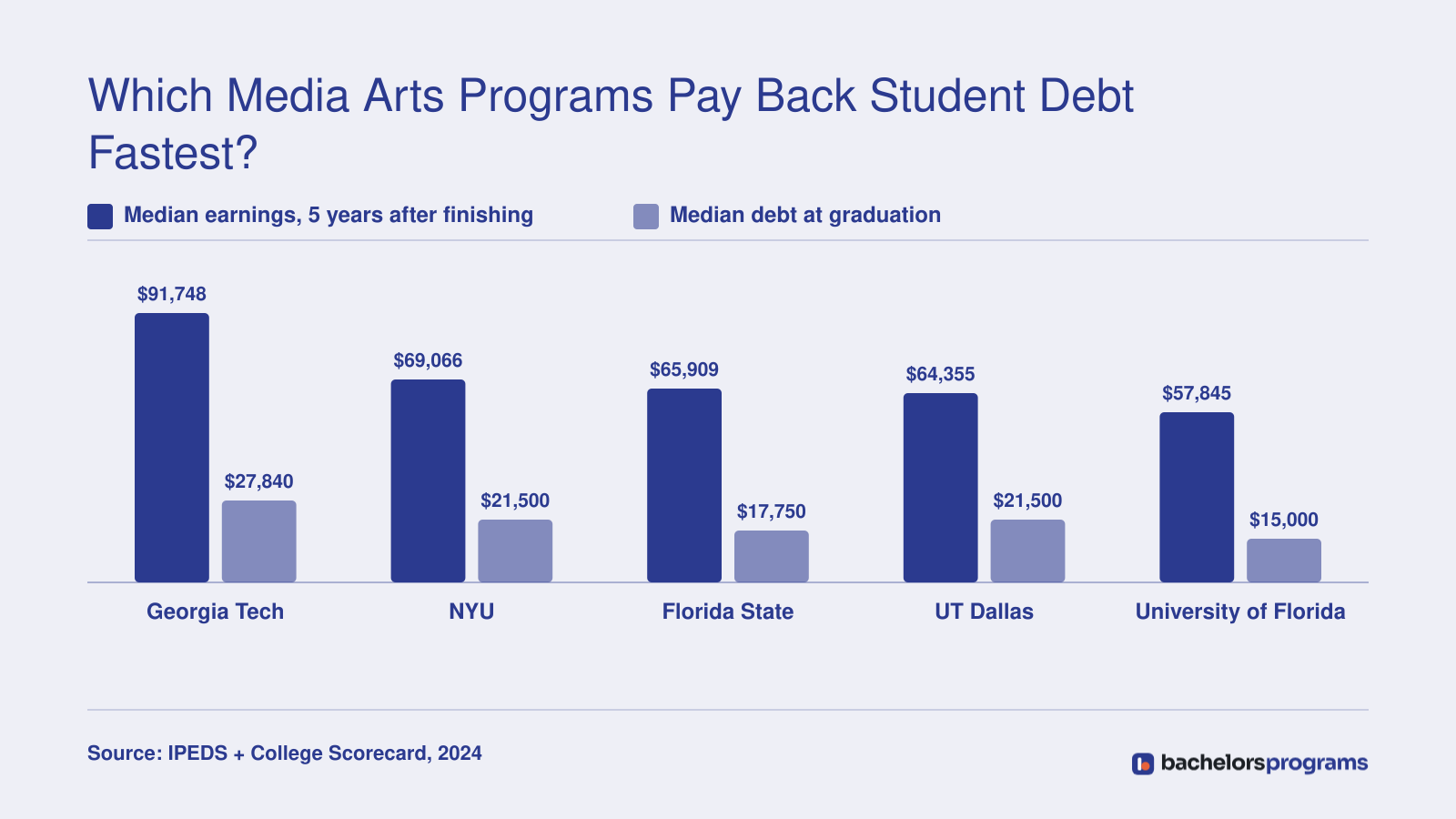
Which Media Arts Programs Pay Back Student Debt Fastest?
Graduates of Georgia Tech's computational media program earn a median of $91,748 five years after finishing, the highest figure in this chart, against $27,840 in median debt. Comparing pay with what students owe, the University of Florida ($57,845 earned vs. $15,000 owed) and Florida State ($65,909 vs. $17,750) pay back fastest: median earnings run close to four times median debt. Every figure is a program-level median for that school's media arts bachelor's degree, not a campus-wide average.
Questions to Ask Yourself
Does your concentration depend on shared studios and crews?
Can you cover the hardware and software on top of tuition?
Can you land internships without a campus career office nearby?
Media Arts Degree Salary by Career Path
A media arts bachelor's degree leads to several distinct occupations, and pay varies widely between them. The figures below come from the U.S. Bureau of Labor Statistics Occupational Outlook Handbook: May 2025 median wages and projected growth for 2025 to 2035.
Wages and Growth by Occupation
- Film and video editors and camera operators: $75,100 median, 3% projected growth.1 This path usually starts in a film and video production concentration.
- Producers and directors: $90,360 median, 4% growth.2 Film and video production is also the usual route here.
- Special effects artists and animators: $102,030 median, 0% growth.3 Animation and visual effects coursework leads to this work.
- Web developers and digital designers: $99,520 median, 5% growth.4 Students typically get there through web and interactive design.
- Graphic designers: $62,960 median, -2% growth.5 This is the direct outcome of a graphic design concentration.
How to Read These Numbers
Each figure is a median across all workers in the occupation, including people with a decade or more of experience. Graduate earnings reported for individual programs earlier on this page come from recent alumni, not from workers a decade into their careers. Expect early-career pay to land below these occupational medians, sometimes well below, particularly in freelance-heavy fields such as editing and design.
The medians also reflect a mix of education levels and employers. A graduate with a strong portfolio and internship experience can close the gap faster than the median suggests, but a bachelor's degree alone does not guarantee the numbers above.
What the Growth Rates Suggest
Web and interactive work shows the strongest projected demand of the five, while animation and visual effects shows no projected growth and graphic design a slight decline. That does not mean jobs vanish. Openings still arise as people leave the workforce or change careers. It does mean competition is tighter in the flat and declining fields, so a specialty that pairs creative skill with technical fluency, such as motion graphics with interactive design, gives you more options.
If pay and demand matter most to you, compare the concentration you are drawn to against its occupation above before choosing a program.
What Special Effects Artists and Animators Earn
This figure reflects pay across all experience levels in the field, so new media arts graduates typically start below it.
Media Arts Admissions Checklist: Portfolios and Transfer Credit
Requirements vary by school and by applicant status, so confirm each program's current guidelines. These items appear most often.
- Portfolio of creative workMost media arts and film programs ask for one. Size varies: the College for Creative Studies asks for 5 to 12 pieces, and UMass Dartmouth asks transfer applicants for 12 to 15 original works. Video limits are tight. Pratt asks for 3 to 5 minutes, NYU Tisch caps film work at 5 minutes, and UNCSA allows up to 10 minutes of combined film or video.
- Submission platform and file limitsNYU Tisch uses SlideRoom. Northeastern collects portfolios after you apply, through its Application Status Check portal. Expect file caps, such as Northeastern's 120 MB limit on video and UMass Dartmouth's 30 MB limit on audio.
- Statement or written narrativeMany programs pair your work with writing. Northeastern lists a 500-word personal statement. Pratt film applicants describe each submission and their role in it.
- Transcripts and test scoresSend official transcripts. Many schools are test-optional, but check each school's current policy.
- Transfer credit and articulationOakland University has a film articulation agreement with Oakland Community College that runs from August 1, 2026, through July 31, 2031. CSUN Film Production requires 60 units plus prerequisite courses at a B- or better. Its portfolio deadline for spring 2027 entry was October 4, 2026.
- Studio course reviewSchools such as the College for Creative Studies may ask for work samples before granting studio credit. Pratt accepts only comparable coursework from accredited institutions.
Media Arts programs by state
Media Arts Degree FAQs
Can you get a bachelor's degree in media arts online?
Do media arts programs require an admissions portfolio?
What can you do with a bachelor's degree in media arts?
Is a media arts degree worth it if you can learn the software on your own?
Compare Media Arts programs on the data that matters
Explore more Arts & Design majors or browse every field of study.
All Arts & Design programs Browse every field of study