Best Game Programming & Development Degree Programs
Compare 210+ accredited Game Programming & Development programs, with net price after aid, graduation rates, earnings and debt from IPEDS and the U.S. College Scorecard.

A bachelor's degree in game programming and development is where you learn to build the systems underneath a game: C++ and C# code, Unreal and Unity engine work, graphics pipelines, physics. Studios screen on shipped projects and playable portfolios more than on transcripts.
Cost is harder to pin down. Average net price after aid at the schools ranked here runs from roughly $6,400 to $22,100 a year, and a few programs gate the major itself behind a portfolio review. Portfolios decide hiring; the degree decides what you can afford while you build one.
Key Points
- Rankings weigh federal data on net price, completion rates, and graduate earnings.
- Game programming centers on C++, C#, and engines; design centers on mechanics.
- Confirm institutional accreditation from an agency the Education Department recognizes.
Best Bachelor's Degree in Game Programming and Development Schools Ranked
These ten schools separate themselves on a balance of value and outcomes: average net prices after aid that stay manageable even at private institutions, and completion rates that show which schools actually get students to the finish line. Each card lists city and state, delivery format, average net price after aid, and the share of undergraduates who graduate. Formats run from fully online to strictly campus-based, and several schools offer both.
George Mason University
#1Fairfax, VA · $15,000 – $20,000/yr (est.)
Best for: Washington, D.C. applicants drawn to game art
George Mason's game degree lives in the School of Art, and the BFA in Computer Game Design leans into the artistic side of playable media while still requiring real coding. Students move through a 28-credit Mason Core, a 51-53 credit major core, and a senior capstone taken twice, and a new Metro partnership is opening experiential opportunities for Computer Game Design students. The Fairfax campus sits inside the Washington, D.C. tech corridor, which puts studios, contractors, and serious-games employers within commuting range.
- 120 credits total, built on a 28-credit Mason Core
- 51-53 credit major core plus 12 credits of digital media electives
- Senior capstone (GAME 490) taken twice, 3 credits each
- 2.0 GPA in the major and C or better in all GAME coursework
- 45 credits must be at the 300-499 level
- Emphasizes artistic game design alongside technical skills
- Minors in Computer Game Design and in Sport and Computer Game Design
University of Michigan-Dearborn
#2Dearborn, MI · ~$9,000/yr (est.)
Best for: Michigan commuters wanting paid co-op experience
Dearborn packages game development inside an ABET-accredited computer and information science degree, so the Game Design concentration sits on the same data structures, algorithms, and software engineering spine as the computer science track. Paid co-op placements have run with employers such as Apple, Ford, and NASA, and the Go Blue Guarantee covers tuition for qualifying in-state students. Four concentrations plus an accelerated bachelor's-to-master's path let students shift toward AI or information systems without leaving the department.
- ABET-accredited BS in Computer and Information Science
- Game Design concentration among four concentration options
- Paid co-op placements with employers such as Apple, Ford and NASA
- Curriculum aligned with ACM and IEEE recommendations
- Go Blue Guarantee covers tuition for qualifying in-state students
- Accelerated BS/MS option completes both degrees in five years
- Rolling admissions
Miami University
#3Oxford, OH · $18,000 – $41,000/yr (est.)
Best for: Interdisciplinary learners splitting time between art and code
Miami University runs its Games + Simulation major jointly through the Department of Emerging Technology in Business and Design, the art department, and computer science, which is why students choose a concentration in game art, game design, or game development. Admission is competitive, with a limited number of slots and criteria beyond GPA. The Princeton Review placed the undergraduate program 27th overall and in the top 10 among public universities in 2023, and the College of Creative Arts reports 95% of 2021 graduates employed or in graduate study within six months.
- Concentrations in game art, game design or game development
- Taught jointly by Emerging Technology in Business and Design, art and computer science
- Sequence opens with IMS 111 Introduction to Game Careers
- Competitive admission with a limited number of slots
- Ranked 27th overall and top 10 among public universities by Princeton Review in 2023
- 95% of 2021 College of Creative Arts graduates employed or in advanced degrees within six months
University of Cincinnati
#4Cincinnati, OH · ~$26,000/yr (est.)
Cincinnati's game pathway is a concentration inside an ABET-accredited Bachelor of Science in Information Technology, the first BSIT in Ohio. The program runs five semesters of paid co-op alternating with coursework and closes with a two-semester senior design project presented at the annual IT Expo. Students can enroll on campus or fully online, and the curriculum stretches beyond entertainment into simulated environments built for training and testing.
- ABET-accredited BSIT, the first such program in Ohio
- Five semesters of paid co-op alternating with classes
- Two-semester senior design project shown at the annual IT Expo
- Covers game engines, programming, storytelling, testing and publishing
- Also builds simulated environments for training and testing
- Offered on campus and fully online
- Transfer applicants need 24 semester hours and a 2.75 GPA
The University of Texas at San Antonio
#5San Antonio, TX · $9,000 – $22,000/yr (est.)
UT San Antonio delivers game development through a Bachelor of Arts in Multidisciplinary Studies, a build-your-own structure that lets students assemble three approved focus areas rather than follow one fixed major. The Game Design path pairs a Game Programming focus with Digital Art and Media and Game Studies options, and coursework runs through C#, C++, and Python. It is a flexible route for students who want room for writing, art, or production alongside code, and the university's student body is majority Hispanic.
- Game Design path with Game Programming, Digital Art and Media and Game Studies focus areas
- Programming in C#, C++ and Python
- 120 semester credit hours, at least 39 of them upper division
- 42-hour core curriculum plus a 3-hour technology requirement
- Each focus area needs coordinator and dean approval
- 2.0 GPA required in the major
Maryville University
#6Saint Louis, MO · ~$22,000/yr (est.)
Maryville's Computer Science BS carries a Game Development track inside a six-track department, so students take the same computer science core as peers headed into AI, data science, or cybersecurity. The Game Development sequence covers game design principles, asset creation, and scripting, and the degree finishes with a capstone. Courses run online and on campus, part-time study is an option, and an accelerated master's in AI, data science, or actuarial science can be added in one extra year.
- Six tracks including Game Development
- Game Development courses cover design principles, asset creation and scripting
- 120 credits: 60-credit major, 36-credit track, 18 elective credits
- Capstone project required
- Online and on-campus formats, with some track courses online only
- Accelerated master's in AI, data science or actuarial science in one extra year
- Part-time study available
Kennesaw State University
#7Kennesaw, GA · ~$15,000/yr (est.)
Kennesaw State offers a standalone Bachelor of Science in Computer Game Design and Development, the only four-year public game design bachelor's in Georgia, taught face-to-face, online, or hybrid with entry points in fall, spring, and summer. Concentrations span media production, distributed and mobile systems, serious games for education, planning and management, and simulation informatics. The Princeton Review ranks it among the top 50 undergraduate game programs worldwide, the department hosts a Global Game Jam hackathon, and a 2026-27 partnership with Ghost Gaming adds esports and game-development activity.
- 120 credits delivered face-to-face, online or hybrid
- Three start dates per year; primary campus in Marietta
- Concentrations include media production, mobile systems, serious games and simulation
- Only four-year public game design bachelor's in Georgia
- Princeton Review Top 50 undergraduate game design programs worldwide
- Coursework spans artificial intelligence, 2D and 3D graphics and software engineering
- Double Owl pathways to Computer Science, IT or Software Engineering master's degrees
- Hosts a Global Game Jam hackathon
Utah Valley University
#8Orem, UT · $5,000 – $10,000/yr (est.)
Utah Valley's Animation and Game Development BS splits into 2D animation, 3D animation and VFX, and Game and XR Development, so the same department trains artists and engine programmers. The Game and XR track runs through four game development courses, two game engine courses, mixed reality, and portfolio development, using Maya, Unity, Unreal Engine, and Houdini. Admission to the major is by portfolio review after the first-year courses, and students may apply twice.
- Three tracks, including Game & XR Development
- Coursework includes Game Development I-IV, Game Engine I-II and Mixed Reality Experiences
- Uses Maya, Unity, Unreal Engine and Houdini
- Portfolio review after first-year courses; students may apply twice
- 120 credits, including 68 track credits and 40 upper-division credits
- 2.5 GPA in discipline core courses required to graduate
- 30 UVU residency credits required
Boise State University
#9Boise, ID · $20,000 – $25,000/yr (est.)
Boise State's Games, Interactive Multimedia, and Mobile Technology BS sits in the School of the Arts within the College of Arts and Sciences, which shapes it as a creative-technology degree rather than a pure computer science track. The same department offers minors in Interactive Animation and in Interactive Film and Mixed Reality, plus a Creative Arts Technology certificate, so students can stack credentials around the major. The degree is campus-based, and those add-ons make it straightforward to fold animation or mixed reality coursework into the plan.
- Housed in the College of Arts and Sciences, School of the Arts
- Same department offers a minor in Interactive Animation
- Minor in Interactive Film and Mixed Reality also available
- Creative Arts Technology certificate offered
Georgia State University
#10Atlanta, GA · $9,000 – $25,000/yr (est.)
Georgia State's Bachelor of Science in Game Development is a four-year Atlanta campus degree with fall, spring, and summer entry. Students work in C#/C++, Unity, Unreal Engine, and Blender, use a 32-camera volumetric capture system, and spend a full year on a collaborative design team building a launch-ready game alongside senior-year internships. The Creative Media Industries Institute also partners with the Georgia Film Academy on esports management certifications.
- Admits students in fall, spring or summer
- Major admission needs a 2.5 GPA with no grade below C in prerequisite math and CMIS courses
- Coursework in C# and C++, Unity, Unreal Engine and Blender
- Volumetric capture system with 32 cameras
- Full-year collaborative team building a launch-ready game
- CMII-supported senior year internships
- Partnership with Georgia Film Academy on esports management certifications
Cost & outcomes by school
Federal data for the highest-earning Game Programming & Development programs, independent of the ranking above. Earnings are this field's bachelor's graduates four years after completing where the Scorecard reports them, else the school's undergraduate median.
| School | Net price / yr | Grad rate | Earnings | Debt | Grads/yr | Format |
|---|---|---|---|---|---|---|
| DigiPen Institute of Technology WA | $44,446 | 61% | $137,503 | $27,000 | 64 | Campus |
| Rochester Institute of Technology NY | $34,906 | 70% | $113,559 | $27,000 | 15 | Campus |
| University of Michigan-Dearborn MI | $9,492 | 58% | $106,484 | $18,502 | 39 | Campus |
| Worcester Polytechnic Institute MA | $43,071 | 90% | $103,470 | $27,000 | — | Campus |
| Rensselaer Polytechnic Institute NY | $36,228 | 84% | $102,051 | $23,750 | — | Campus |
| DePaul University IL | $30,902 | 68% | $101,315 | $24,500 | 164 | Campus |
| Kettering University MI | $34,660 | 71% | $94,823 | $27,000 | — | Campus |
| Northeastern University MA | $30,915 | 91% | $92,538 | $24,250 | — | Campus |
| University of Southern California CA | $32,740 | 92% | $92,498 | $18,000 | — | Campus |
| California Polytechnic State University-San Luis Obispo CA | $16,665 | 86% | $90,768 | $18,500 | — | Campus |
| Manhattan University NY | $27,256 | 64% | $86,316 | $26,000 | — | Campus |
| Drexel University PA | $38,509 | 78% | $84,648 | $25,325 | — | Campus |
Sources: U.S. Department of Education. Net price, graduation rate, earnings and debt: College Scorecard (earnings and debt for this field's bachelor's graduates where reported, else school-wide); graduates: IPEDS. A dash means no figure is reported.
Cost, debt & payoff
Median earnings of this field's bachelor's graduates (4 yrs after completing, else the school's undergraduate median) vs. their median federal loan debt · U.S. College Scorecard
Across these programs the median graduate earns about $55,552 and finishes with roughly $23,673 in debt — a ratio that clears a common rule of thumb (keep debt below first-year salary). Net price and debt vary widely school to school, so check the per-school figures in the table above before you shortlist.
How We Ranked These Game Programming Schools
The ranking favors programs where the signals agree: a net price students can absorb, a solid completion rate, and graduates who earn enough for the degree to pay off. Every input is federal data the schools report themselves, so the order rests on filed figures rather than viewbook copy.
The Inputs, in Plain Terms
- Net price (school-wide): average yearly cost after aid, not sticker tuition.
- Graduation rate (school-wide): the share of first-time, full-time students who finish within 150% of normal time. It describes the college, not the game program.
- Earnings (program-level): median earnings for people who completed the game programming and development credential.
- Median debt (program-level): what borrowers in that same credential owed when they left.
- Completions (program-level): how many students finished, a sign the program runs at real scale rather than on paper.
Two Layers, Kept Apart
Earnings and debt attach to the credential. The two school-wide measures describe the whole institution. Separating them keeps a strong computer science department from inflating a thin game program, and keeps a modest college from hiding a genuinely good one.
Small Cohorts, Missing Medians
Game programming is a niche field, and some cohorts are too small to publish a median without identifying individual graduates. Federal data withholds those figures rather than guess, so a gap here reflects class size, not program quality.
A Shortlist, Not a Verdict
Use the ranking to decide who to call. Ask admissions for the program's own placement numbers, the engines and languages it teaches, and recent internship partners. Confirm what you hear before you commit four years and tuition to it.
Game Programming vs. Game Design vs. Computer Science Degrees
These three bachelor's degrees overlap, but they start from different places. Game programming leans on C++ or C#, engines, and systems, while game design leans on mechanics, level design, and narrative. A computer science degree with game electives keeps non-game software jobs open, which is a useful hedge in a volatile industry. Course details below are typical patterns and vary by school.
| Factor | Game Programming | Game Design | Computer Science |
|---|---|---|---|
| Core focus | Building game software: gameplay code, graphics, physics, and engine systems | Planning how a game plays and feels: game theory, interactive design, story, animation | Computer theory, problem-solving, and system design applied to many kinds of software |
| Federal program classification | CIP 11.0204, in the Computer and Information Sciences family | CIP 50.0411, in the visual and performing arts family | CIP 11.0701, in the Computer and Information Sciences family |
| Typical coursework | Programming in C++ or C#, computer graphics, game physics, engine development, human-computer interaction | Game theory, level design, narrative development, animation, simulation, some scripting | Data structures, algorithms, operating systems, databases, software engineering, plus optional game electives |
| Math load | Moderate to heavy: linear algebra and physics are common | Light to moderate: usually less math, more design theory | Heaviest: discrete math, calculus, and algorithm analysis are common |
| Portfolio output | Playable builds, engine tools, and code samples that show technical skill | Playable prototypes, level designs, design documents, and story work | Software projects and code repositories, with a game project if you choose game electives |
| Entry-level roles targeted | Gameplay, graphics, or tools programmer; junior engine developer | Junior game designer, level designer, or narrative or systems designer | Software developer across industries, including games if your portfolio supports it |
| Job flexibility outside games | Good, since programming skills transfer, though coursework is game-specific | Narrower, with some overlap in interactive media and simulation | Broadest, with the most non-game software options |
Game Programming Degree Cost and Student Debt Compared
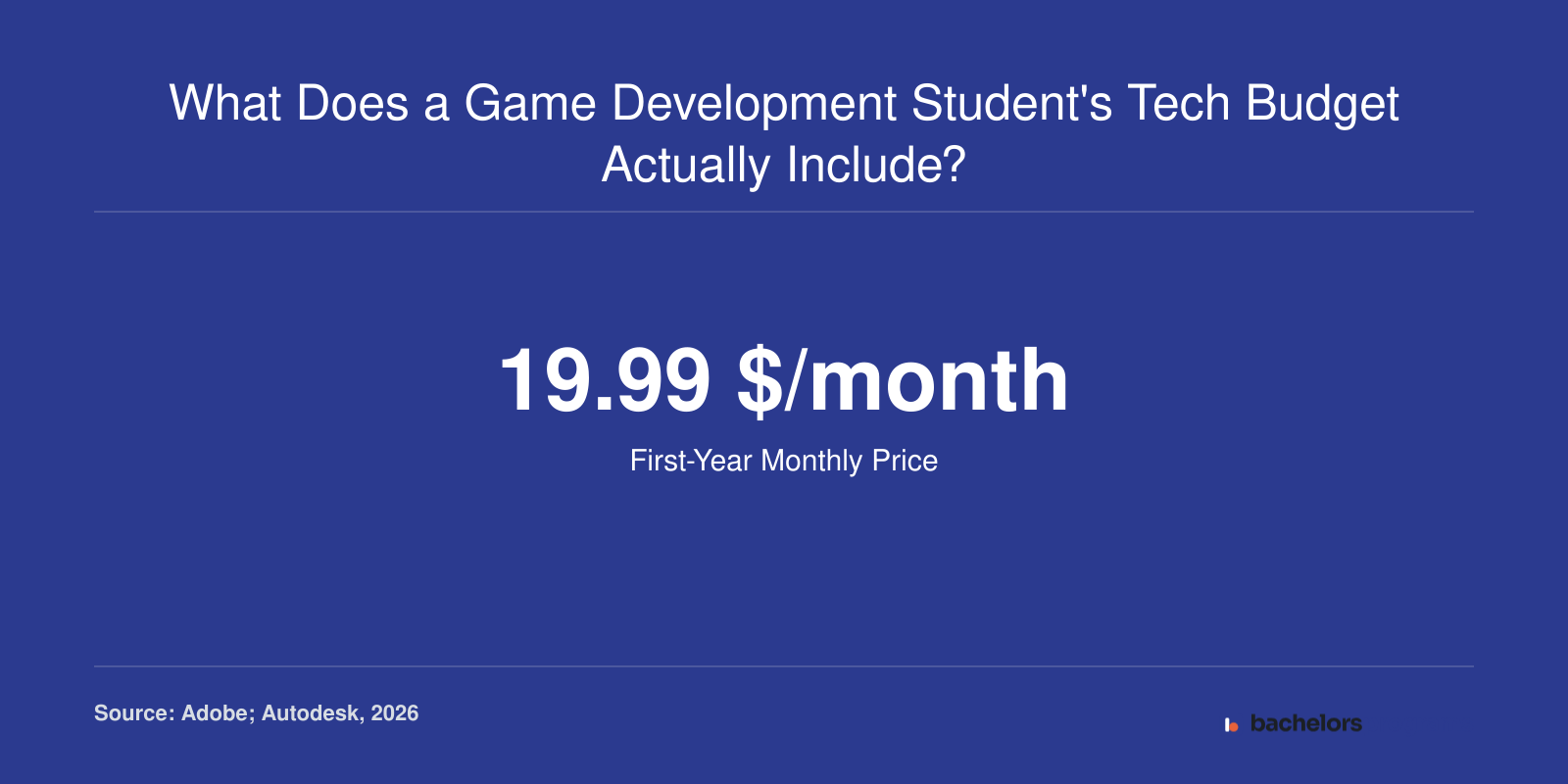
The most affordable schools here are listed from lowest to highest average net price after aid, alongside published tuition and fees before aid; median debt at completion and the median 10-year monthly payment appear only where federal data reports them for the game program itself (so far, the University of Michigan-Dearborn), and a blank cell means the figure is not published, not that it is zero. Budget for hardware too: Indiana University's April 2026 lower-cost example is a laptop of about $1,100 with at least 6 GB of graphics memory and 16 GB of RAM (32 GB recommended), while Drexel University's 2026-2027 minimum calls for 16 GB of RAM and an 8 GB graphics card, and UT Dallas recommends 64 GB of RAM, so stronger machines can cost well beyond that entry price. Some core software can cost nothing: Unity's Student plan is free for eligible students, Autodesk Maya is free through eligible institutional access, and some schools, such as Emerson College, provide Adobe Creative Cloud at no charge, though pricing for other tools varies and you should confirm what your program supplies.
| School | Average Net Price After Aid | Published In-State Tuition and Fees (Before Aid) | Published Out-of-State Tuition and Fees (Before Aid) | Median Program Debt at Completion | Median 10-Year Monthly Payment |
|---|---|---|---|---|---|
| College of Staten Island CUNY (NY) | $5,579 | $7,490 | $15,440 | ||
| Utah Valley University (UT) | $6,376 | $6,507 | $18,489 | ||
| Lake Washington Institute of Technology (WA) | $6,817 | $5,997 | $12,062 | ||
| Indiana University-South Bend (IN) | $8,653 | $8,424 | $22,811 | ||
| Lamar University (TX) | $9,366 | $8,905 | $18,745 | ||
| University of Michigan-Dearborn (MI) | $9,492 | $15,640 | $32,896 | $18,502 | $196 |
| The University of Texas at San Antonio (TX) | $10,836 | $9,326 | $22,249 | ||
| The University of Texas Permian Basin (TX) | $12,723 | $9,607 | $21,900 | ||
| Arkansas Tech University (AR) | $12,970 | $8,674 | $14,668 | ||
| University of the Cumberlands (KY) | $14,107 | $9,875 | $9,875 |
What Does a Game Development Student's Tech Budget Actually Include?
Related Articles
Software Developer Pay at a Glance
Are Game Programming Degrees Accredited? What to Verify
Yes, most legitimate bachelor's degrees in game programming are covered by institutional accreditation, and that is the credential that matters most.1 The U.S. Department of Education does not accredit colleges itself. It recognizes outside accreditors, including regional bodies such as HLC, MSCHE, NECHE, NWCCU, SACSCOC and WSCUC; which one applies depends on where the school is located.2
Program-Level Accreditation
No single accreditor is dedicated to game development, and programmatic accreditation is not universally required.3 Two bodies come up most often:
- ABET: It accredits programs, not institutions, through its Computing Accreditation Commission.3 A game degree is not automatically eligible. A computer science degree with a game concentration usually carries ABET status on the CS program, not on the concentration, so verify the exact degree title.
- NASAD: It covers art and design education, which can include game art, animation, visual development, interaction design and digital media.3 Its scope is not ABET-level computing accreditation, and it does not automatically cover every game design degree.
A BA or BFA in game design may fall outside ABET's scope entirely.3
Why Institutional Accreditation Matters
Federal financial aid eligibility depends on a school's accreditor being recognized by the Department of Education.2 Accreditation also shapes whether other colleges accept your transfer credits and whether a graduate school will admit you later.
How to Check
- Start with DAPIP: The Department of Education's database lists the accreditor, status, dates, program and location.5 The data comes from accrediting and state agencies and is not audited, so confirm with the accreditor directly.4
- Use CHEA's directory: CHEA recognition is separate from federal recognition.2 Use it to identify the accreditor, then search that accreditor's own directory for your campus or program.
- Check ABET or NASAD records: If a school claims either, look up the exact degree and campus.
Watch for qualifiers such as "seeking accreditation," "pending," "candidate," "concentration," or "selected locations."4 Each one means full accreditation has not been confirmed for the program you want.
What to Look for: Languages, Engines, Portfolios, and Internships
Use this checklist when comparing curricula and campus resources. The strongest programs teach the skills that studios actually advertise for and leave you with work you can show.
- C++ and C# in required coursesC++ is the core language of Unreal Engine and most AAA, engine and graphics work. C# drives Unity, which is common in mobile, XR and indie studios. In a 2026 analysis of 986 game developer job postings, C++ appeared in 23.7% of ads and C# in 22.6%.
- Hands-on Unity and Unreal courseworkLook for projects built in both engines. In GDC's 2026 survey, 42% of developers named Unreal and 30% named Unity as their primary engine. Electives in graphics, physics or AI programming are a plus.
- Team capstone or shipped projectA required team build gives you portfolio pieces and practice with the collaboration and communication skills that job ads frequently list.
- Game lab and hardware accessAsk whether students can use console dev kits, VR headsets or a dedicated lab rather than only personal laptops.
- Internship support and studio tiesAsk about studio partnerships, career fairs and placement help. This matters more given the industry layoffs reported in GDC's 2026 survey.
- Portfolio requirementPrepare a playable prototype, readable code with Git history and short write-ups that explain your technical decisions. Git appeared in 65% of postings in one 2025 U.S. analysis.
Game Programming & Development programs by state
Compare Game Programming & Development programs on the data that matters
Explore more Arts & Design majors or browse every field of study.
All Arts & Design programs Browse every field of study