Best Digital Photography Degree Programs
Compare 190+ accredited Digital Photography programs, with net price after aid, graduation rates, earnings and debt from IPEDS and the U.S. College Scorecard.

In a field where much of the work is freelance or contract-based, what a bachelor's degree in digital photography costs matters more than the name on the diploma. College Scorecard figures put one-year median earnings for photography graduates at schools ranked here between $23,686 and $29,011, while program-level median debt runs from $15,000 to $22,500.
The ranking spans campus and online formats. BFA, BS, and BA tracks trade depth against flexibility, and gear adds a cost that published tuition never shows.
A camera body, lenses, and software licenses usually come before the first critique, and that spending rarely appears in a school's published price.
Key Points
- Texas State's BFA in Photography requires 120 credits, 77 in the major.
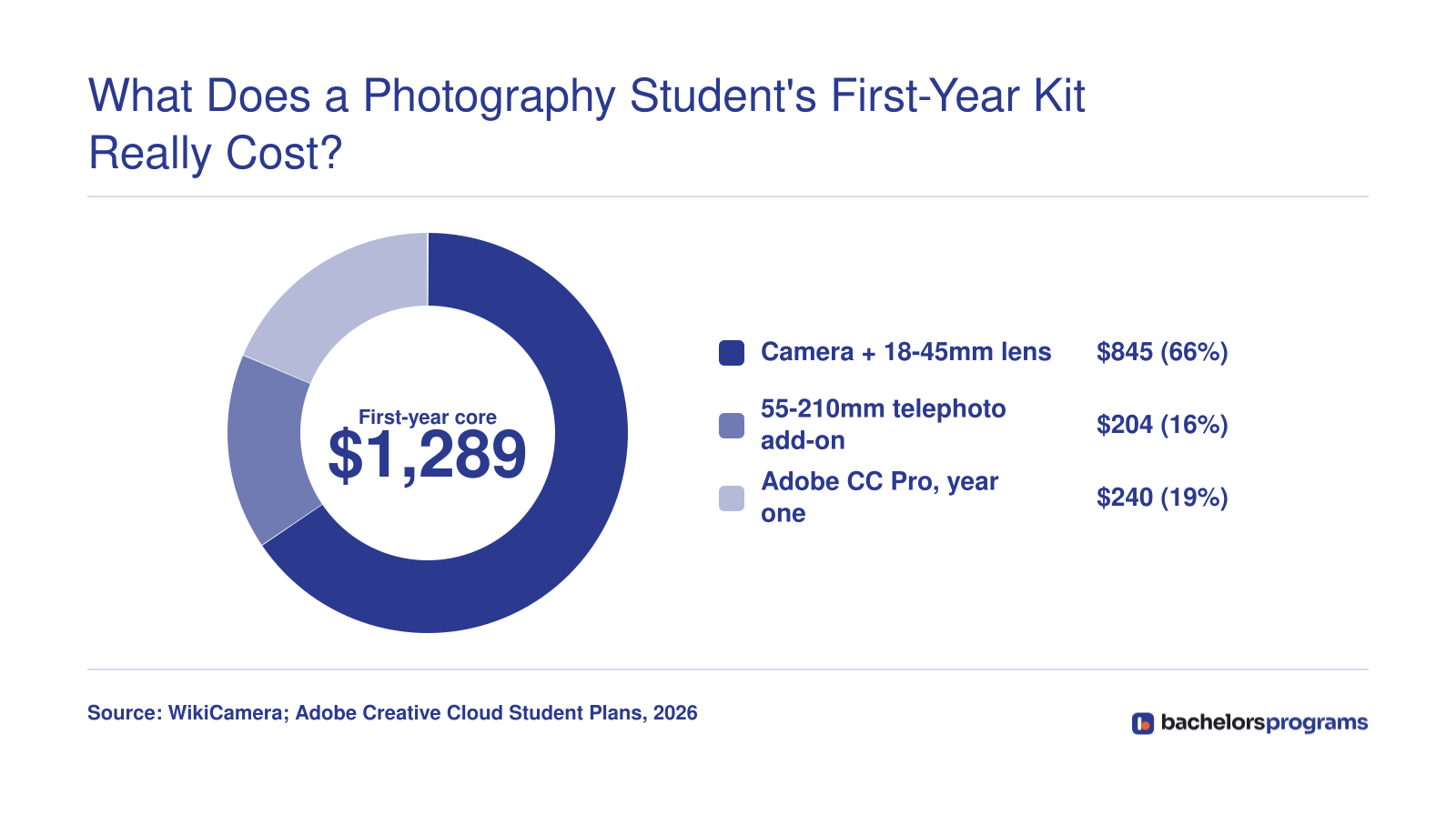
- A two-lens Canon EOS R50 kit plus Creative Cloud runs about $1,289.
- Among ranked schools, New York University posts the strongest graduate earnings.
The 10 Best Digital Photography Degree Programs
This list is drawn from every delivery format, campus and online alike, and in this edition all ten ranked programs are campus-based; each card notes how the program is delivered. Criteria, data sources, and weighting are explained in the methodology section below. Program-level debt and earnings figures appear where the federal data publishes them, with the time window stated.
University of California-Berkeley
#1Berkeley, CA · ~$13,000/yr (est.)
Best for: Aspiring fine artists at a research university
Berkeley's Department of Art Practice treats digital photography as one of ten studio concentrations inside a BA in Art Practice, and the degree runs 12 courses with at least three in art history. Every major finishes with a capstone senior thesis exhibition at the Worth Ryder Art Gallery, and the department accepts transfer students with prerequisite studio work who typically finish in four semesters. Students who borrowed federal aid carried median federal debt of $15,000 at completion, and median earnings one year after finishing were $29,011. The school's graduation rate is 92.8%.
- Digital photography is one of 10 studio concentration options
- 12 courses total, including at least three in art history
- Capstone senior thesis exhibition at the Worth Ryder Art Gallery
- 2.0 GPA minimum, plus two lower-division studio courses
- Transfer students typically finish in four semesters
- Up to four studio courses may transfer
- Portfolio review may be required for some applicants
Purdue University
#2West Lafayette, IN · ~$15,000/yr (est.)
Best for: Budget-minded students at a large public campus
Purdue's Photography and Related Media major is a 45-credit BA inside a 120-credit degree, built on a 12-credit art and design core and 18 credits of required photography coursework in black and white process, color imaging, lighting, and digital media. A portfolio review gates continuation into upper-level study, which ends in advanced coursework and a group exhibition. Program graduates who used federal aid carried median federal debt of $17,369 at completion, and median earnings four years after finishing were $52,105. The school's graduation rate is 83.1%.
- 120 total credit hours, including a 45-credit major
- 12-credit art and design core opens the major
- 18 credits of required photography courses
- 9 credits of C-level courses such as digital video and commercial practice
- Portfolio review required before continuing in the major
- Advanced studies culminate in a group exhibition
- 32 upper-level credits and a 2.0 GPA required to graduate
California State University-Long Beach
#3Long Beach, CA · $7,000 – $20,000/yr (est.)
Best for: Hands-on learners drawn to darkroom work
Cal State Long Beach runs the largest photography program in this group, awarding a BFA in Photography alongside a BA in Art and a photography minor. Studio work covers analog and digital camera operation, darkroom printing and alternative processes, critical analysis, and writing for the arts, with a visiting artists and scholars lecture series and MFA studio visits built into the calendar. Faculty hold advising hours, and School of Art advisors supply course checklists and roadmaps. The school's graduation rate is 68.9%.
- BFA in Photography plus a BA in Art and a photography minor
- Studio work covers analog and digital camera operation and editing
- Darkroom printing and alternative processes taught
- Visiting Artists and Scholars Lecture Series, known as Art 101
- In-class lectures, panels, and MFA student studio visits
- Course checklists and roadmaps from School of Art advisors
- Faculty answer advising questions during office hours
University of Washington-Seattle Campus
#4Seattle, WA · ~$14,000/yr (est.)
The University of Washington's Division of Art organizes its BA in Art into three areas of study, and Photo/Media is the one built around photography, video, mixed media, and installation. Students complete introductory courses before choosing an area, then pair program-specific studio work with required art history coursework in classes taught by working artists. Median earnings for program graduates one year after finishing were $28,561. The school's graduation rate is 85.2%.
- Photo/Media is one of three areas of study in the Division of Art
- Work spans photography, video, mixed media, and installation
- Introductory courses completed before choosing an area
- Art history coursework required alongside studio classes
- Studio-based classes taught by working artists and educators
Clemson University
#5Clemson, SC · $20,000 – $25,000/yr (est.)
Clemson's BFA in Visual Arts lets students choose photography as one of seven emphases, and the photography track covers both traditional black and white film and contemporary digital capture. A four-course foundations program and a mandatory Foundations Review come first, and the degree closes with a three-course Senior Studio, a BFA exhibition, and a professional portfolio. Students also have access to a five-week summer study abroad in Italy and to the photo and sculpture labs in Lee Hall. The school's graduation rate is 86.6%.
- Photography is one of seven BFA emphasis options
- Covers traditional black and white film and contemporary digital formats
- Four-course foundations program and mandatory Foundations Review
- Senior Studio spans three courses and ends in a BFA exhibition
- Five-week summer study abroad in Italy
- Access to photo and sculpture labs in Lee Hall
- 2.0 GPA required to change into the BFA
University at Buffalo
#6Buffalo, NY · $20,000 – $25,000/yr (est.)
University at Buffalo's BFA in Fine Arts with a photography concentration carries 74 credits in the major out of 120 total, including a 62-credit photography core that runs from Introduction to Photography through Advanced Photography Projects. Students add four electives, choose among Studio Photography, View Camera, Black and White Film Photography, and Experimental Photography, and complete a senior thesis across two semesters. Program graduates who borrowed federal aid carried median federal debt of $18,861 at completion, and median earnings one year after finishing were $26,630. The school's graduation rate is 75.2%.
- 120 credits total, with 74 credits in the major
- 62-credit photography core through Advanced Photography Projects
- Four photography electives, 12 credits, include Studio Photography and View Camera
- Two-semester senior thesis required
- Transfer students may apply up to 18 art credits
- 2.5 GPA in art courses needed to graduate
- Program Distinction noted on the official transcript
Washington University in St Louis
#7St. Louis, MO · ~$22,000/yr (est.)
Washington University in St. Louis awards its BFA in Studio Art through the Sam Fox School, where photography is one of five concentrations and studio courses account for 65 credits, roughly half the degree. First-year students take core studios in drawing, 2D, 3D, and digital studio plus a weekly seminar, then move into concentration work and professional practice seminars on artist statements and CVs. Seniors mount a public thesis exhibition, and the photography curriculum now includes drone photography among the practices taught. The school's graduation rate is 94.3%.
- Photography is one of five studio art concentrations
- 65 credits of studio courses, about half the degree
- Darkroom and digital photography studios, plus studio spaces for juniors and seniors
- Drone photography now part of the photographic practices taught
- Professional practice seminars cover artist statements and CVs
- Public BFA thesis exhibition and capstone presentation
- BA in Art track takes 30-36 studio credits with no capstone
University of Illinois Urbana-Champaign
#8Champaign, IL · ~$14,000/yr (est.)
The University of Illinois Urbana-Champaign's BFA in Studio Art with a photography focus pairs photography courses with Art + Design foundation work, art history, and general education. The facilities are the draw: darkrooms, shooting studios, Mac and Windows workstations, professional scanners, Epson large format printers, video cameras, digital cameras, tripods, portable lighting, and an extensive fine art library. Faculty expertise covers black and white printing, studio lighting, color, digital photography, video, and installation. The school's graduation rate is 85.1%.
- Darkrooms and shooting studios available to students
- Mac and Windows workstations plus professional scanners
- Epson large format printers and video cameras on site
- Digital cameras, tripods, and portable lighting provided
- Faculty expertise in studio lighting, color, and digital photography
- Art + Design foundation and art history courses required
- Extensive fine art library on campus
Wake Forest University
#9Winston-Salem, NC · $25,000 – $30,000/yr (est.)
Wake Forest University awards a BA in Studio Art in which majors take eight studio art courses and two art history courses, then complete a three-course sequence in one studio area such as photography. The photography sequence runs from Introduction to Darkroom Photography and Introduction to Digital Photography up through advanced work, with Street Photography and Photography and the Artist's Book also offered. Applicants submit a portfolio of visual work, and qualified students can pursue Honors in Art by presenting and defending a project before department faculty. The school's graduation rate is 89.2%.
- Eight studio art courses plus two art history courses
- Three-course sequence in one studio area, photography included
- Sequence runs from Introduction to Darkroom Photography to Digital Photography
- Street Photography and Photography and the Artist's Book offered
- Four-credit Studio Art Capstone, ART 393, required
- Portfolio of visual work required for admission
- Honors in Art option with a project defended before faculty
- 2D, 3D, and 4D course requirements outside the sequence
University of South Carolina
#10Columbia, SC · ~$23,000/yr (est.)
The University of South Carolina awards a BFA in Photography: Studio Art through the McCausland College of Arts and Sciences, with coursework in digital and film photography, theoretical discourse, and the history of the medium across cultures. Students work in darkrooms, digital printing labs, and shooting studios, check out cameras and equipment for class projects, and complete a solo exhibition before graduating. Upper-level courses center on individual projects, portfolios, books, and exhibitions, and alumni employers include Google, Nike, and Richland Library. Median earnings for program graduates one year after finishing were $23,686, and median federal debt at completion was $22,500. The school's graduation rate is 78.8%.
- Coursework in both digital and film photography
- Darkrooms, digital printing labs, and shooting studios
- Cameras and other photography equipment available to check out
- Solo exhibition required to graduate
- Upper-level courses center on portfolios, books, and exhibitions
- Coursework covers photo installations and book publishing
- Alumni employers include Google and Nike
Cost & outcomes by school
Federal data for the highest-earning Digital Photography programs, independent of the ranking above. Earnings are this field's bachelor's graduates four years after completing where the Scorecard reports them, else the school's undergraduate median.
| School | Net price / yr | Grad rate | Earnings | Debt | Grads/yr | Format |
|---|---|---|---|---|---|---|
| Princeton University NJ | $6,128 | 98% | $110,066 | $10,320 | — | Campus |
| Georgetown University DC | $40,815 | 95% | $103,494 | $15,500 | — | Campus |
| Northeastern University MA | — | — | $92,538 | $24,250 | — | Campus |
| University of Virginia VA | $21,565 | 96% | $86,863 | $17,500 | — | Campus |
| Washington University in St Louis MO | $21,786 | 94% | $86,182 | $17,500 | 19 | Campus |
| Loyola University Maryland MD | $30,574 | 79% | $82,652 | $27,000 | — | Campus |
| University of Illinois Urbana-Champaign IL | $14,355 | 85% | $81,054 | $19,500 | 5 | Campus |
| University of Washington-Seattle Campus WA | $14,091 | 85% | $78,466 | $14,615 | 70 | Campus |
| Wake Forest University NC | $28,719 | 89% | $78,158 | $21,500 | — | Campus |
| Kennesaw State University GA | $15,048 | 52% | $78,034 | $24,125 | — | Campus |
| Molloy University NY | $24,347 | 70% | $77,789 | $27,000 | — | Campus |
| Rutgers University-Camden NJ | $18,745 | 67% | $74,479 | $21,500 | — | Campus |
Sources: U.S. Department of Education. Net price, graduation rate, earnings and debt: College Scorecard (earnings and debt for this field's bachelor's graduates where reported, else school-wide); graduates: IPEDS. A dash means no figure is reported.
Cost, debt & payoff
Median earnings of this field's bachelor's graduates (4 yrs after completing, else the school's undergraduate median) vs. their median federal loan debt · U.S. College Scorecard
Across these programs the median graduate earns about $52,084 and finishes with roughly $22,500 in debt — a ratio that clears a common rule of thumb (keep debt below first-year salary). Net price and debt vary widely school to school, so check the per-school figures in the table above before you shortlist.
How We Ranked Bachelor's Degree in Digital Photography Programs
Each program here was scored on the same five factors, so a small private art school and a large public university land on comparable footing. Together they describe cost, completion, debt, what graduates earn, and whether the degree can be finished online, usually the first things families ask about.
What We Measure
- Average net price: what students actually pay after grant aid, not the sticker tuition.
- Graduation rate: the proportion of students at the institution who complete their degree.
- Program-level median earnings: reported earnings for graduates of the photography program after completion.
- Median federal debt at completion: borrowed principal for graduates of the program.
- Online availability: whether the bachelor's degree in digital photography can be completed remotely.
Our Data Sources
The U.S. Department of Education's College Scorecard supplies these figures. Program-level earnings and debt are drawn from records tied to the photography CIP code at the bachelor's level, while graduation rate and net price come from institution-level Scorecard data.
What the Data Cannot Tell You
Net price averages what aided students pay; it is not a quote for your situation. Your package depends on your FAFSA results and each school's aid policy. Graduation rate describes the whole institution, not the photography department. And some small programs do not publish earnings at all, because too few graduates are reported to protect student privacy. Where that happens, the ranking leans on the remaining measures.
Accreditation status and portfolio requirements were checked by hand rather than scored. The admissions checklist below covers both.
BFA vs. BS vs. BA in Digital Photography: Which Degree Fits Your Goals?
A bachelor's degree in digital photography is not one fixed template. Texas State University's BFA in Photography requires 120 credits, including 42 in general education and 77 in the major, a split that leaves little room for courses outside the discipline.1
BFA: Studio Heavy and Portfolio Driven
The BFA is the professional studio degree, and most BFAs land at 120 to 126 credits. Texas State's 120-credit BFA puts 77 credits into photography and major coursework. Temple University's 2026-2027 BFA requires at least 126 semester hours.2 Willamette University's 121-credit BFA includes a 60-credit photography major and a 6-credit thesis,3 while University at Buffalo's BFA requires 120 credits, 74 in the major, a 3-credit thesis, and a 1-credit capstone.4 Expect critique-heavy studio sequences, a thesis or capstone, and a public portfolio. Best fit: students aiming at fine art, gallery representation, editorial photography, or an MFA.
BS and BA: More Flexibility, Different Depth
A BS in photography or digital photography usually leans commercial, technical, or production-oriented. A BA spreads work across the liberal arts. Grand Valley State University's BA/BS photography table totals 101 credits, with 43 in general education, 31 in photography, 9 in a communication core, and 9 electives, plus a capstone listed at 1 to 6 credits.5 There, general education carries more credits than the photography core. The lighter major load makes double majors, internships, and study abroad easier to fit. Best fit: students who want photography paired with business, communication, or another field, or who want a broader education before choosing a career.
Associate Degrees and Certificates
Associate degrees and certificates crowd search results. They take less time and cost less, and they can be a practical entry point for assistant, retouching, or studio management work. What you give up is depth: fewer upper-level studio courses, less general education, and usually no path to graduate study. A bachelor's degree in digital photography keeps those doors open.
Match the degree to the portfolio you want to build. A thesis show and intensive studio training point to the BFA. Room for a second field of study points to the BA or BS.
Questions to Ask Yourself
Do you want to show work in galleries and teach, or shoot for paying clients?
Will your portfolio be stronger with 70+ studio credits, or do you need business, marketing, and writing courses?
Could an associate degree plus a transfer pathway get you the same bachelor's for less?
Do you need a fully online format, or can you travel for studio residencies and critiques?
Online vs. On-Campus Digital Photography Degrees
Delivery format shapes a photography education more than the diploma does. Where you study determines how you shoot, who critiques your work, and what gear you can borrow, so compare online and on-campus programs on those terms rather than on convenience alone.
What "Fully Online" Really Means in Photography
Online photography is not passive. At Southern New Hampshire University, portfolio development runs on instructor and peer critique, and the program lists no in-person residency requirement for 2026. Academy of Art University critiques work through an online portal with video and written feedback from faculty and classmates, and adds optional live sessions, including Zoom workshops and sound-stage shoots. Assignments are shot locally and reviewed digitally. One caveat: the Open Studio course requires an individual project plus either PH 275 or director approval1, so plan your course sequence early.
Equipment and Studio Access
Online students carry the production burden. SNHU requires an interchangeable-lens camera with manual controls and RAW capture, a tripod, a lighting kit, and Adobe Creative Cloud; phone and tablet cameras are not accepted.2 Campus programs supply what a spare room cannot: darkrooms, shooting studios, large-format printers, and check-out equipment at schools such as Illinois, South Carolina, and Clemson. Washington University in St. Louis adds dedicated darkroom and digital studios along with studio space for juniors and seniors.
Who Should Choose Which
Working adults and career changers get the most from online study, since assignments fit around a job and a local shooting schedule. Students who want daily studio time, equipment access, faculty mentorship, and exhibition experience should choose campus. The ranked table here lists campus-based programs, while online options such as SNHU and Academy of Art serve a different set of constraints.
Related Articles
What Does a Photography Student's First-Year Kit Really Cost?
Pairing an entry-level Canon EOS R50 two-lens kit with Adobe's student Creative Cloud Pro rate puts the core of a first-year kit at about $1,289, before you add a laptop, monitor, external storage, and printing. A full-frame kit pushes the camera alone to roughly $1,400-$2,800, and the Adobe student rate rises to $479.88 in year two. Some programs fold equipment or software into tuition, so compare total cost, not tuition alone.
Admission, Portfolio, and Transfer Requirements Checklist
Requirements vary by school, so treat this checklist as a starting point and confirm each item with the programs on your shortlist.
- High school diploma or GEDEvery bachelor's program expects proof that you completed secondary school or earned an equivalent credential.
- Application and transcriptsSend official transcripts from high school and from any college you attended.
- Portfolio (if required)Expect about 10 to 20 images at many schools. SVA asks for 10 to 20 photos or videos submitted through SlideRoom. CalArts wants about 20 individual images, prefers work from the last three years, and does not accept SlideRoom. Not every program asks for a portfolio; Belmont's BA in Photographic Studies does not, so check whether your program requires one at all.
- Artist statement or essayLength varies by school. SVA asks for a 500-word statement of intent, and CalArts asks for 500 to 1,000 words.
- Test scoresAsk each school whether SAT or ACT scores are required, optional, or not considered.
- Transfer creditsCredits are usually evaluated course by course. AA and AS degrees covered by an articulation agreement tend to transfer most predictably. An AAS in photography may transfer only in part, and some studio courses may count as electives rather than major requirements.
- FAFSAFile the FAFSA early to qualify for federal grants, loans, and work-study.
Top Program-Level Earnings Among Ranked Photography Degrees
Among the schools ranked here, New York University's photography program posts the strongest graduate earnings.
Digital Photography programs by state
Frequently Asked Questions About Digital Photography Degrees
These answers cover the questions prospective students ask most about cost, gear, financial aid, transfer credit, and timing. Details vary by school, so confirm specifics with each admissions office.
Is a photography degree worth it?
Are there online photography schools that provide cameras?
Can I get a photography degree with financial aid if I study online?
Can I transfer an associate degree in photography into a bachelor's?
How long does an online bachelor's degree in digital photography take?
Compare Digital Photography programs on the data that matters
Explore more Arts & Design majors or browse every field of study.
All Arts & Design programs Browse every field of study