Best Game Art & Design Degree Programs
Compare 140+ accredited Game Art & Design programs, with net price after aid, graduation rates, earnings and debt from IPEDS and the U.S. College Scorecard.
Studios hire from portfolios, not transcripts, but a bachelor's degree in game art and design is where many artists build one. What it costs to build that portfolio varies sharply. Average annual net price after aid runs from $6,555 at Cal State Fullerton to $51,949 at Gnomon, with USC at $32,740.
Cheaper does not mean easier to enter. Cal State Fullerton admits students to its BFA only by portfolio review, with deadlines in mid-September and mid-March.
Hiring managers still judge finished work first, so a degree earns its price through the studio time, critique, and deadlines that produce that work.
Key Points
- USC game art graduates earned a median $64,846 one year out.
- Ringling, RIT, DigiPen and UNC Charlotte require portfolios; SCAD's is optional.
- Want an online degree? Every ranked program here is campus-based.
Best Bachelor's Degree in Game Art and Design Schools Ranked
The ten programs below rank highest on what a degree costs after aid, whether students actually finish, and how selective the school is. A short methodology note sits below the ranking to explain how each factor is weighed.
University of Southern California
#1Los Angeles, CA · ~$33,000/yr (est.)
Best for: Aspiring character artists near the film industry
USC's School of Cinematic Arts runs a 128-unit Bachelor of Fine Arts in Game Art on its Los Angeles campus, where studio courses run as collaborative workshops and attendance is mandatory. Students choose from five concentrations, including character animation, environmental design and visual effects, and median earnings for game art graduates one year after finishing were about $64,800.
- 128-unit BFA based in the School of Cinematic Arts
- Five concentration options, from character animation to visual effects
- Studio courses run as collaborative workshops; attendance is mandatory
- Grade of C or better required in every required and prerequisite course
- Core Game Art courses such as CTAN 280 and CTIN 488 cannot be waived
- Los Angeles location near film, television and game producers
- Lab fees apply to some classes
University of Central Florida
#2Orlando, FL · ~$10,000/yr (est.)
Best for: In-state students seeking low per-credit tuition
UCF's Game Design track inside the BA in Digital Media is a 120-credit, cohort-based degree in Orlando with 51 credits in the major and a two-course Game Design Workshop capstone. Coursework covers game design, production, testing and modeling for realtime systems, with electives such as level design and digital sculpting.
- 120-credit BA with a 51-credit Game Design major
- 6 basic core credits plus 39 advanced core credits
- Capstone runs as Game Design Workshop I and II
- At least a C and a GPA minimum in 3000-level Digital Media courses
- Electives include game level design and digital sculpting
- Equipment fee of $90 per term for full-time students
- Honors in the Major thesis option available
- Computer labs reserved for majors
California State University-Fullerton
#3Fullerton, CA · $7,000 – $20,000/yr (est.)
Best for: Art students wanting a portfolio-review BFA
Cal State Fullerton admits students to the BFA in Art first, then into the Game Art, Animation and Immersive Media concentration by portfolio review held twice a year. The 132-unit degree carries 36 concentration units across 3D modeling, rigging, lighting, realtime narrative and a capstone, with virtual and augmented reality work built in.
- 132-unit BFA with 36 units in the concentration
- 30 upper-division concentration units plus 9 studio art elective units
- Admission by portfolio review, held in fall and spring
- 3.0 GPA across four foundational art courses required
- Two attempts allowed to qualify for the BFA
- Portfolios due mid-September or mid-March
- Work spans 3D modeling, rigging, lighting and look development
- Virtual, augmented and mixed reality focus
Indiana University-Bloomington
#4Bloomington, IN · $12,000 – $42,000/yr (est.)
Indiana University Bloomington splits its BS in Game Design between the College of Arts and Sciences and The Media School, and the Art focal area suits students who want to build the visuals. Majors complete nine credit hours in one focal area; median earnings one year after finishing were about $26,400.
- Bachelor of Science in Game Design
- Nine credit hours required in a single focal area
- Focal areas include Art, programming, sound and design theory
- Degree awarded through the College of Arts and Sciences and The Media School
- Balances technical and creative game design coursework
University of Maryland-Baltimore County
#5Baltimore, MD · $15,000 – $20,000/yr (est.)
UMBC offers an Animation and Interactive Media concentration inside the Visual Arts BA in Baltimore, with separate animation and interactive media tracks. Coursework runs through modeling, texturing, rigging, sound design and advanced 3D animation techniques to a senior project; median earnings one year after finishing were about $34,000.
- Animation and Interactive Media concentration inside the Visual Arts BA
- Two tracks: Animation and Interactive Media
- Coursework in modeling, texturing, rigging and sound design
- Advanced 3D Animation Techniques and Expression in Time and Motion
- Animation track adds Writing for Media and Special Effects & Motion Graphics
- Interactive Media track adds History and Theory of Games
- Senior Projects capstone required
Gnomon
#6North Hollywood, CA · ~$52,000/yr (est.)
Gnomon is a North Hollywood school built around digital production, and its BFA in Digital Production with a Game Art concentration runs 12 terms of production-style coursework. The curriculum pushes beyond basic asset creation into advanced industry techniques, with graduates pointed toward character, environment, texture, VFX, lighting and animation roles.
- BFA in Digital Production with a Game Art concentration
- Course grid runs from Term 1 through Term 12
- Named career paths include Character Artist and Environment Artist
- Named career paths include Texture Artist and VFX Artist
- Named career paths include Gameplay Animator and Rigging TD
- Game Art courses are specific to the concentration grid
- Builds advanced industry techniques beyond basic asset creation
Pennsylvania State University
#7University Park, PA · ~$33,000/yr (est.)
Penn State's Bachelor of Design in Digital Arts and Media Design lets students choose an Interactive Media and Games track inside a 121-credit degree at University Park. The track covers game art, game design, physical computing, virtual worlds and data visualization, ending in a senior thesis and a two-course capstone; median earnings one year after finishing were about $43,300.
- Bachelor of Design in Digital Arts and Media Design
- 121 credits; 45 in General Education and 80 to 84 in the major
- Interactive Media and Games track carries 19 credits
- Game Studio required, with Game Studio II among the options
- Coursework spans game art, physical computing and virtual worlds
- Senior thesis plus Capstone I and II
- Grade of C or better in major courses; 2.00 GPA to graduate
- Faculty are practicing professional artists
Iowa State University
#8Ames, IA · $19,000/yr (est. net price)
Iowa State's BS in Game Design runs 121 credits in Ames with three focus areas: Game Art, Game Computing and Game Worlds. The Game Art path covers drawing, visual design, storyboarding, character animation and 3D modeling, and students finish with a capstone studio and a portfolio of games; median earnings one year after finishing were about $37,600.
- 121-credit BS in Game Design
- Three focus areas: Game Art, Game Computing and Game Worlds
- 40 credits of general education and 65 to 66 in game design
- Game Art covers drawing, storyboarding, character animation and 3D modeling
- 18 credits of Game Art electives
- Capstone project studio in the final year
- Team-based multidisciplinary design experience
- Graduates leave with a portfolio of games
University of Arizona
#9Tucson, AZ · ~$17,000/yr (est.)
The University of Arizona awards a BA in Game Design at its Tucson campus, a 120-unit degree covering design, development tools and platforms, play testing, user needs and analytics. It does not require extensive programming background, and students build a minor or second major into the degree.
- 120-unit BA in Game Design
- No extensive computer programming knowledge required
- Covers play testing, user needs and analytics
- Coursework includes research methods and technology ethics and policy
- Digital Engagement course required
- Minor or dual major built into the degree
- Fall early action deadline is November 1
University of North Carolina at Charlotte
#10Charlotte, NC · $15,000 – $20,000/yr (est.)
UNC Charlotte's BFA in Art with a Digital Media and Game Design concentration is a 120-credit campus degree with 79 credits inside the Department of Art & Art History. Studio courses are limited to art majors, admission requires an entrance portfolio, and new art majors begin in fall.
- BFA in Art with a Digital Media and Game Design concentration
- 120 credits, with 79 inside the Department of Art & Art History
- Entrance portfolio required for admission
- New art majors admitted for fall semester only
- Coursework in 3D modeling, animation, video, sound and interactive media
- Studio and graphic design courses limited to art majors
- Accredited institutional member of the National Association of Schools of Art and Design
Cost & outcomes by school
Federal data for the highest-earning Game Art & Design programs, independent of the ranking above. Earnings are this field's bachelor's graduates four years after completing where the Scorecard reports them, else the school's undergraduate median.
| School | Net price / yr | Grad rate | Earnings | Debt | Grads/yr | Format |
|---|---|---|---|---|---|---|
| Gnomon CA | $51,949 | 100% | $114,785 | $28,332 | — | Campus |
| Stevens Institute of Technology NJ | $41,346 | 87% | $108,772 | $27,000 | — | Campus |
| Worcester Polytechnic Institute MA | $43,071 | 90% | $103,470 | $27,000 | 30 | Campus |
| Lawrence Technological University MI | $32,918 | 61% | $99,444 | $27,000 | 36 | Campus |
| Northeastern University MA | — | — | $92,538 | $24,250 | — | Campus |
| University of Southern California CA | $32,740 | 92% | $89,022 | $18,000 | 50 | Campus |
| Northeastern University MA | $30,915 | 91% | $87,336 | $25,500 | 70 | Campus |
| Manhattan University NY | $27,256 | 64% | $86,316 | $26,000 | — | Campus |
| New York University NY | $37,050 | 88% | $82,509 | $20,500 | — | Campus |
| University of the Pacific CA | $25,447 | 69% | $78,445 | $19,500 | 14 | Campus |
| Southern Methodist University TX | $40,892 | 84% | $78,354 | $19,500 | 22 | Campus |
| George Mason University VA | $17,915 | 68% | $76,343 | $19,500 | — | Online or campus |
Sources: U.S. Department of Education. Net price, graduation rate, earnings and debt: College Scorecard (earnings and debt for this field's bachelor's graduates where reported, else school-wide); graduates: IPEDS. A dash means no figure is reported.
Cost, debt & payoff
Median earnings of this field's bachelor's graduates (4 yrs after completing, else the school's undergraduate median) vs. their median federal loan debt · U.S. College Scorecard
Across these programs the median graduate earns about $54,064 and finishes with roughly $25,188 in debt — a ratio that clears a common rule of thumb (keep debt below first-year salary). Net price and debt vary widely school to school, so check the per-school figures in the table above before you shortlist.
How We Ranked These Game Art & Design Schools
Ranking game art and design schools means comparing programs on evidence you can check: what students pay, how many finish, what graduates earn, and how much debt they carry. This list leans on federal College Scorecard and IPEDS records rather than reputation or paid placement.
What We Compare
Each program is reviewed on three broad categories: - Cost: what students actually pay after grants and scholarships, plus median debt among graduates. - Outcomes: graduation rates, plus published earnings for that program's graduates where the federal data reports them. - Access and scale: admission rate and how many students complete the program each year.
We do not publish percentage weights. One formula would imply a precision the data cannot support, and a school strong on cost but weak on earnings should read differently to you than the reverse.
Where the Numbers Thin Out
The completion and net price figures describe the whole institution, not the game art major alone. Program-level earnings are missing for some schools, usually because too few graduates land in the federal sample. A blank is not a zero, and it is not a red flag.
Using the List
Treat the ranking as a starting filter. Pull three to five schools, then run each one's net price calculator against your actual aid award, review student portfolios, and confirm the curriculum teaches the software studios actually use. The ranking narrows the field; your portfolio and your aid letter make the final call.
Game Art vs. Game Design vs. Game Development: Which Degree Fits You?
Game art centers on visuals, game design on systems and player experience, and game development on programming. A BFA carries a heavier studio-credit share (SCAD's BFA puts 75 major-curriculum hours inside a 180-hour degree), while a BA leaves more room for liberal arts, and Lindenwood's online Game Design BA with a Game Art emphasis requires 54 credit hours. Game art also appears as a concentration inside broader art or animation degrees, and technical art and animation are hybrid paths that pair artistic skill with scripting and engine work, so many gaming majors in college sit between these three tracks.
| Factor | Game Art | Game Design | Game Development |
|---|---|---|---|
| Core focus | Visual production: 2D and 3D art, storytelling, and interactive media (Seattle University) | Rules, systems, prototyping, and player experience | Programming-oriented study of how games are built and run |
| Typical credential | BFA or BA | BA or BS | BS |
| Signature coursework | SCAD: Sketching and Drawing, Core Principles: Game Art, Game Development Studio I and II | Plymouth State: Game Design Principles, Game Design Workshop, UX/UI. Lindenwood: Prototype Studio, Team Studio I | Illinois Tech: Introduction to Software Development, Game Design I. Arizona Online: C# and Unity coursework |
| Primary software | Unity, Unreal Engine, Maya, Blender, Adobe Creative Suite | Unity, Unreal Engine, Blender, Maya, Photoshop, ZBrush, GitHub | Unity Game Engine and the C# language |
| Math and coding load | Light: an introductory programming course alongside heavy studio work | Moderate: introductory programming plus scripting inside engines | Heaviest: programming and software development courses throughout |
| Credit structure example | SCAD BFA: 75 major hours in a 180-hour degree. Seattle University: 120 semester credits | Champlain: 48 game design credits, 42 general education, 30 general elective. Plymouth State: 120 credits | Ball State concentration: 27 concentration credits plus 33 to 36 core-major credits. Arizona Online: 115 credits |
| Typical first jobs | Junior 3D, environment, character, or concept artist | Junior game designer, level designer, or QA tester | Junior gameplay, tools, or engine programmer |
Online and Hybrid Game Art Degree Options
Can you earn a bachelor's degree in game art and design online? The answer here is no: every program in the ranking is delivered on campus, whether in Los Angeles, Orlando, Baltimore, or a college town like Ames or Bloomington. Online study is still open to you, but it changes what you should check before you enroll anywhere.
What Residency Buys You
Studio labs stocked with the same hardware and software the industry runs, live critique where an instructor marks up your model in front of the room, and team game jams that imitate a real production sprint. Those habits are difficult to reproduce through a screen, and hiring managers read portfolios for evidence of them.
What Online Buys You
Flexibility around a job, no relocation, and the ability to stay on in-state tuition. The risk is a program that hands you recorded lectures, a discussion board, and little else.
Questions to Ask Before You Enroll Online
- Are critiques synchronous? Weekly live sessions with an instructor and classmates beat asynchronous comments on a screenshot.
- Is there a collaborative capstone? Look for a semester-long team project where artists, designers, and programmers ship a playable build together.
- Who teaches portfolio review? Faculty with shipped commercial titles, not adjuncts pulled in for one term.
- What does the school supply? Software licenses, a hardware specification, and whether you need your own drawing tablet.
Hybrid formats, with some studio time and some remote coursework, split the difference if you live within commuting distance of a campus. Ask admissions to name the specific courses that meet in person.
Portfolio Requirements and Admissions for Game Art Programs
Portfolio rules differ from school to school. Ringling, RIT, DigiPen and UNC Charlotte require a portfolio for admission. SCAD's undergraduate portfolio is optional and used for scholarship consideration. At Cal State Fullerton, the portfolio controls entry into the BFA itself. Overall admission rates at the schools ranked here run from 9.8 percent at USC to 90.5 percent at Cal State Fullerton.
- Number of piecesRIT asks for 7–10 of your best visual works. SCAD's guidelines call for 8–10 visual art pieces, with 2–3 minutes of time-based media such as animation or game design as an option.
- Observational drawingRingling's Game Art major requires 3–5 drawings or paintings made from real life, not from photos or screenshots.
- 3D or digital workRingling accepts 3D models, animation clips, coding and digital concept art as supporting work. RIT caps motion work at 3 minutes total and excludes fan art, AI-generated art and video game clips.
- Process or sketchbook pagesSCAD does not require a sketchbook, and Ringling encourages process work. DigiPen requires written explanations of your process and design choices.
- Artist statement and descriptionsRIT wants each piece uploaded as its own file with a title, medium and your role. DigiPen's BA in Game Design asks for a written prompt response plus 2 prior works, with no web links or executables.
- Transcripts and GPASome majors set grade floors, including a 2.8 GPA minimum for UCF's Game Design track and a 3.0 minimum for Cal State Fullerton's BFA.
- Deadline windowRIT's portfolio is due with your application. Cal State Fullerton reviews portfolios in mid-September or mid-March and gives two attempts to qualify.
Related Articles
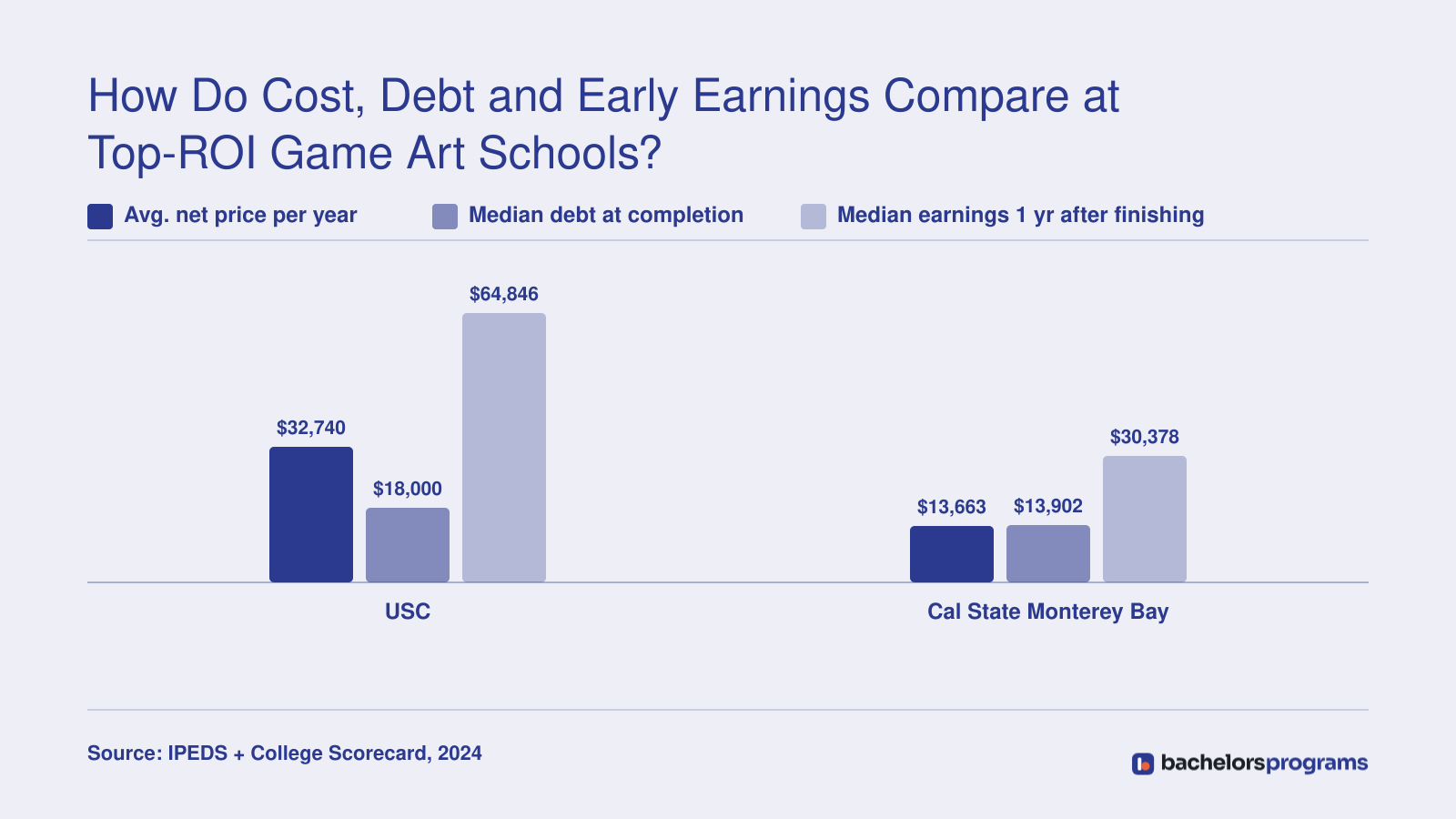
How Do Cost, Debt and Early Earnings Compare at Top-ROI Game Art Schools?
USC graduates in this field earned a median $64,846 one year after finishing. They carried median debt of $18,000 at completion, about $191 a month on a 10-year repayment plan, at a school with an average annual net price of $32,740. Cal State Monterey Bay costs far less, with a $13,663 net price and $13,902 in median debt (about $147 a month), though first-year earnings start lower at $30,378. Net price is an average for aided students, not your bill. Cal State Fullerton, Gnomon, Pacific and SMU are left off the chart because full program-level debt and first-year earnings are not reported for them.
What Animators and Game Artists Earn
Game artists are typically counted by the federal government as special effects artists and animators, so this occupation's wage data is the most useful benchmark for a bachelor's degree in game art and design.
Game Art & Design programs by state
Game Art Degree FAQs
These answers cover the questions prospective students ask most often about a bachelor's degree in game art and design. Requirements differ by school and degree type, so confirm details with each admissions office before you apply.
Can you get a game art and design degree online?
Do you need a portfolio to get into a game art program?
Do game studios care whether you have a degree, or only your portfolio?
Can you transfer community college art credits into a game art bachelor's degree?
Compare Game Art & Design programs on the data that matters
Explore more Arts & Design majors or browse every field of study.
All Arts & Design programs Browse every field of study