Best Accounting Schools in Colorado
Compare 16 accredited Accounting programs in Colorado at 14 colleges, with net price after aid, graduation rates, earnings and debt from IPEDS and the U.S. College Scorecard.

Colorado's accounting programs split between low-cost regional campuses and pricier private and research schools, and CPA licensure adds a further constraint: for applications filed before January 1, 2027, the state requires 150 semester credit hours, 30 more than a standard bachelor's degree delivers. The bachelor's degree in accounting is the entry point, most often a Bachelor of Science (B.S.) in Accounting, though several schools here award a business administration degree with an accounting emphasis.
Options run from Boulder and Denver to Pueblo, Durango and Grand Junction, on campus and online, all from Colorado-based schools. Price, format and credit planning matter as much as brand when the goal is a CPA license.
Key Points
- Colorado Mountain College has the lowest average net price on this list.
- MSU Denver residents pay $11,124 in tuition, versus $30,684 for non-residents.
- Colorado's State Board of Accountancy, part of DORA, issues CPA licenses.
Best Accounting Schools in Colorado: Top 10 Bachelor's Programs Ranked
Colorado accounting programs range from a large public research university in Boulder to a mountain college that runs its business degree fully online. The ten bachelor's programs below include B.S. and B.A. accounting degrees, business administration degrees with an accounting concentration, and a Bachelor of Innovation, all based in Colorado and open to students who want to study in state or online.
University of Colorado Boulder
#1Boulder, CO · $25,000 – $30,000/yr (est.)
Best for: Students wanting a flagship research campus
The University of Colorado Boulder anchors its accounting degree in the Leeds School of Business, where students take accounting theory and reasoning coursework on top of the business core. Accounting majors add 18 semester hours of accounting and can fill electives in finance, information systems, and international business. An accelerated 4+1 option lets strong students finish a master's in five years, the shorter route to the 150 credit hours Colorado CPA licensure requires. The program sits at a large public research university on the Boulder campus.
- 120 total credit hours
- Covers accounting theory and concepts
- Accounting coursework begins after the Business Core
- Takes at least three semesters beyond the Business Core
- Requires 18 semester hours of accounting courses
- Electives in finance, information systems, international business
- Optional 4+1 accelerated bachelor's and master's path
University of Denver
#2Denver, CO · ~$36,000/yr (est.)
Best for: CPA-track students planning a fifth year
The University of Denver runs its accounting degree through the School of Accountancy inside the Daniels College of Business, with a cohort-based core and a 1:18 faculty-to-student ratio. Most graduates continue into the Master of Accountancy to reach the credit hours needed to sit for the CPA exam, though a 3/2 dual degree awards both the B.S. in Accounting and the Master of Accountancy in five years or less. Students entering with AP, IB, or community college credit can finish the pair in four years. It is a private university in a residential Denver neighborhood.
- Cohort-based Core structure
- Faculty-to-student ratio of 1:18
- 3/2 dual degree awards BSAcc and MAcc in five years or less
- AP, IB, or community college credit can shorten the path to four years
- Most graduates continue to the Master of Accountancy for CPA requirements
- Accounting minor open to business majors only
Colorado Mountain College
#3Glenwood Springs, CO · $8,000/yr (est. net price)
Best for: Resort-town residents who study fully online
Colorado Mountain College awards a Bachelor of Science in Business Administration with an accounting concentration, and the concentration meets the education requirement to sit for the CPA exam in Colorado. The college runs the degree at Breckenridge, Rifle, Spring Valley at Glenwood Springs, and Steamboat Springs, and fully online, a combination that sets it apart among Colorado accounting programs. Students choose from five concentrations, and adding a second takes a program change form signed by an advisor plus a meeting with the academic dean about internships. The four-year degree totals 120 credit hours.
- 120 credit hours over four years
- Meets Colorado CPA exam education requirements
- Includes Income Tax, Intermediate Accounting I and II, and Auditing
- Also covers Governmental and Not-For-Profit Accounting
- Offered at Breckenridge, Rifle, Spring Valley, Steamboat Springs and online
- Five concentration options; adding one requires a program change form
Regis University
#4Denver, CO · ~$18,000/yr (est.)
Regis University offers accounting as a major inside a Bachelor of Science in Business Administration in the Anderson College of Business, taught on campus in 16-week semesters. Sample coursework includes Cost Accounting, Income Tax Accounting I, and Auditing Principles and Procedures, and the major builds a foundation for sitting for the CPA exam. Full-time and part-time enrollment are both available, and a FastForward option pairs the bachelor's with a master's. The Jesuit university sits in northwest Denver.
- 16-week semester format on campus
- Sample courses: Cost Accounting, Income Tax Accounting I, Auditing Principles
- Builds a foundation for sitting for the CPA exam
- Full-time and part-time enrollment; $1,583 per credit for part-time
- FastForward dual bachelor's and master's option
- General business track option available
University of Colorado Colorado Springs
#5Colorado Springs, CO · $10,000 – $24,000/yr (est.)
The University of Colorado Colorado Springs delivers accounting as an emphasis within its Bachelor of Innovation in Business, a degree built around applied business work rather than a traditional B.S. structure. Accounting students take Intermediate Accounting, Cost Accounting, Individual Income Tax, and Auditing alongside the business administration core. Coursework covers generally accepted accounting principles, cost behavior and activity-based costing, federal income tax concepts, and generally accepted auditing standards. Graduates are prepared for public accounting, industry, and not-for-profit and governmental roles.
- Named courses include Intermediate Accounting (ACCT 3010)
- Cost Accounting (ACCT 3110) and Individual Income Tax (ACCT 4210)
- Auditing (ACCT 4600) covers generally accepted auditing standards
- Emphasis on GAAP and accounting theory
- Activity-based costing and cost behavior covered in class
- Class assignments include preparing tax returns
Colorado Christian University
#6Lakewood, CO · $25,000 – $30,000/yr (est.)
Colorado Christian University structures its accounting bachelor's around a 120-credit plan: 48 general education credits, a 34-credit business core, 24 credits of accounting core, and electives. Coursework covers GAAP reporting for business, not-for-profit, and governmental entities, U.S. GAAS attest engagements, federal taxation, and AICPA and PCAOB ethics. Accounting majors can apply 500-level electives toward the CCU MBA at no additional cost or added time to graduation. The campus is in Lakewood, west of downtown Denver.
- 120 total credit hours
- 48 general education credits plus a 34-credit business core
- 24 credits of accounting core and 6 credits of accounting electives
- Covers GAAP reporting for business, not-for-profit, and governmental entities
- Auditing covers U.S. GAAS attest engagements
- AICPA and PCAOB ethics, Sarbanes-Oxley, and business law
- Up to 18 credits of 500-level electives apply toward the CCU MBA
- Scripture applied to accounting ethics dilemmas
Colorado State University Pueblo
#7Pueblo, CO · $10,000/yr (est. net price)
Colorado State University Pueblo offers a 120-credit accounting degree through the Hasan School of Business, designed to be completed in four years. Students study financial and managerial accounting, cost accounting, taxation, auditing, business law, and ethics, with advising through the PACK Center. Summer courses can shorten the timeline, and the curriculum adds finance, marketing, and economics for a broad business foundation. Graduates are prepared for public accounting, tax, forensic accounting, and analyst roles as well as positions in government and education.
- 120 total credit hours, designed for four years
- Financial and managerial accounting, cost accounting, and auditing
- Business law, taxation, and ethics built into the major
- Summer courses can accelerate completion
- Advising available through the PACK Center
- Housed in the Hasan School of Business
Colorado Mesa University
#8Grand Junction, CO · ~$15,000/yr (est.)
Colorado Mesa University offers a Bachelor of Science in Accounting with two concentrations: Public Accounting, built for students pursuing CPA licensure in Colorado, and General Accounting, aimed at private industry, government, and nonprofits. Students gain hands-on experience through internships, cooperative education, and a Volunteer Income Tax Assistance lab, and a five-year 3+2 option adds an MBA to the bachelor's. A Fraud Examination professional certificate is available alongside the degree. Graduates are recruited by local and regional CPA firms.
- Two concentrations: Public Accounting and General Accounting
- Five-year 3+2 option pairs the bachelor's with an MBA
- Internships, cooperative education, and a VITA tax lab
- Fraud Examination professional certificate offered
- Local and regional CPA firms recruit graduates
- Designed for students pursuing CPA licensure in Colorado
- 2.0 GPA minimum
- 3+2 pathway to the MBA
- Job offers can arrive months before graduation
- Students assist residents with tax filing
- Prepares for roles in private industry, government, and nonprofits
- Hands-on VITA tax preparation experience
- Not designed for CPA certification
- Networking with local CPAs and community
Fort Lewis College
#9Durango, CO · ~$17,000/yr (est.)
Fort Lewis College grants a Bachelor of Arts in Accounting through the Katz School of Business, built on a 60-credit major core plus a liberal arts foundation for 120 credits total. The program's Beta Alpha Psi chapter is active, with weekly speakers and service projects, and some students work as auditors before they graduate. Many secure jobs with local firms after their junior year, and the major covers CPA exam requirements and background checks. It is a small public liberal arts college in southwest Colorado.
- 120 total credit hours
- 60-credit major core plus a liberal arts foundation
- Prepares students for CPA licensure requirements and background checks
- Active Beta Alpha Psi chapter with weekly speakers
- Some students work as auditors before graduating
- Analyze, record, interpret, and communicate financial transactions
Metropolitan State University of Denver
#10Denver, CO · $15,000/yr (est. net price)
Metropolitan State University of Denver lets students complete its Bachelor of Science in Accounting online, in person, or in a hybrid mix, and it enrolls the largest accounting graduating class on this list. The 120-semester-hour degree splits into 33 general studies credits, a 45-credit business core, 21 accounting major credits, and 9 upper-division accounting electives. Students need a 2.0 average in the business core and major, a C or better in each accounting course, and at least 12 upper-division accounting hours taken at MSU Denver. Internships run through the C2 Hub, and a Senior Experience capstone closes the degree.
- 120 semester hours: 33 general studies, 45 business core, 21 accounting
- 9 upper-division accounting elective credits
- Online, in-person, or hybrid formats
- Five areas including audit under GAAS and accounting information systems
- 2.0 average required in the business core and major
- C or better required in each accounting course
- At least 12 upper-division accounting hours at MSU Denver
- Internships through the C2 Hub; 3-credit Senior Experience capstone
Cost & outcomes by school
Federal data for the highest-earning Accounting programs, independent of the ranking above. Earnings are this field's bachelor's graduates four years after completing where the Scorecard reports them, else the school's undergraduate median.
| School | Net price / yr | Grad rate | Earnings | Debt | Grads/yr | Format |
|---|---|---|---|---|---|---|
| University of Denver CO | $36,131 | 76% | $96,903 | $15,830 | 53 | Campus |
| Metropolitan State University of Denver CO | $15,327 | 32% | $73,698 | $22,087 | 86 | Hybrid |
| Regis University CO | $18,397 | 61% | $73,054 | $23,556 | 14 | Campus |
| Colorado Mesa University CO | $15,103 | 41% | $71,577 | $22,000 | 23 | Campus |
| University of Colorado Boulder CO | $25,346 | 74% | $69,738 | $19,500 | — | Campus |
| University of Colorado Denver/Anschutz Medical Campus CO | $11,900 | 46% | $64,270 | $20,500 | — | Online |
| Colorado Christian University CO | $29,500 | 64% | $64,060 | $34,939 | 29 | Campus |
| Colorado State University-Fort Collins CO | $21,279 | 67% | $60,543 | $20,000 | — | Campus |
| Colorado State University Pueblo CO | $10,051 | 40% | $59,567 | $21,500 | 8 | Campus |
| Fort Lewis College CO | $17,296 | 36% | $59,298 | $19,225 | 15 | Campus |
| Colorado Technical University-Colorado Springs CO | $16,745 | 19% | $57,068 | $34,500 | 170 | Hybrid |
| University of Colorado Colorado Springs CO | $15,788 | 47% | $54,659 | $20,000 | — | Campus |
Sources: U.S. Department of Education. Net price, graduation rate, earnings and debt: College Scorecard (earnings and debt for this field's bachelor's graduates where reported, else school-wide); graduates: IPEDS. A dash means no figure is reported.
Cost, debt & payoff
Median earnings of this field's bachelor's graduates (4 yrs after completing, else the school's undergraduate median) vs. their median federal loan debt · U.S. College Scorecard
Across these programs the median graduate earns about $64,165 and finishes with roughly $21,000 in debt — a ratio that clears a common rule of thumb (keep debt below first-year salary). Net price and debt vary widely school to school, so check the per-school figures in the table above before you shortlist.
Most Affordable Bachelor's in Accounting Programs in Colorado
Average net price, what students pay after grants and scholarships, is the clearest measure of what a bachelor's degree in accounting will actually cost in Colorado. Based on 2024 IPEDS and College Scorecard figures, Colorado Mountain College has the lowest average net price among the schools ranked here at $7,813 a year, followed by Colorado State University Pueblo at $10,051. The University of Colorado Denver, which appears in our directory, is also included below for comparison. Compare graduation rates alongside price, since finishing on time keeps total cost down.
| School | City | Program | Format | In-State Tuition & Fees | Out-of-State Tuition & Fees | Average Net Price | Graduation Rate |
|---|---|---|---|---|---|---|---|
| Colorado Mountain College | Glenwood Springs | Business Administration (BS), Accounting Concentration | Campus and online | $2,616 | $12,840 | $7,813 | 27.4% |
| Colorado State University Pueblo | Pueblo | Accounting, Bachelor of Science in Business Administration | Campus | $9,720 | $17,944 | $10,051 | 39.7% |
| University of Colorado Denver/Anschutz Medical Campus | Denver | Accounting, BS in Business Administration | Online | $10,383 | $29,391 | $11,900 | 46.1% |
| Colorado Mesa University | Grand Junction | Accounting | Campus | $9,927 | $25,124 | $15,103 | 40.6% |
| Metropolitan State University of Denver | Denver | Accounting Major, B.S. | Hybrid (online, in-person, or hybrid) | $11,124 | $30,684 | $15,327 | 31.5% |
Online and Hybrid Bachelor's in Accounting Options at Colorado Schools
Metropolitan State University of Denver lists its accounting major as available in online, in-person, or hybrid formats, and its in-state tuition of roughly $11,124 sits well below the $30,684 out-of-state rate the school publishes.
Most Colorado Accounting Degrees Are Built for Campus
Most of the accounting programs ranked here are campus-based, which suits traditional full-time students who want face-to-face faculty access, semester internships and on-campus recruiting by public accounting firms. University of Colorado Boulder, University of Denver, Regis University, University of Colorado Colorado Springs, Colorado Christian University, Colorado State University Pueblo, Colorado Mesa University and Fort Lewis College all list campus programs.
Online and Hybrid Options
Working adults and career changers get the most from the flexible options. MSU Denver's mix of formats lets a student holding a job stack evening or online coursework toward the same degree. Colorado Mountain College offers a business administration bachelor's with an accounting concentration, taught on campus and fully online.
Colorado-Based, Wherever You Study
Every online option here comes from a school based in Colorado, not an out-of-state provider, so coursework and CPA preparation are tied to Colorado requirements. Out-of-state students studying online should check the rate before applying: Colorado Mountain College charges $5,112 in-state against $12,840 out-of-state, and MSU Denver's gap is wider still. Transfer credit rules vary by school, so confirm them before applying.
Admissions Requirements for a Bachelor's Degree in Accounting in Colorado
Colorado's public universities increasingly treat community college as a built-in first half of the accounting degree, and the admissions rules reflect it.
GPA, Testing and Transfer Limits
- Metropolitan State University of Denver: The typical minimum is a 2.0 high school GPA. Students with 20 or more credits plus a diploma or GED, or 24 or more transferable credits, may also qualify. Up to 90 eligible transfer credits can count toward the 120-credit degree. The school's pages do not state an SAT or ACT policy.
- University of Colorado Denver: The business school accepts a maximum of 90 applicable transfer hours, and work from other institutions needs a C- or better.1 Credits should be within 10 years of use; older ones are evaluated individually.2 No SAT or ACT policy is stated for the accounting program.
- University of Colorado Boulder: The school is test-optional. Transfer applicants face no stated minimum GPA or credit-hour requirement. With fewer than 24 post-high-school credits, your high school record is reviewed too. Transfer grades must be C- or higher. Accounting is an emphasis within the Leeds business program, not a separate bachelor's title.
For the other schools here, we have no confirmed GPA, test or transfer-cap policy to report. Check each admissions page directly rather than assuming.
Community College Pathways
GT Pathways guarantees up to 31 general education credits with a C or better among Colorado public institutions. Those credits count toward the gen-ed core, but they do not automatically satisfy accounting requirements. A statewide associate of arts or science (60 credits) can lead to a bachelor's with no more than 60 additional credits, subject to the receiving program.
Business-specific agreements go further. A Denver community college's accounting transfer associate degree applies all 61 credits toward an accounting bachelor's at either MSU Denver or CU Denver.3 A Denver-area accounting technician associate degree has a guaranteed 2+2 path into CU Denver's B.S. in Business Administration, Accounting. You must graduate with the associate degree, only courses with C+ or better are guaranteed, and gen-ed must come from GT Pathways.
Practical Tips
- Finish introductory accounting and economics before you transfer, so you start upper-division coursework on schedule.
- Ask whether the business school has its own admission step beyond university admission. At CU Boulder, the accounting emphasis needs three semesters beyond the Business Core and 18 accounting hours.
- Get a written course-by-course evaluation from the receiving school before you enroll. Statewide frameworks do not guarantee every credit counts toward the major.
Cost of an Accounting Bachelor's Degree in Colorado
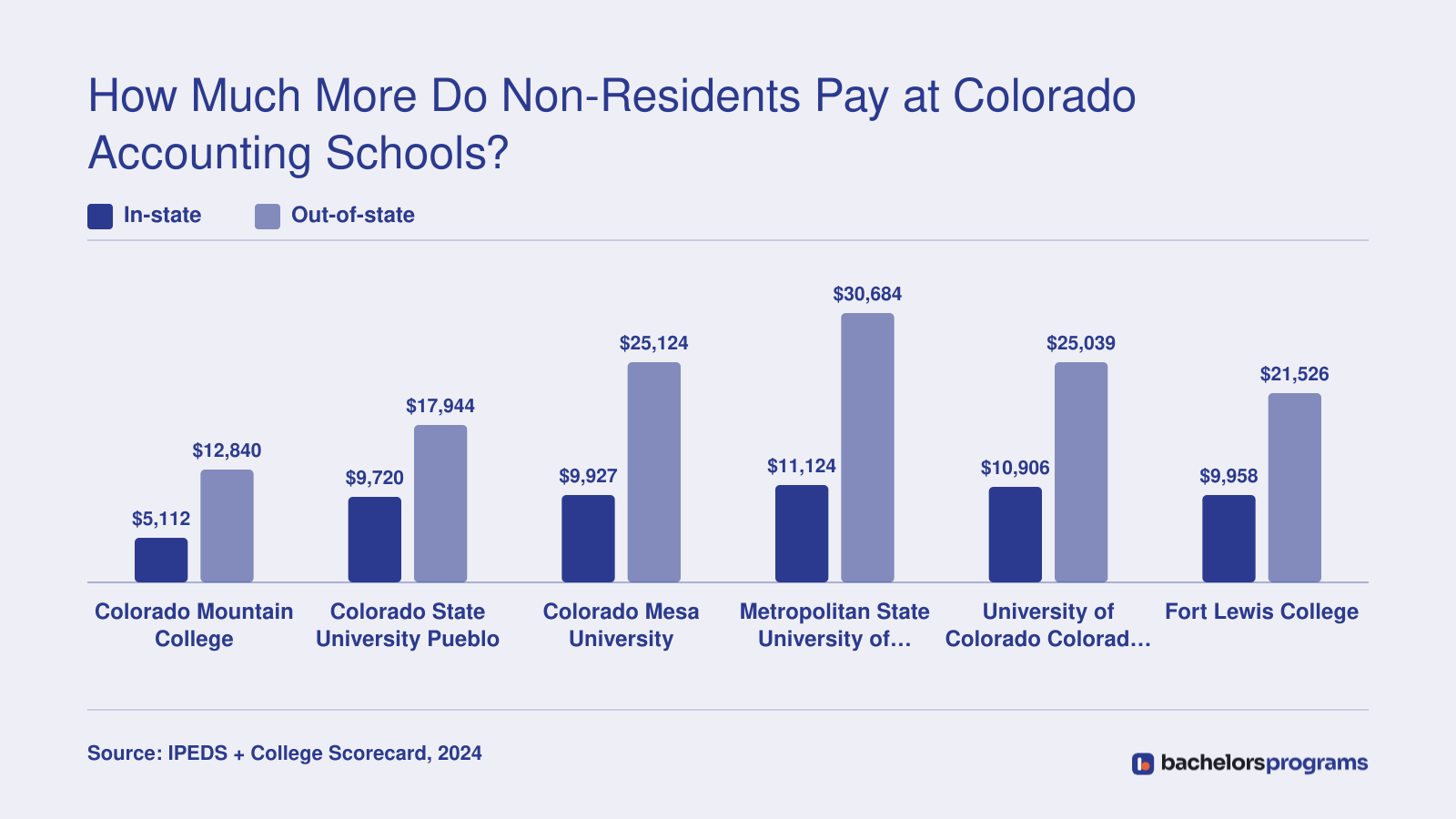
Residency decides the price of a Colorado accounting degree more than any other factor. At the public schools here, an out-of-state student pays roughly 1.5 to 3 times the in-state rate, and the gap is widest at Metropolitan State University of Denver: $11,124 in-state against $30,684 out-of-state.
Tuition and Net Price
Colorado Mountain College is the lowest-cost route, at $2,616 in-state and $12,840 out-of-state. Colorado State University Pueblo ($9,720 in-state, $17,944 out-of-state), Colorado Mesa University ($9,927 and $25,124), Fort Lewis College ($9,958 and $21,526) and the University of Colorado Colorado Springs ($10,149 and $24,336) cluster near $10,000 for residents. Regis University charges a single private rate of $46,340.
At Regis, net price after aid is far lower than sticker price: $18,397. Elsewhere it runs from $7,813 at Colorado Mountain College to $17,296 at Fort Lewis. These net figures are sector-average estimates, not a quote for your family, so run each school's own calculator.
Colorado Aid That Lowers the Bill
- College Opportunity Fund: A stipend paid per credit hour to participating Colorado public colleges for in-state undergraduates.1 The legislature sets the amount annually, so confirm the current figure.2 The lifetime limit is 145 credit hours, with 30 more available after a bachelor's degree. Private-school students face added requirements, including Pell-level need.
- Colorado Student Grant: A need-based state grant. The most recent guidelines available (2021-22) listed maximum awards from $500 to $5,000 depending on need level.3 Treat those as dated, and check your school's aid office for current awards.
- Colorado Promise and institutional programs: These generally require about one year of Colorado residency, FAFSA or CASFA filing, and income limits.4 CSU Pueblo's Colorado Promise Scholarship, for example, has cited a $70,000 family income ceiling and 15 credits per semester.5 Terms change, so verify them.
None of the state grants reviewed here is specific to accounting majors. Accounting students qualify through the general need, residency and enrollment rules.
Debt and a Practical Saving Tip
Median debt figures are institution-wide, not specific to accounting. They run from $9,000 at Colorado Mountain College to $22,000 at Colorado Mesa, and $25,000 at Regis.
The simplest way to cut the bill is to start at Colorado Mountain College, whose business administration B.S. includes an accounting concentration, or to complete the first two years at a community college and transfer. Either way, establish Colorado residency early so you pay in-state rates.
How Much More Do Non-Residents Pay at Colorado Accounting Schools?
Non-residents pay more than Colorado residents at every public school shown here. The widest gap is at Metropolitan State University of Denver, where out-of-state students pay $30,684 against $11,124 for residents, a difference of $19,560. The smallest gap is at Colorado Mountain College ($5,112 vs. $12,840, a $7,728 difference), with Colorado State University Pueblo close behind at $8,224.
Related Articles
Colorado CPA Licensure: The 150-Credit-Hour Rule and How a Bachelor's Gets You There
A CPA license is Colorado's legal permission to practice as a certified public accountant, issued by the Colorado State Board of Accountancy within the Department of Regulatory Agencies (DORA). Your bachelor's degree is the foundation, but under the current rules it is not the full education requirement.
What Colorado Requires Today
For applications filed before January 1, 2027, licensure requires a bachelor's degree or higher, 150 non-duplicative semester hours, passing scores on all four sections of the Uniform CPA Examination, 1,800 hours of accounting experience verified by a licensed CPA, and a separate written professional ethics exam.1 The Colorado Society of CPAs describes the AICPA ethics exam as open-book with a passing score of 90% or higher.2
Within those 150 hours, the board looks for:
- Accounting: 33 semester hours, with at least 27 above the introductory level and at least 3 in auditing focused on U.S. standards.
- Business: 27 semester hours, with no more than 9 counted from any single subject (extra hours still count toward the 150).
- Internships: No more than 3 semester hours of internship course credit.
Exam eligibility comes earlier. You can sit for the CPA Exam with a bachelor's degree, 120 semester hours, 27 accounting hours (21 above introductory), a 3-hour auditing course and 21 business hours.3
Closing the 30-Credit Gap
A typical bachelor's degree runs about 120 credits, so licensure under the 150-hour rule means roughly 30 more. Common routes include extra undergraduate coursework or a minor, a combined 4+1 or 3+2 bachelor's-to-master's track, or a graduate program after you finish your bachelor's.
New pathways take effect January 1, 2027, and they matter for anyone entering college now: a bachelor's plus two years of accounting experience, a bachelor's plus 30 credits and one year of experience, or a post-baccalaureate master's plus one year of experience.1
Major, Emphasis or Credit Hours
The label on your degree matters less than the courses on your transcript. Metropolitan State University of Denver and the University of Denver offer accounting majors, while Regis University and Colorado State University Pueblo place accounting inside a business administration degree. An accounting concentration or emphasis can work just as well, provided it delivers enough upper-level accounting hours and a qualifying auditing course.
Confirm Before Your Final Years
Rules are changing, and every program is built differently. Before planning your junior and senior years, ask an advisor to map your courses against the board's requirements, and check the board's current rules for the year you expect to apply.
AACSB Accreditation and CPA Exam Pass Rates at Colorado Schools
Accreditation tells you how a program is built, while CPA pass rates tell you how its graduates perform. In Colorado, the first is easy to confirm and the second is not.
Who holds AACSB accreditation
AACSB International is the main business accreditor, and some schools also hold a separate accounting accreditation. These schools are accredited in both business and accounting:
- Colorado State University-Fort Collins1
- University of Colorado Boulder2
- University of Colorado Denver3
- University of Colorado Colorado Springs4
- University of Denver5
The University of Northern Colorado's Monfort College of Business holds dual accreditation in business administration and accounting.6 Metropolitan State University of Denver lists its accounting program as AACSB-accredited. We found no accreditation details for the other schools here, so check their program pages directly.
Employers and CPA firms care because the label signals a vetted curriculum, qualified faculty and a recognized credential. Many firms recruit mainly from accredited programs.
What pass rates are available
- University of Colorado Boulder: It reports a 73% first-time pass rate on the 2024 Uniform CPA Exam. That figure covers its graduate accounting candidates, not bachelor's graduates specifically. Boulder also ranks 12th nationally among programs with more than 60 candidates.
- Everyone else: We could not confirm school-level pass rates for the other schools. University of Colorado Denver states that its undergraduate accounting degree covers all Colorado CPA exam requirements, but that is not a pass rate.
How to read the numbers
Pass rates swing with the number of students who sit the exam. A small group can make a school look far better or worse than it is, and results from different reporting years are not directly comparable. Treat any single figure as one data point, and ask each program for several years of results along with the number of candidates.
Is a Bachelor's in Accounting Worth It in Colorado?
The core tradeoff is upfront price versus long-run pay: a costlier program may lead to strong accounting salaries, while a cheaper one can reach the same career with far less debt.
What the Numbers Show
Federal outcome data for the University of Denver's accounting bachelor's show median earnings of $67,392 one year after graduation, $96,903 at four years and $103,111 at five years. Median federal loan debt for those graduates is $15,830. That works out to about $168 a month on a standard 10-year plan, roughly 3% of gross monthly pay in the first year. DU's average net price after aid is $36,131 a year, so the debt figure reflects heavy aid and family support, not the full bill.
For a rough, institution-wide proxy (not an accounting-specific result), compare cost with earnings. Colorado Mountain College pairs a $7,813 net price with median earnings of $44,127 ten years after enrollment across all its students, which gives it a strong earnings-to-cost ratio.
Our Take
- Best fit: Students committed to CPA licensure, since public accounting rewards the credential.
- Lowest-risk path: In-state students at public schools such as CU Boulder or Colorado Mountain College, where borrowing tends to stay modest.
- Check first: Your net price after aid, not sticker tuition.
- Ask before enrolling: How the program helps you reach Colorado's 150-hour CPA requirement.
Compare Accounting programs on the data that matters
Explore more Business & Management majors or browse every field of study.
All Business & Management programs Browse every field of study