Best Business Degree Programs in Colorado
Compare 62 accredited Business programs in Colorado at 25 colleges, with net price after aid, graduation rates, earnings and debt from IPEDS and the U.S. College Scorecard.

Colorado's community colleges now award bachelor's degrees in business: Trinidad State, Front Range and Arapahoe all run applied business administration programs alongside the research universities. That widens the price range considerably. In-state tuition and fees for a business bachelor's in the state run from $2,616 at Colorado Mountain College to $9,720 at CSU Pueblo, while private and flagship options sit well above that.
Every program covered here is a bachelor's, on campus or online, at a Colorado-based school. CU Boulder's Leeds School takes the top spot, with the cheapest and highest-earning picks further down.
A degree's sticker price and its graduates' earnings do not track each other closely in this state.
Key Points
- University of Colorado Boulder's Leeds School of Business tops this Colorado ranking.
- Colorado Mountain College posts the lowest average net price: $7,813 yearly.
- For 2027, Colorado CPA candidates need at least a bachelor's degree.
Best Bachelor's in Business Schools in Colorado, Ranked
The University of Colorado Boulder leads this ranking of business bachelor's programs in Colorado, pairing a large research university setting with a 120-credit BS in Business Administration at the Leeds School of Business. The ten schools below range from flagship research campuses and a private university in Denver to community colleges whose applied bachelor's degrees let associate degree holders finish close to home or entirely online. Net prices are averages after aid and graduation rates are institution-wide figures, so treat both as context rather than as a quote for your own situation.
University of Colorado Boulder
#1Boulder, CO · $25,000 – $30,000/yr (est.)
Best for: Students wanting a large flagship business school
The flagship campus in Boulder runs its undergraduate business degree through the Leeds School of Business, a 120-credit BS in Business Administration with six areas of emphasis, including accounting, business analytics, finance, real estate, and management and entrepreneurship. Leeds holds AACSB accreditation, and the university reports an institution-wide graduation rate near 74% with an average net price after aid of about $25,300. Coursework is on campus in Boulder.
- 120 credit hours, including business core and general education
- Six areas of emphasis, including accounting, finance and real estate
- Each emphasis requires 18 semester hours beyond the core
- 16 semester hours of business electives; study abroad with approval
- Integrated core taught through a running business case
- Leeds School of Business holds AACSB accreditation
Colorado State University-Fort Collins
#2Fort Collins, CO · ~$21,000/yr (est.)
Best for: Colorado residents seeking a mid-size research campus
Colorado State's Fort Collins campus offers a Business Administration major through the College of Business, with concentrations that include accounting and marketing and a second concentration option in international business. The degree requires 120 credits, a senior capstone, and at least half of the credits completed at CSU; transfer applicants need a 3.000 GPA and a B- or better in ECON 202. Institution-wide, roughly 67% of students graduate and the average net price after aid is about $21,300. Classes run in person, and applicants should confirm the College of Business's current AACSB status directly with the school.
- Concentrations include accounting and marketing
- International business available as a second concentration
- 120 total credits, including a senior capstone
- Transfer applicants need a 3.000 GPA and ECON 202 with a B-
- At least 50% of credits must be completed at CSU
- Accelerated program option available
Trinidad State College
#3Trinidad, CO · $10,000 – $15,000/yr (est.)
Best for: Associate degree holders wanting a low-cost finish
Trinidad State's bachelor's is a Bachelor of Applied Science in Business Administration with a management concentration, built for students who already hold an associate degree and want a four-year credential without starting over. Delivery is hybrid, with online and part-time options aimed at working adults, and the coursework focuses on management, communication, and data-driven decision making. The institution-wide graduation rate is about 55%, and the average net price after aid is roughly $10,800, one of the lowest figures on this list.
- Management concentration
- Designed for students who already hold an associate degree
- Online and part-time options for working adults
- Coursework in management, communication and data-driven decisions
- Four-year degree path
University of Denver
#4Denver, CO · ~$36,000/yr (est.)
The University of Denver's Daniels College of Business has held AACSB accreditation continuously since 1923, and its 185-credit BSBA requires an international experience plus 75 upper-division credits. Students can add concentrations such as finance or business information and analytics, and at least half of the business coursework must be taken at DU. The private university graduates about 76% of its students institution-wide, with an average net price after aid near $36,100. All coursework is on campus in Denver.
- 185 total credits, including 75 upper-division credits
- International experience required for graduation
- Concentrations include finance and business information and analytics
- At least 50% of business courses must be taken at DU
- Minimum 2.0 GPA; last 45 credits completed at DU
- Daniels College of Business accredited by AACSB since 1923
- Professional development program built into the degree
Morgan Community College
#5Fort Morgan, CO · $5,000 – $10,000/yr (est.)
Morgan Community College in Fort Morgan offers a fully online Bachelor of Applied Science in Business Administration for students who already hold an AAS in business or a similar field. The upper-division coursework covers business strategy, financial management and budgeting, marketing and digital media, human resources, operations and project management, and ethics and business law. The college reports an institution-wide graduation rate near 45% and an average net price after aid of about $9,300, among the lowest in the state. Colorado Opportunity Fund dollars and federal aid both apply.
- Fully online delivery
- Requires a prior AAS in business administration or similar
- Coursework in strategy, budgeting, marketing, HR and operations
- Colorado Opportunity Fund and FAFSA/CASFA accepted
- Projects and practical coursework built in
University of Colorado Denver/Anschutz Medical Campus
#6Denver, CO · $10,000 – $15,000/yr (est.)
CU Denver's Business School runs its BS in Business Administration in a hybrid format in the heart of downtown Denver, and the portfolio has expanded to include Business Intelligence and AI, entrepreneurship, human resources, information systems, international business, risk management and insurance, and sports business. A 2026 partnership with the 27J school district adds a direct-admissions pathway for eligible Northern Front Range students. Institution-wide, about 46% of students graduate and the average net price after aid is roughly $11,900, a strong value among four-year options here.
- Hybrid format based in downtown Denver
- Tracks: Accounting
- 120 credits, including 45 upper-division hours
- 30 residency hours required
- Experiential learning requirement, with internships available
- Management concentration requiring 24 credit hours
- Available on campus and fully online
- Courses in organizational design, change management and applied marketing
- Prepares for roles in corporate, public and nonprofit sectors
- Entrepreneurship electives available
Front Range Community College
#7Westminster, CO · $10,000 – $15,000/yr (est.)
Front Range Community College offers an online Bachelor of Applied Science in Business Administration designed as a finish for associate degree holders, with about 60 credits beyond the associate level and a full-time pace of four semesters. Course materials are free, and the curriculum covers management, marketing, finance, and operations with faculty who work in the field. The college's institution-wide graduation rate is about 35% and the average net price after aid is roughly $13,000. Everything is delivered online through the Westminster-based college.
- Online delivery
- About 60 credits beyond the associate degree
- Four semesters full time; six to eight part time
- Free course materials
- Designed for associate degree holders
University of Northern Colorado
#8Greeley, CO · $18,000/yr (est. net price)
The Monfort College of Business at the University of Northern Colorado awards a 120-credit BS in Business Administration with 11 concentrations, from accounting and finance to hospitality and event management and wealth and asset management. Every major completes three professional workshops plus an internship or approved experience, and students with a 3.0 cumulative GPA by junior year can take three MBA-level courses that count toward the bachelor's. Monfort describes itself as AACSB accredited, and its students frequently place in the top 5 to 10% nationwide on the ETS Field Test in Business. The institution-wide graduation rate is about 51%, with an average net price after aid near $17,800.
- 11 concentrations, including accounting, finance and entrepreneurship
- 120 credit hours, about four years
- Three professional workshops plus an internship or approved experience
- Accounting track prepares students for the CPA exam
- AACSB accreditation held by the Monfort College of Business
- 3.0 GPA by junior year unlocks three MBA-level courses
- Students often rank in the top 5 to 10% on the ETS Field Test in Business
Red Rocks Community College
#9Lakewood, CO · $5,000 – $10,000/yr (est.)
Red Rocks Community College in Lakewood offers a Bachelor of Applied Science in Business Administration that stacks onto one of five qualifying associate degrees, including accounting, business administration, and real estate. Students apply during their final AAS semester and then complete about 60 upper-division credits with applied projects and industry partners. The institution-wide graduation rate is about 32% and the average net price after aid is roughly $9,000. Instruction is on campus.
- Stacks onto five qualifying AAS degrees
- About 60 upper-division credits after the AAS
- Apply during the final semester of the AAS
- Applied learning with industry partners
Colorado Christian University
#10Lakewood, CO · $25,000 – $30,000/yr (est.)
Colorado Christian University is a private Christian institution in Lakewood that offers a campus BS in Business Administration and a separate fully online BS in Business with an entrepreneurship emphasis. The campus program includes an accounting concentration, a dual-degree MBA option, and coursework taught by practitioner-professors. The online version runs in five-week blocks with multiple start dates and generous transfer credit, aimed at adult learners. Institution-wide, about 64% of students graduate and the average net price after aid is roughly $29,500.
- Campus program in Lakewood
- Accounting concentration available
- Dual-degree MBA option
- Taught by experienced practitioner-professors
- Christian worldview integrated into business coursework
- Fully online, designed for adult students
- Five-week course blocks with multiple start dates
- 120 total credits, 36 in the major core
- Generous transfer credit policies
- Optional entrepreneurship emphasis
Cost & outcomes by school
Federal data for the highest-earning Business programs, independent of the ranking above. Earnings are this field's bachelor's graduates four years after completing where the Scorecard reports them, else the school's undergraduate median.
| School | Net price / yr | Grad rate | Earnings | Debt | Grads/yr | Format |
|---|---|---|---|---|---|---|
| Colorado School of Mines CO | $28,690 | 82% | $97,335 | $23,000 | 2,772 | Campus |
| Regis University CO | $18,397 | 61% | $72,105 | $25,000 | 1,070 | Campus |
| University of Denver CO | $36,131 | 76% | $71,155 | $21,844 | 3,468 | Campus |
| University of Colorado Boulder CO | $25,346 | 74% | $69,738 | $19,500 | 15,166 | Campus |
| University of Colorado Denver/Anschutz Medical Campus CO | $11,900 | 46% | $64,270 | $20,500 | 5,026 | Hybrid |
| Colorado State University-Fort Collins CO | $21,279 | 67% | $60,543 | $20,000 | 11,424 | Campus |
| Colorado State University Pueblo CO | $10,051 | 40% | $55,563 | $21,500 | 1,186 | Online |
| University of Colorado Colorado Springs CO | $15,788 | 47% | $54,659 | $20,000 | 3,854 | Online |
| University of Northern Colorado CO | $17,760 | 51% | $52,231 | $20,470 | 2,832 | Campus |
| Metropolitan State University of Denver CO | $15,327 | 32% | $52,093 | $21,500 | 5,218 | Online |
| Colorado Christian University CO | $29,500 | 64% | $50,416 | $28,312 | 1,338 | Campus |
| Arapahoe Community College CO | $11,571 | 29% | $48,341 | $11,884 | 82 | Online |
Sources: U.S. Department of Education. Net price, graduation rate, earnings and debt: College Scorecard (earnings and debt for this field's bachelor's graduates where reported, else school-wide); graduates: IPEDS. A dash means no figure is reported.
Cost, debt & payoff
Median earnings of this field's bachelor's graduates (4 yrs after completing, else the school's undergraduate median) vs. their median federal loan debt · U.S. College Scorecard
Across these programs the median graduate earns about $51,255 and finishes with roughly $20,360 in debt — a ratio that clears a common rule of thumb (keep debt below first-year salary). Net price and debt vary widely school to school, so check the per-school figures in the table above before you shortlist.
How We Sorted Colorado's Business Schools: Data Sources and Weighting
Two rankings of the same business schools can disagree sharply, one program at number three, another at number fifteen, because each is measuring something different. Here is what moves a school up or down on this page, in plain terms.
What Goes Into the Order
Four things carry the most weight: how much graduates earn after finishing, the net price students actually pay once grants and aid are counted, the share of students who complete a degree, and earnings reported specifically for business program graduates. Sticker tuition gets mentioned, but net price counts for more.
Where the Figures Come From
The outcomes, earnings and cost figures come from federal sources, chiefly the College Scorecard and IPEDS, the same datasets researchers and families use. The scope is undergraduate bachelor's programs, both campus and online, at schools based in Colorado. Master's degrees and institutions headquartered elsewhere sit outside that boundary.
Where the Numbers Stop Short
Completion rates and average student cost are reported for the whole institution, not the business department alone, so a strong business school can sit inside a middling campus average. Earnings are medians: half of graduates earn more and half earn less, and any one salary can land far from that midpoint.
No competing ranking publishes its full criteria, which makes it hard to know what a placement really reflects. Ours is spelled out so you can weigh it yourself and check any school against the federal data.
Most Affordable Bachelor's in Business Programs in Colorado
Colorado Mountain College has the lowest average net price in our data, at $7,813 a year for its campus-based Business Administration bachelor's, with Red Rocks Community College ($9,044) the most affordable of the schools ranked here. Net price is the average yearly cost after grants and scholarships and includes housing, books and other expenses, which is why it can run higher than sticker tuition. Every school below is public, which keeps in-state costs low, and Trinidad State College stands out for out-of-state students at $7,318 in tuition.
| School | City | Public or Private | Format | In-State Tuition | Out-of-State Tuition | Average Net Price | Graduation Rate |
|---|---|---|---|---|---|---|---|
| Colorado Mountain College | Glenwood Springs | Public | Campus | $5,112 | $12,840 | $7,813 | 27% |
| Red Rocks Community College | Lakewood | Public | Campus | $4,859 | $17,459 | $9,044 | 32% |
| Morgan Community College | Fort Morgan | Public | Online | $4,252 | $16,852 | $9,266 | 45% |
| Colorado State University Pueblo | Pueblo | Public | Online and campus | $9,720 | $17,944 | $10,051 | 40% |
| Trinidad State College | Trinidad | Public | Hybrid | $4,608 | $7,318 | $10,772 | 55% |
Related Articles
Online and Hybrid Bachelor's in Business Options at Colorado Schools
Can you earn a business bachelor's online from a Colorado school? Yes. The format varies by campus, so it helps to sort the schools by how they deliver the degree.
Campus, Online and Hybrid Formats
- Campus-based: University of Colorado Boulder, Colorado State University-Fort Collins, University of Denver, University of Northern Colorado, Red Rocks Community College and Colorado Christian University.
- Online: Morgan Community College and Front Range Community College.
- Hybrid: Trinidad State College and the University of Colorado Denver/Anschutz Medical Campus.
CU Denver's Business-General (Transfer) BS is the one program here described as available both online and on campus; the rest list a single format. Colorado Mesa University, Metropolitan State University of Denver and other Colorado schools also offer business bachelor's degrees, but confirm their delivery formats on their program pages.
Details Worth Checking
Morgan Community College advertises a fully online option, and Front Range Community College's business degree is online with free course materials. Both are built for students who already hold an associate degree, and Front Range describes its tuition as less than half that of a university.
At CU Denver, the Entrepreneurship, Management and Marketing concentrations are listed as hybrid. The official pages do not state an on-campus residency requirement. One 2025-26 planning document, however, describes Entrepreneurship as designed for in-person study with many courses online, so ask an advisor which description applies. The catalog requires at least 30 semester hours of business courses taken as a CU Denver student, without saying they must be on campus.1
On price, CU Denver's tuition differs by residency, and WICHE residents may qualify for reduced rates. The pages reviewed do not set a separate online rate, so ask each school whether online students pay in-state tuition.
Who Suits Online Study
Online and hybrid formats fit working adults and transfer students, especially those finishing a bachelor's after an associate degree. If you need campus recruiting and in-person networking, a campus-based program may serve you better.
Getting in: GPA, Test Policy and Transfer Credit at Colorado Business Schools
Getting into a Colorado business bachelor's program comes down to three things: your GPA, whether you send test scores, and how your earlier college credits count. Policies differ by school, and some schools publish very little.
Selectivity and the Leeds Acceptance Rate
The Leeds School of Business acceptance rate is not reported separately in federal data. The closest figure is CU Boulder's university-wide rate of 78.1%. Leeds' own admissions page is the place to check how direct admission and internal transfer into the business school work. No Leeds-specific GPA, test or transfer rules are published beyond CU Boulder's general test-optional status.
University-wide acceptance rates, for comparison:
- CU Denver: 74.7%
- University of Denver: 77.8%
- CU Boulder: 78.1%
- University of Northern Colorado: 85.9%
- Colorado State University-Fort Collins: 88.5%
Federal data reports no admission rate for the community colleges or Colorado Christian University.
GPA and Test Policy
Colorado's public four-year schools do not require SAT or ACT scores from first-time freshmen, though you may submit them. CU Boulder, Colorado State, CU Denver, Colorado Mesa and MSU Denver all list themselves as test-optional. The University of Denver is private and sits outside that statewide policy, and we found no published test policy for it. CU Denver states no numeric minimum or typical GPA, and neither do the other schools we reviewed. UNC has no published GPA or test policy that we could confirm.
Transfer Credit and gtPathways
Generally, applicants with 24 or more college-level credits after high school are reviewed under transfer standards. CU Denver draws the line at 23 or fewer semester hours: younger applicants are judged on high school work and test scores plus college GPA, while those above the line are judged mainly on college work.1
gtPathways is the statewide list of guaranteed-transfer general education courses, 31 credits in all. In 2026, a grade of C- or better is generally required, and that grade carries a 10-year transfer guarantee. Colorado State accepts up to 31 credits of completed guaranteed-transfer coursework from any Colorado public college or university, at C- or better.2 CU Denver also asks for C- or better on gtPathways courses.3
MSU Denver accepts gtPathways toward its General Studies requirements.4 Out-of-state courses may transfer but are not automatically covered4, and its Transferology tool gives a potential evaluation before you apply.5 For UNC, Colorado Mesa and Leeds, we found no published transfer or gtPathways rules, so ask an admissions office before you count on specific credits.
Questions to Ask Yourself
Do you need direct admission to a business school, or can you apply after general-education courses?
Will you live in Colorado long enough to benefit from in-state tuition?
Do you need online or hybrid study around a job?
Would the Denver-Boulder recruiting pipeline matter to your career plans?
What a Bachelor's in Business Costs in Colorado: Tuition, Net Price and State Aid
Residents and non-residents face very different prices for the same business bachelor's at Colorado's public schools. At Trinidad State College, in-state tuition and fees run $4,608 against $7,318 out of state. At Front Range Community College the figures are $4,663 and $17,263, and at the University of Colorado Denver they are $10,383 and $29,391.
Net Price After Aid
The average price students actually pay, once grants and scholarships are subtracted, tells a different story, because it counts more than tuition. Morgan Community College reports $9,266, Red Rocks Community College $9,044, Trinidad State $10,772 and CU Denver $11,900. These figures typically fold in housing and other living costs, so use them as a budgeting guide rather than a bill.
Colorado Aid Programs
- College Opportunity Fund: A per-credit stipend for eligible in-state undergraduates, set each year by the General Assembly. You must create a COF account and authorize your school to apply it. The lifetime limit is 145 credit hours, with 30 more available after a bachelor's, and waivers can be requested. Confirm the current per-credit amount with the Colorado Department of Higher Education.
- Colorado Student Grant: A state need-based grant. Award amounts and rules change by year and by school, so ask your financial aid office for the current figure.
- Colorado Opportunity Scholarship Initiative: Programs vary by participating school and partner. Students released from a Division of Youth Services facility within five years can receive up to $5,000 a year. Matching scholarships for 2025-2026 drew on $6.5 million and required financial need shown through Pell eligibility, up to 250% of the maximum Pell income level.
Residency for In-State Tuition
In-state status generally requires 12 continuous months of Colorado domicile before your first class. Domicile means a fixed, permanent home plus intent to stay, and attending school alone does not qualify. Students under 22 may qualify through a parent or guardian who has been domiciled in Colorado for a year. Schools review evidence case by case, such as a Colorado driver's license, vehicle registration, voter registration, employment and state income tax filings.
One Way to Stack Aid
File your federal aid application early, confirm in-state classification and your COF authorization, then ask the financial aid office which institutional scholarships and COSI matching funds can be added on top. Morgan Community College, for example, lists both COF and scholarships among its aid options, so pairing them can cut net price.
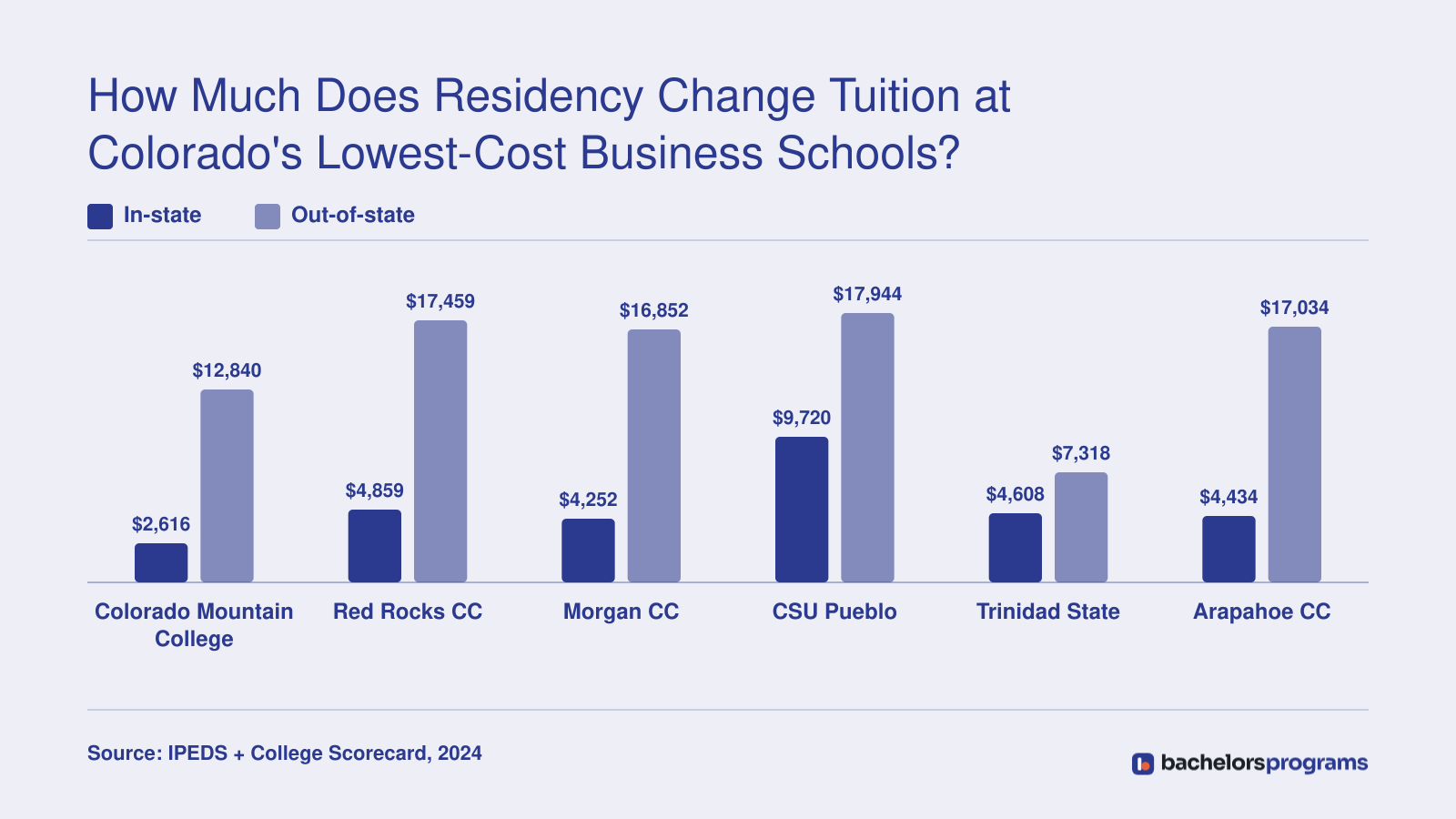
How Much Does Residency Change Tuition at Colorado's Lowest-Cost Business Schools?
In-state tuition and fees at Colorado's lowest-cost business schools range from $2,616 at Colorado Mountain College to $9,720 at CSU Pueblo. Out-of-state students pay $7,318 to $17,944. Trinidad State College has the smallest residency gap, about $2,700, while Red Rocks, Morgan and Arapahoe community colleges each charge nonresidents roughly $12,600 more. These are sticker prices: grant aid lowers what most students actually pay, and net price after aid, which also counts housing and books, runs from $7,813 to $11,571 at these schools.
Colorado CPA Licensure at a Glance for Accounting Majors
Business Careers in Colorado After Your Bachelor's
What do business graduates actually earn in Colorado, and where are the jobs? The Denver area is the largest market; Colorado Springs and Fort Collins are smaller, and wage data for individual occupations is patchier than you might expect.
Where the Jobs Are
Denver-Boulder leans toward finance, technology, health care, aerospace and energy. Colorado Springs has a strong defense and aerospace footprint, and Fort Collins mixes higher education, health care, technology and manufacturing. These are general patterns, not a 2026 hiring list. Business and financial operations roles made up about 10.5% of jobs (169,260) in the Denver-Aurora-Centennial area and 8.4% (26,700) in Colorado Springs as of May 2025.
What the Wages Look Like
The figures below are BLS means, not medians, and they come from different years.
- Denver-Aurora-Centennial: business and financial operations occupations average $103,680 a year (May 2025).
- Colorado Springs: the same group averages $94,840 (May 2025). Financial and investment analysts average $109,760 across 480 jobs, and management analysts average $56.97 an hour.
- Fort Collins: financial and investment analysts average $87,830 (May 2023).
- Statewide: financial and investment analysts average $113,480 (May 2023).
Nationally, financial analysts earned a median of $103,570 in May 2025, and BLS projects 7% growth from 2025 to 2035. The most recent Colorado figure for market research analysts dates to 2019, so it is not a reliable current benchmark.
Concentrations and Career Paths
- Finance: financial analyst and investment roles, concentrated in the Denver metro and Colorado Springs.
- Accounting: corporate, public and government accounting. CPA licensure is the main licensed pathway, covered in the licensure box above.
- Marketing: market research and brand or digital roles, most common in Denver-Boulder.
- Management: management analyst, operations and project roles across all three metros.
- Supply chain: logistics, purchasing and distribution jobs, especially around the Denver metro.
Reading Scorecard Figures Next to BLS Wages
The College Scorecard earnings shown earlier follow graduates of specific schools in the years right after they leave. BLS wages cover everyone in an occupation, from entry level to senior. A new graduate's pay will usually sit below the regional averages above, so treat the two as separate yardsticks rather than subtracting one from the other.
Compare Business programs on the data that matters
Explore more Business & Management majors or browse every field of study.
All Business & Management programs Browse every field of study