Best Accounting Schools in Georgia
Compare 43 accredited Accounting programs in Georgia at 41 colleges, with net price after aid, graduation rates, earnings and debt from IPEDS and the U.S. College Scorecard.

Georgia employed 44,020 accountants and auditors in May 2025, a workforce fed largely by the state's bachelor's degree in accounting programs. The common credential is the Bachelor of Science (B.S.) in Accounting, though B.B.A. and B.A. versions exist here.
Cost, convenience and reputation pull in different directions. The cheapest campus is rarely the highest-earning one, and admissions standards at the strongest programs add a second filter.
Then comes licensure: Georgia's 150-semester-hour CPA requirement exceeds what most four-year degrees deliver, so credit planning starts well before graduation.
Key Points
- The University of Georgia ranks first, posting the strongest accounting earnings statewide.
- Dalton State College's average net price after aid is just $5,012.
- Georgia CPA licensure traditionally requires 150 semester hours, beyond a standard bachelor's.
Best Bachelor's Degree in Accounting Programs in Georgia: Our Top 10
The University of Georgia takes the top spot on our list of the best bachelor's degree in accounting programs in Georgia, combining a large, heavily recruited business school with the strongest earnings figures in the state. The nine schools below it each bring something different, from small private cohorts to the lowest net prices in the state, and every entry lists what the degree requires and what graduates go on to earn. Our methodology section explains how these ten were chosen.
University of Georgia
#1Athens, GA · ~$14,000/yr (est.)
Best for: High-achieving students targeting public accounting
The University of Georgia is the state's flagship campus, and its accounting major sits inside the Terry College of Business, where students take 24 hours of required accounting coursework and can add a 12-hour area of emphasis in business analytics. A Double Dawgs pathway carries undergraduates into the accounting master's, and Beta Alpha Psi and NABA chapters plus a fall accounting career fair keep recruiting front and center. Accounting graduates earn a median of $93,260 four years after completion, and the school's overall graduation rate is 90%.
- 24 hours of required accounting courses, including Intermediate Accounting I-III
- Admission to the major requires a 2.6 overall GPA and a 300-400 word statement
- ACT or SAT scores plus an accounting exam required for major admission
- 12-hour Area of Emphasis in Business Analytics available to majors
- Double Dawgs pathway leads to the Accounting MAcc
- Beta Alpha Psi and NABA chapters; accounting career fair each fall
- Spring Accounting Banquet funds scholarships for accounting majors
Georgia College & State University
#2Milledgeville, GA · $9,000 – $30,000/yr (est.)
Best for: Seniors starting CPA credit hours a year early
Georgia College & State University in Milledgeville blends accounting into a broad liberal arts and business education, with small enough cohorts that seniors who qualify for the Master of Accountancy can start graduate classes early. Those graduate hours supply the extra credit needed to sit for the CPA exam, and internships and study abroad trips round out the experience. Accounting graduates earn a median of $69,875 four years after completion, and the school's overall graduation rate is 64%.
- Qualified seniors may take Master of Accountancy classes during senior year
- Program supplies the extra hours needed to sit for the CPA examination
- Internships and study abroad trips built into the offering
- More than half of department graduates finish with no student debt
- Career paths include auditor, tax accountant, fraud investigator and CFO
Mercer University
#3Macon, GA · ~$24,000/yr (est.)
Best for: Business students preferring small private cohorts
Mercer University's Macon campus pairs a private-university business degree with small classes and a service-learning tax program, where students prepare real returns for local residents through the IRS VITA initiative. Coursework reaches across financial, cost, audit, taxation and governmental accounting, and alumni have landed at Deloitte, Ernst & Young and PwC. A Double Bear pathway moves graduates into a master's program without a GMAT or GRE, accounting graduates earn a median of $75,529 four years after completion, and the school's overall graduation rate is 70%.
- Covers financial, cost, audit, taxation, not-for-profit and governmental accounting
- IRS VITA program gives students real tax preparation experience in Macon
- Graduates hired by Deloitte, Ernst & Young and PwC
- Double Bear path to a master's requires no GMAT or GRE
- Coursework includes Fraud Examination and Tax Accounting
- Faculty hold Ph.D.s and bring industry experience to class
Georgia Southern University
#4Statesboro, GA · $15,000 – $20,000/yr (est.)
Georgia Southern University runs an AACSB-accredited accounting degree on its Statesboro campus, backed by an Executive-in-Residence series and an annual Accounting Day that put working professionals in front of students. Majors can add certificates in ethical leadership or forensics, and internships with firms such as Aprio and BDO feed into roles like controller and CFO. Accounting graduates earn a median of $74,282 four years after completion, and the school's overall graduation rate is 55%.
- AACSB-accredited accounting degree taught on the Statesboro campus
- Executive-in-Residence and Accounting Day bring professionals to class
- Certificates in Ethical Leadership and Forensics available to majors
- Internships with firms such as Aprio and BDO
- Beta Alpha Psi and the Accounting Association for professional networking
- Prepares students for professional accounting certifications
Berry College
#5Mount Berry, GA · $22,000/yr (est. net price)
Berry College is a small residential campus in Mount Berry where accounting classes stay small and professors have practiced as CPAs. Students can intern with the college's internal auditor or at local firms, and Berry's 15 student-managed enterprises give them hands-on budgeting and money-management work before they graduate. Alumni have moved on to Big Four firms and to graduate study, and the school's overall graduation rate is 69%.
- Small classes taught by professors who have worked as practicing CPAs
- Internships with the college's internal auditor or at local CPA firms
- 15 student-managed enterprises on campus for hands-on budgeting work
- Berry Accounting Association builds leadership and professional contacts
- Alumni have joined Big Four accounting firms
- Coursework includes managerial and cost accounting and accounting information systems
Kennesaw State University
#6Kennesaw, GA · ~$15,000/yr (est.)
Kennesaw State University's School of Accountancy awards a 120-credit accounting degree with fall, spring and summer starts and a mix of online, face-to-face and hybrid sections, which makes it one of the more flexible schedules in the state. The school holds Institute of Internal Auditors Center of Excellence recognition and offers a Double Owl pathway from the bachelor's into a master's degree. Accounting graduates earn a median of $77,710 four years after completion, and the school's overall graduation rate is 52%.
- 120-credit degree with fall, spring and summer start dates
- Online, face-to-face and hybrid course formats
- Institute of Internal Auditors Center of Excellence recognition
- Prepares students for the CPA, CMA, CIA and CFE exams
- Double Owl pathway from the bachelor's into a master's degree
- Semester-by-semester degree pathway published for four-year completion
University of West Georgia
#7Carrollton, GA · $13,000/yr (est. net price)
The University of West Georgia in Carrollton teaches accounting through small classes with a liberal arts foundation, covering public, industry, government, tax and forensic accounting rather than a single track. Internships and networking events connect students with local, regional and national employers, and graduates move straight into staff roles or continue to graduate study. Accounting graduates earn a median of $70,405 four years after completion, and the school's overall graduation rate is 43%.
- Small classes built on a liberal arts foundation
- Coursework spans public, industry, government, tax and forensic accounting
- Internships and networking events with local and national employers
- Prepares graduates for immediate employment or graduate study
- Builds skills in discipline, accountability and problem solving
University of North Georgia
#8Dahlonega, GA · ~$10,000/yr (est.)
The University of North Georgia offers its accounting major at both the Dahlonega and Gainesville campuses, with a Beta Alpha Psi chapter that asks members to hold at least a 3.0 major and overall GPA. A required professional development sequence and an online advising module keep students on track, and recent interns have worked at Home Depot and H&R Block while graduates have joined PricewaterhouseCoopers and Riggs & Ingram. Accounting graduates earn a median of $70,468 four years after completion, and the school's overall graduation rate is 37%.
- Classes offered at the Dahlonega and Gainesville campuses
- Beta Alpha Psi chapter requires a 3.0 major and overall GPA
- Internships at Home Depot, H&R Block and Rushton and Company
- Graduates hired by PricewaterhouseCoopers, Riggs & Ingram and Mansfield Oil
- PROS professional development requirement and online advising module
- CPA licensure needs 150 credit hours plus a bachelor's degree
Clayton State University
#9Morrow, GA · $5,000 – $10,000/yr (est.)
Clayton State University in Morrow requires an internship of every business major and runs the longest-standing VITA tax clinic at any Georgia college, so juniors and seniors prepare returns for local residents before they graduate. The AACSB-accredited accounting degree can be completed on campus or online, with three entry points a year and study abroad that counts for course credit. Accounting graduates earn a median of $63,862 four years after completion, and the school's overall graduation rate is 40%.
- AACSB-accredited, 120-credit degree with fall, spring and summer starts
- Internships required for every business major
- VITA tax clinic is the longest-running program of its kind in Georgia
- Classes meet on the Morrow campus or online
- Study abroad can count for course credit
- Careers include CPA, internal auditor, financial planner and cost estimator
Valdosta State University
#10Valdosta, GA · $10,000 – $15,000/yr (est.)
Valdosta State University publishes a term-by-term four-year plan for its accounting degree and requires a C or better in every major course, which keeps the path to graduation clear. Upper-level electives reach into fraud examination, forensic accounting and internal auditing, and an accounting internship can count toward the degree. Accounting graduates earn a median of $60,751 four years after completion, and the school's overall graduation rate is 42%.
- 120 total hours with 18 hours of required accounting courses
- C or better required in every major course
- Electives include Fraud Examination, Forensic Accounting and Internal Auditing
- Accounting internship can count toward the degree
- Recommended four-year plan published for full-time students
- Business core and major courses total 18 hours each
Cost & outcomes by school
Federal data for the highest-earning Accounting programs, independent of the ranking above. Earnings are this field's bachelor's graduates four years after completing where the Scorecard reports them, else the school's undergraduate median.
| School | Net price / yr | Grad rate | Earnings | Debt | Grads/yr | Format |
|---|---|---|---|---|---|---|
| Georgia Institute of Technology GA | $12,116 | 94% | $102,772 | $21,672 | — | Campus |
| University of Georgia GA | $13,936 | 90% | $93,260 | $20,000 | 234 | Campus |
| Emory University GA | $22,585 | 91% | $80,137 | $18,250 | 14 | Campus |
| Kennesaw State University GA | $15,048 | 52% | $77,710 | $24,892 | 215 | Hybrid |
| Mercer University GA | $23,847 | 70% | $75,529 | $26,643 | 37 | Campus |
| Georgia Southern University GA | $15,267 | 55% | $74,282 | $20,500 | 118 | Campus |
| University of North Georgia GA | $9,823 | 37% | $70,468 | $19,893 | 63 | Campus |
| University of West Georgia GA | $12,786 | 44% | $70,405 | $19,500 | 40 | Campus |
| Georgia College & State University GA | $20,686 | 64% | $69,875 | $20,000 | 38 | Campus |
| Augusta University GA | $13,787 | 49% | $67,666 | $23,803 | 23 | Campus |
| Dalton State College GA | $5,012 | 25% | $66,902 | $18,100 | 35 | Campus |
| DeVry University-Georgia GA | $28,229 | 13% | $66,596 | $45,916 | 1 | Online |
Sources: U.S. Department of Education. Net price, graduation rate, earnings and debt: College Scorecard (earnings and debt for this field's bachelor's graduates where reported, else school-wide); graduates: IPEDS. A dash means no figure is reported.
Cost, debt & payoff
Median earnings of this field's bachelor's graduates (4 yrs after completing, else the school's undergraduate median) vs. their median federal loan debt · U.S. College Scorecard
Across these programs the median graduate earns about $52,889 and finishes with roughly $24,941 in debt — a ratio that clears a common rule of thumb (keep debt below first-year salary). Net price and debt vary widely school to school, so check the per-school figures in the table above before you shortlist.
Cheapest Bachelor's in Accounting Schools in Georgia
Dalton State College has the lowest average net price after aid in our data: $5,012 a year, with in-state tuition and fees of $3,336. Among the schools ranked here, Clayton State University has the lowest net price at $8,365, and the University of North Georgia follows at $9,823. Net price is a school-wide average for undergraduates who receive aid, drawn from U.S. Department of Education IPEDS and College Scorecard data (2024), so your own cost will depend on your family income, aid package and housing choices.
| School | City | Accounting Degree | Average Net Price After Aid | In-State Tuition & Fees |
|---|---|---|---|---|
| Dalton State College | Dalton | Bachelor of Business Administration in Accounting | $5,012 | $3,336 |
| Savannah State University | Savannah | BBA with Accounting Focus | $8,172 | $5,750 |
| Clayton State University | Morrow | BBA in Accounting | $8,365 | $5,180 |
| University of North Georgia | Dahlonega | Accounting (B.B.A.) | $9,823 | $5,285 |
| Fort Valley State University | Fort Valley | BBA with Accounting Major | $10,338 | $5,526 |
Online and Hybrid Bachelor's in Accounting Options at Georgia Schools
Online study promises flexibility, but in Georgia the fully online accounting bachelor's is harder to find than the hybrid version. The schools that offer real flexibility tend to blend online and face-to-face courses, so the practical question is how much campus time you can accept.
Fully Online and Hybrid
The University of Georgia is explicit: it does not offer any undergraduate online degrees, so its 120-credit Accounting B.B.A. is a campus program in Athens.1 UGA's fully online accounting option is a graduate program, not a bachelor's, so it does not solve the undergraduate need.2 Kennesaw State University lists its Bachelor of Business Administration in Accounting as hybrid, with online, face-to-face and hybrid courses, so plan for some scheduled or campus commitments alongside online work. Clayton State University's BBA in Accounting notes classes on campus or online, which adds flexibility without amounting to a fully online degree.
Where Online Availability Is Unconfirmed
Program listings for Georgia College & State University, Mercer University, Georgia Southern University, Berry College, the University of West Georgia, the University of North Georgia and Valdosta State University all describe campus-based bachelor's degrees. We could not confirm a fully online accounting bachelor's at those schools, so ask admissions directly before you rule a school in or out.
Cost and Residency
Online does not automatically mean one price. Georgia's public universities publish separate in-state and out-of-state rates; at Kennesaw State, tuition is listed at about $5,808 in state and $17,736 out of state for the accounting BBA. Confirm which rate applies to your online program, and ask about residencies, proctored exams or live class times.
Admission Requirements for Georgia Bachelor's in Accounting Programs
Admission to an accounting bachelor's program in Georgia usually happens in two steps: you are admitted to the university, then you move into the accounting major, often with a GPA check along the way. How hard step one is varies a lot from school to school.
Selectivity and GPA
The University of Georgia admits about 38% of applicants, making it the most selective school here by a wide margin.1 Its accounting program lists a 2.6 GPA minimum for the major. West Georgia admits roughly 52%, Berry about 64%, and Mercer, Kennesaw State, Clayton State, North Georgia, and Valdosta State fall between about 68% and 72%. Georgia College & State admits about 78% and Georgia Southern about 88%. For the other schools, we did not find a published minimum GPA for the major, so check each admissions page directly.
Test Policy
UGA lists the SAT or ACT as part of its application. Its reported averages are about 1375 on the SAT and 32 on the ACT, but those are averages, not cutoffs.1 Georgia Southern's reported averages are about 1060 (SAT) and 21 (ACT), again not minimums. For the remaining schools, we could not confirm whether tests are required, optional, or not stated, so treat that as unpublished until you see it on the school's own page.
Transfer Credit
Georgia's public universities guarantee full credit for Core Curriculum courses and for field of study courses when the major is the same.2 Private schools such as Mercer and Berry set their own transfer rules, and we found no published policy to summarize.
A 2026 business agreement also accepts 27 credit hours systemwide from an Associate of Applied Science in Accounting at participating bachelor's in accounting programs.
The caveats matter:
- Admission still applies: Transfer students must still meet the receiving school's admission and business program requirements.
- Upper-level limits: Caps on 3000- and 4000-level credit depend on the institution and its AACSB accreditation.
- Participation: We could not confirm that every school here accepts all of these credits, so ask for a written credit evaluation before enrolling.
What a Bachelor's Degree in Accounting Costs in Georgia
A public university sticker price and what a student actually pays are two different numbers, and in Georgia the gap is wide. Sticker price for in-state students is roughly $5,180 at Clayton State University, $5,285 at the University of North Georgia, $5,808 at Kennesaw State University, and $11,450 at the University of Georgia. Average net price, which folds in grants and scholarships, tells another story: about $8,365 at Clayton State, $9,823 at North Georgia, and $13,936 at the University of Georgia.
In-state, out-of-state, and private costs
Residency matters enormously at the public schools. Georgia Southern University charges about $6,022 in state and $17,734 out of state. Valdosta State University runs $6,124 against $17,836, and the University of Georgia jumps from $11,450 to $31,688. Private institutions charge one rate to everyone: Mercer University publishes about $42,312 and Berry College about $41,686, but average net prices land near $23,847 and $22,320 respectively, since both discount heavily through institutional aid. Treat every net price as an average across all undergraduates, not a quote for your family.
HOPE and Zell Miller basics
The HOPE Scholarship requires a 3.00 HOPE GPA on a 4.00 scale, calculated by the Georgia Student Finance Commission from core courses in English, math, science, foreign language, and social science.2 It pays an award rate per credit hour, up to 15 hours a term.1 Students must hold a 3.00 cumulative HOPE GPA at the end of each spring and at 30, 60, and 90 attempted semester hours; eligibility can be regained only once.2
Zell Miller sets a higher bar: a 3.70 high school HOPE GPA plus either a 1200 SAT (math and reading, single national administration) or a 25 ACT composite.3 Retention requires a 3.30 cumulative HOPE GPA at the same checkpoints, with HOPE as a fallback.2 Award charts for 2026-2027 took effect in fall 2026.4
Stack your aid
File the FAFSA even if you expect HOPE. State scholarships apply to tuition, while Pell and departmental accounting scholarships can absorb fees, books, and housing that HOPE never touches.
Related Articles
Accounting Careers and Wages in Georgia
What do accountants and auditors actually earn in Georgia, and does it change much outside Atlanta? Georgia had 44,020 accountants and auditors in May 2025, according to the U.S. Bureau of Labor Statistics (BLS), with a median annual wage of $81,900.2
Atlanta Against Other Georgia Metros
Atlanta-Sandy Springs-Roswell dominates the job market, with 30,150 accountants and auditors in May 2025.1 That is roughly two-thirds of the statewide total. Savannah is much smaller, at 1,360 jobs, and its median wage of $79,7902 sits a little below the state figure. Comparable wage data for Atlanta, Augusta, Columbus, Macon and Athens was not available, so no wages are quoted for those metros. The Georgia Department of Labor and BLS metro pages publish current figures if you want to compare a specific city.
Atlanta's concentration of employers matters for students at schools such as Oglethorpe University, Clark Atlanta University and Kennesaw State University, which sit in or near the metro. Graduates of Valdosta State University, Savannah State University or Columbus State University will find fewer openings locally, though the work exists statewide.
Outlook and Entry-Level Takeaways
BLS projects 5 percent national growth for accountants and auditors from 2025 to 2035, about 79,400 additional jobs. That is steady demand, not a boom.
A median describes the middle of the field, including experienced CPAs and managers. New graduates usually start below it and move toward it as they gain experience and, often, the CPA license. Still, a statewide median above $80,000 suggests a bachelor's degree in accounting has solid earning potential in Georgia, especially for graduates willing to work in the Atlanta area.
Georgia CPA Requirements for Accounting Majors
How many credits do you need to become a CPA in Georgia? The traditional answer is 150 semester hours, which is more than a standard bachelor's degree in accounting provides on its own.1 The Georgia State Board of Accountancy sets the rules, and a framework effective January 1, 2026 created additional education routes.2
Education and the 150-Hour Rule
The main routes are a bachelor's degree in any major plus 150 semester hours, a master's in accounting or taxation, or a bachelor's degree without the extra hours to reach 150. The first two carry the shorter experience requirement. The bachelor's-only route requires longer experience, listed as 2 years.2
A bachelor's degree in accounting is the usual foundation. Students typically reach 150 hours in one of three ways:
- Extra credits: Add courses beyond the degree, often at the same school or a community college.
- Combined program: Some schools bundle bachelor's and graduate coursework into one longer track.
- Master's degree: A graduate program supplies the remaining hours and counts as its own route.
Exam and Experience
Candidates must pass the Uniform CPA Exam before applying for a license.3 Exam eligibility calls for a bachelor's degree with an accounting concentration (or a Board-determined equivalent), including at least 20 semester hours of accounting above the elementary level.4
For the 150-hour and master's routes, experience is 1 year and 2,000 hours, supervised by an active CPA in good standing.2 It can be completed in public accounting, business, industry, government, or college teaching.1 Teaching must be at a four-year institution and cover at least two accounting areas above the introductory level. The work must be recent, finished no more than a year before you apply.2
Confirm Your Coursework Qualifies
The Board sets accounting-course credit minimums, not your school. Traditional standards call for 30 semester hours of accounting above the introductory level.1 Sources disagree on the business-credit minimum, listing 24 hours in some places and 18 in the 2026 pathway summary. Before you choose electives, compare your program's degree plan against the current rules.
Rules change, so check the Georgia State Board of Accountancy website for current requirements before you plan your credits and timeline.
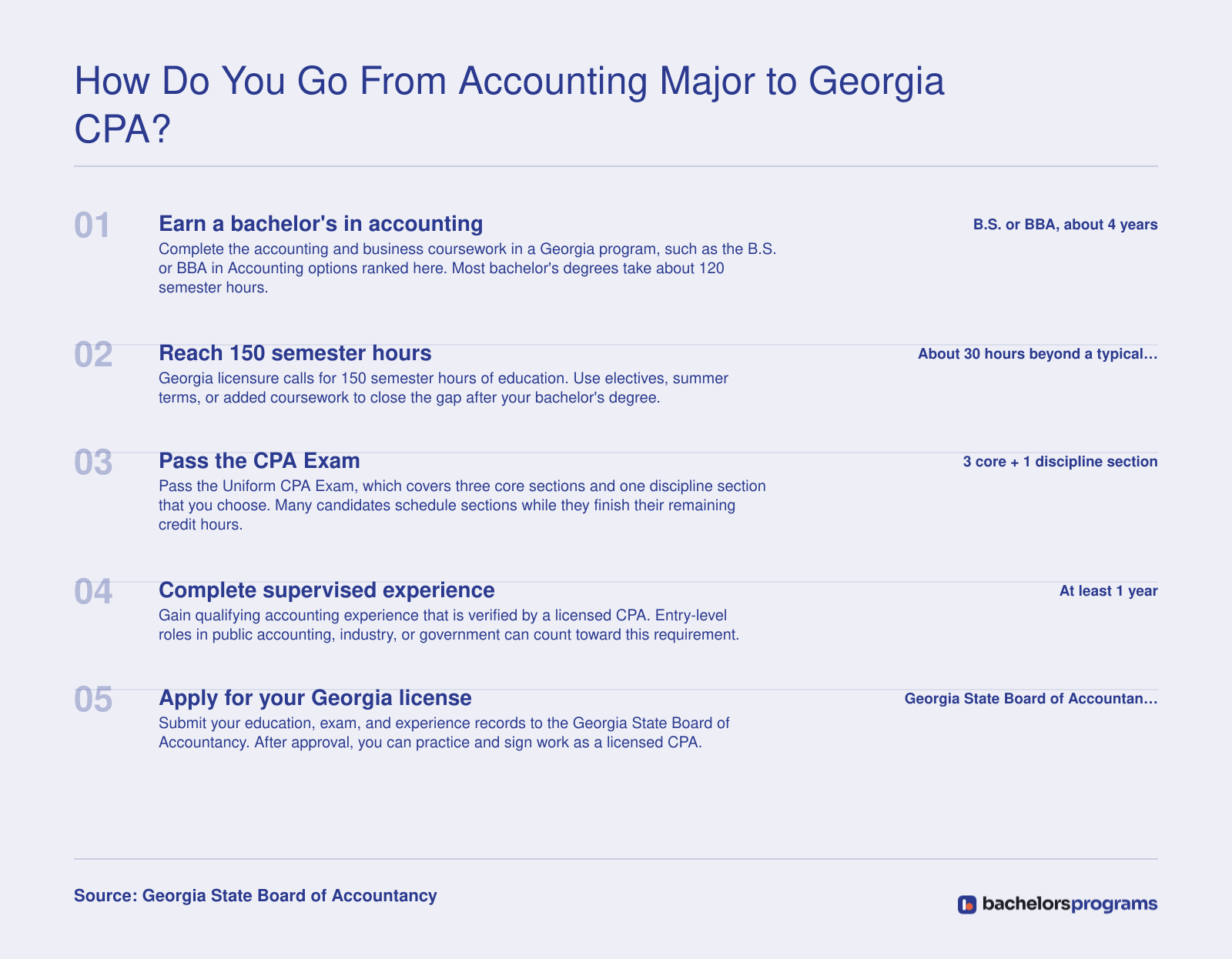
How Do You Go From Accounting Major to Georgia CPA?
Becoming a CPA in Georgia follows a set order: you finish your degree, build up enough credit hours, pass the national exam, gain supervised work experience, and then apply for your license. Planning for each step while you are still an undergraduate can save you time and tuition later.
How We Ranked Georgia Accounting Schools
The ranking compares accounting bachelor's programs in Georgia using public federal data rather than reputation surveys. We pulled figures from IPEDS, the U.S. Department of Education's national database of college statistics, and from College Scorecard, which reports graduation, cost, and post-graduation earnings.
What Feeds the Ranking
The factors include graduation rate, in-state tuition, net price after aid, and the earnings of program graduates. The cheapest and highest-earning lists on this page draw on the cost and earnings figures directly.
Limits to Keep in Mind
These numbers are useful for comparison, but they are not precise forecasts for any one student.
- Graduation rate: This is an institution-wide average across all majors, not an accounting-only rate.
- Net price: This is also an institution-wide average, and your own cost depends on your aid, residency, and housing choices.
- Earnings: Program earnings are medians measured at stated windows after graduation, so they describe past graduates, not future ones.
Scope and Missing Data
Only bachelor's programs at schools based in Georgia are included, whether delivered on campus or online. Graduate study is not part of this page. Federal sources do not report every figure for every program, especially at smaller schools. When a program figure is missing, we leave it out rather than estimate it, and the school is judged on the measures that are reported.
Data Year and Next Steps
Figures reflect the most recent federal releases available as of November 2026. Tuition, admission policies, and program details change often, so confirm current information on each school's website before you apply.
Compare Accounting programs on the data that matters
Explore more Business & Management majors or browse every field of study.
All Business & Management programs Browse every field of study