Best Psychology Schools in Georgia
Compare 47 accredited General Psychology programs in Georgia at 39 colleges, with net price after aid, graduation rates, earnings and debt from IPEDS and the U.S. College Scorecard.

Published in-state tuition for a Georgia psychology bachelor's runs from about $5,800 at a large public university to more than $60,000 at a private research university. Most schools award it as a Bachelor of Science (B.S.) or Bachelor of Arts (B.A.) in Psychology, and the credential itself is the same on a resume either way.
The real tradeoff is price against selectivity and format. Georgia schools deliver that degree on campus, in hybrid form and fully online.
A bachelor's alone does not qualify anyone to practice as a psychologist, which requires graduate training and state licensure.
Key Points
- At Wesleyan College, aid drops $27,650 tuition to $12,724 average net price.
- Georgia Southern's 124-credit psychology B.S. can be completed online.
- A bachelor's alone won't qualify you to practice as a Georgia psychologist.
Best Bachelor's Degree in Psychology Schools in Georgia: Our Top 10
The ten programs below represent the strongest bachelor's degree in psychology options in Georgia heading into 2026, spanning a flagship research university, small private colleges and large regional publics that also teach the major online. Net price figures are sector-averaged estimates of what students pay after grant aid, and every graduation rate shown is school-wide rather than specific to psychology majors. Each entry notes delivery format, admission rate and the program details that matter most when you compare schools side by side.
University of Georgia
#1Athens, GA · ~$14,000/yr (est.)
Best for: In-state students wanting a research flagship
Georgia's flagship public university runs one of the state's largest psychology departments and builds its major around the American Psychological Association's five undergraduate goals. Students can add a neuroscience emphasis, earn academic credit for research through the Center for Undergraduate Research Opportunities, and compete for departmental awards. The Athens campus admits roughly 38% of applicants and posts a school-wide graduation rate near 90%.
- Follows the APA's five undergraduate learning goals
- Neuroscience emphasis available within the major
- Intro courses run 150 to 300 students; major courses average about 35
- Academic credit for research through CURO
- Department awards include the Scott Torgesen Award ($500)
- Graduates enter human resources, sales and customer service
- Prepares students for graduate study in psychology, medicine, law and business
Emory University
#2Atlanta, GA · ~$23,000/yr (est.)
Best for: Future clinicians who want a selective campus
Emory is the most selective option on this list, admitting about 11% of applicants, and its Atlanta psychology department runs a tightly sequenced Bachelor of Arts with small upper-level courses. The major is deliberately compact at 12 courses, leaving room for a second major or pre-health coursework, and strong students can request graduate psychology courses. School-wide, about 91% of students finish their degree.
- 12 courses, about 39 credit hours, all completed for a letter grade
- Four foundation courses must be finished by the end of junior year
- An AP Psychology score exempts PSYC 111
- Two survey courses, one from Area I and one from Area II
- At least four depth courses at the 300 level or above
- Required statistics course: QTM 100
- Graduate psychology courses open with permission
Spelman College
#3Atlanta, GA · $35,000 – $40,000/yr (est.)
Best for: Women seeking a field-intensive mental health track
Spelman is a historically Black women's college in Atlanta, and its psychology department pairs a 44-credit major with concentrations in mental health and neuroscience. The mental health track is field-intensive, with internship and practicum placements, and every major completes a capstone project. About 25% of applicants are admitted, and the school-wide graduation rate is roughly 79%.
- 44 credit hours: 24 in core courses and 20 in electives
- Core includes Introduction to Psychological Sciences I and II with labs
- Capstone portfolio plus a signature capstone project
- Mental Health concentration with internship and practicum experience
- Neuroscience concentration draws on neurobiology, chemistry and genetics
- Coursework covers African American and women's experience
Mercer University
#4Macon, GA · ~$24,000/yr (est.)
Mercer is a private university in Macon whose psychology B.A. blends a liberal education core with lab work and empirical or honors project sequences. Majors aiming at graduate school can apply for Departmental Honors, which requires a 3.50 psychology GPA and a 3.00 overall GPA. Mercer admits about 69% of applicants and graduates about 70% of its students school-wide.
- Macon Campus bachelor's degree in psychology
- Departmental Honors track; application filed with the department chair
- Honors eligibility: 3.50 psychology GPA and 3.00 overall GPA
- Honors completion requires PSY 496a and PSY 496b
- Lab work plus empirical or honors project sequences
- Prepares students for graduate education
Covenant College
#5Lookout Mountain, GA · $26,000/yr (est. net price)
Covenant is a small Christian college on Lookout Mountain that teaches psychology through a biblical lens, with coursework in counseling methods, lifespan development and animal cognition. The 126-hour major includes a dedicated psychology laboratory, a senior capstone, and internships at behavioral health and community organizations. It admits roughly 87% of applicants, and its school-wide graduation rate is about 71%.
- 126 credit hours: a 59-hour core plus electives
- Senior capstone ties past coursework, interests and goals
- Dedicated General Psychology laboratory
- Internships at behavioral health and community organizations
- Juniors and seniors can do one-on-one faculty research
- Psychology and neuroscience minors available
- Coursework includes counseling methods and animal cognition
Georgia Southern University
#6Statesboro, GA · $15,000 – $20,000/yr (est.)
Georgia Southern's psychology department is one of the few in the state to offer the bachelor's degree both online and on campus, and its Behavior Analysis minor is a useful add-on for students heading into applied behavior analysis. Majors take part in faculty-led research, off-campus internships and organizations such as Psi Chi. The university admits about 88% of applicants and graduates about 55% of students school-wide.
- 124 total credit hours
- Available online and on campus
- Faculty-led research participation and off-campus internships
- Behavior Analysis minor available
- Student organizations include Psi Chi and the Psych Coalition
- Graduates work at employers such as Coca-Cola and the VA
- $30 application fee
Kennesaw State University
#7Kennesaw, GA · ~$15,000/yr (est.)
Kennesaw State is one of Georgia's largest public universities, and its psychology department runs the degree in person, hybrid and fully online. Electives reach into industrial-organizational, forensic, clinical and health psychology, and a senior capstone pulls the coursework together. KSU admits about 69% of applicants and graduates roughly 52% of students school-wide.
- In-person, hybrid and online options
- Capstone required
- Courses in human development, research methods and statistics
- Electives include industrial-organizational, forensic and health psychology
- Internships, research, teaching and study abroad available
- Prepares students for mental health, education, healthcare and business roles
Augusta University
#8Augusta, GA · $8,000 – $25,000/yr (est.)
Augusta University sits on a health sciences campus, and that setting shapes its psychology program: a pre-medicine track, undergraduate research, and more than 20 local internship sites. Classes run around 35 students, and honors sections and a leadership certificate are available. The university admits about 86% of applicants and graduates about 49% of students school-wide.
- 124 credit hours across a four-year, full-time program
- Small classes of about 35 students
- More than 20 local internship sites
- Pre-Medicine track available
- Undergraduate research, study abroad and a leadership certificate
- Honors classes offered
University of West Georgia
#9Carrollton, GA · $13,000/yr (est. net price)
West Georgia's psychology B.S. runs in residence on the Carrollton campus, with a curriculum that includes humanistic, transpersonal and critical psychology alongside standard research methods. Admission to the major is separate from admission to the university: students need 45 completed credits, a C or better in the introductory course and a B or better in three psychology courses. UWG admits about 52% of applicants and graduates about 43% of students school-wide.
- 120 semester hours on the Carrollton Campus
- Requires 45 completed credits and a C or better in PSYC 1101
- Also requires a B or better in three psychology courses
- PSYC 4884 Integrative Seminar capstone
- Coursework in humanistic, transpersonal and critical psychology
- Some partially or fully online courses allowed
- $40 application fee
Valdosta State University
#10Valdosta, GA · $10,000 – $15,000/yr (est.)
Valdosta State offers unusual flexibility for a regional public: the psychology major is available as a B.A. or B.S., on campus or fully online in 8-week terms. The B.S. adds a thesis or capstone option and guided electives that can support a minor, while the B.A. requires foreign language coursework. VSU admits about 72% of applicants and graduates about 42% of students school-wide.
- 120 total credit hours
- Foreign language courses required
- Psychology Club hosts guest lectures and trips
- Psi Chi International Honor Society chapter
- Summer study abroad in the Czech Republic and London
- Faculty research on memory, aging and technology
- 120 total credit hours
- Thesis or capstone option, including senior thesis or seminar
- Statistical methods and experimental psychology required
- Guided electives can support a minor
- Industrial/organizational and rehabilitation psychology offered
- Courses in child, adolescent and adult psychology
- All psychology courses available online
- 8-week course terms
- Semester-by-semester pathway mapped for students
- Focus on learning, cognition, motivation and mental disorders
- Prepares for graduate study in psychology, law and healthcare
- Courses designed by expert faculty
Cost & outcomes by school
Federal data for the highest-earning General Psychology programs, independent of the ranking above. Earnings are this field's bachelor's graduates four years after completing where the Scorecard reports them, else the school's undergraduate median.
| School | Net price / yr | Grad rate | Earnings | Debt | Grads/yr | Format |
|---|---|---|---|---|---|---|
| Georgia Institute of Technology GA | $12,116 | 94% | $102,772 | $21,672 | — | Campus |
| Emory University GA | $22,585 | 91% | $59,628 | $19,702 | 169 | Campus |
| University of Georgia GA | $13,936 | 90% | $59,446 | $18,845 | 694 | Campus |
| Georgia College & State University GA | $20,686 | 64% | $58,140 | $22,250 | — | Campus |
| Morehouse College GA | $39,013 | 59% | $54,867 | $26,000 | 28 | Campus |
| Life University GA | $29,791 | 38% | $54,291 | $31,000 | 22 | Online |
| Spelman College GA | $38,967 | 79% | $52,775 | $25,674 | 108 | Campus |
| LaGrange College GA | $20,875 | 47% | $51,745 | $26,979 | 6 | Campus |
| Mercer University GA | $23,847 | 70% | $51,723 | $26,000 | 103 | Campus |
| Kennesaw State University GA | $15,048 | 52% | $50,645 | $24,000 | 584 | Hybrid |
| University of North Georgia GA | $9,823 | 37% | $50,135 | $17,750 | — | Campus |
| Piedmont University GA | $20,599 | 47% | $49,130 | $25,500 | 10 | Campus |
Sources: U.S. Department of Education. Net price, graduation rate, earnings and debt: College Scorecard (earnings and debt for this field's bachelor's graduates where reported, else school-wide); graduates: IPEDS. A dash means no figure is reported.
Cost, debt & payoff
Median earnings of this field's bachelor's graduates (4 yrs after completing, else the school's undergraduate median) vs. their median federal loan debt · U.S. College Scorecard
Across these programs the median graduate earns about $45,656 and finishes with roughly $24,779 in debt — a ratio that clears a common rule of thumb (keep debt below first-year salary). Net price and debt vary widely school to school, so check the per-school figures in the table above before you shortlist.
How We Ranked Georgia Psychology Schools
What Goes Into the Ranking
The order below rests on federal data that every college reporting to the U.S. Department of Education must file, published through the College Scorecard. We weigh what it costs to attend, how many students finish and come back for a second year, and what psychology graduates from each school actually earn and borrow. No school pays for placement, and no editorial impressions move a program up or down.
Institution-Wide vs. Program-Level Numbers
It matters which figures describe the whole campus and which describe psychology specifically:
- Campus-wide: Graduation rate, retention, average net price after aid, and published in-state tuition. These reflect all undergraduates, not psychology majors alone.
- Psychology-specific: Median earnings for graduates of the psychology program, median federal loan debt at graduation, and the number of bachelor's degrees the department awards each year.
What the Data Cannot Tell You
Scorecard figures are medians, so half of every graduating class sits above the number and half below. There is no federal measure of curriculum quality, faculty research, internship placement, or advising, all of which shape an undergraduate psychology experience. Smaller programs often publish no earnings or debt figures, usually because too few graduates were in the cohort to report one.
Use It as a Shortlist
Treat the rankings below as a starting point for campus visits and advisor conversations. Before you apply, confirm tuition, aid, concentrations, and transfer credit directly with each school's admissions office.
Most Affordable Bachelor's in Psychology Schools in Georgia
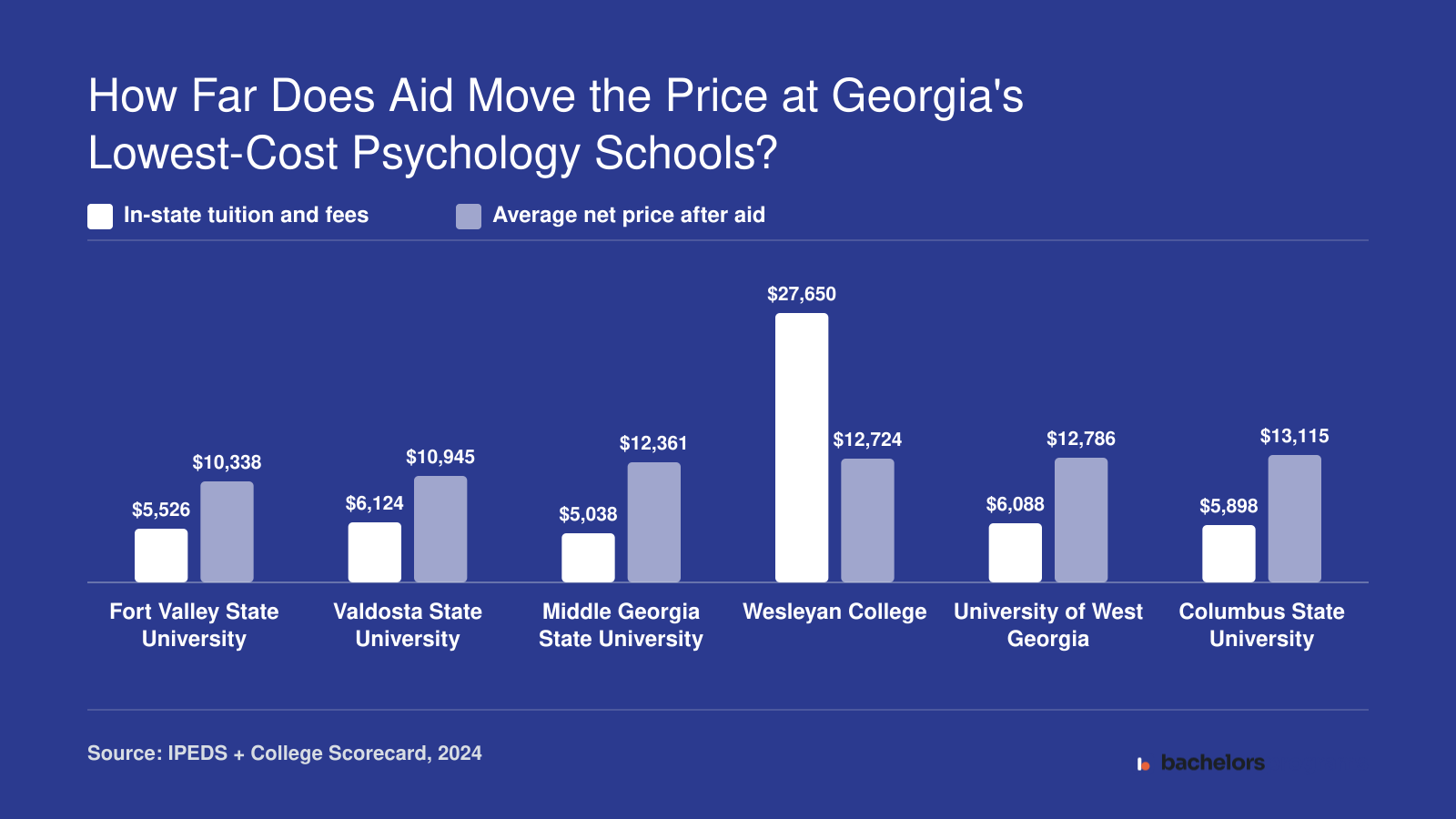
Here, cheapest means the lowest average annual net price, the amount students actually pay after grants and scholarships, based on 2024 U.S. Department of Education data from IPEDS and the College Scorecard. Fort Valley State University, a public HBCU in our directory, comes in lowest at $10,338 a year, and Valdosta State University is the lowest-cost ranked school at $10,945. Wesleyan College, a private college, posts a $27,650 sticker price that runs several times higher than in-state rates at the public universities, yet aid brings its net price down to $12,724, close to the University of West Georgia's $12,786.
| School | City | Sector | Psychology Program | Format | Average Net Price (per year) | In-State Tuition and Fees | Graduation Rate | Median Earnings 10 Years After Entry (All Graduates) |
|---|---|---|---|---|---|---|---|---|
| Fort Valley State University | Fort Valley | Public | Psychology, B.A. | Campus and online | $10,338 | $5,526 | 41% | $36,666 |
| Valdosta State University | Valdosta | Public | B.A. Degree with a Major in Psychology | Campus | $10,945 | $6,124 | 42% | $49,361 |
| Middle Georgia State University | Macon | Public | Psychology | Online | $12,361 | $5,038 | 25% | $40,863 |
| Wesleyan College | Macon | Private nonprofit | Psychology, BA | Campus | $12,724 | $27,650 | 45% | $44,317 |
| University of West Georgia | Carrollton | Public | Bachelor of Science with a Major in Psychology | Campus | $12,786 | $6,088 | 43% | $49,587 |
Cost of a Bachelor's in Psychology in Georgia: Tuition, Net Price and HOPE Aid
In Georgia, state aid and institutional grants reshape what families actually pay, so sticker price overstates the cost.
Tuition Versus Net Price
Published in-state tuition ranges from about $5,808 at Kennesaw State University to $11,450 at the University of Georgia, with Georgia Southern, West Georgia and Valdosta State all near $6,100. Average net price after grants runs higher than tuition, since it folds in housing, food and books: roughly $10,945 at Valdosta State, $12,786 at West Georgia and $13,936 at Georgia's flagship in Athens. Private schools can land close to that range. Wesleyan College, in our directory, lists tuition of $27,650 but an average net price of $12,724, nearly identical to West Georgia's.
School-wide median debt among graduates sits between about $18,500 at the University of Georgia and $24,779 at Valdosta State. Those are institution-wide figures, not psychology-specific.
HOPE, Zell Miller and Georgia Match
For 2026-27, the HOPE Scholarship requires a 3.0 calculated HOPE GPA and four rigor credits from high school.1 At public colleges it applies to standard undergraduate tuition for up to 15 hours; at private colleges it covers up to 12 hours, with the amount based on full- or half-time enrollment.3
The Zell Miller Scholarship asks for a 3.7 GPA (or valedictorian or salutatorian status) plus HOPE eligibility.5 It pays full standard tuition at public institutions and tuition assistance at private ones.5 Both awards require Georgia residency: 12 consecutive months if you lived in the state at high school graduation, 24 months if not.4
Georgia Match is a separate grant, and the Georgia Student Finance Commission's GAfutures site lists its current rules and award levels. Check the exact private-school dollar amounts there too, since they change from year to year.
One Practical Tip
Keeping the scholarship matters as much as winning it. HOPE renewal requires a 3.0 cumulative GPA at the end of each spring semester and at 30, 60 and 90 attempted hours.2 Zell Miller renewal requires 3.3.6 Falling short of 3.0 ends HOPE, though it can be regained once.2 Check your GPA before each checkpoint; if you are close, retake a course or lighten your load the semester before.
How Far Does Aid Move the Price at Georgia's Lowest-Cost Psychology Schools?
The widest gap is at Wesleyan College, where $27,650 in published tuition falls to a $12,724 average net price after aid, a difference of $14,926. At the public universities, net price runs higher than tuition because it also counts housing, books and other costs, not just tuition and fees. Net price is a sector-specific average: public figures reflect in-state students receiving aid, and private figures reflect all aided students.
Online and Hybrid Bachelor's in Psychology Options at Georgia Schools
Georgia Southern University's 124-credit Bachelor of Science in Psychology can be completed online, or in person at Statesboro, Savannah or Hinesville.1 Yes, you can earn a psychology bachelor's online from a Georgia school, and several offer a flexible route.
Where the formats are offered
- Georgia Southern University: Online and on-campus, with the same B.S. credential at every location.
- Middle Georgia State University: The B.S. in Psychology is offered online and in person at Cochran and Macon, with transfer pathways listed at Dublin and Warner Robins.2
- Georgia Gwinnett College: A 123-credit B.S. delivered as a hybrid, mixing on-campus and online coursework.
- Kennesaw State University: Its B.S. lists in-person, hybrid and online options.
The other ranked schools, including the University of Georgia, Emory University, Spelman College, Mercer University, Covenant College and Augusta University, deliver their psychology majors mainly on campus. The University of West Georgia lists its B.S. as face-to-face, though some individual courses may run partly or fully online.
Who online suits and what to check
Online and hybrid formats fit working adults, parents, and transfer students who already hold credits and want to finish close to home. Middle Georgia State's multi-campus pathways are built with that kind of student in mind.
Before you commit, confirm a few details on the program page:
- Tuition: Georgia Southern and Kennesaw State publish in-state tuition near $6,000 a year and out-of-state tuition near $17,700. Ask whether online courses carry different rates or fees, and whether out-of-state online students pay the higher figure.
- In-person requirements: Hybrid programs like Georgia Gwinnett's require campus time. Ask about labs, exams, internships and capstones.
- Transfer credit: Ask how many of your credits apply and how many remain.
Admissions: GPA, Test Policy and Transfer Credit
Admission to the psychology programs ranked here is not one bar but several. Emory University admits roughly 11% of applicants and Spelman College about 25%, while the University of Georgia sits near 38%. A middle band, made up of the University of West Georgia (about 52%), Mercer University and Kennesaw State University (both near 69%) and Valdosta State University (about 72%), asks for solid grades without the same scarcity of seats. Covenant College, Augusta University and Georgia Southern University admit roughly 86% to 88% of applicants.
Test Scores and GPA
UGA publishes the clearest rules. First-year applicants for 2026-2027 must submit SAT or ACT scores1, and the university publishes no universal high school GPA cutoff; review is holistic2, so no GPA or test score guarantees a seat. For the other schools on this list, confirm the current GPA and testing rule with the admissions office before you apply, because policies shifted repeatedly through the 2020s and are not uniform across the state.5
Transferring Credit
UGA's transfer route requires at least 30 completed transferable semester hours, with a 3.30 transfer GPA for applicants holding 30 to 59 hours and 3.00 for those with 60 or more.3 UGA also lists higher 2026-cycle consideration thresholds of 3.50 and 3.204, so plan to clear the higher number. SAT and ACT scores are not considered for transfer applicants3, and decisions are space-available.
Before you apply anywhere, pull the transfer equivalency guide or articulation agreement for the psychology major and map every course you have taken against it. If you are moving within Georgia's public system, ask about system-level transfer credit resources and core-course equivalencies first, so you know which credits land in the major rather than in general electives.
Related Articles
What Can You Do With a Bachelor's in Psychology in Georgia? Careers and Licensure
A bachelor's degree in psychology in Georgia leads into human services, human resources, and business roles, but not into practice as a psychologist.
Where Graduates Actually Work
The most direct path is social and human service assistance: case aide, residential support, community outreach. Nationally, social and human service assistants earned a median of $45,930 in May 2025, and the Bureau of Labor Statistics projects 7% growth from 2025 to 2035, with about 48,900 openings a year across the country.1 Employers in this field often prefer or require a bachelor's in human services or a related social science; psychology qualifies.
Human resources is the higher-paying adjacent route. HR specialists earned a national median of $75,940 in May 2025, with 6% projected growth;2 labor relations specialists, a smaller and more specialized group, showed a median of $95,420.3 Both typically require a bachelor's for entry. Marketing, sales, and social service management absorb psychology graduates as well.
The BLS profile of psychology degree holders found a $60,000 median wage in 2024, against $73,000 across all fields, with 61% working in jobs that require at least a bachelor's.4
Those are national numbers. Georgia pay and openings follow their own track, so check Georgia Department of Labor wage data for the metro where you plan to work.
Licensure Requires a Doctorate
Georgia licenses psychologists through the Georgia Board of Examiners of Psychologists, and the license requires a doctoral degree. A bachelor's alone does not get you there, so plan on graduate school if clinical practice is the goal.
Credentials at the Bachelor's Level
Some human services positions carry their own certification or agency-based credential, separate from psychology licensure. Requirements vary by employer and setting, so confirm with the hiring organization before you commit to a specialization.
The earnings figures in the ranking above show what graduates of individual Georgia programs report early in their careers. Read them as a starting range, not a ceiling.
Georgia Psychology Degree FAQs
These answers draw on the rankings, cost figures, online options and career data covered earlier on this page. Use them as a starting point, then confirm details on each school's own program page.
What are the best psychology schools in Georgia?
What is the cheapest college for psychology in Georgia?
Can you get a bachelor's degree in psychology online in Georgia?
What can you do with a bachelor's degree in psychology in Georgia?
Compare General Psychology programs on the data that matters
Explore more Psychology majors or browse every field of study.
All Psychology programs Browse every field of study