Best Computer Science Schools in Georgia
Compare 30 accredited Computer Science programs in Georgia at 22 colleges, with net price after aid, graduation rates, earnings and debt from IPEDS and the U.S. College Scorecard.

Georgia schools award the computer science bachelor's mostly as a Bachelor of Science (B.S.), occasionally as a Bachelor of Arts (B.A.), and the options run well beyond one city. Atlanta anchors the state's tech economy, with Georgia Tech, Emory and Georgia State there. Athens has the University of Georgia, and regional campuses from Dahlonega to Valdosta offer lower-cost routes, plus online programs at Georgia-based schools.
The tension is familiar: the most selective programs carry the strongest brand but admit few applicants, while regional universities cost less and admit more broadly. Employers in metro Atlanta hire from both groups.
Key Points
- Clayton State University has the lowest average net price, $8,365 a year.
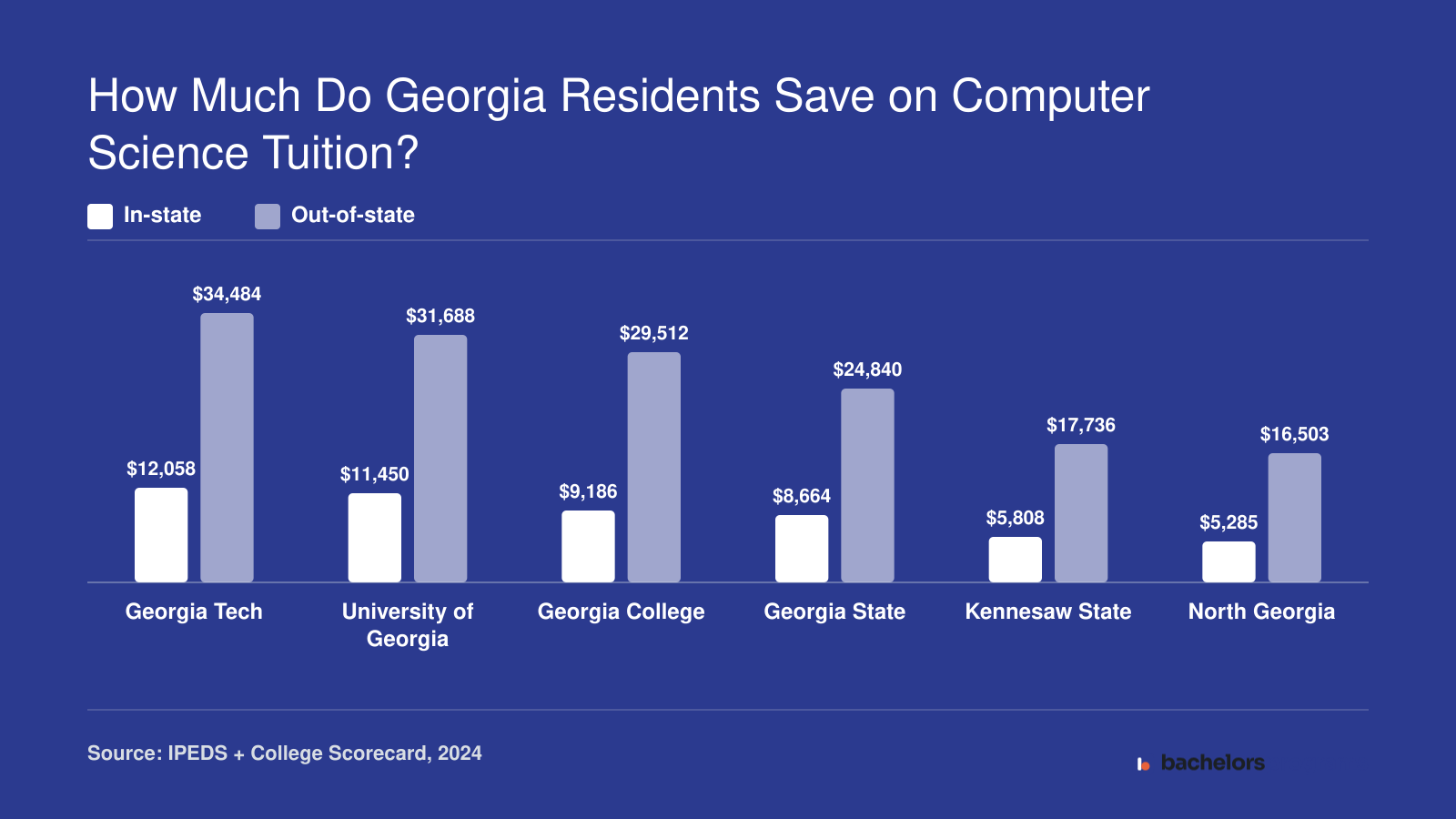
- In-state students save about $22,426 yearly on Georgia Tech tuition and fees.
- Computer and math jobs hold 4.1% of Atlanta metro employment (3.4% nationally).
Best Computer Science Schools in Georgia: Our Ranked List
These ten Georgia schools award a bachelor's degree in computer science, and the list runs from a globally known institute in Atlanta to regional universities with ABET-accredited programs and broad admission. Each card shows what the school reports for completion, selectivity, and, where the data exists, what graduates earn after finishing. Read them as starting points for a shortlist, not as a verdict on which campus will fit you.
Georgia Institute of Technology
#1Atlanta, GA · ~$12,000/yr (est.)
Best for: High-achieving students seeking customizable computing degrees
Georgia Tech is the state's flagship engineering and computing campus, and its College of Computing lets undergraduates shape a B.S. in Computer Science around two self-selected Threads rather than one fixed track. Schools offering this program graduate 94% of students, and admission is highly selective at about 14%. Undergraduates can add a five-year co-op, a research option, or an accelerated path toward a master's degree.
- 124 credit hours plus a two-hour wellness course
- Threads system: choose two of nine specializations
- Tracks: Computing and Media, Computing and Devices
- C or better required in all required CS courses
- Five-year cooperative plan and international study options
- BS/MS option available with a 3.4 GPA and 6 shared hours
- Capstone design requirement and undergraduate thesis option
University of Georgia
#2Athens, GA · ~$14,000/yr (est.)
Best for: Georgia residents wanting a large research campus
The University of Georgia pairs a large research university experience in Athens with a computing department that has been building ties to health care research. Schools offering this program graduate 90% of students, and about 38% of applicants are admitted. Median earnings for graduates four years after finishing run about $107,397, among the strongest marks on this list.
- 120 credit hours including the general education core
- 21 upper division major hours required
- Prerequisite GPA of 2.7 with C or better in key courses
- Areas of emphasis include artificial intelligence and cybersecurity
- Double Dawgs pathway to an accelerated graduate degree
- Co-op and internship opportunities available
Emory University
#3Atlanta, GA · ~$23,000/yr (est.)
Best for: Students who want computing within liberal arts
Emory's computer science department sits inside a liberal arts and sciences framework in Atlanta, and the B.S. is built around a structured mathematics and systems core. Schools offering this program graduate 91% of students, and admission is the most selective in the state at roughly 11%. Median earnings for graduates four years after finishing are about $159,541, the highest figure among the ranked Georgia schools.
- Required sequence runs from CS 170 and CS 171 to Analysis of Algorithms
- Practicum in CS 370 or CS 371W required
- Choose from AI, computational linguistics, machine learning or databases
- Three 300-level and three 400-level CS courses required
- 2.0 GPA minimum, every course taken for a letter grade
- Cannot be combined with another CS or AI major or minor
Georgia State University
#4Atlanta, GA · $9,000 – $25,000/yr (est.)
Georgia State runs one of the largest computer science undergraduate populations in the state from its downtown Atlanta campus, with more than 3,000 students enrolled. Schools offering this program graduate 53% of students, and the university admits about 55% of applicants, an accessible route into a major metro tech market. Median earnings for graduates four years after finishing are about $100,582.
- Required courses front-loaded, concentrations chosen later
- More than 3,000 undergraduates enrolled in the program
- Internship pipelines with employers such as Coca-Cola, Delta and UPS
- Prepares graduates for industry, government and business roles
Kennesaw State University
#5Kennesaw, GA · ~$15,000/yr (est.)
Kennesaw State's computer science program is ABET-accredited and built on a technical core plus a wide band of major electives that students use to specialize. Schools offering this program graduate 52% of students, and admission is comparatively open at roughly 69%. Median earnings for graduates four years after finishing are about $96,481.
- ABET-accredited by the Computing Accreditation Commission
- 42 credit hours of Core IMPACTS plus 40 major hours
- 15 credit hours of major electives and 5 university electives
- C or better required in major courses; 2.00 cumulative GPA
- No separate program admission criteria beyond university admission
- Graduates work as software engineers and programmer analysts
Georgia College & State University
#6Milledgeville, GA · $9,000 – $30,000/yr (est.)
Georgia College & State University in Milledgeville delivers an ABET-accredited computer science degree in a small public liberal arts setting. Schools offering this program graduate 64% of students, and roughly 78% of applicants are admitted. Median earnings for graduates four years after finishing are about $96,335.
- ABET-accredited under general and computer science criteria
- Career paths include software engineer, network architect and database administrator
- Department reports over half of graduates finish with no student debt
- Departmental scholarships available
- Student organizations and honor societies for computing majors
Mercer University
#7Macon, GA · ~$24,000/yr (est.)
Mercer University in Macon offers computer science as both a B.A. and a B.S., letting students choose between a broader liberal arts shape and a more technical one. Schools offering this program graduate 70% of students, and about 69% of applicants are admitted. With a student-to-faculty ratio near 11 to 1, undergraduates work closely with faculty on research and internships.
- Offers both a B.A. and a B.S. in computer science
- Coursework covers programming languages, algorithms and computer hardware
- Research and internship opportunities for undergraduates
- Housed in the College of Liberal Arts and Sciences
- Emphasis on teamwork, communication and system design
Berry College
#8Mount Berry, GA · $22,000/yr (est. net price)
Berry College combines a project-first computer science curriculum with unusual access to real IT work through its student-run BITS program. Schools offering this program graduate 69% of students, and about 64% of applicants are admitted. The Mount Berry campus adds makerspaces and a physical computing lab that support hands-on coursework.
- Project-based coursework from embedded systems to compilers
- BITS program lets students support the college's own IT infrastructure
- Labs include Student Projects, Physical Computing and Hackberry makerspace
- Students collaborate with faculty on published research
- Major and minor both available
Augusta University
#9Augusta, GA · $8,000 – $25,000/yr (est.)
Augusta University's computer science department pairs an ABET-accredited B.S. with a campus known for health sciences in east Georgia. Schools offering this program graduate 49% of students, and roughly 86% of applicants are admitted, the most open door among the ranked schools. Students can add concentrations in artificial intelligence or computer graphics.
- ABET-accredited Bachelor of Science in Computer Science
- Tracks: Artificial Intelligence, Computer Graphics
- Coursework spans operating systems, networks, databases and information security
- Emphasizes teamwork, communication and ethical computing
- Prepares graduates for roles such as software developer and systems analyst
University of North Georgia
#10Dahlonega, GA · ~$10,000/yr (est.)
The University of North Georgia offers its B.S. in Computer Science at the Dahlonega and Cumming campuses north of Atlanta, with an ABET-accredited curriculum and optional concentrations. Schools offering this program graduate 37% of students, and admission is broad at roughly 68%. Programming and cyber defense competition teams give students applied practice outside class.
- 121 credit hours including a 42-hour Core IMPACTS
- 39 required major hours plus 12 hours of upper-level CSCI electives
- Tracks: Computational Science, Information Assurance and Security
- No D grades count in CSCI courses for the program of study
- Offered at the Dahlonega and Cumming campuses
- Cyber defense and programming competition teams available
Cost & outcomes by school
Federal data for the highest-earning Computer Science programs, independent of the ranking above. Earnings are this field's bachelor's graduates four years after completing where the Scorecard reports them, else the school's undergraduate median.
| School | Net price / yr | Grad rate | Earnings | Debt | Grads/yr | Format |
|---|---|---|---|---|---|---|
| Emory University GA | $22,585 | 91% | $159,541 | $15,500 | 120 | Campus |
| University of Georgia GA | $13,936 | 90% | $107,397 | $20,495 | 391 | Campus |
| Georgia Institute of Technology GA | $12,116 | 94% | $102,772 | $21,672 | — | Campus |
| Georgia State University GA | $15,931 | 53% | $100,582 | $21,500 | 527 | Campus |
| Kennesaw State University GA | $15,048 | 52% | $96,481 | $20,125 | 304 | Campus |
| Georgia College & State University GA | $20,686 | 64% | $96,335 | $23,219 | 11 | Campus |
| Clayton State University GA | $8,365 | 40% | $94,876 | $21,500 | 32 | Campus |
| Mercer University GA | $23,847 | 70% | $58,354 | $24,199 | 21 | Campus |
| Berry College GA | $22,320 | 70% | $53,800 | $23,250 | 17 | Campus |
| Morehouse College GA | $39,013 | 59% | $52,889 | $25,000 | 20 | Campus |
| LaGrange College GA | $20,875 | 47% | $51,745 | $25,730 | — | Campus |
| Covenant College GA | $26,265 | 72% | $50,412 | $22,500 | — | Campus |
Sources: U.S. Department of Education. Net price, graduation rate, earnings and debt: College Scorecard (earnings and debt for this field's bachelor's graduates where reported, else school-wide); graduates: IPEDS. A dash means no figure is reported.
Cost, debt & payoff
Median earnings of this field's bachelor's graduates (4 yrs after completing, else the school's undergraduate median) vs. their median federal loan debt · U.S. College Scorecard
Across these programs the median graduate earns about $50,135 and finishes with roughly $21,672 in debt — a ratio that clears a common rule of thumb (keep debt below first-year salary). Net price and debt vary widely school to school, so check the per-school figures in the table above before you shortlist.
Most Affordable Computer Science Schools in Georgia
Georgia's public universities keep a bachelor's in computer science within reach. Based on 2024 IPEDS and College Scorecard data from the U.S. Department of Education, Clayton State University in Morrow has the lowest average net price at $8,365 a year, followed by the University of North Georgia at $9,823. Valdosta State University, Albany State University (a historically Black university) and Georgia Southwestern State University all come in near $12,000 or less after aid. Every school below lists in-state tuition and fees close to $5,000 to $6,000, and all five deliver the degree on campus.
| School | City | Average Net Price (per year) | In-State Tuition and Fees | Program Format |
|---|---|---|---|---|
| Clayton State University | Morrow | $8,365 | $5,180 | On campus |
| University of North Georgia | Dahlonega | $9,823 | $5,285 | On campus |
| Valdosta State University | Valdosta | $10,945 | $6,124 | On campus |
| Albany State University | Albany | $11,898 | $5,656 | On campus |
| Georgia Southwestern State University | Americus | $12,019 | $5,220 | On campus |
Which Georgia Schools Have ABET-Accredited Computer Science Programs?
A computer science degree from an ABET-accredited program has been reviewed against external standards. A degree from a program without that review depends on the school's own quality controls. Neither is automatically better for every student, but the difference matters when you compare options.
What ABET Accreditation Means
ABET accredits individual programs, not whole universities.1 Bachelor's degrees in computer science fall under its Computing Accreditation Commission (CAC), which checks curriculum, faculty, facilities and student outcomes against published criteria.1 Some employers, especially in government and defense-related work, prefer or expect graduates of accredited programs. Some graduate programs also weigh accreditation when they review applications.
Ranked Schools Listed by ABET
ABET's accredited program search lists bachelor's-level computer science programs at these ranked schools:
- Georgia Institute of Technology: accredited under CAC.
- University of Georgia: accredited under CAC.
- Kennesaw State University: accredited under CAC.
Where a Program Is Not Listed
The other ranked schools, including Emory University, Georgia State University, Mercer University, Berry College and the regional state universities, did not appear in the ABET findings we reviewed for a bachelor's computer science program. That does not mean those programs are weak. Many are well regarded and lead to strong careers. It does mean you cannot assume accreditation, so ask each school directly.
Check Before You Apply
Accreditation status can change, and a program can be reviewed or added after any list is published. Before you apply, search ABET.org's accredited program database by school and program name, and confirm the exact degree title and campus.
Georgia Tech vs. UGA and Other Top Computer Science Programs
Is Georgia Tech or UGA the better choice for a computer science bachelor's? Pick Georgia Tech if you have a highly competitive record and want a technical, research-heavy program in the middle of Atlanta's tech economy. Pick UGA if you want strong computer science inside a broader university experience in Athens, with an easier path to admission and room to explore other majors.
Side-by-Side Numbers
- Admission rate: Georgia Tech admits about 14% of applicants. UGA admits about 38%.
- In-state tuition and fees: $12,058 at Georgia Tech and $11,450 at UGA.
- Out-of-state tuition and fees: $34,484 at Georgia Tech and $31,688 at UGA.
- Average net price: $12,116 at Georgia Tech and $13,936 at UGA, so Tech costs slightly less after aid despite higher sticker tuition.
- Specialization: Georgia Tech builds its B.S. around nine "Threads" that students combine to shape the degree, plus a five-year co-op plan and a BS/MS option. UGA offers areas of emphasis, co-op opportunities and Double Dawgs pathways into graduate study, and it asks for a 2.7 prerequisite GPA to enter the major.
- Graduation rate: 94% at Georgia Tech and 90% at UGA.
Emory is the third school in this comparison. It is even more selective (about 11% admitted), with $64,280 in tuition and fees, a $22,585 average net price and a 10-to-1 student-to-faculty ratio.
Accreditation
Accreditation is worth confirming before you weigh these programs against each other. Kennesaw State, Georgia Tech and the University of Georgia each list ABET accreditation for their computer science bachelor's programs.
Where Regional Campuses Win
The flagships are not the only strong route. Several smaller and regional schools beat them on cost, class size or access:
- Lower cost: The University of North Georgia charges $5,285 in-state and has a $9,823 average net price, the lowest here. Kennesaw State's in-state tuition is $5,808.
- Easier admission: Augusta University admits about 86% of applicants, Georgia College about 78% and Kennesaw State about 69%.
- Smaller classes: Mercer (11 to 1), Berry (12 to 1) and Augusta (16 to 1) offer closer faculty contact than either flagship's 17 to 1.
Online and Hybrid Computer Science Bachelor's Options at Georgia Schools
Flexibility is the draw of an online degree, but in Georgia the strongest computer science programs are still built around the campus. Before you plan around remote study, check how each school actually delivers its degree.
Campus-Based Programs
The program pages for Georgia Institute of Technology, University of Georgia, Emory University, Georgia State University, Kennesaw State University, Georgia College & State University, Mercer University, Berry College, Augusta University and University of North Georgia describe campus-based bachelor's degrees in computer science. None of those pages presents a fully online or hybrid track. Kennesaw State's catalog states plainly that the program is located on campus. University of North Georgia spreads its major across two campuses, Dahlonega and Cumming, which gives some location choice but not remote delivery.
If you need an online or hybrid format, contact each school's admissions or department office to confirm what is currently offered. Program pages can lag behind new offerings.
Conflicting Listings and Fine Print
Treat directory listings with caution. One Georgia public university appears in a program directory as offering an online Bachelor of Science in Computer Science, yet its own college and department pages label the same degree "in-person." Available pages do not settle whether that program is fully online, hybrid, or simply mislabeled. Ask the school directly before you enroll.
Online Tuition and Degree Equivalence
No online tuition rate for a computer science bachelor's turned up in the program pages reviewed, so any comparison with on-campus pricing would be a guess. Georgia schools that run fully online programs may add an online learning fee on top of tuition, so ask for the full per-credit cost in writing. For reference, published in-state tuition and fees on campus run about $5,285 at University of North Georgia and $5,808 at Kennesaw State, against $12,058 at Georgia Tech.
If an online route does exist, confirm three things: whether any in-person labs, exams or capstone work are required, whether the diploma and curriculum match the campus degree, and whether the program holds the same ABET accreditation.
Questions to Ask Yourself
Do you need a fixed schedule, or does your work and family life call for an online or hybrid bachelor's in computer science?
Would you rather pay in-state prices at a regional campus, or compete for a spot at a highly selective flagship?
Is living in Atlanta, near internships and employers, worth the extra cost to you?
Admissions: GPA, Test Policy, and Transfer Credit
Getting into a bachelor's degree in computer science in Georgia often involves two decisions, not one: the university decides whether to admit you at all, and at some schools the computing department decides separately whether you may declare the major. Knowing which school works which way shapes how you spend your senior year.
GPA and test scores
Georgia Tech sets no published minimum or target GPA for first-year applicants.1 It reads your GPA off the high school transcript, using a 100-point weighted scale when your school provides one; if none is supplied, Tech recalculates a weighted 4.0 from core academic courses and adds half a point for AP, IB, dual enrollment, AS and A Level work. Its current SAT/ACT requirement for first-year applicants is not stated on the first-year preparation page, so confirm the policy for your term before booking a test date.1 Expectations at the University of Georgia, Georgia State University, Kennesaw State University and the other public options shift from cycle to cycle, so read each school's own admissions page rather than relying on an older number.
Transfer and dual enrollment routes
Georgia Tech transfer applicants need at least 30 semester or 45 quarter credit hours.2 For its transfer pathway programs, those hours must be earned after high school graduation, which means dual enrollment and AP or IB credit do not count toward that total. Every major requires transferable equivalents of English Composition 1101 and 1102 plus Calculus I, each with a C or better,3 and the College of Computing holds transfer applicants to a 3.3 GPA.4 Coursework graded C or better at accredited U.S. colleges generally transfers when content and contact hours correspond, though transfer grades are excluded from your Georgia Tech GPA.5 Pathway applicants (Arts and Sciences, Conditional, Talent Initiative, Atlanta Public Schools) face a higher bar: a 3.5 cumulative GPA and B or better in all college coursework.6 The First-Generation Pathway is no longer offered as a first-year decision outcome, though offers made before December 2026 will be honored.7
Admitted dual enrollment students must have the college itself send an official transcript before that credit is evaluated. Start calculus early and keep the grades clean, and transfer stays a live option.
Cost of a Computer Science Degree in Georgia: Tuition, Net Price and State Aid
For most Georgia families, merit aid now does more to set the price of a computer science degree than the tuition sticker does.
Sticker Price vs. Net Price
In-state tuition and fees at the public schools here run from about $5,180 at Clayton State University to $12,058 at Georgia Institute of Technology. Out-of-state rates are far higher: $16,503 at the University of North Georgia and $34,484 at Georgia Tech. Net price, what a student actually pays once grants and scholarships are applied, tells a different story. Georgia Tech's is $12,116, close to its in-state sticker price. The University of North Georgia's is $9,823 and Augusta University's is $13,787. Private schools such as Emory, Mercer and Berry often discount heavily with institutional aid, so their net price can land much nearer to the publics than the sticker suggests. Use each school's own net price calculator to check.
Net price is an average across students, not a quote for you. Your family's income, your grades and your housing choice will move it.
How HOPE and Zell Miller Work in 2026-27
- HOPE Scholarship: You must be a Georgia resident with a 3.00 high school HOPE GPA.1 You then keep a 3.00 college GPA, checked at 30, 60 and 90 semester hours.2 At public schools it covers standard tuition for up to 15 enrolled hours.3 At private schools it covers up to 12.
- Zell Miller Scholarship: You need a 3.70 high school GPA and a 1200 SAT (or ACT equivalent), or valedictorian or salutatorian standing. You keep a 3.30 college GPA. At public schools it pays full tuition.
Both end after 127 semester hours.1 The ACT equivalent is posted by January 15 and can change yearly.1 Award dollars at private schools depend on the institution. Check GAfutures for current Georgia Match grant details, because the 2026-27 award rules were not clear in the state materials reviewed.
A Worked Example
Take an in-state student at the University of North Georgia, where tuition and fees come to $5,285. HOPE pays standard tuition for up to 15 hours, so what remains is mainly mandatory fees. Add housing, food and books, and you arrive at the school's average net price of $9,823. A Zell Miller recipient at a public school starts from full tuition coverage and pays even less. Neither scholarship is automatic, though. Dropping below the GPA checkpoints can cost you the award.
How Much Do Georgia Residents Save on Computer Science Tuition?
Residency is the biggest cost lever at Georgia's public universities. Georgia residents at Georgia Tech pay about $22,426 less per year in tuition and fees than out-of-state students, and the gap runs from roughly $11,200 to $20,300 at the other public schools shown. For 2026-27, the University System of Georgia approved a 1% increase in in-state undergraduate tuition and a 3% increase for out-of-state students, so the gap will grow slightly.
Related Articles
Computer Science Careers and Jobs in Georgia
Computer and mathematical occupations make up 4.1% of employment in the Atlanta-Sandy Springs-Roswell metro, above the 3.4% national share, according to May 2025 federal wage data.3 That concentration shapes the market: Georgia's demand for computer science graduates clusters around one large tech hub rather than spreading evenly across the state.
What the Pay Looks Like
National medians from the Bureau of Labor Statistics frame the range. Software developers, QA analysts and testers, the closest match for most bachelor's graduates, earned a median of $134,040 in May 2025, and a bachelor's degree is the typical entry requirement.1 Computer occupations as a group earn a median of $109,470, against $50,980 for all occupations.1
Atlanta sits close to national norms. Computer and mathematical occupations in the metro averaged $56.39 an hour, slightly under the national $57.73, in a metro where all occupations averaged $34.57 versus $33.54 nationally.3 Computer systems analysts, one of the larger local titles, held 8,300 jobs at an average of $57.55 an hour.4
Projections suggest steady rather than explosive demand: 6% growth for computer occupations from 2025 to 2035, with about 280,000 openings a year nationally from growth and replacement.1 Computer programmers are the exception, projected to shrink 7% over the same window2, which favors graduates with breadth in systems, data and security over narrow coding skills alone.
Atlanta's Employer Mix
Hiring runs through financial technology and payments, logistics and freight operations, media and telecom, health care IT, and cybersecurity. Those employers cluster from Midtown and Buckhead out to the Perimeter and the Alpharetta corridor, and they recruit from Georgia campuses statewide.
No License Required
Georgia does not license computer scientists. There is no state board exam and no supervised practice requirement, unlike nursing or teaching. Employers screen on demonstrated work: internships, a portfolio of projects, and coursework in data structures and systems.
Reading the Payback
Set these wages against the earnings figures in the ranking table and the tuition numbers in the cost section. In-state tuition at a public Georgia university is usually a fraction of what a private school charges, while the gap in starting salary between schools tends to be far smaller than the gap in four-year cost. That comparison, more than the order of any ranking, decides payback.
Common Questions About Computer Science Degrees in Georgia
What is the best computer science school in Georgia?
Is Georgia Tech or UGA better for computer science?
Can you earn a bachelor's degree in computer science online from a Georgia school?
Do you need a license to work as a software developer in Georgia?
Compare Computer Science programs on the data that matters
Explore more Computers & IT majors or browse every field of study.
All Computers & IT programs Browse every field of study